Great Lakes Institute of Management, Chennai
Globally Recognized by AACSB (US) & AMBA (UK) | 18 LPA Avg. CTC for PGPM 2026


CAT 2026 Quant preparation gets easier when all the crucial formulas, shortcuts, and calculation tricks are right there in one place. CAT 2026 is scheduled to be held on November 29, 2026, so having compact revision material can help you save valuable preparation time. This CAT 2026 Formula Sheet brings must-know formulas from Arithmetic, Algebra, Geometry, Number System, and Modern Maths together in one place. But what formulas should you memorise, and which quick tricks can actually help you solve questions faster? Keep reading to make your Quant revision more focused and effective.
This Story also Contains
To boost your preparation and analyse your strong and weak topics, attempt Now: CAT 2026 Free Mock Test
Download the CAT 2026 formula PDF designed for fast revision and last-minute preparation. This free formula sheet covers all the important formulae that will be helpful to solve questions quickly in the CAT exam.
Download Now: CAT 2026 Important Formulas
A CAT 2026 Formula Sheet acts as a quick revision companion that brings all important Quant formulas together in one place. It helps candidates revise faster, improve formula recall, and solve questions more accurately during CAT preparation.
| Benefit | How It Helps |
|---|---|
| Saves Revision Time | Quick access to important formulas without referring to multiple books |
| Improves Concept Clarity | Helps connect formulas with underlying concepts |
| Reduces Calculation Errors | Minimizes confusion between similar formulas |
| Enhances Mock Performance | Improves formula recall during practice tests |
| Builds Exam Confidence | Strengthens last-minute revision and retention |
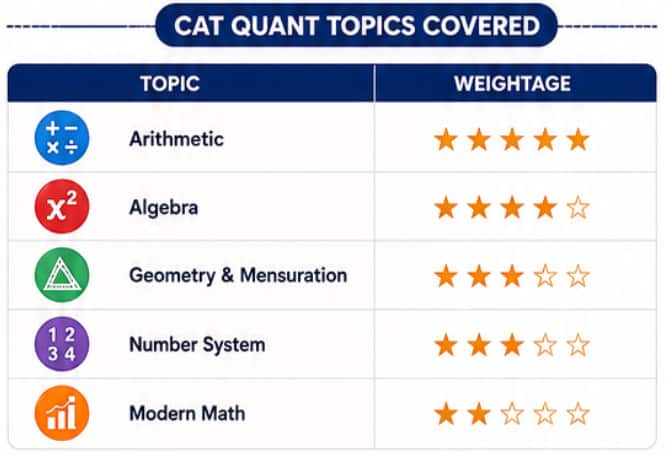
The CAT Quantitative Aptitude section primarily covers five major areas: Arithmetic, Algebra, Geometry & Mensuration, Number System, and Modern Mathematics. Understanding these topics can help candidates organize their preparation and revise formulas more effectively.
| Topic | Subtopics |
|---|---|
| Arithmetic | Percentages, Profit & Loss, SI & CI, Ratio & Proportion, Average, Time & Work, Time-Speed-Distance, Mixtures & Alligation |
| Topic | Subtopics |
|---|---|
| Algebra | Linear Equations, Quadratic Equations, Polynomials, Functions, Logarithms, Inequalities, AP, GP, HP |
| Topic | Subtopics |
|---|---|
| Geometry & Mensuration | Triangles, Circles, Quadrilaterals, Polygons, Coordinate Geometry, Area, Perimeter, Surface Area, Volume |
| Topic | Subtopics |
|---|---|
| Number System | Divisibility Rules, Factors, Multiples, Prime Numbers, HCF & LCM, Remainders, Cyclicity, Unit Digits, Factorials |
| Topic | Subtopics |
|---|---|
| Modern Mathematics | Permutation & Combination, Probability, Set Theory, Venn Diagrams, Binomial Theorem, Mathematical Reasoning |
These topics form the core of the CAT Quant syllabus and are the source of most formula-based questions asked in the exam.
Mastering important geometry formulas is crucial for cracking the CAT exam, as geometry is a key topic in the Quantitative Aptitude section. The following section covers all essential CAT geometry formulas, including areas, polygons, angles, and properties of triangles and circles to help you solve problems quickly and accurately.
| Topic | Formula |
|---|---|
| Area of Triangle | $\frac{1}{2}\times\text{Base}\times\text{Height}$ |
| Heron's Formula | $A=\sqrt{s(s-a)(s-b)(s-c)}$; $s=\frac{a+b+c}{2}$ |
| Pythagoras Theorem | $a^2+b^2=c^2$ (for right-angled triangle) |
| Equilateral Triangle Area | $\frac{\sqrt{3}}{4}a^2$ |
| Circumference of Circle | $2\pi r$ |
| Area of Circle | $\pi r^2$ |
| Length of Arc | $\frac{\theta}{360^\circ}\times2\pi r$ |
| Area of Sector | $\frac{\theta}{360^\circ}\times\pi r^2$ |
| Area of Rectangle | $L\times B$ |
| Perimeter of Rectangle | $2(L+B)$ |
| Area of Square | $a^2$ |
| Perimeter of Square | $4a$ |
| Area of Parallelogram | $\text{Base}\times\text{Height}$ |
| Area of Rhombus | $\frac{1}{2}d_1d_2$ |
| Sum of Interior Angles | $(n-2)\times180^\circ$ |
| Each Interior Angle (Regular Polygon) | $\frac{(n-2)\times180^\circ}{n}$ |
| Each Exterior Angle (Regular Polygon) | $\frac{360^\circ}{n}$ |
| Surface Area of Sphere | $4\pi r^2$ |
| Volume of Sphere | $\frac{4}{3}\pi r^3$ |
| Surface Area of Cylinder | $2\pi r(h+r)$ |
| Volume of Cylinder | $\pi r^2h$ |
| Surface Area of Cone | $\pi r(r+l)$ |
| Volume of Cone | $\frac{1}{3}\pi r^2h$ |
Trigonometry plays a vital role in the CAT Quantitative Aptitude section, making it essential to learn and memorise key formulas. This comprehensive list of important CAT trigonometry formulas helps aspirants solve complex problems with speed, accuracy, and confidence during the exam.
These are defined in relation to a right-angled triangle:
$\sin\theta=\frac{\text{Opposite Side}}{\text{Hypotenuse}}$
$\cos\theta=\frac{\text{Adjacent Side}}{\text{Hypotenuse}}$
$\tan\theta=\frac{\text{Opposite Side}}{\text{Adjacent Side}}$
$\csc\theta=\frac{\text{Hypotenuse}}{\text{Opposite Side}}$
$\sec\theta=\frac{\text{Hypotenuse}}{\text{Adjacent Side}}$
$\cot\theta=\frac{\text{Adjacent Side}}{\text{Opposite Side}}$
$\sin^2\theta+\cos^2\theta=1$
$1+\tan^2\theta=\sec^2\theta$
$1+\cot^2\theta=\csc^2\theta$
$\sin(-\theta)=-\sin\theta$
$\cos(-\theta)=\cos\theta$
$\tan(-\theta)=-\tan\theta$
$\csc(-\theta)=-\csc\theta$
$\sec(-\theta)=\sec\theta$
$\cot(-\theta)=-\cot\theta$
$\sin(A+B)=\sin A\cos B+\cos A\sin B$
$\sin(A-B)=\sin A\cos B-\cos A\sin B$
$\cos(A+B)=\cos A\cos B-\sin A\sin B$
$\cos(A-B)=\cos A\cos B+\sin A\sin B$
$\tan(A+B)=\frac{\tan A+\tan B}{1-\tan A\tan B}$
$\tan(A-B)=\frac{\tan A-\tan B}{1+\tan A\tan B}$
Quantitative Aptitude formulas form the foundation of the Quantitative Aptitude section in the CAT 2026 exam. Here are some important CAT 2026 quant section-wise formulae for CAT 2026 preparation:
The Arithmetic section is the most important section in the Quantitative Aptitude Section, which is also useful for solving the Data Interpretation problems. Following are some 50+ Important Formulas for CAT Preparation of this section, which are given in this CAT Formula Sheet:
Following are some Important CAT Formulas of percentage:
$X$ is what percentage of $Y$:
$\frac{X}{Y}\times100%$
$X$ is what percentage more/less than $Y$:
$\frac{|X-Y|}{Y}\times100%$
Following are some formulas which can be used as CAT Quant Formulae:
| Concept | Formula |
|---|---|
| Successive percentage change | Overall change $=a+b+\frac{ab}{100}$ |
| Changes in $A$ when $B$ and $C$ are altered | Overall change $=b+c+\frac{bc}{100}$ |
| Price increase followed by a decrease | Overall change $=x-y-\frac{xy}{100}$ |
Following are some Important CAT Formulas of this topic:
| Concept | Formula |
|---|---|
| Selling Price and Profit | $\text{S.P.}=\text{C.P.}+\text{Profit}$ |
| Selling Price and Loss | $\text{S.P.}=\text{C.P.}-\text{Loss}$ |
| Profit Percentage | $\text{Profit %}=\frac{\text{Profit}}{\text{C.P.}}\times100$ |
| Loss Percentage | $\text{Loss %}=\frac{\text{Loss}}{\text{C.P.}}\times100$ |
| Discount Percentage | $\text{Discount %}=\frac{\text{M.P.}-\text{S.P.}}{\text{M.P.}}\times100$ |
| Selling Price with Profit | $\text{S.P.}=\text{C.P.}\left(\frac{100+\text{Profit %}}{100}\right)$ |
| Selling Price with Loss | $\text{S.P.}=\text{C.P.}\left(\frac{100-\text{Loss %}}{100}\right)$ |
The following are some basic and Important Formulas for CAT 2026 related to Simple Interest and Compound Interest:
| Concept | Formula |
|---|---|
| Simple Interest | $\text{S.I.}=\frac{P\times R\times T}{100}$ |
| Compound Amount (Annually) | $A=P\left(1+\frac{R}{100}\right)^n$ |
| Compound Amount (Half-Yearly) | $A=P\left(1+\frac{R}{200}\right)^{2T}$ |
| Total Amount | $A=P+\text{Interest}$ |
where $P=$ Principal, $R=$ Rate of Interest, and $T=$ Time.
Following are some formulas which can be used as CAT Quant Formula Cheat Sheet for the preparation and exam point of view:
| Concept | Formula |
|---|---|
| Doubling Time with Compound Interest | $\text{Time to double}\approx\frac{72}{R}$ years |
| Difference Between C.I. and S.I. (2 years) | $\text{C.I.}-\text{S.I.}=P\left(\frac{R}{100}\right)^2$ |
| Difference Between C.I. and S.I. (3 years) | $\text{C.I.}-\text{S.I.}=P\left(\frac{R}{100}\right)^2\left(3+\frac{R}{100}\right)$ |
where $R=$ annual interest rate.
The following are some basic and Important Formulas for CAT 2026 related to Time, Speed, and Distance:
| Concept | Formula |
|---|---|
| Distance | $D=S\times T$ |
| Average Speed | $\text{Average Speed}=\frac{\text{Total Distance}}{\text{Total Time}}$ |
| Concept | Formula |
|---|---|
| Time for a train to cross a pole/person | $T=\frac{l}{s}$ |
| Time for a train to cross a platform/tunnel | $T=\frac{l+d}{s}$ |
| Time for trains to cross each other (same direction) | $T=\frac{l_1+l_2}{ |
| Time for trains to cross each other (opposite direction) | $T=\frac{l_1+l_2}{s_1+s_2}$ |
Where:
$l=$ Length of the train
$d=$ Length of platform/tunnel
$s=$ Speed of the train
$l_1,l_2=$ Lengths of Train 1 and Train 2
$s_1,s_2=$ Speeds of Train 1 and Train 2
| Concept | Formula |
|---|---|
| Speed of Boat in Still Water | $x$ kmph |
| Speed of Stream/Water/Current | $y$ kmph |
| Travelling Time | $t$ hr |
| Distance (Downstream: same direction) | $D=(x+y)t$ km |
| Distance (Upstream: opposite direction) | $D=(x-y)t$ km |
| Concept | Formula |
|---|---|
| Speed of Hour Hand | $0.5^\circ$ per minute |
| Round covered by Hour Hand | $1\text{ round}=360^\circ$ in $12$ hours or $720$ minutes |
| Speed of Minute Hand | $6^\circ$ per minute |
| Round covered by Minute Hand | $1\text{ round}=360^\circ$ in $1$ hour or $60$ minutes |
| Angle between Hour and Minute Hands | $\theta=\left |
We have provided below the shortcut formulae related to average speeds, boat stream, circular tracks, meeting point, to make your calculations faster in the CAT 2026 exam.
Case 1: Equal distances, different speeds
If the distance covered in each stage of a journey is the same, but speeds are different, the average speed is the harmonic mean:
$\text{Average Speed}=\frac{2s_1s_2}{s_1+s_2}$
Example:
Distance from $A$ to $B$ and $B$ to $C$ is the same. Speeds: $s_1$ and $s_2$. Then:
$\text{Average Speed}=\frac{2s_1s_2}{s_1+s_2}$
Case 2: Equal time, different speeds
If the time taken in each stage is the same but speeds differ, the average speed is the arithmetic mean:
$\text{Average Speed}=\frac{s_1+s_2}{2}$
If two people start from the same point on a circular track of length $D$ km with speeds $a$ and $b$ kmph in the same direction:
Time for first meeting:
$t_{\text{first}}=\frac{D}{|a-b|}$
Time to meet again at the starting point:
$t_{\text{start}}=\operatorname{LCM}\left(\frac{D}{a},\frac{D}{b}\right)$
Number of distinct meeting points:
$\text{Meeting Points}=|x-y|$
where $x:y$ is the simplified ratio of speeds.
Example: If $a=12$ kmph, $b=9$ kmph:
$x:y=12:9=4:3$
Therefore, $x=4$ and $y=3$.
If two people start from the same point in opposite directions:
Time for first meeting:
$t_{\text{first}}=\frac{D}{a+b}$
Time to meet again at the starting point:
$t_{\text{start}}=\operatorname{LCM}\left(\frac{D}{a},\frac{D}{b}\right)$
Number of distinct meeting points:
$\text{Meeting Points}=x+y$
where $x:y$ is the simplified ratio of speeds.
If a person $P$ starts from $A$ towards $B$, and $Q$ starts from $B$ towards $A$, and they meet after time $t$:
$t=\sqrt{xy}$
where:
$x=$ time taken by $P$ to reach $B$ after meeting
$y=$ time taken by $Q$ to reach $A$ after meeting
If the speed of the boat downstream is $u$ kmph and upstream is $v$ kmph:
Speed of boat in still water:
$\text{Boat Speed}=\frac{u+v}{2}\text{ kmph}$
Rate of stream:
$\text{Stream Speed}=\frac{u-v}{2}\text{ kmph}$
While preparing for the arithmetic section, also check out this PDF, to practice topic-wise questions:
The Geometry section is the lengthiest section in the Quantitative Aptitude Section which has lots of properties and formulas.
The sum of all interior angles in a triangle is $180^\circ$ and the sum of all exterior angles is $360^\circ$.
The sum of any two sides is always greater than the third one and the difference of any two sides is less than the third one.
Let $a,b,c$ be the sides of a triangle, then
$|b-c|<a<b+c$
In a scalene triangle the greatest side is always greater than one-third of the perimeter and less than half of the perimeter.
Let $a,b,c$ be the sides of the triangle and $a$ be the greatest side. Let the perimeter be $P$. Then
$\frac{P}{3}<a<\frac{P}{2}$
Example: In a scalene triangle $ABC$, the perimeter is $24$ cm and all sides are integers.
Let $a,b,c$ be sides of the triangle with $a$ the greatest side. Then
$\frac{24}{3}<a<\frac{24}{2}$
$8<a<12$
So possible values are $9,10,11$ cm.
For $a,b,c$ sides of a triangle and $a$ the greatest side:
If $a^2<b^2+c^2$, then the triangle is acute angled.
If $a^2=b^2+c^2$, then the triangle is right angled (Pythagoras theorem).
If $a^2>b^2+c^2$, then the triangle is obtuse angled.
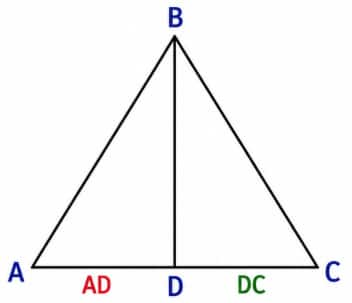
Here $D$ is the midpoint of side $AC$, so $AD=DC$.
Length of the Median:
$BD=\frac{1}{2}\sqrt{2(AB^2+BC^2)-AC^2}$
$3\times(\text{Sum of squares of sides})=4\times(\text{Sum of squares of medians})$
That is,
$3(a^2+b^2+c^2)=4(M_a^2+M_b^2+M_c^2)$
where $a,b,c$ are the sides of the triangle and $M_a,M_b,M_c$ are the medians.
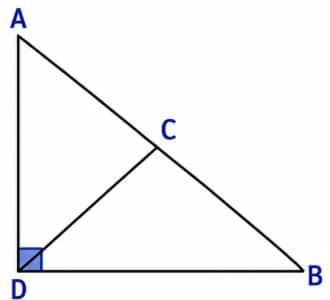
In a right-angled triangle,
$\text{Median of Hypotenuse}=\frac{1}{2}\times\text{Hypotenuse}$
That is,
$CD=\frac{AB}{2}$
If all the medians are drawn in the triangle, then the 6 small triangles are generated in the triangle, which are equal in the Area.
Heron’s Formula
If all sides of a triangle are given. Let $a,b,c$ be the sides of the triangle:
$\text{Area}=\sqrt{s(s-a)(s-b)(s-c)}$
where
$s=\frac{a+b+c}{2}$
is the semiperimeter.
If two sides and the included angle are given:
$\text{Area}=\frac{1}{2}\times(\text{Product of given sides})\times\sin(\text{included angle})$
$\text{Area}=\frac{1}{2}ab\sin C$
(Example: sides $a,b$ and included angle $C$ are given.)
If a side and its respective altitude (perpendicular drawn from the opposite vertex) is given, then:
$\text{Area of the triangle}=\frac{1}{2}\times\text{Base}\times\text{Height (Altitude)}$
Area of an equilateral triangle:
$\text{Area}=\frac{\sqrt{3}}{4}a^2$
Height (Altitude) of an equilateral triangle:
$h=\frac{\sqrt{3}}{2}a$
Area of a triangle:
$\text{Area}=r\times s$
where $r$ is the inradius and $s$ is the semiperimeter.
Area of a triangle:
$\text{Area}=\frac{abc}{4R}$
where $a,b,c$ are sides and $R$ is the circumradius.
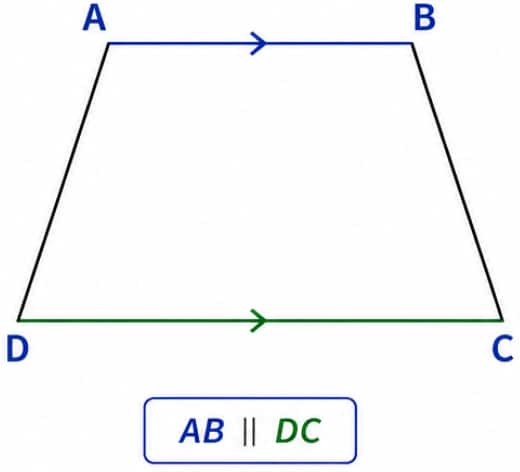
Trapezium
| Area: $A=\frac{1}{2}\times(\text{Sum of Parallel Sides})\times\text{Height}$ $A=\frac{1}{2}(AB+CD)\times H$ |
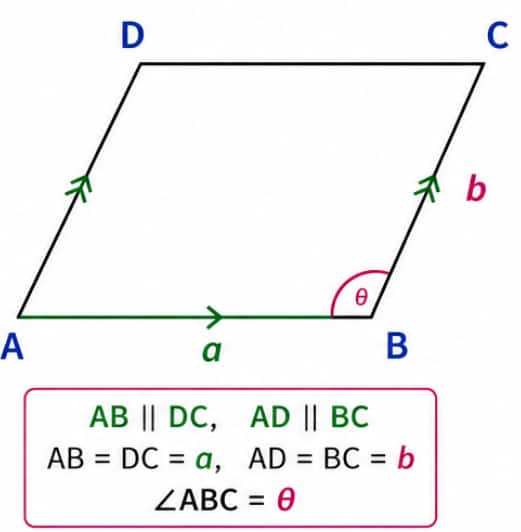
Parallelogram
| Opposite angles and sides are equal. Diagonals bisect each other. Sum of squares of diagonals: $d_1^2+d_2^2=2(a^2+b^2)$ Area: $A=\text{Base}\times\text{Height}=a\times h$ Area (with angle): $A=ab\sin\theta$ |
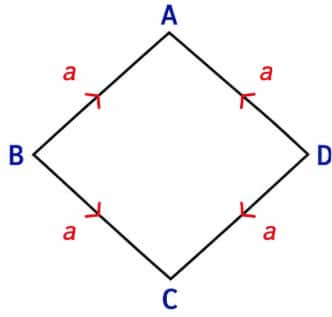
Rhombus
| All sides and opposite angles are equal. Diagonals bisect each other at 90∘. Sum of squares of diagonals: $d_1^2+d_2^2=4a^2$ Area: $A=\frac{1}{2}d_1d_2$ Perimeter: $P=4a$ Where: $a$ = length of a side |
Rectangle | Perimeter: $2(l+b)$ (where l= length, b= breadth) |
Square | Perimeter: $4a$ (where a= side of square) |
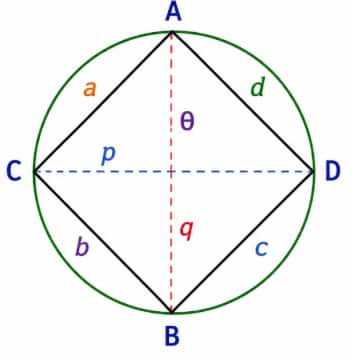
Cyclic Quadrilateral
| Sum of opposite angles: $\angle A+\angle C=180^\circ$ $\angle B+\angle D=180^\circ$ Area: $A=\frac{1}{2}d_1d_2\sin\theta$ where $\theta$ is the angle between the diagonals. Using Brahmagupta’s Formula: $A=\sqrt{(s-a)(s-b)(s-c)(s-d)}$ where $a,b,c,d$ are the sides and $s=\frac{a+b+c+d}{2}$ is the semi-perimeter. |
Let $r$ be the radius of the circle.
| Formula | Expression |
|---|---|
| Circumference of a Circle | $2\pi r$ |
| Area of a Circle | $\pi r^2$ |
Let $r$ be the radius of the semi-circle.
| Formula | Expression |
| Length of Curved Part | $\pi r$ |
| Perimeter of a Semi-Circle | $\pi r+2r$ |
| Area of a Semi-Circle | $\frac{\pi r^2}{2}$ |
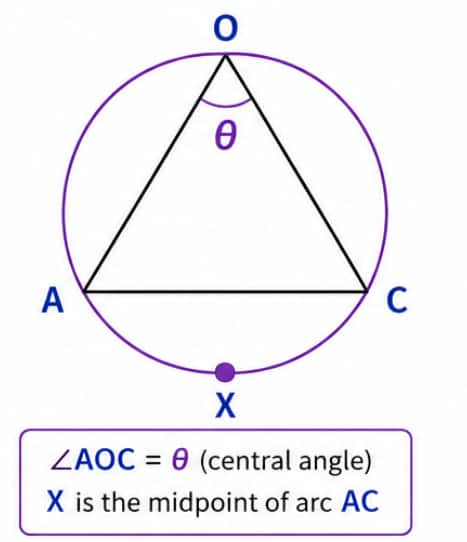
$OAXC$ is called the sector of the circle, and $AXC$ is called the segment.
| Formula | Expression |
|---|---|
| Length of Arc $AXC$ | $\frac{\theta}{360^\circ}\times 2\pi r$ |
| Area of Sector $OAXC$ | $\frac{\theta}{360^\circ}\times \pi r^2$ |
| Sector–Arc Relation | $2\times\text{Area of Sector}=\text{Length of Arc}\times\text{Radius}$ |
| Area of Segment $AXC$ | $\text{Area of Sector }OAXC-\text{Area of }\triangle OAC$ |
| Area of Segment | $A=\frac{\theta}{360^\circ}\pi r^2-\frac{1}{2}r^2\sin\theta$ |
Where:
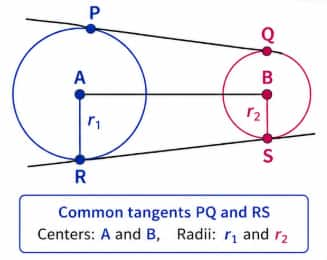
$PQ$ and $RS$ are the direct common tangents of the two circles and are equal in length.
The length of the direct common tangent is:
$$L^2=d^2-(r_1-r_2)^2$$ or $$L=\sqrt{d^2-(r_1-r_2)^2}$$
Where:
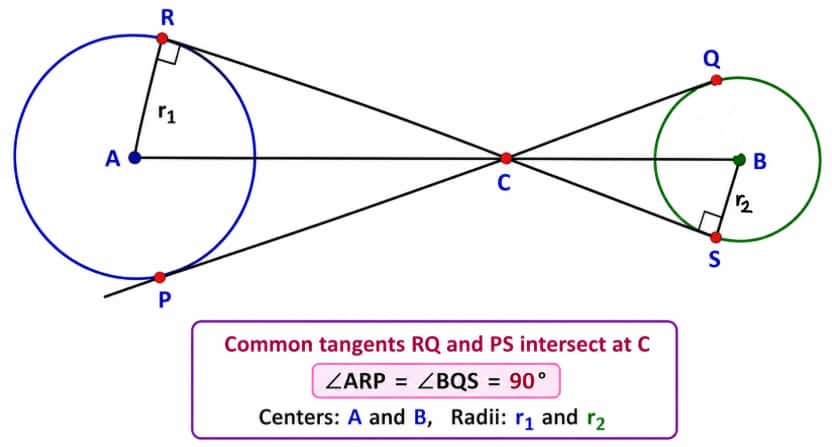
$PQ$ and $RS$ are the transverse common tangents of the two circles and are equal in length.
The length of the transverse common tangent is:
$$L^2=d^2-(r_1+r_2)^2$$ or $$L=\sqrt{d^2-(r_1+r_2)^2}$$
Where:
Mensuration questions in CAT 2026 require a clear understanding of surface area and volume formulas for common 3D figures. The key formulas for cubes, cuboids, cylinders, cones, spheres, and hemispheres are given below for quick revision.
Let $a$ be the side of the cube.
| Formula | Expression |
|---|---|
| Lateral Surface Area (L.S.A.) | $4a^2$ |
| Total Surface Area (T.S.A.) | $6a^2$ |
| Volume | $a^3$ |
Let $l=$ length, $b=$ breadth, and $h=$ height.
| Formula | Expression |
|---|---|
| Lateral Surface Area (L.S.A.) | $2(l+b)h$ |
| Total Surface Area (T.S.A.) | $2(lb+bh+hl)$ |
| Volume | $lbh$ |
Let $r=$ radius of the circular base and $h=$ height.
| Formula | Expression |
|---|---|
| Curved Surface Area (C.S.A.) | $2\pi rh$ |
| Total Surface Area (T.S.A.) | $2\pi r(r+h)$ |
| Volume | $\pi r^2h$ |
Let $r=$ radius of the circular base, $h=$ height, and $l=$ slant height.
| Formula | Expression |
|---|---|
| Slant Height | $l=\sqrt{r^2+h^2}$ |
| Curved Surface Area (C.S.A.) | $\pi rl$ |
| Total Surface Area (T.S.A.) | $\pi r(r+l)$ |
| Volume | $\frac{1}{3}\pi r^2h$ |
Let $r$ be the radius of the sphere.
| Formula | Expression |
|---|---|
| Total Surface Area | $4\pi r^2$ |
| Volume | $\frac{4}{3}\pi r^3$ |
Let $r$ be the radius of the hemisphere.
| Formula | Expression |
|---|---|
| Curved Surface Area (C.S.A.) | $2\pi r^2$ |
| Total Surface Area (T.S.A.) | $3\pi r^2$ |
| Volume | $\frac{2}{3}\pi r^3$ |
Algebra is an important part of CAT 2026 Quantitative Aptitude, covering topics such as quadratic equations, progressions, indices, surds, and logarithms. The key Algebra formulas are listed below for quick revision.
| Formula | Expression |
|---|---|
| General Form | $ax^2+bx+c=0$ |
| Roots Formula | $x=\frac{-b\pm\sqrt{b^2-4ac}}{2a}$ |
| Sum of Roots | $-\frac{b}{a}$ |
| Product of Roots | $\frac{c}{a}$ |
| Discriminant | $D=b^2-4ac$ |
| Vertex | $x=-\frac{b}{2a}$ |
| Maximum/Minimum Value | $y=-\frac{D}{4a}$ |
| Condition | Nature of Roots |
|---|---|
| $D>0$ | Real and distinct |
| $D=0$ | Real and equal |
| $D<0$ | Imaginary and distinct |
| Perfect Square $D$ | Rational roots |
| Non-Perfect Square $D$ | Irrational roots |
| Formula | Expression |
|---|---|
| $n$th Term | $T_n=a+(n-1)d$ |
| Sum of $n$ Terms | $S_n=\frac{n}{2}[2a+(n-1)d]$ |
| Alternative Sum Formula | $S_n=\frac{n}{2}(a+l)$ |
| Number of Terms | $n=\frac{l-a}{d}+1$ |
| Formula | Expression |
|---|---|
| $n$th Term | $T_n=ar^{n-1}$ |
| Sum of $n$ Terms ($r>1$) | $S_n=\frac{a(r^n-1)}{r-1}$ |
| Sum of $n$ Terms ($r<1$) | $S_n=\frac{a(1-r^n)}{1-r}$ |
| Infinite GP Sum | $S_\infty=\frac{a}{1-r},\quad \lvert r\rvert<1$ |
| Formula | Expression |
|---|---|
| Basic Relation | If $a,b,c$ are in AP, then $\frac{1}{a},\frac{1}{b},\frac{1}{c}$ are in HP |
| $n$th Term | Reciprocal of the $n$th term of the corresponding AP |
| Series | Sum |
|---|---|
| First $n$ Natural Numbers | $\frac{n(n+1)}{2}$ |
| Squares of First $n$ Natural Numbers | $\frac{n(n+1)(2n+1)}{6}$ |
| Cubes of First $n$ Natural Numbers | $\left[\frac{n(n+1)}{2}\right]^2$ |
| First $n$ Odd Numbers | $n^2$ |
| Squares of First $n$ Even Numbers | $\frac{2n(n+1)(2n+1)}{3}$ |
| Squares of First $n$ Odd Numbers | $\frac{n(2n+1)(2n-1)}{3}$ |
| Rule | Formula |
|---|---|
| Product Rule | $a^m\cdot a^n=a^{m+n}$ |
| Quotient Rule | $\frac{a^m}{a^n}=a^{m-n}$ |
| Power Rule | $(a^m)^n=a^{mn}$ |
| Product Power | $(ab)^n=a^nb^n$ |
| Quotient Power | $\left(\frac{a}{b}\right)^n=\frac{a^n}{b^n}$ |
| Negative Exponent | $a^{-n}=\frac{1}{a^n}$ |
| Property | Formula |
|---|---|
| Definition | $\log_b a=x\iff b^x=a$ |
| Log of 1 | $\log_b 1=0$ |
| Log of Base | $\log_b b=1$ |
| Product Rule | $\log_b(mn)=\log_b m+\log_b n$ |
| Quotient Rule | $\log_b\left(\frac{m}{n}\right)=\log_b m-\log_b n$ |
| Power Rule | $\log_b(m^n)=n\log_b m$ |
| Change of Base | $\log_b a=\frac{\log_k a}{\log_k b}$ |
| Base Switch Rule | $\log_a b=\frac{1}{\log_b a}$ |
While preparing for algebra, you can check out this PDF and strengthen your concepts and practice questions:
CAT Algebra PDF Handbook 2026: Everything You Need
Memorise the roots, sum of roots, and discriminant formulas for Quadratic Equations.
Revise AP, GP, and Series formulas regularly as they are frequently tested.
Practice Logarithm properties and index rules together since questions often combine both concepts.
Maintain a separate Algebra formula sheet for last-minute CAT 2026 revision.
Focus on formula application through CAT previous year questions and mock tests rather than rote memorisation.
The CAT 2026 Quantitative Aptitude Cheat Sheet PDF is a compact, high-utility resource covering all essential formulas, theorems, and shortcuts from Arithmetic, Algebra, Geometry, Modern Math, and Number Systems.
Download Now: CAT 2026 Quantitative Aptitude Cheat Sheet PDF
Approximation and mental calculation can help CAT 2026 aspirants reduce calculation time, particularly when the answer choices are sufficiently far apart. However, approximation should be used selectively; if two choices are very close, accurate calculation is safer.
Some useful CAT Quant calculation tricks include:
| Technique | Example | Quick Approach |
|---|---|---|
| Round numbers | $49.8 \times 20.2$ | Approximate as $50 \times 20 = 1000$ |
| Percentage splitting | $17%$ of $600$ | $10% + 5% + 2% = 60+30+12=102$ |
| Multiplication by 5 | $248 \times 5$ | $2480 \div 2 = 1240$ |
| Multiplication by 25 | $64 \times 25$ | $64 \times 100 \div 4 = 1600$ |
| Near-base multiplication | $98 \times 97$ | $(100-2)(100-3)=9506$ |
| Fraction conversion | $12.5%$ of $240$ | $12.5%=1/8$, so $240/8=30$ |
Aspirants should also memorise common fraction-percentage equivalents such as $1/2=50%$, $1/3\approx33.33%$, $1/4=25%$, $1/5=20%$, and $1/8=12.5%$. These conversions are especially useful in Arithmetic and DI calculations.
Memorising every CAT Quant formula at once is usually ineffective. Formulas are easier to retain when they are repeatedly applied to questions rather than simply reread.
Use these techniques to improve formula retention:
Create topic-wise formula groups: Keep Arithmetic, Algebra, Geometry, Number System, and Modern Maths formulas separate.
Understand before memorising: Know what each variable represents and when the formula applies.
Use active recall: Cover the formula and try writing it from memory.
Solve 3–5 questions: Apply each newly revised formula to CAT-level problems.
Mark frequently forgotten formulas: Maintain a separate list of formulas you repeatedly miss.
Follow spaced revision: Revisit important formulas after 1 day, 3 days, and 7 days.
Maintain a one-page final sheet: Keep only the formulas, identities, and conversions you genuinely need.
The aim is not memorisation alone but quick formula recognition and correct application under time pressure.
During the final weeks before CAT 2026, use the formula sheet for rapid recall rather than learning new concepts. Divide formulas into Strong, Needs Revision, and Frequently Forgotten categories and focus mainly on the latter two.
A practical revision cycle is:
Formula → Recall → 2–3 Questions → Check Mistakes → Revise Again
For example, after revising Time, Speed and Distance formulas, solve a few mixed questions without referring to the sheet. Mark any formula you cannot recall or apply correctly for another revision.
In the final few days, prioritise frequently used formulas, standard values, fraction-percentage conversions, geometry results, algebraic identities, and calculation shortcuts.
Use this checklist to track the major Quant formula areas you need to revise before CAT 2026.
Use these topic links to quickly revisit the relevant CAT Quant concepts and formulas:
| Formula Area | What to Revise |
|---|---|
| Percentages | Increase/decrease, successive percentage change |
| Profit & Loss | Profit, loss, discount, marked price |
| Ratio & Proportion | Ratios, proportions, direct/inverse variation |
| Averages | Basic and weighted averages |
| SI & CI | Interest, amount, growth and depreciation |
| Time & Work | Work rate, efficiency, combined work |
| TSD | Relative speed, average speed, trains, boats |
| Mixtures | Concentration and alligation |
| Algebra | Identities, equations, inequalities, logarithms |
| Number System | Factors, Divisibility Rules , HCF-LCM, remainders |
| Geometry | Triangles, circles, quadrilaterals, polygons |
| Mensuration | Area, perimeter, surface area and volume |
| Modern Maths | P&C, probability, sets |
| Calculation Skills | Fractions, percentages, squares, cubes and approximations |
After completing the checklist, test yourself without looking at the sheet to ensure you can both recall formulas and identify where to apply them.
As CAT 2026 approaches, focus on revising and applying known formulas rather than trying to learn large amounts of new material.
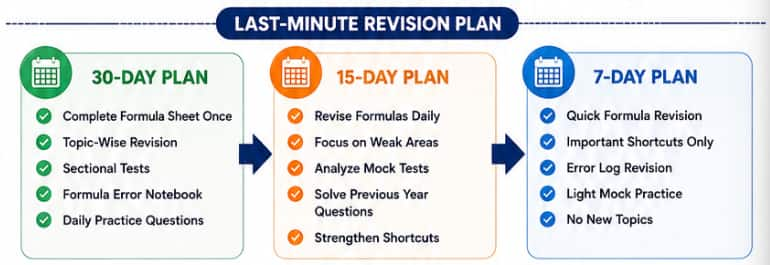
Use the first phase to complete one full revision cycle across all major Quant topics.
Focus Areas:
Complete formula revision of all topics
Solve sectional tests regularly
Maintain a formula error notebook
Revise high-frequency CAT formulas
With 15 days left, shift the focus towards applying formulas through mocks and previous-year questions.
Focus Areas:
Revise formula sheets every day
Analyse mock-test mistakes
Practise formula-based questions
Strengthen weak topics
Use the final week for quick revision, error correction, and confidence building rather than learning unfamiliar concepts.
Focus Areas:
Quickly revise all formula sheets
Memorise important shortcuts
Revise error logs and notes
Take limited mocks and focus on analysis
Before each CAT mock, spend 15–20 minutes revising key formulas from Arithmetic, Algebra, Geometry, Number System, and Modern Maths. This improves recall, speed, and accuracy.
Use this quick checklist to cover the most important formulas before starting a mock:
| Topic | Key Areas |
|---|---|
| Arithmetic | Percentages, SI-CI, Time & Work |
| Algebra | Quadratic Equations, Logs, AP-GP |
| Geometry | Triangles, Circles, Mensuration |
| Number System | Remainders, HCF-LCM, Cyclicity |
| Modern Maths | Probability, P&C, Set Theory |
A quick review of these areas can help reduce formula-based errors and improve calculation speed during the mock.
A personalised formula sheet can make revision more effective by focusing on frequently tested concepts, shortcuts, and areas where you make mistakes.
Follow these steps to build a concise and useful CAT 2026 formula sheet:
| Step | What to Do |
|---|---|
| Organize Topic-Wise | Separate Arithmetic, Algebra, Geometry, Number System, and Modern Maths |
| Include High-Frequency Formulas | Focus on formulas commonly tested in CAT |
| Add Usage Notes | Mention where and when to apply each formula |
| Maintain Shortcut Tables | Include percentages, squares, cubes, and approximations |
| Update After Mocks | Add forgotten formulas and common mistakes |
| Revise Regularly | Keep formulas fresh throughout your preparation |
Keep the sheet concise, highlight frequently used formulas, and update it regularly based on your mock-test performance.
Keep it concise and easy to scan.
Limit each topic to one or two pages.
Highlight frequently used formulas.
Update it after every mock.
Revise it regularly, especially in the final months.
The right study material can strengthen both concepts and problem-solving skills, from Quant fundamentals to CAT-level practice and revision.
| Book Name | Author | Best For | Difficulty Level |
|---|---|---|---|
| How to Prepare for Quantitative Aptitude for CAT | Arun Sharma | Concept Building, Practice Questions, CAT-Level Preparation | Beginner to Advanced |
| Quantitative Aptitude for CAT | Nishit K. Sinha | Detailed Theory, CAT-Level Practice, Advanced Questions | Intermediate to Advanced |
| Quantitative Aptitude Quantum CAT | Sarvesh K. Verma | Shortcut Techniques, Speed Building, Advanced Practice | Intermediate to Advanced |
| NCERT Mathematics Class 9 & 10 | NCERT | Building Basic Concepts in Arithmetic, Algebra, and Geometry | Beginner |
| NCERT Mathematics Class 11 & 12 (Selected Topics) | NCERT | Functions, Coordinate Geometry, Progressions, Probability | Beginner to Intermediate |
| CAT Previous Year Question Papers | CAT Archives | Understanding CAT Question Patterns and Trends | All Levels |
| CAT Mock Tests and Sectional Tests | Various Coaching Platforms | Exam Simulation and Performance Analysis | All Levels |
| Preparation Stage | Recommended Resource |
|---|---|
| Beginner | NCERT Class 9 & 10 Mathematics |
| Foundation Building | Arun Sharma |
| Concept Strengthening | Nishit K. Sinha |
| Speed & Shortcuts | Sarvesh K. Verma |
| Exam-Level Practice | Previous Year CAT Papers |
| Final Preparation | Full-Length CAT Mock Tests |
Preparation Tip: If you are starting from scratch, begin with NCERT and Arun Sharma. Candidates targeting a 99+ percentile in CAT 2026 Quant should additionally practice from Nishit K. Sinha, Quantum CAT, previous year papers, and high-quality mock tests.
Explore the best CAT 2026 eBooks and study materials recommended by experts for complete preparation of Quantitative Aptitude. These resources will help aspirants revise efficiently and boost exam preparation.
| Category | Ebook | Download |
|---|---|---|
| Quant Fundamentals & Revision | 100 Quant Facts Every CAT Aspirant Must Know | Download Now |
| CAT 2025 Quantitative Aptitude Questions with Answers PDF | Download Now | |
| Sectionwise & Topic-wise Quant Preparation | CAT 2026 Number System PDF Handbook | Download Now |
| CAT 2025 Number System Important Concepts & Practice Questions | Download Now | |
| CAT 2026 Geometry & Mensuration PDF | Download Now | |
| CAT 2025 Quantitative Aptitude Study Material: Geometry and Mensuration | Download Now | |
| CAT 2026 Modern Maths PDF Handbook | Download Now | |
| Permutation & Combination: Important Concepts & Questions | Download Now | |
| Quant Practice & PYQs | CAT Quant PYQs: Complete 5-Year Question Bank (2021–2025) | Download Now |
| CAT 2026: 10 Most Repeated Concepts in Quant | Download Now | |
| CAT Time & Work: Top 30 Practice Questions with Solutions | Download Now | |
| CAT Quadratic Equations: Top 30 Practice Questions with Solutions | Download Now | |
| CAT 2026 Quantitative Aptitude: 20 Free Sectional Tests | Download Now |
Frequently Asked Questions (FAQs)
Yes, NCERT books, particularly for subjects like Mathematics, provide a solid foundation. They are especially beneficial for beginners to grasp basic concepts before moving to more complex materials.
Important formulas are Area of Circle (πr²), Circumference (2πr), and Pythagoras theorem (a² + b² = c²). Triangle area ½ × base × height and Volume of Cylinder (πr²h) are also common. CAT Geometry questions depend directly on these.
Focus on the formulas you are most likely to use while solving questions from Arithmetic, Algebra, Geometry, Number System, and Modern Maths. Prioritise formulas for percentages, averages, profit and loss, time and work, TSD, equations, logarithms, geometry, mensuration, remainders, probability, and P&C.
Absolutely. Many aspirants successfully prepare using self-study materials, previous year papers, and practice tests. Discipline and a well-structured study plan are key to self-preparation.
You don’t need every formula ever made - just focus on those repeatedly asked in previous CAT papers. Prioritise core areas like Arithmetic, Algebra, and Geometry for best results.
Write formulas in a separate notebook or digital sheet, revise them daily, and practise topic-wise questions. Repetition through mock tests helps build long-term memory and faster recall during the exam.
A well-organised CAT formula sheet saves revision time, prevents confusion, and improves problem-solving speed. It’s especially useful for last-minute revision before mocks and the final CAT exam.

On Question asked by student community
Hello, for AP NEET PG Category C seats, NRI documents are generally required if you are applying under the NRI quota, and eligibility depends on the applicable counselling rules. The fee payment currency and procedure should be confirmed from the current Dr. NTRUHS notification at its official website drntr.uhsap.in.
Hello, CAT aur B-school entrance exams ke baare mein aap exam dates, eligibility, registration, exam pattern, syllabus, colleges ya admission process ki information dekh sakte hain. Aapki requirement ke according relevant details yahan mil sakti hain: https://bschool.careers360.com/exams
You can download the latest CAT syllabus from here:
Hey there,
For a B.Sc. with Chemistry, Botany and Zoology (CBZ), if the CAT application asks separately for:
If the Discipline dropdown has a more specific option such as “Biological Sciences,” “Life Sciences,” or “Zoology/Botany,”
Hey there,
Yes. With 2 years of work experience, you are eligible to target the regular 2-year MBA at IIM Calcutta as long as you have a bachelor's degree with at least 50% marks (45% for SC/ST/PwD). Work experience is not required for eligibility.
For
Directions for question:
The bar-graph given below shows the foreign exchange reserves of Nepal (in million Rupees) from 2014 to 2021. Answer the following questions based on the graph :

Question:
What was the percentage increase (rounded to the nearest integer, if deemed necessary) in the foreign exchange reserves in

Globally Recognized by AACSB (US) & AMBA (UK) | 18 LPA Avg. CTC for PGPM 2026
75+ years of legacy | #1 Entrance Exam | Score accepted by 250+ BSchools
Gateway to IBS Hyderabad & 8 other IBS campuses | Scholarships worth 10 CR
Highest Package 29.30 LPA | 12 LPA Median CTC | 230+ Recruiters | AACSB Accredited | Ranked 51 in Asia by QS International
AACSB Accredited | Highest CTC: 22 LPA
Among top 6% B-Schools globally to be accredited by AACSB | Highest Package-35 LPA