KCC Institute of Legal and Higher Education, Greater Noida
Law Admissions 2026 Open | Avail Merit-Based Scholarships


Think about your daily commute—how long it takes to reach college depends on distance, your speed, and sometimes even traffic conditions. This simple real-life situation perfectly captures the essence of Time, Speed and Distance, one of the most important topics in quantitative aptitude and competitive exam maths. From calculating average speed and relative speed to understanding the concept of proportionality between time, speed, and distance, these questions test both logical thinking and calculation accuracy. In exams like CAT, XAT, CUET, SSC, Banking, and other aptitude tests, this chapter often appears in multiple formats, ranging from direct formula-based problems to tricky application-oriented questions. In this article, you’ll find important time, speed and distance questions, step-by-step solved examples, shortcut techniques, and a clear explanation of direct and inverse proportionality, all designed to help you build strong fundamentals and boost your problem-solving speed.
This Story also Contains
Speed, Distance, and Time form the foundation of motion-related problems in mathematics and quantitative aptitude. This concept is widely used in competitive exams, school-level physics, and aptitude tests, as it helps analyze how fast an object moves, how far it travels, and how long the motion takes.
Distance refers to the total length of the path covered by an object during motion, regardless of the direction taken. It is usually measured in units like meters or kilometers and represents how far an object has traveled.
Time is the duration taken to cover a given distance. It answers the question of how long the motion lasts and is commonly measured in seconds, minutes, or hours.
Speed is defined as the rate at which distance is covered over time. In simple terms, it shows how fast an object is moving and is calculated as the ratio of distance traveled to the time taken.
Understanding these basic definitions is essential before moving on to advanced topics such as average speed, relative speed, uniform and non-uniform motion, and time–speed–distance problem-solving techniques frequently asked in exams.
Example
Suppose a car is travelling from City A to City B, which is 60 kilometres apart. If the car travels at 60 km/hr speed, then it will take 1 hour to cover this distance.
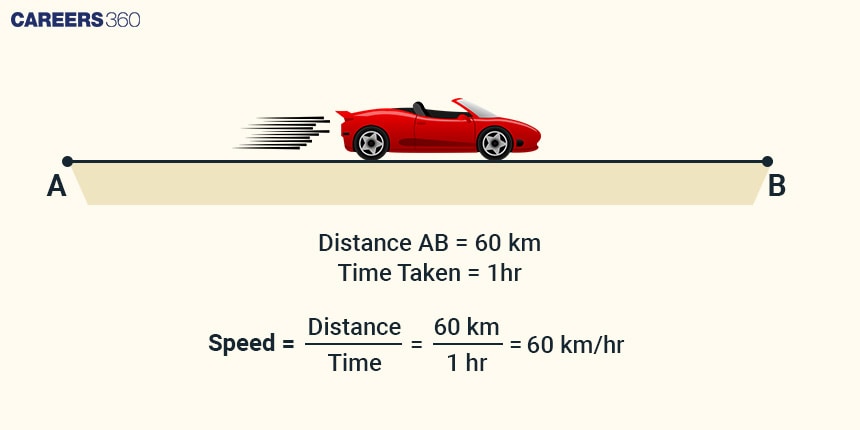 Relation between Speed, Distance, and Time
The relationship between speed, distance, and time is the backbone of solving numerical problems in this chapter. Almost every time, speed, and distance question—whether from school exams or competitive exams—is based on these three fundamental formulas. Understanding when and how to apply them makes problem-solving much easier and faster.
| Formula | Explanation |
|---|---|
| Speed = $\frac{\text{Distance}}{\text{Time}}$ | Used to calculate speed when the distance covered and time taken are given |
| Distance = Speed × Time | Used to find the distance traveled when speed and time are known |
| Time = $\frac{\text{Distance}}{\text{Speed}}$ | Used to calculate time taken when distance and speed are known |
Using these formulas, most basic time–speed–distance problems can be solved directly. However, one crucial point students often overlook is unit consistency. Always ensure that distance, speed, and time are expressed in compatible units (for example, km with km/h, meters with m/s) before applying the formulas. Correct units + correct formula = correct answer.
Understanding the units of speed, distance, and time is extremely important for solving numerical problems accurately. Many mistakes in time, speed, and distance questions happen not because the formula is wrong, but because units are not converted properly. Before applying any formula, always check whether all quantities are expressed in compatible units.
| Quantity | Common Units | Important Conversions |
|---|---|---|
| Distance | Kilometre (km), Metre (m), Mile | 1 km = 1000 m 1 mile = 1.6 km |
| Time | Hour (hr), Minute (min), Second (s) | 1 hour = 3600 seconds 1 minute = 60 seconds |
| Speed | Kilometre per hour (km/hr), Metre per second (m/s) | 1 km/hr = $\frac{5}{18}$ m/s 1 m/s = $\frac{18}{5}$ km/hr |
Being comfortable with these unit conversions helps you quickly handle questions involving speed conversion, average speed, relative speed, and real-life motion problems. A quick unit check before solving can save you from silly errors and boost your overall accuracy.
To convert km/hr to m/s, we need to convert the kilometre to metre and hour to seconds.
1 km/hr = $\frac{\text{1 km}}{\text{1 hr}}$ = $\frac{\text{1000 m}}{\text{3600 s}}$ = $\frac{5}{18}$ m/s
We can also write it as, 1 km/hr = $\frac{1}{3.6}$ m/s
To convert m/s to km/hr, we need to convert the metre to kilometre and to second to hour.
1 m/s = $\frac{\text{1 m}}{\text{1 s}}$ = $\frac{\frac{1}{1000} km}{\frac{1}{36000} hr}$ = $\frac{18}{5}$ km/hr
We can also write it as, 1 m/s = 3.6 km/hr
The concept of proportionality plays a crucial role in solving advanced time, speed, and distance problems in mathematics and quantitative aptitude. Proportionality helps us understand how one variable changes when another variable changes, while the remaining quantity stays constant. In this chapter, we mainly deal with direct variation and inverse (indirect) variation, both of which are frequently tested in competitive exams like CAT, XAT, CUET, SSC, and Banking exams. Let us describe each concept in detail:
This section focuses on direct proportionality in time, speed, and distance, where two quantities increase or decrease together while the third remains constant. It explains how distance varies directly with speed or time, supported by simple examples and concepts frequently tested in quantitative aptitude and competitive exams.
When time remains constant, the distance travelled is directly proportional to speed. This means that if the speed increases, the distance covered increases in the same ratio.
Distance ∝ Speed (when Time is constant)
Example:
A car covers a distance of 100 km at a speed of 25 km/hr in a fixed time.
If the speed is increased to 50 km/hr (which is double), the distance covered in the same time will also double.
New distance = 100 × 2 = 200 km
This clearly shows that increasing speed while keeping time constant results in more distance covered, a classic case of direct proportionality.
When speed is constant, the distance travelled is directly proportional to time. In simple terms, the longer you travel at the same speed, the more distance you cover.
Distance ∝ Time (when Speed is constant)
Example:
A car covers 100 km in 2 hours at a constant speed.
If the travel time is increased to 4 hours at the same speed, the distance covered will also double.
New distance = 100 × 2 = 200 km
This type of question is common in basic time–distance problems and helps build intuition for proportional reasoning.
This section covers the concept of inverse proportionality in time, speed, and distance, where one quantity increases as the other decreases while the distance remains constant. It explains how speed and time are inversely related, along with clear logic and examples commonly asked in aptitude and competitive exam questions.
When the distance remains constant, speed is inversely proportional to time. This means that if you want to take less time to cover the same distance, you must travel at a higher speed.
Speed ∝ $\frac{1}{\text{Time}}$
Example:
A journey of a fixed distance takes 3 hours at a speed of 40 km/hr.
If the time is reduced to 2 hours, the required speed will be:
New speed = $\frac{40 × 3}{2}$ = 60 km/hr
This shows that reducing time for the same distance forces an increase in speed, which is a key idea behind inverse proportionality questions.
Understanding these direct and inverse proportionality concepts makes it much easier to solve tricky time, speed, and distance problems, especially those involving ratio-based shortcuts and exam-level applications. Once this logic is clear, many seemingly difficult questions become quick and manageable.
Understand the basic formulas of time, speed and distance and their interrelation.
Always convert all units to a consistent set before solving a problem. For instance, if the distance is in kilometres and time is in hours, ensure the speed is in km/hr.
The formula for average speed when travelling different distances at different speeds is:
Law Admissions 2026 Open | Avail Merit-Based Scholarships
BBA/MBA/PGDM Early Bird Applications Deadline 19th Oct '26. Apply now using coupon code CAREER250 and get ₹250 off the application fee
Average speed = $\frac{\text{Total distance}}{\text{Total time}}$.
When two objects are moving in the same direction, the relative speed is the difference in their speeds.
When two objects are moving in opposite directions, the relative speed is the sum of their speeds.
Time, speed and distance concept is widely used in the concept of Average speed and Relative speed as well as in application of Time, speed, and distance in problems on trains.
Q.1.A man travels $\frac{3}{4}$th of the distance of his journey by bus, $\frac{1}{6}$th by rickshaw, and the remaining 2 km on foot. The total distance travelled by the man is:
12 km
18 km
20 km
24 km
Hint: Let the total distance be $x$ km. Find the remaining distance and equate it with 2 km.
Solution:
Given:
A man travelled by bus $\frac{3}{4}$th of the total distance.
The man travelled by rickshaw $\frac{1}{6}$th of the total distance.
The man travelled on foot = 2 km
Let the total distance be $x$ km.
Remaining distance
$= x - \frac{3x}{4} - \frac{x}{6}$
According to the question,
$x - \frac{3x}{4} - \frac{x}{6} = 2$
$⇒ \frac{12x - 9x - 2x}{12} = 2$
$⇒ \frac{x}{12} = 2$
$\therefore x = 24$
Hence, the correct answer is option (4).
Q.2. To cover a certain distance at a speed of 60 km/hr, a train takes 15 hours. If it covers the same distance in 12 hours, what will its speed be?
65 km/hr
70 km/hr
75 km/hr
80 km/hr
Hint: Use the formula Distance = Speed × Time.
Solution:
Given:
Speed = 60 km/hr
Time = 15 hours
Distance = Speed × Time
$= 60 × 15 = 900$ km
Required speed to cover this distance in 12 hours
$= \frac{900}{12} = 75$ km/hr
Hence, the correct answer is option (3).
Q.3. Sound travels at 330 metres per second. The distance (in kilometres) of a thundercloud when its sound follows the flash after 10 seconds is:
0.33 km
3.3 km
33 km
33.3 km
Hint: Use the formula Distance = Speed × Time.
Solution:
Given:
Speed of sound = 330 m/s
Distance = Speed × Time
$= 330 × 10 = 3300$ metres
$= 3.3$ km
Hence, the correct answer is option (2).
Q.4. At an average speed of 80 km/hr, the Shatabdi Express reaches Ranchi from Kolkata in 7 hours. The distance between Kolkata and Ranchi is:
506 km
560 km
506 m
650 m
Hint: Use Distance = Average Speed × Time.
Solution:
Given:
Average speed = 80 km/hr
Time = 7 hours
Distance = $80 × 7 = 560$ km
Hence, the correct answer is option (2).
Q.5. A truck covers a distance of 550 metres in one minute whereas a bus covers a distance of 33 km in $\frac{3}{4}$ hour. Then the ratio of their speeds is:
$1:2$
$2:3$
$3:4$
$4:5$
Hint: Use Speed = $\frac{\text{Distance}}{\text{Time}}$.
Solution:
Speed of truck
$= \frac{550}{60} = \frac{55}{6}$ m/s
Speed of bus
$= \frac{33 × 1000}{\frac{3}{4} × 3600} = \frac{110}{9}$ m/s
Required ratio
$= \frac{\frac{55}{6}}{\frac{110}{9}}$
$= \frac{55}{6} × \frac{9}{110}$
$= \frac{3}{4}$
$= 3:4$
Hence, the correct answer is option (3).
Q.6. Rameshwar goes on a trip on his motorcycle and rides for 405 kilometres. If he rides for 6 hours at a speed of 45 km/hr, find at what speed he travels for the remaining 3 hours of the journey.
55 km/hr
52 km/hr
45 km/hr
40 km/hr
Hint: Use Speed = $\frac{\text{Distance}}{\text{Time}}$.
Solution:
Total distance = 405 km
Distance covered in 6 hours
$= 6 × 45 = 270$ km
Remaining distance
$= 405 - 270 = 135$ km
Speed for remaining 3 hours
$= \frac{135}{3} = 45$ km/hr
Hence, the correct answer is option (3).
Q.7. If a train maintains an average speed of 42 km/hr, it arrives at its destination on time. If the speed is 40 km/hr, it arrives 15 minutes late. Find the distance of the journey.
210 km
209 km
205 km
200 km
Hint: Use Distance = Speed × Time.
Solution:
Let time be $x$ hours at 42 km/hr.
At 40 km/hr, time becomes $x + \frac{1}{4}$ hours.
$42x = 40\left(x + \frac{1}{4}\right)$
$⇒ 2x = 10$
$\therefore x = 5$
Distance
$= 42 × 5 = 210$ km
Hence, the correct answer is option (1).
Q.8. The speeds of three cars are in the ratio $1:3:5$. The ratio of the time taken to cover the same distance is:
$3:5:15$
$15:3:5$
$15:5:3$
$5:3:1$
Hint: Time is inversely proportional to speed.
Solution:
Time ∝ $\frac{1}{\text{Speed}}$
Required ratio
$= 1 : \frac{1}{3} : \frac{1}{5}$
LCM of 1, 3, and 5 = 15
$= 15 : 5 : 3$
Hence, the correct answer is option (3).
Q.9. Anuj drives at 70 km/hr with 3 halts of 10 minutes each, while Anup drives at 80 km/hr with 4 halts of 15 minutes each. If Anuj takes 8.5 hours, find the time taken by Anup.
8 hours
7 hours
4 hours
6 hours
Hint: Use Speed = $\frac{\text{Distance}}{\text{Time}}$.
Solution:
Anuj’s halt time
$= 30$ minutes = 0.5 hours
Actual travel time
$= 8.5 - 0.5 = 8$ hours
Distance
$= 70 × 8 = 560$ km
Anup’s halt time
$= 60$ minutes = 1 hour
Travel time
$= \frac{560}{80} = 7$ hours
Total time
$= 7 + 1 = 8$ hours
Hence, the correct answer is option (1).
Q.10. Raghav covers a distance of 3300 m in 45 minutes. What is his speed (in km/hr)?
5
4.4
3.75
2.25
Hint: Use Speed = $\frac{\text{Distance}}{\text{Time}}$.
Solution:
Distance
$= \frac{3300}{1000} = 3.3$ km
Time
$= \frac{45}{60} = 0.75$ hours
Speed
$= \frac{3.3}{0.75} = 4.4$ km/hr
Hence, the correct answer is option (2).
Frequently Asked Questions (FAQs)
The basic formula of time, speed, and distance is Distance = Speed × Time.
Speed can be calculated by the following formula:
Speed = $\frac{\text{Distance}}{\text{Time}}$.
The SI unit of speed is metre/second (m/s), but the most commonly used unit of speed is kilometre/hour (km/hr).
To convert km/hr to m/s, we need to convert the kilometre to metre and hour to seconds.
1 km/hr = $\frac{\text{1 km}}{\text{1 hr}}$ = $\frac{\text{1000 m}}{\text{3600 s}}$ = $\frac{5}{18}$ m/s
We can also write it as, 1 km/hr = $\frac{1}{3.6}$ m/s
The formula of time is given as:
Time = $\frac{\text{Distance}}{\text{Time}}$

Law Admissions 2026 Open | Avail Merit-Based Scholarships
BBA/MBA/PGDM Early Bird Applications Deadline 19th Oct '26. Apply now using coupon code CAREER250 and get ₹250 off the application fee
Ranked #36 amongst institutions in Management by NIRF | 100% Placement
Globally Recognized by AACSB (US) & AMBA (UK) | 18 LPA Avg. CTC for PGPM 2026
Leading Design College | 95% Placement Record | Merit-cum-Means Scholarships for Deserving Students
NEET PG All India & State College Predictor with Admission Process Guide