KCC Institute of Legal and Higher Education, Greater Noida
Law Admissions 2026 Open | Avail Merit-Based Scholarships


The Entner–Doudoroff (ED) pathway is an alternative glucose catabolic route found in certain bacteria and archaea, producing pyruvate, G3P, ATP, NADH, and NADPH. Unlike glycolysis, which yields 2 ATP, the ED pathway yields only 1 ATP, but provides NADPH crucial for biosynthesis. This pathway is important in microbial metabolism, ecology, and NEET-level biochemistry.
This Story also Contains
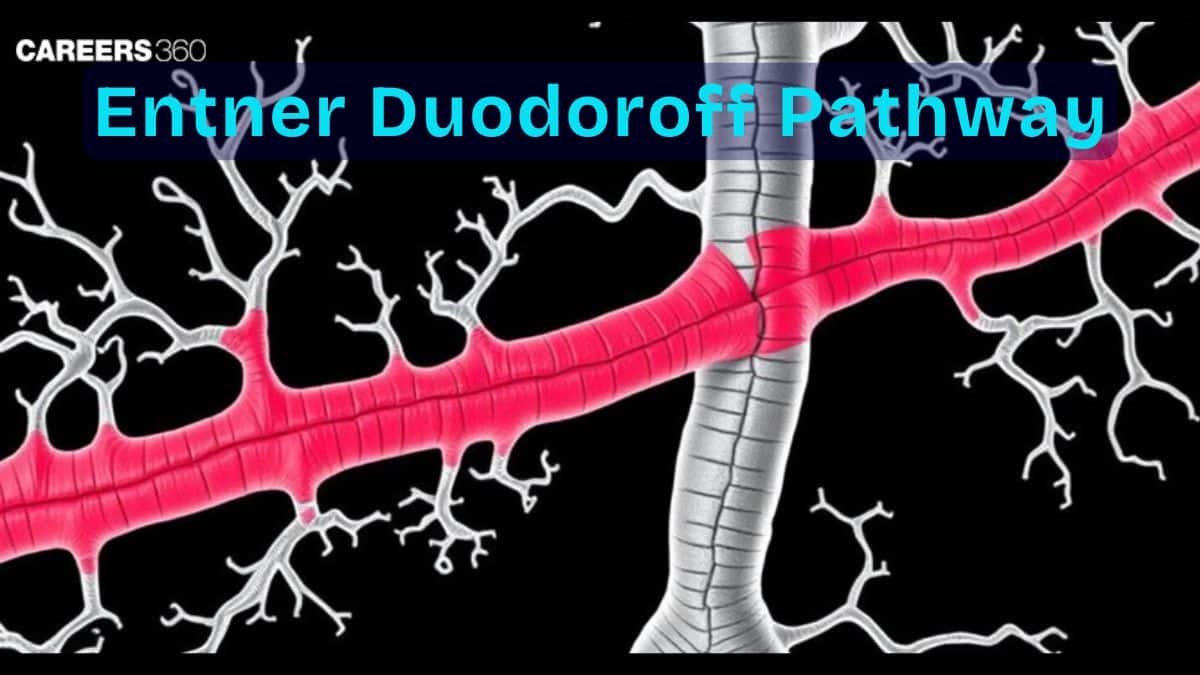
The Entner-Doudoroff Pathway is an alternative glycolytic pathway found in some bacteria and archaea converting glucose to pyruvate while endowing ATP and NADPH. Unlike the much more common Embden-Meyerhof-Parnas, EMP, pathway (traditional glycolysis), this pathway involves unique enzymatic machinery and intermediates, including 2-keto-3-deoxy-6-phosphogluconate, or KDPG. The ED Pathway is one of the most interesting routes of metabolism in microbial ecology because it shows a very interesting way of producing energy and biosynthesis under certain conditions.
The steps of the Entner Duodoroff Pathway are given below:
Enzyme:
Glucose dehydrogenase
Gluconolactonase
Law Admissions 2026 Open | Avail Merit-Based Scholarships
BBA/MBA/PGDM Early Bird Applications Deadline 19th Oct '26. Apply now using coupon code CAREER250 and get ₹250 off the application fee
Mechanism:
Gluconolactone is hydrolysed by gluconolactonase to form 6-phosphogluconate.
Enzyme:
6-Phosphogluconate dehydratase
KDPG aldolase
Mechanism:
6-Phosphogluconate to 2-Keto-3-deoxy-6-phosphogluconate (KDPG):
6-phosphogluconate is dehydrated by 6-phosphogluconate dehydratase to form KDPG, an intermediate in the pathway.
Enzyme: KDPG aldolase
Mechanism: KDPG is split by KDPG aldolase to form one molecule of pyruvate and one molecule of glyceraldehyde-3-phosphate (G3P).
Through EMP pathway from G3P onward
Produces: 1 NADH, 1 ATP
The energy yield of ED Pathway
Molecule | Yield |
1 | |
NADH | 1 |
NADHPH | ! |
Total energy | Lower than glycolysis |
The glycolysis yields 2 ATP, ED yields 1 ATP.
The differences between the pathway is included in the table:
Feature | ED Pathway | EMP | PPP |
ATP | 1 ATP | 1 ATP | Not for ATP |
NADH | 1 | 2 | 0 |
NADPH | 1 | 0 | 2 |
Intermediate | KDPG | F1, 6BP | Ribulose-5- phosphate |
Organisms | Some bacteria | All cells | All cells |
Purpose | Energy + NADPH | Energy | Biosynthesis, NADPH |
The key enzymes involved are:
Glucose Dehydrogenase:
Function: It is used to catalyse the reaction where glucose is oxidised.
Importance: It is important because this enzyme ensures that the pathway does not halt because the compound gluconolactone is not stable.
KDPG Aldolase :
Function: The enzyme is responsible for cleaving KDPG to pyruvate and glyceraldehyde-3-phosphate (G3P).
Importance: The enzyme gives the two products emerging on the exit of the pathway and therefore emerging products are available for more metabolism. Most significantly since pyruvate is part of the cycle produced it means the energy demands of the cell and the energy cycle via respiration can be met
The coenzymes involved are:
NADP+
Role: Accept electrons from glucose oxidation to gluconolactone and maintains the balance of reducing and oxidising agents in the cell, and provides reducing equivalents to the biosynthetic pathways.
Function: The reduction of NADP+ to NADPH is the first reaction in this pathway. It represents a very important initial reaction for which adequate reducing power is required for anabolic reactions, for instance, the synthesis of fatty acids and nucleotides.
NAD+
Role: Although an early coenzyme, NADP↓ is more prominent than NAD+ as a glycolytic coenzyme, because NAD+ could function very well with glycolysis at a more advanced stage of nutrient depletion
Function: NAD+ is reduced to NADH in glycolysis and all catabolic reactions
The importance of Entner Duodoroff Pathway are:
The NADH proceeds through the electron transport chain to form ATP.
Links the Entner-Doudoroff pathway to the rest of the cell's catabolism.
Produces NADPH for biosynthesis of fatty acids and nucleotides
Important for metabolic engineering, for example, bioethanol producing in Zymomonas
Helps to classify bacteria biochemically.
Important topics for NEET are:
Steps of Entner Duodoroff Pathways
Enzymes Involved
Q1. The organism which lacks phosphofructokinase and can not degrade glucose by the glycolytic process is
Nostoc fluorescens
Opuntia lindeneri
Pseudomonas saccharophila
None of these
Correct answer: 3) Pseudomonas saccharophila
Explanation:
Archaea is an organism devoid of phosphofructokinase (PFK) and unable to break down glucose through the glycolytic pathway, particularly methanogens like Methanococcus jannaschii. These beings depend on different metabolic routes for energy generation, such as the Entner-Doudoroff pathway or altered ones rather than traditional glycolysis.
PFK is a crucial enzyme in glycolysis, transforming fructose-6-phosphate into fructose-1,6-bisphosphate. Its non-existence signifies that these organisms adopt alternative carbohydrate-processing strategies outside typical glycolysis.
Hence, the correct answer is option 3) Pseudomonas saccharophila.
Q2. In eukaryotes, __________is the main enzyme for replication.:
DNA polymerase
RNA polymerase
DNA ligase
None of the above
Correct answer: 1) DNA polymerase
Explanation:
DNA polymerase, in eukaryotes, DNA polymerase ? has 3’→5’ exonuclease activity for proofreading which is the main enzyme for replication. RNA polymerase is the primary function of DNA polymerase is to synthesize primers. The smaller subunit has a primase activity and the largest subunit has polymerization activity. DNA ligase is the main function is DNA repair and removes primers for Okazaki fragments from the lagging strand.
Hence, the correct answer is option 1) DNA polymerase.
Q3. In the Entner-Doudoroff (ED) pathway. glucose is phosphorylated to glucose -6-phosphate by which of the following enzymes:
Hexokinase
Hydrolase
Aldolase
Glucose-6-phosphate dehydrogenase
Correct answer: 1) Glucose-6-phosphate dehydrogenase
Explanation:
In the Entner-Doudoroff pathway, glucose is first phosphorylated to glucose-6-phosphate by the enzyme hexokinase (or glucokinase, depending on the species), as in the case of the first step of glycolysis. Then, unlike glycolysis, the ED pathway is continued with the conversion of glucose-6-phosphate to 2-keto-3-deoxy-6-phosphogluconate, which later splits into two 3-carbon molecules. This pathway is an alternative to glycolysis. It is used by certain bacteria and archaea in the metabolism of glucose, yielding less ATP and NADPH than the classic glycolysis pathway.
Hence, the correct answer is option 1) Hexokinase is the correct answer.
Also Read:
Frequently Asked Questions (FAQs)
The Entner-Doudoroff pathway is an alternative glucose metabolism route found in some bacteria and plants. It breaks down glucose to pyruvate using a different set of enzymes than glycolysis, producing less ATP but offering advantages in certain conditions.
The Entner-Doudoroff pathway differs from glycolysis in its enzymes, intermediates, and energy yield. It produces 1 ATP, 1 NADH, and 1 NADPH per glucose, while glycolysis produces 2 ATP and 2 NADH. The pathway also uses different enzymes, particularly 6-phosphogluconate dehydratase and 2-keto-3-deoxy-6-phosphogluconate aldolase.
The Entner-Doudoroff pathway is found in various microorganisms, mainly some bacteria and archaea. Some examples of organisms include Escherichia coli, Pseudomonas species, and Zymomonas mobilis.
Enzyme involved are glucose dehydrogenase, gluconolactonase, 6-Phosphogluconate dehydratase and KDPG aldolase.
The pathway can be used to understand the overproduction of biochemicals other than isoprenoids involved, such as biocompounds and pharmaceuticals. The NADPH produced by this pathway takes part in biosynthetic procedures and provides the reducing power for the formation of fatty acids, nucleotides, and amino acids.


Law Admissions 2026 Open | Avail Merit-Based Scholarships
BBA/MBA/PGDM Early Bird Applications Deadline 19th Oct '26. Apply now using coupon code CAREER250 and get ₹250 off the application fee
Ranked #36 amongst institutions in Management by NIRF | 100% Placement
Globally Recognized by AACSB (US) & AMBA (UK) | 18 LPA Avg. CTC for PGPM 2026
Leading Design College | 95% Placement Record | Merit-cum-Means Scholarships for Deserving Students
NEET PG All India & State College Predictor with Admission Process Guide