Profit and Loss: Definition, Formula, Question, Examples

Profit and Loss: Definition, Formula, Question, Examples

Team Careers360Updated on 09 Jan 2026, 05:55 PM IST

Think about buying a product at a certain price and selling it later—sometimes you make extra money, and sometimes you don’t. That simple everyday situation is exactly what Profit and Loss is all about. This topic is a core part of quantitative aptitude and appears frequently in school mathematics as well as competitive exams like CAT, XAT, CUET, SSC, Banking, and other government exams. From understanding cost price, selling price, profit, and loss to solving percentage-based profit and loss questions, this chapter tests both conceptual clarity and calculation speed. In this article, you’ll learn the basic concepts of profit and loss, important formulas and shortcuts, step-by-step solved examples, and exam-oriented practice questions to help you score confidently.

This Story also Contains

  1. Terminology Used in Profit and Loss
  2. Discount in Profit and Loss
  3. Mark Up Value (Markup) in Profit and Loss
  4. Formulae used in Profit and Loss
  5. Using Fractional Equivalents of Percentages in Profit and Loss: Why do we use fractional equivalents?
  6. Problems Based on CP, SP, and MP
  7. Problems Based on Successive Discounts
  8. When the Cost Price of Two Articles Is the Same
  9. When the Selling Price of Two Articles Is the Same
  10. Dishonest Shopkeeper and Faulty Weights
  11. Miscellaneous Problems on Markup, Discount, and Profit
  12. Tips and Tricks for Profit and Loss Problems
  13. Solved Examples

1726202731441

1726202731314

Terminology Used in Profit and Loss

To understand Profit and Loss clearly, you must first be familiar with the basic terms used in this chapter. These terminologies form the foundation of all questions related to Profit and Loss, Discount, Marked Price, and Cost Calculations in mathematics and competitive exams.

The most important terms are:
Cost Price (CP), Selling Price (SP), Marked Price (MP), Profit, Loss, Discount, and Markup.

Let’s go through each one in a simple and exam-friendly way.

Cost Price (CP)

What is Cost Price?

Cost Price is the total amount of money spent to produce or purchase a product.
It includes manufacturing cost, raw materials, transportation, labor charges, and any additional expenses.

It is generally denoted by CP.

Example of Cost Price

Suppose a manufacturer spends Rs. 1500 to produce a bicycle.
Then Rs. 1500 is the Cost Price of that bicycle.

Formula of Cost Price

Cost Price = Selling Price – Profit
Cost Price = Selling Price + Loss

Selling Price (SP)

What is Selling Price?

Selling Price is the amount at which a product is sold to a customer.
It is the price a buyer pays to purchase the product.

It is generally denoted by SP.

Example of Selling Price

If a manufacturer sells a bicycle for Rs. 2000, then Rs. 2000 is the Selling Price.

For the buyer:

  • Rs. 2000 becomes his Cost Price

  • If he sells it again later, that new amount becomes his Selling Price

So, the same value can be CP for one person and SP for another.

Formula of Selling Price

Selling Price = Cost Price + Profit
Selling Price = Cost Price – Loss

Marked Price (MP)

What is Marked Price?

Marked Price is the price written on the tag of the product before any discount is given.
It is also known as List Price.

It is generally denoted by MP.

The seller marks a higher price to allow room for discounts and still make a profit.

Marked Price is:

  • Always greater than Cost Price
  • Greater than or equal to Selling Price

Example of Marked Price

If the cost price of a shirt is Rs. 250 and the seller marks it as Rs. 350, then:

  • Cost Price (CP) = Rs. 250
  • Marked Price (MP) = Rs. 350

Here, Rs. 350 is the Marked Price.

Formula of Marked Price

Marked Price = Selling Price + Discount

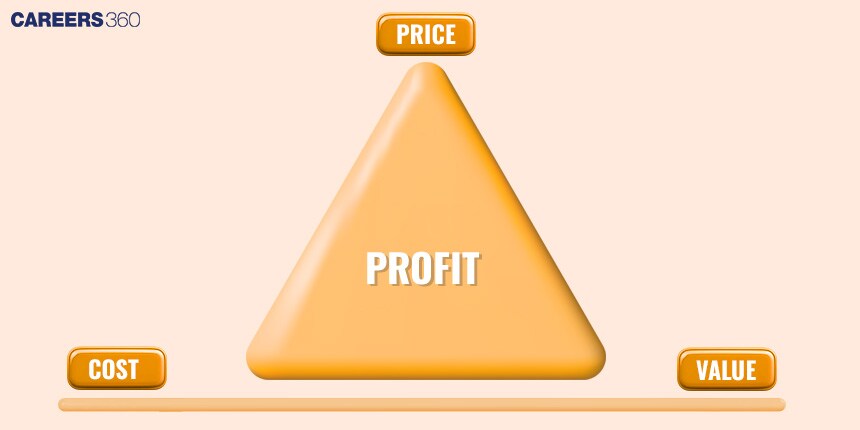
Profit

1726202731370

What is Profit?

When the Selling Price (SP) of a product is greater than its Cost Price (CP), it is called a Profit.
Even if a discount is given on the marked price, as long as the selling price remains higher than the cost price, the seller still makes a profit.

In simple words:
If SP > CP, then there is Profit.

Condition for Profit

Selling Price > Cost Price

Example of Profit

Suppose the cost price of a shirt is Rs. 200.
If the selling price of the same shirt is Rs. 300, then the seller has made a profit.

Because:
SP > CP
300 > 200

So, Profit = Rs. 100.

Formula for Profit

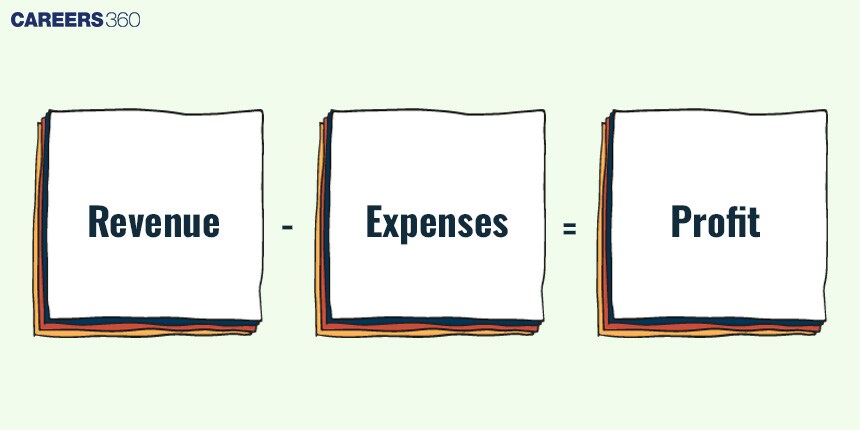
Profit = Selling Price – Cost Price

Formula for Profit Percentage

Profit percentage = $\frac{\text{Selling Price – Cost Price}}{\text{Cost Price}} \times 100$

Loss

1726202731537

When the Selling Price (SP) of a product is less than its Cost Price (CP), it is called a Loss.
Even after giving a discount on the marked price, if the final selling price becomes lower than the cost price, the seller suffers a loss.

In simple words:
If SP < CP, then there is Loss.

Condition for Loss

Selling Price < Cost Price

Example of Loss

Suppose the cost price of a shirt is Rs. 200.
If the selling price of that shirt is Rs. 150, then the seller has made a loss.

Because: SP < CP
150 < 200

So, Loss = Rs. 50.

Formula for Loss

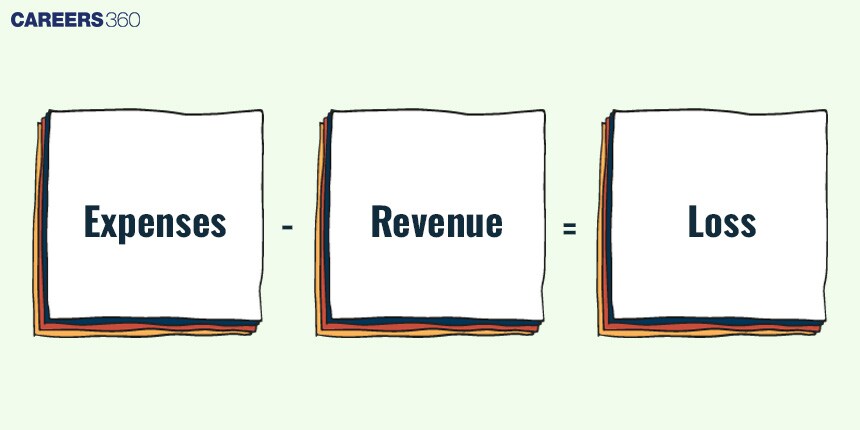
Loss = Cost Price – Selling Price

Formula for Loss Percentage

Loss percentage = $\frac{\text{Cost Price – Selling Price}}{\text{Cost Price}} \times 100$

Discount in Profit and Loss

What is Discount?

The difference between the Marked Price (MP) and the Selling Price (SP) is called the Discount.
It is the reduction in price given by the seller to attract buyers.

Example of Discount

Suppose the marked price of a shirt is Rs. 300 and the selling price is Rs. 250.

Discount = Rs. (300 – 250) = Rs. 50

Formula for Discount

Discount = Marked Price – Selling Price

Formula for Discount Percentage

Discount percentage =$\frac{\text{Marked Price – Selling Price}}{\text{Marked Price}} \times 100$

Mark Up Value (Markup) in Profit and Loss

What is Markup Value?

Markup is the extra amount added by the seller to the Cost Price (CP) to decide the Marked Price (MP).
It is usually added in percentage form and depends entirely on the cost price.

So, Marked Price is calculated by increasing the Cost Price by a certain percentage.

Example of Markup

If the cost price of an item is Rs. 200 and the seller applies a markup of Rs. 50, then:

Marked Price = Rs. (200 + 50) = Rs. 250

Here, Rs. 50 is the Markup Value.

Formula for Markup Value

Markup = Marked Price – Cost Price

Formula for Markup Percentage

Markup percentage = $\frac{\text{Marked Price – Cost Price}}{\text{Cost Price}} \times 100$

Relationship Between Cost Price, Marked Price, and Markup

Marked Price = Cost Price + Markup

Formulae used in Profit and Loss

Topic

Formula

Profit

Selling price – Cost price

Loss

Cost price – Selling price

Profit percentage

$\frac{\text{Selling price – Cost price}}{\text{Cost price}} \times100$%

Loss percentage

$\frac{\text{Cost price – Selling price}}{\text{Cost price}} \times 100$%

Cost price when a loss occurs

$\frac{100}{100-\text{Loss}\%}×\text{Selling price}$

Cost price when a profit occurs

$\frac{100}{100+\text{Profit}\%}×\text{Selling price}$

Selling price when a loss occurs

$\frac{100- \text{Loss}\%}{100}×$ cost price

Selling price when a profit occurs

$\frac{100+ \text{Profit}\%}{100}×$ cost price

Discount

Marked price – Selling price

Discount percentage

$\frac{\text{Marked price – Selling price}}{\text{Marked price}}×100$

Single equivalent discount after successive discounts

$(a+b-\frac{a×b}{100}$)%, where $a$% and $b$% are successive discounts.

Selling price after Successive discount

$\frac{100-\text{Discount}_1\%}{100}× \frac{100-\text{Discount}_2\%}{100}×$ marked price

Profit percentage for dishonest sellers with faulty weight

$\frac{\text{Faulty weight – True weight}}{\text{True weight}}×100$

Using Fractional Equivalents of Percentages in Profit and Loss: Why do we use fractional equivalents?

The fractional equivalent of percentages makes calculations in Profit and Loss problems much faster and simpler, especially in complex numerical questions.
Instead of working with large numbers and decimals, we convert percentages into fractions and use direct multiplication.

We already know:
To convert a percentage into a fraction, divide it by 100.

This gives us the fractional or decimal form of the value.

Example: Using Fractional Method

A trader buys an item for Rs. 200 and sells it at a profit of 20%.
Find the selling price.

First, convert percentage into fraction:

20% = $\frac{20}{100} = \frac{1}{5}$

This means:

  • On every Rs. 5, the profit is Rs. 1

  • So, selling price becomes Rs. 6 for every Rs. 5

Hence,
Selling Price = $\frac{6}{5} \times 200 = 240$

So, the selling price is Rs. 240.

Problems Based on CP, SP, and MP

Understanding problems based on Cost Price (CP), Selling Price (SP), and Marked Price (MP) is essential for mastering profit, loss, and discount calculations.

  • Cost Price (CP): Price at which an item is purchased

  • Selling Price (SP): Price at which an item is sold

  • Marked Price (MP): Price printed on the product before discount

When CP and SP are Given (To Find Profit Percentage)

Profit percentage =
$\frac{\text{Selling Price – Cost Price}}{\text{Cost Price}} \times 100$

Example

Ten articles were bought for Rs. 8 and sold at 8 for Rs. 10. Find the gain percentage.

Given:

  • Cost price of 10 articles = Rs. 8

  • Selling price of 8 articles = Rs. 10

LCM of 10 and 8 = 40

Cost price of 40 articles
$=\frac{8 \times 40}{10} = 32$

Selling price of 40 articles
$=\frac{10 \times 40}{8} = 50$

Profit percentage
$=\frac{50 - 32}{32} \times 100 = 56.25%$

Hence, the gain percentage is 56.25%.

When CP and SP are Given (To Find Loss Percentage)

Loss percentage =$\frac{\text{Cost Price – Selling Price}}{\text{Cost Price}} \times 100$

Example: A computer with cost price Rs. 30,000 is sold for Rs. 28,000. Find the loss percentage.

Loss Percentage
$=\frac{30000 - 28000}{30000} \times 100$
$=\frac{2000}{30000} \times 100$
$=\frac{20}{3}% = 6\frac{2}{3}%$

Hence, the loss percentage is $6\frac{2}{3}%$.

When MP and Discount Are Given

Selling Price = Marked Price – Discount

Or,
Marked Price = $\frac{100}{100 - \text{Discount%}} \times$ Selling Price

Example: The cost price of an article is Rs. 5500.
It is sold at a profit of 9.09%.
It is also sold at a discount of 20%.
Find the marked price.

Selling Price
$=\frac{100 + 9.09}{100} \times 5500 = 6000$

Marked Price
$=\frac{100}{100 - 20} \times 6000$
$=\frac{100}{80} \times 6000 = 7500$

Hence, the marked price is Rs. 7500.

Problems Based on Successive Discounts

Giving two or more discounts one after another is called Successive Discount.

To convert them into a single equivalent discount:

Single discount
$=(a + b - \frac{a \times b}{100})%$

Where $a%$ and $b%$ are the two successive discounts.

Another method:

Selling Price
$=\frac{100 - D_1}{100} \times \frac{100 - D_2}{100} \times$ Marked Price

When the Cost Price of Two Articles Is the Same

We calculate the selling price of each article separately and then find total profit or loss.

Example: Kushal buys two sets of jeans for Rs. 4000 each.

  • One sold at 8% profit

  • One sold at 6% loss

Selling price of first set
$=\frac{108}{100} \times 4000 = 4320$

Selling price of second set
$=\frac{94}{100} \times 4000 = 3760$

Total SP = 4320 + 3760 = 8080
Total CP = 8000

Profit = 8080 – 8000 = Rs. 80

Hence, Kushal makes a gain of Rs. 80.

When the Selling Price of Two Articles Is the Same

If two articles have the same SP and equal profit and loss percentages, then there is always a loss.

Loss percentage formula:

Loss % = $\frac{x^2}{100}$

Where $x$ is the profit% and loss%.

Example: A refrigerator and a washing machine are sold for Rs. 24,000 each.

  • One at 20% gain

  • One at 20% loss

Loss %
$=\frac{20^2}{100} = 4%$

Total SP = 48,000
Loss = 4% of total CP
Loss = Rs. 2000

So, there is an overall loss of Rs. 2000.

Dishonest Shopkeeper and Faulty Weights

When a shopkeeper uses less weight and charges full price, he makes a hidden profit.

Profit Percentage formula:

$\frac{\text{True Weight – Faulty Weight}}{\text{Faulty Weight}} \times 100$

Example: A shopkeeper gives 930 g instead of 1 kg and sells at cost price.

True weight = 1000 g
Faulty weight = 930 g

Error = 70 g

Gain Percentage
$=\frac{70}{930} \times 100$
$= 7\frac{49}{93}%$

Hence, his profit is $7\frac{49}{93}%$.

Miscellaneous Problems on Markup, Discount, and Profit

These types of questions combine Discount, Profit, Cost Price (CP), Selling Price (SP), and Marked Price (MP) in one problem. They are very common in competitive exams and test how well you understand the complete Profit and Loss cycle.

Question 1

After giving a discount of 20% on an article, a shopkeeper gains 20%. Find the percentage markup.

Let the Cost Price (CP) = 100

Given profit = 20%

Selling Price (SP)
$=\frac{100+20}{100} \times 100 = 120$

Let the Marked Price (MP) = $x$

Discount = 20%, so the selling price is 80% of MP

$0.8x = 120$

$⇒ x = 150$

Now,
Markup percentage
$=\frac{\text{MP} - \text{CP}}{\text{CP}} \times 100$

$=\frac{150 - 100}{100} \times 100$
$= 50%$

Hence, the percentage markup is 50%.

Question 2

The selling price and cost price of an article are Rs. 3960 and Rs. 3600 respectively. If a discount of 12% was given, find the percentage markup.

Given:
Cost Price (CP) = Rs. 3600
Selling Price (SP) = Rs. 3960
Discount = 12%

Let the Marked Price (MP) = $x$

We know:
Selling Price = Marked Price – Discount

$3960 = x - \frac{12}{100} \times x$

$3960 = \frac{88x}{100}$

$⇒ x = 4500$

So,
Marked Price (MP) = Rs. 4500

Now, Markup percentage
$=\frac{\text{MP} - \text{CP}}{\text{CP}} \times 100$

$=\frac{4500 - 3600}{3600} \times 100$
$=\frac{900}{3600} \times 100$
$= 25%$

Hence, the percentage markup is 25%.

Tips and Tricks for Profit and Loss Problems

These quick rules save a lot of time in exams and help you avoid long calculations. Think of them as shortcuts your brain will thank you for.

When Selling Prices Are the Same and Profit % = Loss %

If two articles are sold at the same selling price, and one is sold at a profit of x% while the other is sold at a loss of x%, then there is always a loss.

Loss percentage $=\frac{x^2}{100}$

This is a fixed result. No matter what the actual prices are, the transaction always ends in loss.

Single Equivalent Discount (Successive Discounts)

When two discounts are given one after another, say $a%$ and $b%$, then the single equivalent discount is:

Single equivalent discount $=(a + b - \frac{a \times b}{100})%$

This formula is extremely useful when multiple discounts are involved.

One Profit and One Loss Case

When there is a profit of $a%$ on one article and a loss of $b%$ on another, then the overall profit or loss percentage is:

Net result
$=(a - b - \frac{a \times b}{100})%$

If the result is positive → Net Profit
If the result is negative → Net Loss

Dishonest Seller and Faulty Weights

When a shopkeeper gives less weight but charges for full weight, the profit percentage is calculated using:

Profit percentage
$=\frac{\text{True weight – Faulty weight}}{\text{Faulty weight}} \times 100$

This formula directly shows how much extra the seller gains by cheating in weight.

Solved Examples

Q1. If the selling price of 40 articles is equal to the cost price of 50 articles, the loss or gain percent is:

1. 25% gain
2. 20% gain
3. 25% loss
4. 20% loss

Hint:
Profit % = $\frac{\text{Profit}}{\text{Cost price}} \times 100$

Answer: Let the cost price (CP) of each article be Re. 1.

Then,
Cost price of 50 articles
$= 50 \times 1$
$= Rs. 50$

According to the question,
Selling price (SP) of 40 articles = Cost price (CP) of 50 articles

So,
SP of 40 articles = Rs. 50

Now,
Cost price of 40 articles
$= 40 \times 1$
$= Rs. 40$

Profit on 40 articles
$= \text{SP of 40 articles} - \text{CP of 40 articles}$
$= 50 - 40$
$= Rs. 10$

Now,
Profit percentage
$= \frac{\text{Profit}}{\text{Cost price}} \times 100$
$= \frac{10}{40} \times 100$
$= 25%$

Since the selling price is greater than the cost price, it is a gain.

Hence, the correct answer is 25% gain.

Q2. A horse was sold for Rs. 60,000 at a profit of 20%. For what price should he have sold to gain a 30% profit?

1. Rs. 64,000
2. Rs. 65,000
3. Rs. 50,000
4. Rs. 55,000

Hint:
Cost price = $\frac{100}{100 + \text{Profit%}} \times$ Selling price

Answer: Given:
Selling price (SP) at 20% profit = Rs. 60,000

First, we find the cost price.

Cost price
$= \frac{100}{100 + 20} \times 60000$

$= \frac{100}{120} \times 60000$

$= \frac{5}{6} \times 60000$

$= 50000$

So,
Cost price of the horse = Rs. 50,000

Now, he wants a profit of 30%.

Selling price
$= \frac{100 + 30}{100} \times \text{Cost price}$

$= \frac{130}{100} \times 50000$

$= 1.3 \times 50000$

$= 65000$

Hence, the correct answer is Rs. 65,000.

Q3. If a vendor sells a coconut for Rs. 14.4, he makes a 10% loss. If he wants to make a 25% profit, then at what price (in Rs.) should he sell?

18
20
16
22

Hint:
Cost price = $\frac{\text{Selling price} \times 100}{100 - \text{Loss%}}$

Selling price = $\frac{\text{Cost price} \times (100 + \text{Profit%})}{100}$

Answer: Given:
Selling price (SP) = Rs. 14.4
Loss percentage = 10%

First, we find the cost price.

Cost price
$= \frac{14.4 \times 100}{100 - 10}$

$= \frac{14.4 \times 100}{90}$

$= \frac{14.4}{0.9}$

$= 16$

So,
Cost price of the coconut = Rs. 16

Now, profit required = 25%.

Selling price
$= \frac{16 \times (100 + 25)}{100}$

$= 16 \times 1.25$

$= 20$

Hence, the correct answer is Rs. 20

Q4. If two successive discounts of 50% and 10% are offered, what is the net discount (in %)?

(1) 50
(2) 55
(3) 60
(4) 65

Hint:
Single equivalent discount
$=(a+b-\frac{a\times b}{100})%$
where $a%$ and $b%$ are successive discounts.

Answer: First discount, $a = 50%$

Second discount,
$b = 10%$

Using the formula,

Single equivalent discount
$= a + b - \frac{a \times b}{100}$

Substitute the values,

Single equivalent discount
$= 50 + 10 - \frac{50 \times 10}{100}$

$= 60 - \frac{500}{100}$

$= 60 - 5$

$= 55%$

Hence, the net discount is 55%.

So, the correct option is: (2) 55

Q5. When a discount of Rs. 42 is allowed on the Marked price of an article, the new reduced price becomes 86% of the original price. Find the Marked price.

(1) Rs. 250
(2) Rs. 300
(3) Rs. 350
(4) Rs. 400

Hint:
Discount = Marked price – Selling price

Answer: Let the original Marked Price (MP) be Rs. 100.

Then, the reduced price becomes 86% of the original price.

So,
Selling Price (SP) = Rs. 86

Now,
Discount = Marked Price – Selling Price

Discount
$= 100 - 86$
$= Rs. 14$

So,
For a discount of Rs. 14, the Marked Price is Rs. 100.

Now,
We are given that the actual discount is Rs. 42.

Using direct proportion:

If discount = Rs. 14, then Marked Price = Rs. 100
If discount = Rs. 42, then Marked Price = ?

Marked Price
$= \frac{100 \times 42}{14}$

$= 300$

Hence, the Marked Price is Rs. 300.

So, the correct option is:
(2) Rs. 300

Q6.A sells a car priced at Rs. 36,000. He gives a discount of 8% on the first Rs. 20,000 and 5% on the remaining Rs. 16,000. B also sells a car of the same make, priced at Rs. 36,000. He gives a discount of 7% on the total price. Calculate the actual prices charged by A and B for the cars.

(1) A = Rs. 33,500, B = Rs. 33,400
(2) A = Rs. 33,480, B = Rs. 33,600
(3) A = Rs. 33,450, B = Rs. 33,650
(4) A = Rs. 33,600, B = Rs. 33,480

Hint:
Selling price
$=\frac{100-\text{Discount}%}{100} \times$ Cost price

Answer: Marked price of each car = Rs. 36,000

First, we find the actual price charged by A.

Discount given by A is in two parts.

On first Rs. 20,000, discount = 8%

Discount on first Rs. 20,000
$= \frac{8}{100} \times 20000$

$= 1600$

On remaining Rs. 16,000, discount = 5%

Discount on remaining Rs. 16,000
$= \frac{5}{100} \times 16000$

$= 800$

Total discount given by A
$= 1600 + 800$

$= Rs. 2400$

Actual price charged by A
$= 36000 - 2400$

$= Rs. 33600$

Now, we calculate the actual price charged by B.

B gives a discount of 7% on the total marked price.

Actual price charged by B
$= 36000 \times \frac{100 - 7}{100}$

$= 36000 \times \frac{93}{100}$

$= Rs. 33480$

So,
Actual price charged by A = Rs. 33,600
Actual price charged by B = Rs. 33,480

Hence, the correct option is:
(4) A = Rs. 33,600, B = Rs. 33,480

Q7. The marked price of an article is 50% more than its cost price. If a 20% discount is given, then what will be the profit percentage?

(1) 20%
(2) 25%
(3) 30%
(4) 50%

Hint: Assume the cost price is 100 units, then calculate the marked price.

Answer

Given: The marked price of an article is 50% more than its cost price.

Let the cost price (CP) be 100 units.

Marked price (MP)
= 100 + 50
= 150

A discount of 20% is given on the marked price.

Selling price (SP)
= $\frac{100-20}{100} \times 150$
= $\frac{80}{100} \times 150$
= 120

Profit
= Selling Price − Cost Price
= 120 − 100
= 20

Profit percentage
= $\frac{\text{Profit}}{\text{Cost Price}} \times 100$
= $\frac{20}{100} \times 100$
= 20%

Hence, the correct answer is (1) 20%.

Q8. A shopkeeper used to allow a discount of Rs. 20 on a product. He doubled the discount on the product and sold it for Rs. 80. What was the percentage of the discount offered?

(1) 20%
(2) 25%
(3) 30%
(4) 33.33%

Hint: First, find the marked price of the article and then use this information to solve the question.

Answer

Old discount = Rs. 20
New discount = 2 × 20 = Rs. 40

Selling price (SP) = Rs. 80

Marked price (MP)
= SP + Discount
= 80 + 40
= Rs. 120

Let the discount percentage be $x$%.

Then,
$x%$ of 120 = 40

$\frac{x}{100} \times 120 = 40$

$x = \frac{40 \times 100}{120}$

$x = 33.33%$

Hence, the correct answer is (4) 33.33%.

Q9. Ramesh marks his goods 30% above the cost price. If he sells the item for Rs. 910 after allowing a discount of 15%, find his cost price.

(1) Rs. 823.5
(2) Rs. 758
(3) Rs. 814.2
(4) Rs. 856.5

Hint: Selling price = $\frac{100-\text{Discount}%}{100} \times$ Marked price

Answer

Let the cost price (CP) of the article be Rs. $x$.

Marked price (MP)
= $x + 30%$ of $x$
= $x + \frac{30}{100}x$
= $\frac{130x}{100}$
= $\frac{13x}{10}$

Discount = 15%

Selling price (SP)
= $\frac{100-15}{100} \times \text{MP}$
= $\frac{85}{100} \times \frac{13x}{10}$

According to the question, SP = 910.

So,
$\frac{85}{100} \times \frac{13x}{10} = 910$

$\frac{1105x}{1000} = 910$

$1105x = 910000$

$x = \frac{910000}{1105}$

$x = 823.5$

Hence, the correct answer is (1) Rs. 823.5.

Q10. The difference between a discount of 30% on Rs. 2,000 and two successive discounts of 25% and 5% on the same amount is:

(1) Rs. 30
(2) Rs. 35
(3) Rs. 25
(4) Rs. 40

Hint:
For two successive discounts,
Selling Price = $\frac{100-D_1}{100} \times \frac{100-D_2}{100} \times$ Marked Price

Answer

Marked price = Rs. 2000

First case: Discount = 30%

Final price
= $\frac{70}{100} \times 2000$
= Rs. 1400

Second case: Two successive discounts of 25% and 5%

Final price
= $\frac{75}{100} \times \frac{95}{100} \times 2000$
= 0.75 × 0.95 × 2000
= Rs. 1425

Difference
= 1425 − 1400
= Rs. 25

Hence, the correct answer is (3) Rs. 25.

Q11. A double bed is marked at Rs. 7,500. The shopkeeper allows successive discounts of 8%, 5%, and 2% on it. What is the net selling price?

(1) Rs. 6,500
(2) Rs. 6,000
(3) Rs. 6,423.90
(4) Rs. 6,500.50

Hint:
Single discount = $(a + b - \frac{ab}{100})%$

Answer

First combine 8% and 5%:

Single discount
= $8 + 5 - \frac{8 \times 5}{100}$
= $13 - 0.4$
= 12.6%

Now combine 12.6% and 2%:

Single discount
= $12.6 + 2 - \frac{12.6 \times 2}{100}$
= $14.6 - 0.252$
= 14.348%

Selling price
= $7500 \times \frac{100 - 14.348}{100}$
= $7500 \times \frac{85.652}{100}$
= Rs. 6423.90

Hence, the correct answer is (3) Rs. 6,423.90.

Q12. A merchant changed his trade discount from 25% to 15%. This would increase his selling price by:

(1) $3\frac{1}{3}%$
(2) $6\frac{1}{6}%$
(3) $13\frac{1}{3}%$
(4) $16\frac{1}{3}%$

Hint:
Price Increase = $\frac{\text{Increase}}{\text{Original Price}} \times 100$

Answer

Let the marked price be Rs. 100.

At 25% discount:
Selling price = 100 − 25 = Rs. 75

At 15% discount:
Selling price = 100 − 15 = Rs. 85

Increase in selling price
= 85 − 75
= Rs. 10

Percentage increase
= $\frac{10}{75} \times 100$
= $\frac{40}{3}$
= $13\frac{1}{3}%$

Hence, the correct answer is (3) $13\frac{1}{3}%$.

Q13. When a discount of 25% is given on a cruise trip, the profit is 41%. If the discount is 26%, then the profit is:

(1) 39.12%
(2) 67%
(3) 94.88%
(4) 11.24%

Hint:
The selling price is the sum of cost price and profit.

Answer

Let the cost price (CP) be Rs. 100.

Profit = 41%
Selling price (SP)
= 100 + 41
= Rs. 141

With 25% discount, SP is 75% of MP.

So,
Marked price (MP)
= $\frac{141}{75/100}$
= $\frac{141}{3/4}$
= $\frac{141 \times 4}{3}$
= Rs. 188

Now discount = 26%, so SP is 74% of MP.

New SP
= $\frac{74}{100} \times 188$
= Rs. 139.12

Profit
= 139.12 − 100
= Rs. 39.12

Profit percentage
= 39.12%

Hence, the correct answer is (1) 39.12%.

Q14. A dishonest shopkeeper sells millet at 20 per kg, which he has bought at 16 per kg, and he is giving 800 gm instead of 1000 gm. Find his actual profit percentage.

(1) 52.12%
(2) 58.36%
(3) 54.25%
(4) 56.25%

Hint: Find the actual cost price by calculating the actual amount of millet sold.

Answer

Cost price of 1000 g = Rs. 16

Cost price of 1 g
= $\frac{16}{1000}$
= Rs. 0.016

He gives only 800 g.

Cost price of 800 g
= $0.016 \times 800$
= Rs. 12.8

Selling price of 800 g = Rs. 20

Profit
= 20 − 12.8
= Rs. 7.2

Profit percentage
= $\frac{7.2}{12.8} \times 100$
= 56.25%

Hence, the correct answer is (4) 56.25%.

Q15. A shopkeeper sells rice at 10% profit and uses a weight that is 30% less than the actual measure. His gain percentage is:

(1) $57\frac{1}{8}%$
(2) $57\frac{1}{7}%$
(3) $57\frac{2}{5}%$
(4) $57\frac{3}{7}%$

Hint:
Profit percentage = $\frac{\text{Profit}}{\text{CP}} \times 100$

Answer

Let the cost price (CP) of 1 kg rice be Rs. 100.

He uses 30% less weight.
So, he gives only 700 g instead of 1000 g.

He sells at 10% profit.

Selling price of 700 g
= Rs. 110

Now find SP of 1000 g:

SP of 1000 g
= $\frac{110}{700} \times 1000$
= $\frac{1100}{7}$

Profit
= SP − CP
= $\frac{1100}{7} - 100$

$= \frac{1100 - 700}{7}$

$= \frac{400}{7}$

Profit percentage
= $\frac{400}{7}%$
= $57\frac{1}{7}%$

Hence, the correct answer is (2) $57\frac{1}{7}%$.

Frequently Asked Questions (FAQs)

Q: What do you mean by profit and loss?
A:

When the selling price is greater than the cost price or after giving a discount on the marked price, still the selling price is greater than the cost price, then we call it a Profit.

To have a profit, the selling price > cost price

When the selling price is lower than the cost price or after giving a discount on the marked price, the selling price is lower than the cost price, so we call it a Loss.

To have a loss, selling price < cost price

Q: What is CP vs MP vs SP?
A:

Cost price or CP is the price at which an item is purchased.

The selling price or SP is the price at which an item is sold.

Marked price or MP is the initial price set by the seller before any discounts.

Generally, the Marked price is greater than the cost price and selling price.

Q: Is CP greater than SP?
A:


If the cost price(CP) is greater than the selling price(SP), then the seller has a loss.

Loss = Cost price - Selling price

If the selling price(SP) is greater than the cost price(CP), then the seller has a profit.

Profit = Selling price - Cost price

Q: What is the concept of faulty weight?
A:

Sometimes dishonest shopkeepers use faulty weight to earn more profit and give buyers a lesser quantity of items.

In these cases, to calculate the profit percentage, the formula is:

$\frac{\text{Faulty weight – True weight}}{\text{True weight}}×100$

Q: How are CP and SP calculated?
A:

Cost price(CP) when a loss occurs = $\frac{100}{100-\text{Loss}\%}×\text{Selling price(SP)}$

Cost price(CP) when a profit occurs = $\frac{100}{100+\text{Profit}\%}×\text{Selling price(SP)}$

Selling price(SP) when a loss occurs = $\frac{100- \text{Loss}\%}{100}×$ cost price(CP)

Selling price(SP) when a profit occurs = $\frac{100+ \text{Profit}\%}{100}×$ cost price(CP)

Upcoming Exams
Ongoing Dates
RRB Group D Exam Date

2 Feb'25 - 10 Feb'26 (Online)

Ongoing Dates
BITS LAT Application Date

27 Aug'25 - 24 Feb'26 (Online)