KCC Institute of Legal and Higher Education, Greater Noida
Law Admissions 2026 Open | Avail Merit-Based Scholarships


The pineal gland is a small, pea-shaped endocrine gland located deep within the brain and plays a crucial role in regulating circadian rhythms. It secretes the hormone melatonin, which controls the sleep–wake cycle and seasonal biological rhythms. This guide explains the anatomy, functions, hormonal regulation, disorders, and NEET-focused MCQs on the pineal gland.
This Story also Contains

Pineal gland is a small, pea-shaped endocrine gland. It is located deep within the brain, between two hemispheres where thalamic halves join. It is named because of its shape, resembling a pinecone.
It is also known as the “third eye” because of its light sensitivity and plays an important role in generating circadian rhythms and modulating the sleep-wake cycle by synthesizing the hormone melatonin.
Anatomically, the pineal gland is a small organ.
Situated in the epithalamus
Above the midbrain and near the third ventricle.
About 5 to 8 millimetres in length.
Pinecone-shaped.
Composed of cells called pinealocytes that produce the melatonin
Highly vascularized, second to the kidneys.
Law Admissions 2026 Open | Avail Merit-Based Scholarships
BBA/MBA/PGDM Early Bird Applications Deadline 06th Nov'26. Apply now using coupon code CAREER250 and get ₹250 off the application fee
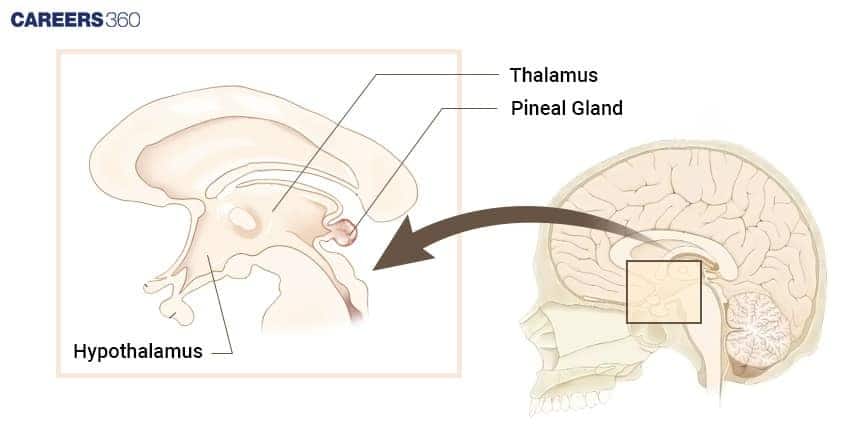
The functions of pineal glands include:
Controls the circadian rhythms, natural internal processes that occur in living organisms
24-hour cycle which responds to light and darkness.
Produces melatonin, a hormone released in response to darkness.
Signals the body that it is night and time to sleep.
This helps to create the proper sleep-wake cycle.
Melatonin influences the sleep-wake cycle through the induction of drowsiness
Regulates the time of sleep and wakefulness.
Participates in seasonal biological rhythms, like those linked to reproduction and mood
Modulates melatonin production based on length of days from one season to another.
Influences reproductive health and stress response.
Pineal gland coordinates with that hypothalamus and pituitary gland.
There are disorders related to the pineal gland are:
Circadian rhythm disturbance and sleeping disorders.
Sleep disorders, like insomnia or somnambulism, due to the imbalance of melatonin production.
Rare, either benign or malignant.
Symptoms include headaches and impaired vision, hydrocephalus
Treatment by surgery, radiation therapy, or chemotherapy.
Accelerates with advancing years.
Extreme calcification inhibits melatonin production
Leading to sleep disorders and neurodegenerative diseases.
Important questions asked in NEET from this topic are:
Pineal gland hormones and their functions
Disorders related to pineal gland
Q1. Which gland is the 'Third eye'?
Pineal
Thyroid
Thymus
Adrenal
Correct answer: 4) Pineal
Explanation:
The gland known as the 'Third eye' is the pineal gland. The hormone melatonin which helps in regulating sleep-wake cycles is produced by the pineal gland which is situated deep within the brain. It is sometimes referred to as the "third eye" due to its light sensitivity and role in regulating circadian rhythms. Its function in reacting to light and controlling sleep has given it this appellation even though it lacks a true eye structure.
Hence, the correct answer is option 1)Pineal.
Q2. Pineal gland is located on the dorsal side of
Midbrain
Hindbrain
Pons
Forebrain
Correct answer: 4) Forebrain
Explanation:
The pineal gland is located on the dorsal side of the forebrain. The pineal gland is located on the dorsal side of the forebrain, between the two hemispheres, in a small groove where the two halves of the thalamus meet. It is a small, pea-shaped endocrine gland that is primarily responsible for the production of melatonin. Melatonin is a hormone that helps regulate sleep-wake cycles and circadian rhythms in response to light. The pineal gland also plays a role in regulating seasonal biological rhythms and may influence reproductive functions. Despite its small size, the pineal gland has significant effects on the body’s biological clock and overall health.
Hence, the correct answer is option 4) Forebrain.
Q3. A hormone responsible for normal sleep-wake cycle is
Epinephrine
Gastrin
Melatonin
Insulin
Correct answer: 3) Melatonin
Explanation:
The hormone melatonin is principally in charge of controlling the circadian rhythm, also known as the sleep-wake cycle. The pineal gland releases it in reaction to darkness. Melatonin promotes relaxation and tiredness by telling the body it's time to get ready for sleep. To keep the body's internal biological clock in sync with the natural day-night cycle, this hormone is very important.
Hence, the answer is the option 3) Melatonin.
Also Read:
Frequently Asked Questions (FAQs)
This will be about the impact of light, more so than blue light from screens, on the production of melatonin by the pineal gland and its relation to sleep.
Symptoms may include sleep disorders, depression, fatigue, and hormonal imbalances.
A little calcification over the years due to ageing, but the low fluoride intake and clean living avoid excess calcification.
The pineal gland synthesizes the hormone melatonin, relating it to sleep/wake cycles.
It lies near the centre of the brain, between the two hemispheres, in the groove where the two halves of the thalamus join.

Law Admissions 2026 Open | Avail Merit-Based Scholarships
BBA/MBA/PGDM Early Bird Applications Deadline 06th Nov'26. Apply now using coupon code CAREER250 and get ₹250 off the application fee
Ranked #36 amongst institutions in Management by NIRF | 100% Placement
Globally Recognized by AACSB (US) & AMBA (UK) | 18 LPA Avg. CTC for PGPM 2026
NEET PG All India & State College Predictor with Admission Process Guide
Top B-School: Ranked #9 in NIRF Management Rankings 2025.