KCC Institute of Legal and Higher Education, Greater Noida
Law Admissions 2026 Open | Avail Merit-Based Scholarships


The thyroid gland is a butterfly-shaped endocrine gland located at the base of the neck that regulates metabolism, growth, and development. It secretes thyroxine (T4), triiodothyronine (T3), and calcitonin, which influence energy balance, brain development, and calcium metabolism. This guide explains thyroid anatomy, physiology, functions, disorders, diagnosis, and NEET-focused MCQs.
This Story also Contains
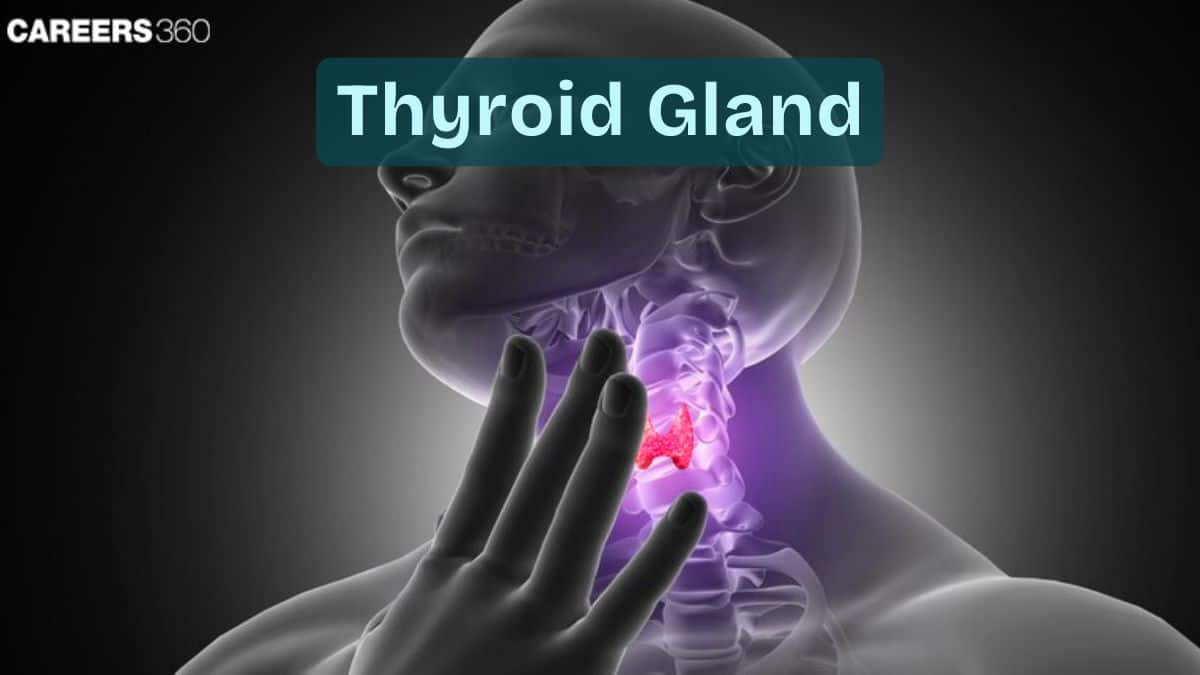
The thyroid is an endocrine gland, shaped like a butterfly, and it is located at the base of the neck. It produces hormones that regulate metabolic processes, growth, and development.
It plays a very vital role in the endocrine system in the maintenance of energy levels of the body, protein synthesis, and health. Normal thyroid function seems essential for normal growth and development and is hence very vital for human health.
The anatomy of the thyroid gland is discussed below:
Located at the front of the neck, just below the larynx (Adam's apple).
Two lateral lobes, connected by an isthmus.
It comprises the following parts:
Lobes: Right and left lobes
Isthmus: Thin band of tissue connecting the two lobes
Follicles: Spherical units storing thyroid hormones
Blood Supply: From the superior and inferior thyroid arteries
Innervation: Receives nerve impulses from the sympathetic nervous system.
Law Admissions 2026 Open | Avail Merit-Based Scholarships
BBA/MBA/PGDM Early Bird Applications Deadline 19th Oct '26. Apply now using coupon code CAREER250 and get ₹250 off the application fee
The thyroid gland produces vital hormones and is controlled through a negative feedback loop involving the hypothalamus and pituitary.
Thyroxine (T4): Major hormone produced, later converted to T3.
Triiodothyronine (T3): Active form derived from T4.
Calcitonin: Concerned with calcium metabolism.
Iodine is considered an 'essential element' for the synthesis of T3 and T4.
TRH is released from the hypothalamus
Stimulates pituitary to release TSH.
TSH in turn causes the thyroid to produce T3 and T4.
Negative feedback maintains hormone balance
Thyroid hormones have effects on many parts of the body. These include:
They elevate the basal metabolic rate
Enhance the rate at which the body makes energy from nutrients.
These hormones are crucial in the normal growth of children.
It is necessary for brain development.
They aid in the maintenance of body temperature through an effect on the amount of heat given off by cells.
Cardiovascular: Controls heart rate and the force of contraction.
Nervous System: Affects mood, thought processes, and overall mental status.
Reproductive System: Necessary for normal functioning and health of reproductive structures.
Diseases of the thyroid gland are of such a major impact on health and well-being, and so must be correctly diagnosed and treated.
Causes: Hashimoto's thyroiditis, lack of iodine.
Symptoms: Fatigue, weight gain, cold intolerance, depression
Diagnosis: Blood tests with high TSH and low T3/T4.
Treatments: Hormone replacement.
Causes: Graves' illness, thyroid nodules, excessive iodine.
Symptoms: Loss of weight, rapid heartbeats, intolerance to heat, anxiety.
Diagnosis: Blood tests with low TSH and high T3/T4.
Treatments: Thyroid-reducing drugs, radioactive iodine therapy, or surgical operation.
Causes: Iodine deficiency, thyroid inflammation
Symptoms: Neck swelling, difficulty in swallowing or breathing.
Diagnosis: Physical examination, ultrasonography, thyroid function tests.
Treatment: Supplements containing iodine, and surgery if required
Types: Benign nodules, papillary carcinoma, follicular carcinoma, medullary thyroid carcinoma, anaplastic carcinoma.
Diagnosis: Fine-needle aspiration biopsy, ultrasound
Treatment: Surgical methods, radioactive iodine therapy, radiation therapy, or chemotherapy.
Thyroid disorders require diagnostic testing to evaluate hormone levels and the structure of the gland.
TSH
T3 and T4 levels
Ultrasound:
Radioactive Iodine Uptake Test
Fine-needle aspiration biopsy.
Thyroid health is maintained through dietary, lifestyle, and medical measures.
Adequate intake of iodine in the form of iodised salt, seafood and milk products.
Periodic thyroid function tests, especially when there is a family history of disorders of the thyroid gland.
One may ensure good thyroid health by maintaining a healthy diet, exercising regularly, and managing stress.
Important questions asked in NEET from this topic are:
Thyroid gland hormones and their functions
Disorders related to Thyroid gland
Q1. Which of the following conditions is not linked to deficiency of thyroid hormone?
Cretinism
Goitre
Myxedema
Exophthalmos
Correct answer: 4) Exophthalmos
Explanation:
Exophthalmos happens due to hyperthyroidism. Exophthalmos, or bulging of the eyes, is a common symptom of Graves' disease, a form of hyperthyroidism. It occurs due to inflammation and swelling of the tissues and muscles behind the eyes caused by an autoimmune response.
Hence, the correct answer is the option 4) Exophthalmos.
Q2. The hormone which regulates the basal metabolism in our body is secreted from
Adrenal cortex
Pancreas
Pituitary
Thyroid
Correct answer: 4) Thyroid
Explanation:
The hormone that oversees the fundamental energy consumption in our body is Thyroxine (T4), produced by the thyroid gland. Within specific organs like the liver and kidneys, T4 transforms into the more potent triiodothyronine (T3), which is crucial for metabolic regulation. These hormones adjust the basal metabolic rate (BMR), the energy expenditure at rest for essential functions such as respiration, blood flow, and cellular activities. The pituitary gland's thyroid-stimulating hormone (TSH) controls thyroxine release, guided by the hypothalamus. They play a pivotal role in growth, development, body temperature management, and overall energy usage.
Hence, the correct answer is option 4) Thyroid.
Q3. Thyroxine has an important role in regulating
Blood calcium level
Basal metabolic rate
Water and electrolyte balance
Both 2 and 3
Correct answer: 4) Both 2 and 3
Explanation:
Thyroid hormones are essential in regulating carbohydrate, protein, and fat metabolism. They affect many metabolic pathways and enhance the overall metabolic rate and energy expenditure of the body. In detail, thyroid hormones stimulate lipolysis, which is the breakdown of fats, and promote the synthesis of proteins and carbohydrates. They also maintain water and electrolyte balance, thus affecting hydration and cellular function. Dysregulation of thyroid hormones brings about some major metabolic disorders that affect weight and energy levels.
Hence, the correct answer is option (4) Both 2 and 3.
Also Read:
Frequently Asked Questions (FAQs)
The thyroid gland produces the hormones thyroxine T4 and triiodothyronine T3, which regulate metabolic processes, growth, and development.
In the diet, sufficient intake of iodine; frequent checkups; and stress management. Ingestion of iodised salt, seafood, and milk products, and a balanced lifestyle support thyroid health.
It is characterised by fatigue, weight gain, cold intolerance, and depression. Other symptoms may include dry skin, constipation, muscle weakness, thinning hair and problems related to memory.
The treatments include antithyroid drugs, radioactive iodine therapy, and in some cases, surgery. Through these treatments, either the production of excessive thyroid hormones will be lessened or eliminated.
Goiter can result from an absence of iodine, autoimmune diseases—such as Graves' disease or Hashimoto's thyroiditis—and thyroid nodules. These illnesses lead to the enlargement of the thyroid gland due to hormonal misbalance or because of immune attacks.


Law Admissions 2026 Open | Avail Merit-Based Scholarships
BBA/MBA/PGDM Early Bird Applications Deadline 19th Oct '26. Apply now using coupon code CAREER250 and get ₹250 off the application fee
Ranked #36 amongst institutions in Management by NIRF | 100% Placement
Globally Recognized by AACSB (US) & AMBA (UK) | 18 LPA Avg. CTC for PGPM 2026
Leading Design College | 95% Placement Record | Merit-cum-Means Scholarships for Deserving Students
NEET PG All India & State College Predictor with Admission Process Guide