KCC Institute of Legal and Higher Education, Greater Noida
Law Admissions 2026 Open | Avail Merit-Based Scholarships


Entomophily refers to pollination carried out by insects such as bees, butterflies, moths, and beetles, which transfer pollen between flowers while collecting nectar or pollen. Insect-pollinated flowers show distinct adaptations: bright colours, fragrance, nectar guides, sticky pollen, and specialized floral structures. This guide covers the mechanism of entomophily, flower adaptations, insect types, ecological importance, threats, diagrams, FAQs, and NEET MCQs.
This Story also Contains
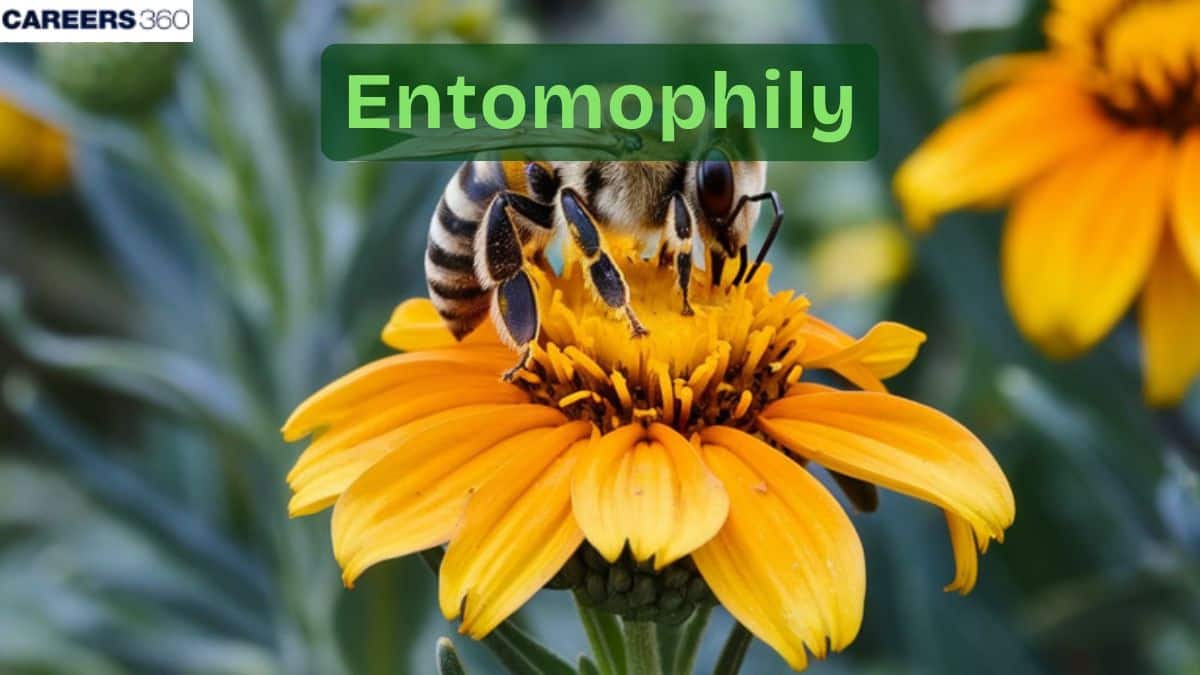
Entomophily refers to the process of pollination carried out through insects. In this system, huge numbers of bees, butterflies, and beetles visit flowers for nectar and pollen but, in the course of their behaviour, transfer pollen from one flower to another.
The characteristics of entomophilous flowers are:
These flowers display vivid colours and attractive visual patterns to draw the attention of insects for pollination.
They produce sweet or strong scents that help insects locate the flowers even from a distance.
A rich supply of nectar acts as a reward, increasing the number of insects and helping in pollen transfer.
Their pollen is sticky or spiny so it easily attaches to the bodies of visiting insects, ensuring effective pollination.
These flowers often have structures like broad landing platforms or directional nectar guides that help insects access nectar while facilitating pollen pickup and deposition.
Mechanism of pollination by insects is discussed below:
Plants dependent upon entomophily have large, showy flowers with bright colours, fragrant scents, and a good amount of nectar, all attracting the attention of insect pollinators.
Moving from flower to flower in search of nectar, pollen grains stick on the body parts of insects from the anthers and deposit them on the stigma of other flowers.
Entomophily represents a mutualistic association between plants and insects. There is some benefit gained by the two interacting species from each other.
Different types of insect pollinators are:
They are among the best and get attracted by flowers that are very coloured and have a smell. They collect nectar and pollen hence providing cross-pollination.
These insects get attracted by brightly coloured flowers and aid in pollination since pollen sticks to them as they drink nectar.
Some flowers are specific to beetles. These insects could, in some cases, lead to pollination. However, they are relatively poor compared to bees in this function.
Nocturnal moths visit night-blooming flowers and participate in pollination during low light.
The significance of entomophily are:
Entomophily promotes genetic diversity in the population of plants through cross-pollination.
Insect pollination process is necessary for the proper development of fruits, vegetables, nuts, and many other crops.
Insect pollination facilitates the duplication of a wide variety of plant species and thus helps in the health and stability of ecosystems.
Threats to entomophily are:
Habitat loss, pesticide use, and climate change have already reduced the populations of insect pollinators, thus posing a threat to plant reproduction and food security.
Agricultural practices that favour monocultures can reduce the availability of diverse flowering plants, impacting the populations of these pollinators.
Non-native species may outcompete native plants and disrupt the relationship between plants and their insect pollinators.
Important questions asked in NEET from this topic are:
Mechanism of Pollination by insects
Significance of entomophily
Q1. Attractants and rewards are required for :
Anemophily
Entomophily
Hydrophily
Cleistogamy
Law Admissions 2026 Open | Avail Merit-Based Scholarships
BBA/MBA/PGDM Early Bird Applications Deadline 06th Nov'26. Apply now using coupon code CAREER250 and get ₹250 off the application fee
Correct answer: 2) Entonomophily
Explanation:
To sustain animal visits, the flowers have to provide rewards to the animals. Nectar and pollen grains are the usual floral rewards. For harvesting the rewards from the flower, the animal visitor comes in contact with the anthers and the stigma. The body of the animal gets a coating of pollen grains, which are generally sticky in animal-pollinated flowers. When the animal carrying pollen on its body comes in contact with the stigma, it brings about pollination. In some species, floral rewards are in providing safe places to lay eggs; an example is that of the tallest flower of Amorphophallus. One biotic agent for pollination is insects which transfer pollen grains to the stigma of flowers. this is known as entomophily and plants are characterised by attractive and brightly coloured flowers.
Hence, the correct answer is option 2) Entomophily.
Q2. In Ficus pollination is affected by
Blastophaga
Acheronita atropos
White Ermine
Mother Shipton
Correct answer: 1) Blastophaga
Explanation:
Ficus carica and other Ficus spp. of Moraceae
Flowers of Ficus plants are enclosed within the hollow pear-shaped hypanthium inflorescence.
There is a narrow orifice for entering the receptacle within which there are three types of flowers male, female and gall.
Figs are pollinated by the gall wasp (Blastophaga) which crawls into the receptacle and lays eggs inside the ovules of the ‘gall flowers’ which it can easily reach by its ovipositor because of the shortness of the style.
The eggs develop larvae which feed on the ovules and form galls.
After passing the pupa stage, the larvae develop into mature wasps and crawl out of the fig.
In so doing they brush against the male flowers near the orifice carrying away pollen on their bodies.
These pollen-laden insects then enter fresh figs where they pollinate the long-styled female flowers and lay eggs within the ‘gall flowers’ in their turn.
Hence, the correct answer is option 1) Blastophaga.
Q3. In which of the following pollination takes place by lever mechanism?
Salvia
Ficus
Ocimum
Antirrhinum
Correct answer: 1) Salvia
Explanation:
Salvia has got a bilabiate corolla with two fertile epipetalous stamens. The stamens and pistil remain hidden under the upper lip. The flower is protandrous and the short epipetalous filament of each stamen is connected to the peculiar distractile connective which is long and lever-like, its two unequal arms separating the two anther lobes. The basal lobe of the anther is sterile while the upper lobe is fertile. A slight pressure on the lower anther lobe brings the upper lobe down.
Hence, the correct answer is option 1) Salvia.
Also Read:
Frequently Asked Questions (FAQs)
Entomophily is the pollination of flowers by insects. It's a mutualistic relationship where insects transfer pollen between flowers while feeding on nectar or pollen, enabling plant reproduction.
Entomophily supports cross-pollination and thus enhances the potential for genetic diversity in plant populations.
The practices of monoculture and pesticide applications affect the populations of insect pollinators and lower the diversity of flowering plants available.
Among these are habitat loss, pesticide use, climate change faced by pollinators, and problems caused by invasive species to the relationships of native plants with their pollinators.
The major insect pollinators include bees, butterflies, beetles, and moths.

Law Admissions 2026 Open | Avail Merit-Based Scholarships
BBA/MBA/PGDM Early Bird Applications Deadline 06th Nov'26. Apply now using coupon code CAREER250 and get ₹250 off the application fee
Ranked #36 amongst institutions in Management by NIRF | 100% Placement
Globally Recognized by AACSB (US) & AMBA (UK) | 18 LPA Avg. CTC for PGPM 2026
NEET PG All India & State College Predictor with Admission Process Guide
Top B-School: Ranked #9 in NIRF Management Rankings 2025.