


Angiosperms - Defination & Characteristics
Angiosperms are flowering plants. They produce seeds enclosed within a fruit. Angiosperms are the largest group of the Plant Kingdom. The examples of angiosperms include trees, shrubs, grasses, and many crops. Angiosperms Class 11 is an important topic to understand as it covers the maximum plant diversity. These plants produce seeds inside the fruit, which makes them different from gymnosperms. In this article, the anatomy and functions of angiosperms are covered, mainly highlighting angiosperms' reproductive structures, classification, and ecological roles.
This Story also Contains
- What are Angiosperms - Definition and Meaning
- Characteristics of Angiosperms
- Classification of Angiosperms- Monocots and Dicots
- Examples of Angiosperms with Families
- Morphological Features of Angiosperms
- Reproductive Structures of Angiosperms
- Pollination and Fertilisation in Angiosperms
- Physiological Processes of Angiosperms
- Economic Importance of Angiosperms
- Recommended Video on Angiosperm
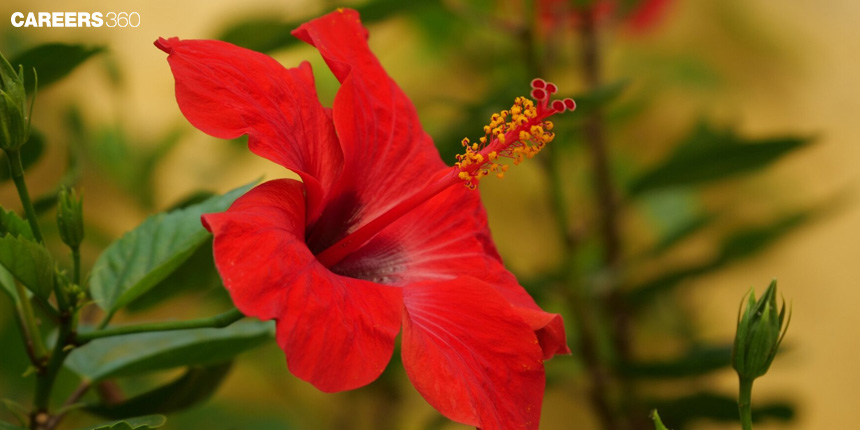
Angiosperms in Biology are important. They dominate the plant kingdom's diversity. Angiosperms economic importance is high as they provide food, oxygen, medicine and raw materials. They show unique reproductive structures, seed formation and seed dispersal. Angiosperms help in agriculture, health, and industry, showing their importance in ecology. Angiosperms life cycle explains pollination and fertilisation. Monocots and Dicots are two main classes of Angiosperms.
What are Angiosperms - Definition and Meaning
Angiosperms are the flowering plants. The most diverse group of the plant kingdom on Earth is the group of angiosperms. They can be distinguished by their ability to produce flowers and enclosed seeds within fruits. These species are critical in supporting most biomes on the land by offering animals and plants food, shelter, and homes.
Angiosperms began in the Cretaceous period, approximately 90- 130 million years ago. They have since diversified to the extent of occupying most of the plant niches on earth. Their adaptive features make them dominate in ecosystems. These angiosperms are ecologically important in agriculture, horticulture, and medicine. So angiosperms are crucial in the current biological sciences.
Characteristics of Angiosperms
Angiosperms have special features that make them different from gymnosperms. The general characteristics of angiosperms that make them distinctive are as follows:
Flowering organs - these are the reproductive parts of the plant. The flowers help the plant to reproduce without many crossings with related species. It creates several varieties, leading to the vast diversity of species dominating the land.
Endosperm - the nutritive tissue formed just after fertilisation and zygote formation. It provides necessary food for the growing embryo and the cotyledons till they disintegrate.
Reduced male gametophyte - the pollen is smaller than that in gymnosperms, making fertilisation faster. It gives angiosperms an advantage in evolution.
Stamen - they are lighter and more adapted to cross-pollination. It helps in reducing the possibilities of self-pollination, thereby increasing species diversity.
Carpels enclosing ovules - this helps to prevent self-pollination and fertilisation. The enclosing carpels later turn into fruit, attracting pollinating agents, thereby helping in the dispersion of seeds.
Classification of Angiosperms- Monocots and Dicots
Angiosperms belong to the Plant Kingdom. They are divided into two main classes - Monocots and Dicots. This angiosperm classification is based on seed structures, leaf venation, and root system, with the floral patterns. The classification is described below:
Taxonomic Classification of Angiosperms
Taxonomic Category | Taxon |
|---|---|
Kingdom | Plantae |
Division | Angiospermae |
Classes | Monotos and Dicots |
Examples of Angiosperms with Families
Angiosperms or flowering plants include numerous families with diverse characteristics. These families show a wide variety of Angiosperms in the Plant Kingdom. The examples of angiosperms with families are given below:
Fabaceae (Leguminosae)
Fabaceae is one of the biggest Legume plant families. Some of the plants belonging to this family are beans, Phaseolus, peas, Pisum, and soybean, Glycine Max. Well-known for the property of fixing nitrogen and being economically valuable in farming.
Asteraceae (Compositae)
Some of the plants belonging to Asteraceae are sunflowers. They are scientifically known as Helianthus, daisy known scientifically as Bellis, and aster known scientifically as Aster. In this, the plant has a compound inflorescence that has a large number of small flowers closely grouped.
Orchidaceae
Orchids are very diverse and are found almost all over the world. There are some 25,000 in number. Characterised by their delicate and frequently ostentatious flowers that are evolved for specific pollination techniques.
Rosaceae
Some of the plants that fall under Rosaceae are roses, commonly known as Rosa, apples( Malus), strawberries( Fragaria) and cherries (Prunus). They are famous for their pulse and the flowers that are eaten raw or cooked.
Lamiaceae (Labiateae)
Mint plants can also be sorted based on the botanical family, which includes mint (Mentha), basil (Ocimum), and sage (Salvia). These are the plants with sweet-smelling leaves and medical uses.
Poaceae (Gramineae)
A large number of important cereal crops are plants of this family. Examples include wheat (Triticum), rice (Oryza), and maize (Zea). They are essential in the human diet and for the production of crops.
Morphological Features of Angiosperms
Angiosperms morphological features include structures like roots, stems, leaves and flowers. These features help angiosperms survive, grow, and reproduce in the Plant Kingdom.
Structure of Flowering Plants
The structure of flowering plants includes:
Roots
Flowering plants have different kinds of root systems, such as a tap root system and a bristle root system. They hold the plant in the ground, take water and nutrients from the soil and contain some supply in them.
Stems
Petioles in flowering plants provide Mechanical support to the plant organs like flowers and fruits, help in the conduction of water and nutrients from roots to the aerial parts and food substances from the leaves to other parts of the flowering plant and sometimes have food storage. It has nodes, which are areas of connection of leaves and buds and internodes, which are the spaces between nodes.
Leaves
There are various forms and structures of leaves, such as the type, e.g., simple and compound, and the shape of a leaf, for instance, needle-shaped or broad-shaped. They execute photosynthesis, convert light energy to sugars, and release gases into the surroundings.
Flowers
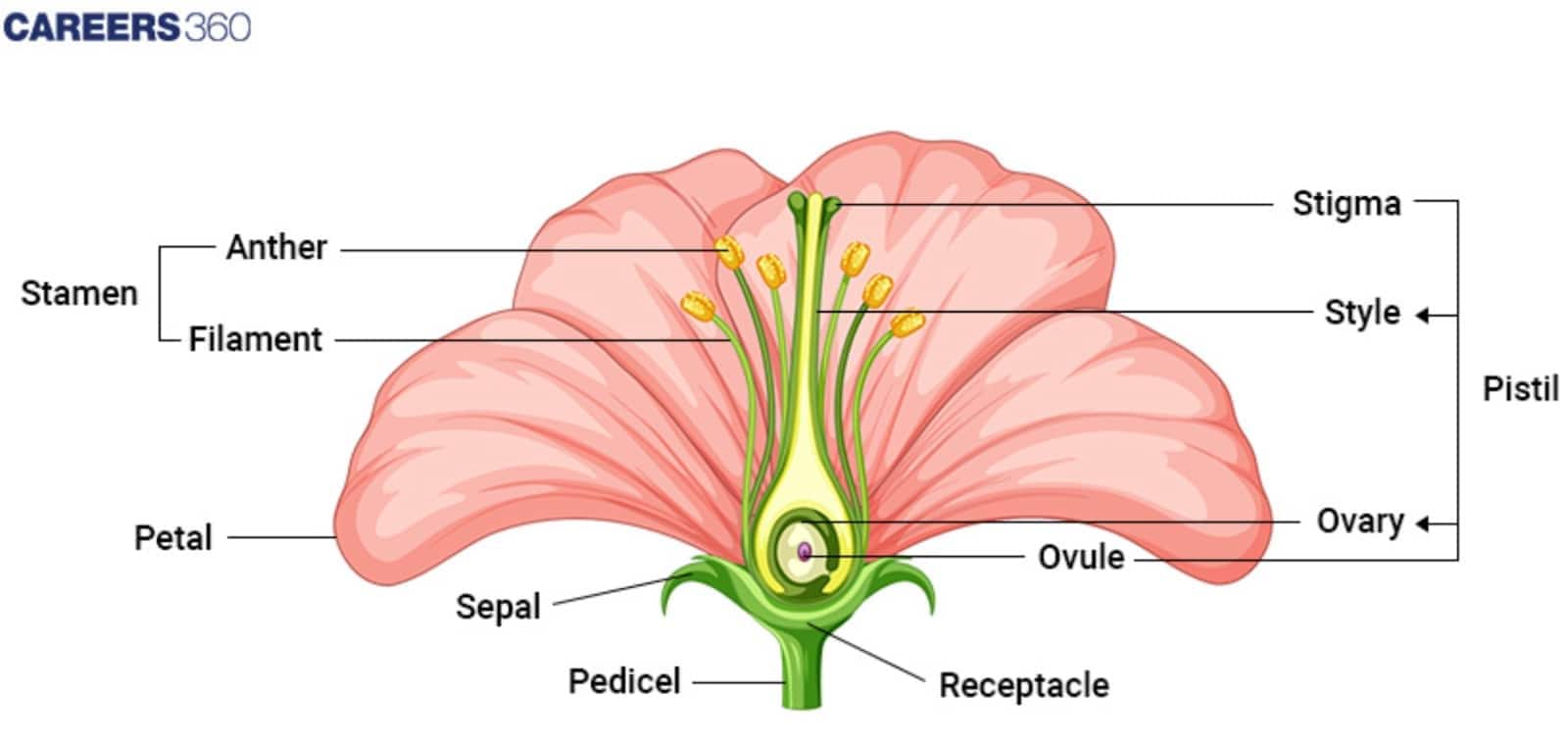
Flowers are the specialised structures for reproduction in plants. Depending on the species, flowers may have different levels of complexity. They may be branched or unbranched with such structures as sepals, petals, stamen (the male organ of reproduction), and pistils (the female organ of reproduction). They ensure pollination to enhance the reproduction process, especially through the development of seeds.
Diagram of an Angiosperm Flower
Reproductive Structures of Angiosperms
Angiosperms are flowering plants. Their reproduction depends on the flower. The flowering plants have both male and female reproductive structures. These structures exhibit complex reproductive strategies in the plant kingdom.
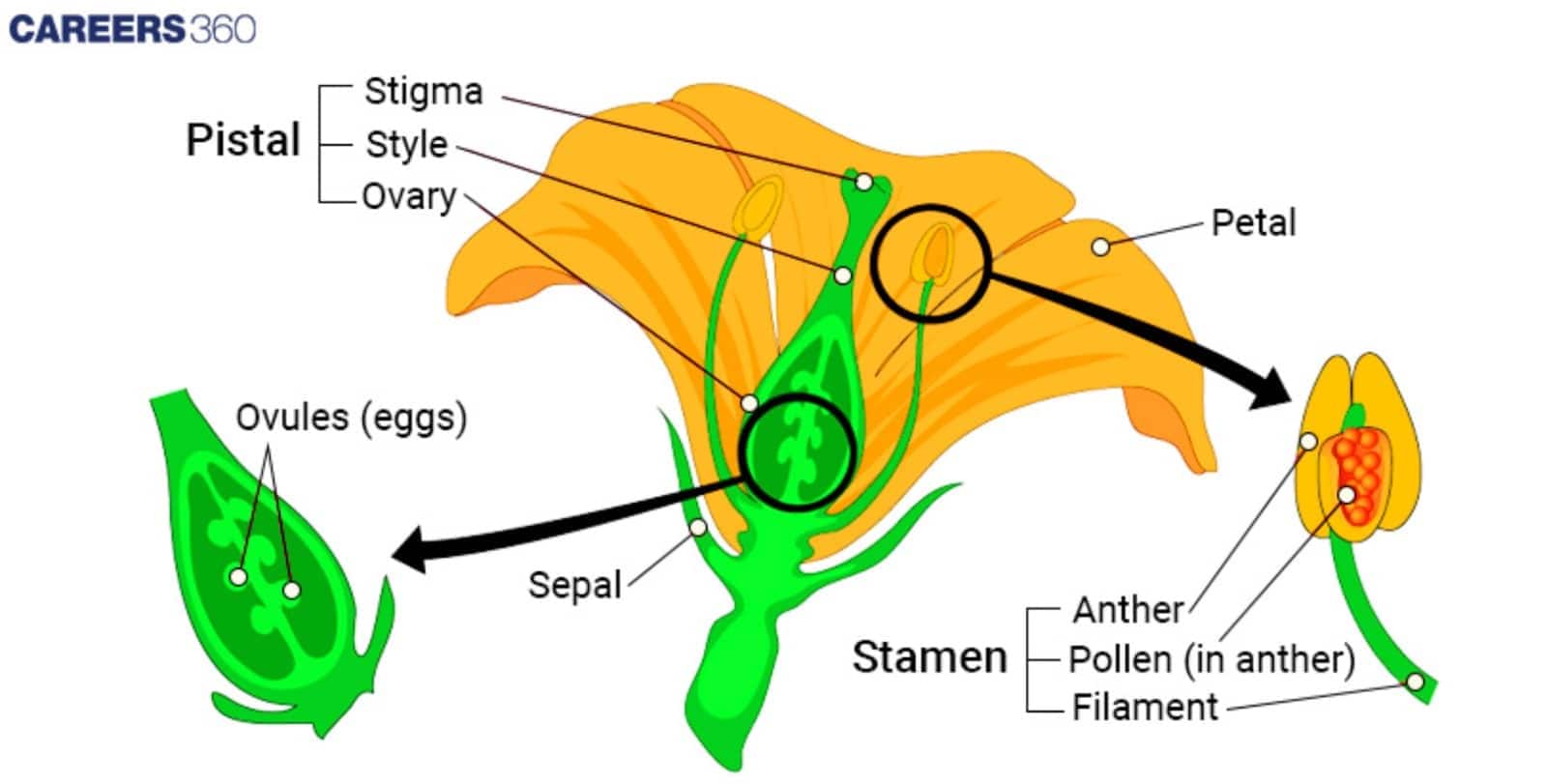
Angiosperms Male Reproductive Structure - Stamen
Stamens produce pollen grains.
Each stamen has an anther and a filament.
Pollen carries male gametes.
Angiosperms Female Reproductive Structure - Carpel/ Pistil
Carpels enclose ovules.
Each pistil has a stigma, a style, and an ovary.
The ovary protects the ovules and later forms fruit.
Diagram of Reproductive Structures of Angiosperms
Pollination and Fertilisation in Angiosperms
The angiosperms' reproduction depends on pollination and fertilisation. These processes ensure seed and fruit formation in the plant kingdom. The mechanism of pollination is described below:
Pollination
Pollination is the process through which pollen grains with male gametophytes are placed on the stigma part of the female reproductive organ, the style, while the anther is the male reproductive organ. It can occur through various mechanisms:
Types of Pollination: There are two types of pollination- self-pollination, which is pollination by pollen from the same flower or another from the same plant and cross-pollination, which is the transfer of pollen from the flower of one plant to another.
Agents of Pollination: The pollination techniques include anemophily or wind pollination, entomophily or insect pollination, ornithophily or bird pollination, mammalophily or mammal pollination, and hydrophily or water pollination. The colour, fragrance and nectar presentation of flowers also vary to correspond with the following pollinators.
Fertilisation Process
Once pollen comes in contact with a compatible stigma, the pollen tube germinates and grows down the style or the stalk of the pistil and reaches the ovule, the structure within the ovary that contains the female gametes. The male gametes reach the female gametes through a pollen tube to impregnate the ovule part which is enveloped. This process of fertilisation causes the development of a zygote into an embryo within the seed coat.
Physiological Processes of Angiosperms
Angiosperms survival depends on three main physiological processes - photosynthesis, respiration and transpiration. The physiological process of angiosperms is described below:
Photosynthesis in Angiosperms
The angiosperms directly capture light in chlorophyll found in chloroplasts to synthesise glucose and oxygen from carbon dioxide and water. Besides, this process facilitates the growth and development of plants and also plays an important role in oxygen generation and the Earth’s carbon cycle.
Respiration in Angiosperms
The flowering plants use glucose derived from photosynthesis for the production of ATP through aerobic respiration. This process takes place in mitochondria and is pertinent to the overall cellular process of nutrition, growth and division.
Transpiration in Angiosperms
Transpiration is the process of loss of water vapour from tissues of plants, particularly stomata in the leaves. This process has the effect of developing a pressure deficit at the upper end, which drives the upward movement of water and dissolved nutrients from the roots to the shoots. Transpiration is responsible for cooling the plant's level, preserving the internal pressure of plant cells, and transporting minerals to different parts of the plant.
Economic Importance of Angiosperms
Angiosperms are the backbone of human life. They provide services from food to medicine. Flowering plants touch every part of a human’s daily existence. Without angiosperms, survival would be impossible.
Food and Crops - Wheat, rice, maize, fruits, and vegetables all come from Angiosperms. They form the foundation of our diet.
Medicinal Plants - Tulsi, neem, mint, and aloe vera are Angiosperms that heal and protect us.
Industrial Uses - Cotton for clothes, timber for houses, and paper from trees are all products of Angiosperms.
Oils and Beverages - Mustard oil, coconut oil, tea, coffee, and cocoa are everyday essentials from Angiosperms.
Ecological Role - They produce oxygen, keep soil fertile, and provide shelter for animals.
Commercial Value - Rubber, sugarcane, tobacco, and spices are Angiosperms that drive global trade.
Angiosperms are not just flowering plants. They are the foundation of human survival. Angiosperms provide food security, medicine, industry and ecology. This makes them truly necessary in both biology and everyday life.
Recommended Video on Angiosperm
Frequently Asked Questions (FAQs)
Angiosperms are defined as flowering plants and refer to seeds enclosed by fruit. The name comes from the Greek words angeion, meaning container or vessel, and sperma, meaning seed.
The presence of flowering organs, endosperms, reduced male and female gametophytes, lighter stamen, and carpels enclosing the ovaries are the specific features that make angiosperms distinct.
Angiosperms are classified into two main groups: Monocots (one cotyledon, parallel venation, fibrous roots) and Dicots (two cotyledons, net‑like venation, tap roots).
Angiosperms provide food crops (wheat, rice, maize), fruits, vegetables, medicinal plants (tulsi, neem, aloe vera), industrial raw materials (cotton, timber, paper), oils, beverages (tea, coffee), and ecological balance through oxygen production.
Important families include Fabaceae (beans, peas, soybeans), Asteraceae (sunflowers, daisies), Orchidaceae (orchids), Rosaceae (roses, apples, strawberries), Lamiaceae (mint, basil, sage), and Poaceae (wheat, rice, maize).
Questions related to
On Question asked by student community
Correct Answer: part
Solution : The correct answer is the second option.
Part: This is a reasonable choice, as it refers to a portion or component. In the context of geographical areas, it might be more commonly associated with a segment or division of a larger whole, like a part
Correct Answer: The transport of male gametes in bryophytes and pteridophytes occurs through water.
Solution : The correct answer is The transport of male gametes in bryophytes and pteridophytes occurs through water.
The transport of male gametes in bryophytes and pteridophytes occurs through water. The male gametes of bryophytes
Correct Answer: example
Solution : The correct choice is the second option.
Example: This word denotes a representative instance that illustrates a general pattern. It is a reasonable choice, and it can be suitable in certain contexts.
The meanings of the other options are as follows:
Signal: This word typically
Correct Answer: rain
Solution : The correct answer is the second option.
The phrase suggests that mountain ranges provide shelter from something. The most fitting option is rain, as mountains can create rain shadows, blocking the passage of rain clouds and resulting in dry conditions on the leeward side (the
Correct Answer: characterised
Solution : The correct choice is the third option.
In the context of the passage, the sentence discusses the characteristics or features of the ancient desert vegetation. It means to describe the distinctive qualities or features of something "characterised" as the best fit.
The meanings of the