


Celsius to Kelvin - Overview, Formula, Features, FAQs
What is the need to convert temperature from the Celsius scale to the Kelvin scale? Why is Kelvin known as the absolute temperature scale, and how does it differ from Celsius? You will find these answer by reading this article on Kelvin and celcius. The Celsius and Kelvin scales are two commonly used temperature measurement systems in science and everyday life. While Celsius (°C) is widely used for everyday temperature readings, Kelvin (K) is the standard unit of temperature in the International System of Units (SI). The Kelvin scale is absolute, starting at absolute zero, where all molecular motion stops, while the Celsius scale is based on the freezing and boiling points of water. Understanding the relationship between these scales is essential for converting temperatures accurately in scientific calculations.
This Story also Contains
- Absolute Zero
- Temperature Conversions
- Some Solved Examples
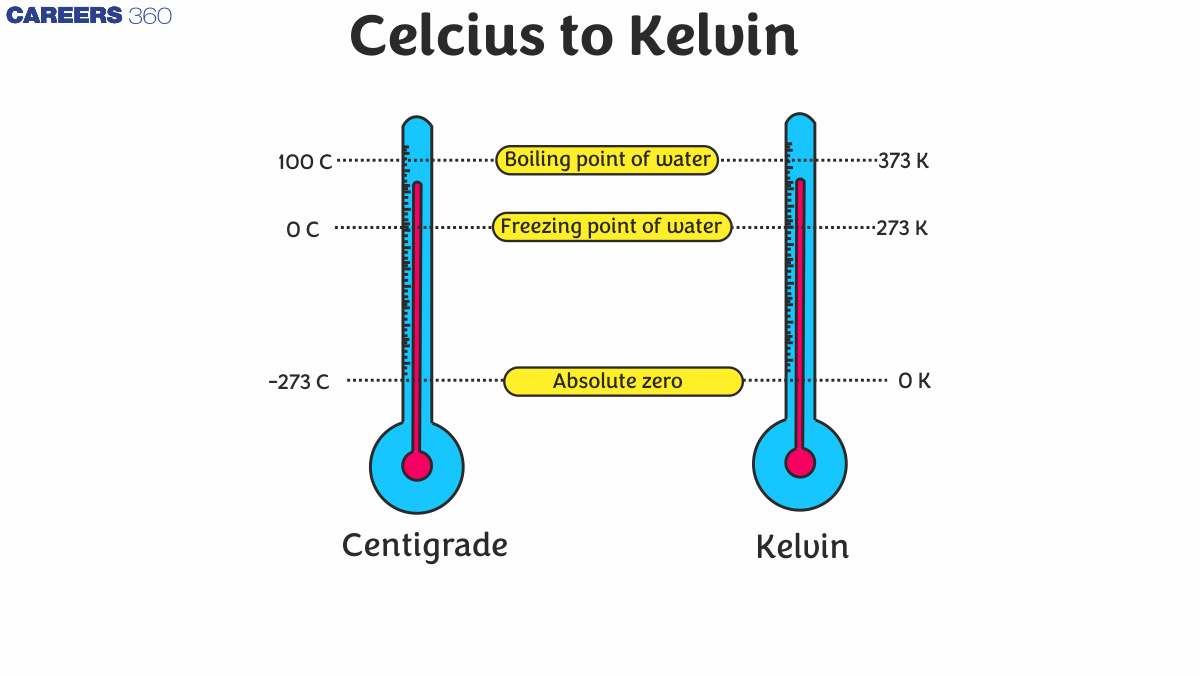
Absolute Zero
Absolute Zero is the lowest theoretical temperature that can exist in the universe. It is defined as 0 Kelvin (0 K), which is equal to –273.15 °C on the Celsius scale. At this temperature, a system possesses minimum possible thermal energy.
The concept of absolute zero arises from the behavior of gases. According to Charles’ Law, the volume of a gas decreases uniformly with a decrease in temperature. If a gas were cooled further, its volume would theoretically become zero at –273.15 °C. This temperature was extrapolated and defined as absolute zero.
Kelvin Scale and Absolute Zero
The Kelvin scale is an absolute temperature scale that starts from absolute zero.
- Absolute zero = 0 K
- Freezing point of water = 273.15 K
- Boiling point of water = 373.15 K
Unlike Celsius, Kelvin has no negative values, making it suitable for scientific calculations.
Also read :
|
NCERT solutions for Class 11 Chemistry Chapter 6 Thermodynamics | |
|
NCERT Exemplar Class 11 Chemistry Solutions Chapter 6 Thermodynamics |
Temperature Conversions
The following is a list of conversion formulas
- Celsius into Kelvin, K = ${ }^0 \mathrm{C}$ + 273.15
- Celsius into Fahrenheit, F = (9/5) 0C + 32
- Fahrenheit to Celsius, ${ }^0 \mathrm{C}$ = (5/9) (F-32)
- Fahrenheit to Kelvin, K = (5/9) (F + 459.67)
- Fahrenheit to Rankin, R = F + 459.67
- Positions in Kelvin, K = (5/9) R
- Freezing point of water=273.15K=0${ }^0 \mathrm{C}$=320F
- Boiling point of water=373.15K=100${ }^0 \mathrm{C}$=2120F
|
Related Topics |
Some Solved Examples
Example 1: Convert 25°C to Kelvin.
Solution:
As we know,
K = °C+273.15K
K= 25+273.15 = 298.15 K
Hence, the temperature in Kelvin is 298.15 K.
Example 2: What is the freezing point of water in Kelvin?
Solution:
As we know, the freezing point of water is 0°C.
Using formula, K = °C+273.15K
K = 0+273.15 = 273.15 K
Hence, the freezing point of water is 273.15 K.
Example 3: Convert the boiling point of water, 100°C, to Kelvin.
Solution:
As we know,
K = °C+273.15 K
K = 100+273.15 = 373.15 K
Hence, the boiling point of water is 373.15 K.
Example 4: The surface temperature on Pluto can drop to -230°C. Convert this to Kelvin.
Solution:
As we know,
K = °C + 273.15 K
K= −230 + 273.15 = 43.15 K
Hence, the temperature in Kelvin is 43.15 K.
Example 5: Which of the following temperatures is the lowest?
A) –40°C
B) 233 K
C) –10°C
D) 250 K
Solution:
Convert all to Kelvin:
- $-40^{\circ} \mathrm{C}=233 \mathrm{~K}$
- $-10^{\circ} \mathrm{C}=263 \mathrm{~K}$
- $250 \mathrm{~K}=250 \mathrm{~K}$
Lowest $=233 \mathrm{~K}$
Hence, the correct answer is option (B)
Frequently Asked Questions (FAQs)
Conversion of Celsius into Kelvin:
Kelvin = Celsius + 273.15.
No, it is not possible to have a negative temperature on the Kelvin scale, also known as the absolute temperature scale. This is because absolute zero, which is 0 kelvin, is the lowest possible temperature.
Absolute zero is the lowest theoretical temperature, 0 K, or -273.15°C, where all molecular motion stops.
The value 273.15 is the difference between the Celsius scale's zero point (water's freezing point) and the Kelvin scale's zero point (absolute zero).
The Kelvin scale is preferred because it starts at absolute zero, providing a true representation of thermal energy. It is essential for thermodynamic equations where absolute temperature values are required
