KCC Institute of Legal and Higher Education, Greater Noida
Law Admissions 2026 Open | Avail Merit-Based Scholarships


Have you ever noticed how many situations in daily life involve connecting one thing to another; for example, a student being linked to a roll number, a person to their phone number, or a child to their parents? These everyday connections form the foundation of relations and functions in mathematics. In Class 12 Mathematics, a relation is defined as a way of showing the connection between elements of two sets, while a function is a special type of relation in which every element of one set is associated with exactly one element of another set. For example, the relation between students and their subjects shows multiple connections, whereas assigning a unique roll number to each student is a function.
This Story also Contains
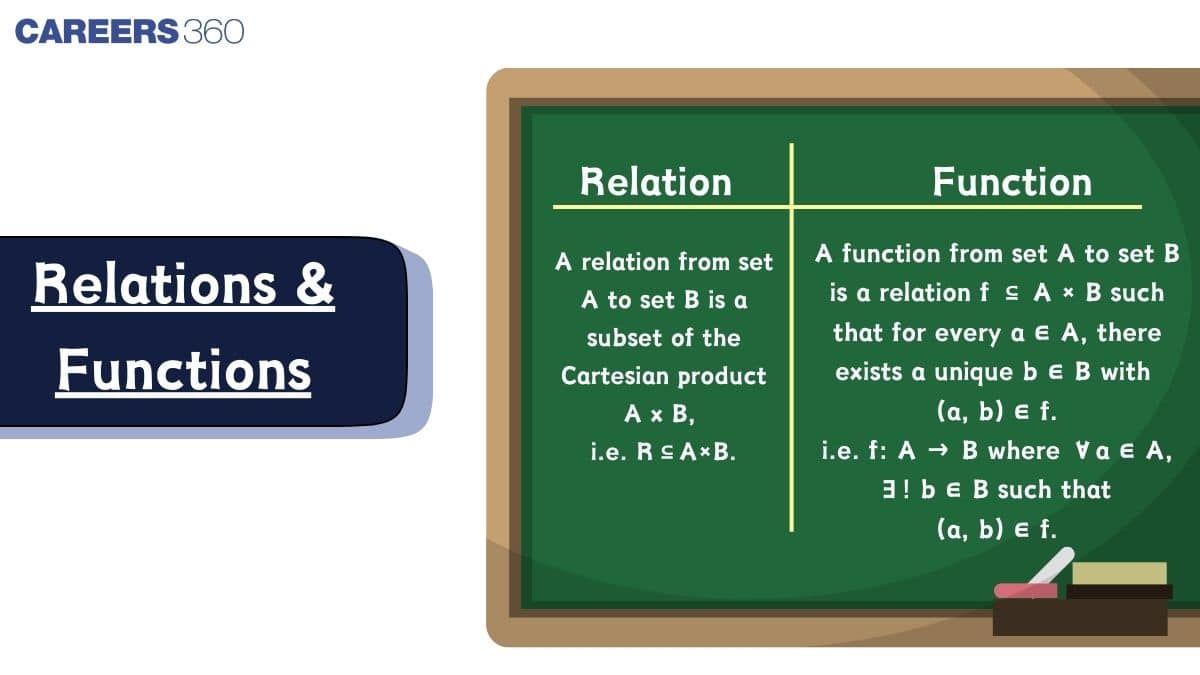
Relations and functions have many real-life applications. Mapping employees to their employee IDs, assigning marks to students, or relating time to distance travelled are all practical examples of functions. These concepts are widely used in science, economics, computer science, and data analysis. In this article, you will find Class 12 Relations and Functions notes, including clear definitions, real-life examples, important formulas, and solved questions explained in a simple and student-friendly manner. These explanations will help you build strong conceptual clarity and prepare effectively for board exams and competitive examinations.
A relation in mathematics connects elements of two sets. It helps in identifying common terms between sets or functions. The total number of relations between two sets $A$ and $B$ depends on their sizes. Relations are fundamental to the study of functions, and they are widely used in areas like database systems, graph theory, and social networks.
Law Admissions 2026 Open | Avail Merit-Based Scholarships
BBA/MBA/PGDM Early Bird Applications Deadline 19th Oct '26. Apply now using coupon code CAREER250 and get ₹250 off the application fee
A relation is a way to associate elements of one set with elements of another set. If two sets have values, a relation connects elements of the first set with those of the second.
A relation $R$ from a non-empty set $A$ to a non-empty set $B$ is a subset of the Cartesian product $A \times B$.
The subset is formed by specifying how the first element relates to the second in ordered pairs.
If $(a,b)$ belongs to $R$, where $a \in A$ and $b \in B$, it is written as $a R b$.
Example:
Let $A = \{1, 2\}$ and $B = \{x, y\}$. A relation can be: $R = \{(1, x), (2, y)\}$.
This means $1$ is related to $x$ and $2$ is related to $y$.
The domain of a relation is the set of all first elements in the ordered pairs of the relation. It represents all possible inputs that have at least one output.
For example, if $R = \{(1, c), (5, a), (8, b)\}$, then the domain is: $\{1, 5, 8\}$.
The range of a relation is the set of all output values or second elements in the ordered pairs.
For the relation $R = \{(1, c), (5, a), (8, b)\}$, the range is: $\{c, a, b\}$.

A function is a special kind of relation where each element in set $A$ is related to exactly one element in set $B$.
Formally, if $A$ and $B$ are two non-empty sets, a function $f: A \rightarrow B$ assigns each element $x \in A$ a unique element $f(x) \in B$.
This is written as: $f: A \rightarrow B$ (read as “$f$ is mapping from $A$ to $B$”).
Every function is a relation, but not every relation is a function.


First and second images represent a function as all the elements in set $A$ is mapped a element in set $B$ while the element $d$ in set $A$ is not mapped to any element in set $B$.

A function can be said as a subset of a relation.
The image of a function is the set of all output values produced from its domain.
Given a function $f: A \rightarrow B$ and a subset $X \subseteq A$, the image is: $f(X) = \{f(x) \mid x \in X\}$.
If we consider the entire domain, the image is the range: $\text{Image}(f) = f(A) = {f(a) \mid a \in A}$.
The pre-image refers to the set of all inputs that map to a particular output.
For a function $f: A \rightarrow B$ and $Y \subseteq B$, the pre-image is: $f^{-1}(Y) = \{x \in A \mid f(x) \in Y\}$.
For a single output value $y \in B$: $f^{-1}({y}) = \{x \in A \mid f(x) = y\}$.
For example, in the ordered pair $(1,2)$, $1$ is the pre-image of $2$ under the function.
The domain of a function is the set of all possible input values for which the function is defined.
If $f: A \rightarrow B$, then $A$ is the domain, i.e. all the elements of the set $A$ are called the Domain of the function.
The co-domain of a function is the set $B$ that includes all possible outputs, whether or not they are actually achieved by the function.
The range is always a subset of the co-domain and can sometimes be equal to it.
The range of a function is the set of all actual output values corresponding to elements in the domain.
For example, for $f: A \rightarrow B$ where $f(x) = x^2$ and $A$ is the set of all integers, the range is:
$\{1, 4, 9, 16, \dots \}$.
Another example:
Let $A = \{1, 2, 3, 4, 5\}$ and $B = \{1, 4, 8, 16, 27, 64, 125\}$.
If $f(x) = x^3$, then:
Domain = $A$
Co-domain = $B$
Range = $\{1, 8, 27, 64, 125\}$.

The range is always a subset of the co-domain, and the Range can be equal to the co-domain in some cases.
In relations and functions, it’s important to understand how they can be visually or mathematically represented. Different forms (roster and set builder form) help in identifying patterns, solving problems, and understanding how elements from one set relate to another. Below are the common ways to represent relations and functions, along with examples based on the topics covered in the relations and functions class 12 and relations and functions examples.
In the Roster Form, relations and functions are written as a list of ordered pairs enclosed within curly brackets. Every pair explicitly shows how elements from set $A$ are connected to elements from set $B$.
Example:
Let $A = \{1, 2\}$ and $B = \{x, y\}$.
The relation is:
$R = \{(1, x), (2, y)\}$.
This is one of the easiest ways to represent relations and functions, especially for small sets.
The Set Builder Form uses a rule or condition to define the relationship between elements of sets, rather than listing all pairs. The symbols ‘:’ or ‘|’ are read as ‘such that’.
Example:
Let $A = \{1,2,3,4,5\}$ and $B = \{1,2,3,4,5,6,7,8,9\}$.
Define a function $f: A \rightarrow B$ by $f(x) = x + 1$.
Then the relation is written as:
$R = \{(x, y) : x \in A, y \in B \text{ and } y = x + 1\}$.
This form is widely used in relations and functions class 12 solutions, where problems involve conditions or formulas.
The Arrow Diagram visually represents how elements of set $A$ map to elements of set $B$. Arrows connect each element from the domain to its corresponding image in the codomain.
Example:
Let $A = \{1,2,3,4,5\}$ and $B = \{1,4,8,16,27,64,125\}$.
Define $f: A \rightarrow B$ as $f(x) = x^3$.
The diagram shows arrows mapping $1 \rightarrow 1$, $2 \rightarrow 8$, $3 \rightarrow 27$, and so on.
Arrow diagrams are useful when solving relations and functions class 12 important questions, making abstract concepts easier to understand.
The Tabular Form is another way to represent relations and functions, where the elements of the domain and codomain are arranged in a table format. This makes it easier to visualise how each input corresponds to an output.
Example:
Let $A = \{1,2,3,4,5\}$ and $B = \{1,4,8,16,27,64,125\}$.
Define the function $f: A \rightarrow B$ by $f(x) = x^3$.
The table representing this function is:
| $x$ | $1$ | $2$ | $3$ | $4$ | $5$ |
| $f(x)$ | $1$ | $8$ | $27$ | $64$ | $125$ |
| Aspect | Relations | Functions |
|---|---|---|
| Definition | A relation is a connection between elements of two sets. | A function is a relation where each element of set $A$ has exactly one image in set $B$. |
| Mapping | One element of set $A$ may be related to one or more elements of set $B$. | Each element of set $A$ is related to only one element of set $B$. |
| Representation | Can be shown using ordered pairs, set-builder, roster form, etc. | Represented in similar ways, but with the condition that each input has a unique output. |
| Domain & Range | All first elements form the domain and all second elements form the range, without restrictions. | The domain is all inputs, and each input is assigned a single output; the range is a subset of the codomain. |
| Example | $R = \{(1, x), (1, y), (2, z)\}$ | $f = \{(1, x), (2, y), (3, z)\}$ where each input has only one output. |
In mathematics, relations and functions can be classified into various types based on the properties they possess. Understanding these types is important for solving problems in relations and functions class 12, relations and functions class 11, and for preparing for exams like JEE Main mathematics relations and functions.
A relation $R$ on a set $A$ is called an empty relation if no element of $A$ is related to any element of $A$, i.e., $R = \emptyset$.
Example:
Let $A = \{2, 4, 6\}$ and $R = \{(a, b) : a, b \in A$ and $a + b$ is odd$\}$.
Here, $R$ contains no element, so it is an empty relation on $A$.
A relation $R$ on a set $A$ is a universal relation if every element of $A$ is related to every other element of $A$, i.e., $R = A \times A$.
Example 1:
Let $A = \{2,4\}$ and $R = \{(2,2), (2,4), (4,2), (4,4)\}$.
Since $R = A \times A$, it is a universal relation.
Example 2:
Let $A = \{1,2,3\}$ and $R = \{(a, b) : |a - b| > -2, a, b \in A\}$.
Each ordered pair satisfies this condition, so $R$ is a universal relation.
A relation where every element of $A$ is related to itself only is called an identity relation, denoted by $I_A$.
It is defined as: $R = \{(a, b) : a \in A, b \in A$ and $a = b\}$ or $I_A = \{(a, a) : a \in A\}$.
Example:
Let $A = {2,4,6}$. Then, $I_A = \{(2,2), (4,4), (6,6)\}$.
A relation $R$ on a set $A$ is reflexive if $(a, a) \in R$ for every $a \in A$.
Example:
Let $A = \{1,2,3\}$
$R_1 = \{(1,1), (2,2), (3,3)\}$
$R_2 = \{(1,1), (2,2), (3,3), (1,2), (2,1), (1,3)\}$
Both are reflexive relations, but
$R_3 = \{(1,1), (2,2), (2,3), (3,2)\}$ is not reflexive because $(3,3)$ is missing.
A relation $R$ is symmetric if whenever $a R b$ holds, then $b R a$ also holds for all $a, b \in A$.
Example:
Let $A = \{1,2,3\}$
$R_1 = \{(1,2), (2,1)\}$
$R_2 = \{(1,2), (2,1), (1,3), (3,1)\}$ are symmetric, while
$R_3 = \{(2,3), (1,3), (3,1)\}$ is not symmetric as $(3,2)$ is missing.
A relation $R$ is transitive if whenever $a R b$ and $b R c$ hold, then $a R c$ also holds for all $a, b, c \in A$.
Example:
Let $A = \{1,2,3\}$
$R_1 = \{(1,2), (2,3), (1,3), (3,2)\}$ is not transitive.
$R_2 = \{(2,3), (3,1)\}$ is not transitive.
$R_3 = \{(1,3), (3,2), (1,2)\}$ is transitive.
A relation is an equivalence relation if it is reflexive, symmetric, and transitive.
Example:
Let $R = \{(1,1), (1,2), (2,1), (2,2)\}$.
Since $R$ satisfies all three properties, it is an equivalence relation.
An inverse relation swaps each ordered pair from a relation.
If $R \subseteq A \times B$, then
$R^{-1} = \{(b, a) : (a, b) \in R\}$.
Example:
Let $R = \{(1,2), (3,4)\}$.
Then, $R^{-1} = \{(2,1), (4,3)\}$.
In mathematics, functions are classified into various types based on how elements from the domain relate to elements in the codomain. These types are essential for understanding concepts in relations and functions class 12, relations and functions examples, and solving problems in class 12 relations and functions important questions.
A one-to-one function, also known as an injective function, is a function where every element in the domain has a unique image in the codomain. In other words, distinct elements of set $A$ are mapped to distinct elements in set $B$.
A function $f: X \rightarrow Y$ is called injective if different elements of $X$ always map to different elements of $Y$. That is, no two elements of set $X$ can have the same image.
Example:
Let $f: X \rightarrow Y$ be defined by $f(x) = x$, where
$X = \{-2, 2, 4, 6\}$ and $Y = \{-2, 2, 4, 6\}$.
Here, every element of $X$ has a distinct image in $Y$, so $f$ is a one-to-one function.

A many-to-one function is a type of function where two or more elements from the domain are mapped to the same element in the codomain. This is a common scenario in problems related to relations and functions class 12, relations and functions examples, and relations and functions class 12 solutions.
A function $f: X \rightarrow Y$ is called many-to-one if two or more elements of the set $X$ have the same image in the set $Y$. That is, it is not a one-to-one function.
In other words, if $f: X \rightarrow Y$ is not injective, it is a many-to-one function.
Example:
In the case below, two elements $x_2$ and $x_3$ correspond to the same image $y_3$:
$f(x_2) = f(x_3) = y_3$.
A well-known example is the function:
$f(x) = x^2$
Domain: All real numbers $(\mathbb{R})$
Codomain: Non-negative real numbers $[0, \infty)$
Here, both $x$ and $-x$ have the same image, so it’s a many-to-one function.

A function $f: X \rightarrow Y$ is an onto function (or surjective) if every element of set $Y$ is the image of at least one element from set $X$. That is, Range = Codomain.
Example:
Let $X = \{x_1, x_2, x_3, x_4\}$ and $Y = \{y_1, y_2, y_3\}$,
then a function $f: X \rightarrow Y$ can be onto if every element in $Y$ is mapped to by some element from $X$.

A function is bijective if it is both one-to-one and onto. Such functions create perfect pairings between the domain and codomain.
Example:
Let $X_1 = \{1, 2, 3\}$ and $X_2 = \{x, y, z\}$
A function $f: X_1 \rightarrow X_2$ is bijective if every element of $X_1$ maps uniquely to every element of $X_2$.
Let's describe even and odd functions:
A function $f(x)$ is odd if $f(-x) = -f(x)$ for all $x$. Odd functions are symmetric about the origin.
A function is even if $f(-x) = f(x)$ for all $x$. Even functions are symmetric about the $y$-axis.
The function $f: \mathbb{R} \rightarrow \mathbb{R}$ defined by $f(x) = x$ for all $x$ is called the identity function.
Domain: $\mathbb{R}$
Range: $\mathbb{R}$
The function $f: \mathbb{R} \rightarrow \mathbb{R}$ defined by $f(x) = C$ where $C$ is a constant is a constant function.
Domain: $\mathbb{R}$
Range: ${C}$
A function $f: \mathbb{R} \rightarrow \mathbb{R}$ defined by
$f(x) = a_0 + a_1x + \dots + a_nx^n$
where $n \in \mathbb{N}$ and $a_0, a_1, ..., a_n \in \mathbb{R}$ is called a polynomial function.
Given functions $f: A \rightarrow B$ and $g: B \rightarrow C$, the composition $g \circ f$ is defined as: $g \circ f(x) = g(f(x))$ for all $x \in A$.

A rational function is of the form $\frac{f(x)}{g(x)}$, where $f(x)$ and $g(x)$ are polynomial functions and $g(x) \neq 0$.
Example:
$f(x) = \frac{x+1}{x+2}$, defined for $x \in \mathbb{R} - {-2}$.
The modulus function is defined as:
$f(x) = |x| =
\begin{cases}
x, & x \geq 0 \\
-x, & x < 0
\end{cases}$
for all $x \in \mathbb{R}$.
Domain: $\mathbb{R}$
Range: $\mathbb{R}^{+} \cup {0}$
The signum function is defined as:
$f(x) =
\begin{cases}
1, & x > 0 \\
0, & x = 0 \\
-1, & x < 0
\end{cases}$
Domain: $\mathbb{R}$
Range: ${1, 0, -1}$
The greatest integer function is defined by $f(x) = [x]$, where $[x]$ is the largest integer less than or equal to $x$.
Example:
$f(x) = [x] = -1$ for $-1 \leq x < 0$,
$f(x) = [x] = 0$ for $0 \leq x < 1$, and so on.
A function $f(x)$ is called a periodic function if there exists a positive real number $T$ such that $f(x+T) = f(x)$ for all $x$ in the domain. The smallest such $T$ is called the period.
| Aspect | Algebra of Relations | Algebra of Functions |
|---|---|---|
| Definition | Relations are subsets of the Cartesian product $A × B$ | Functions are relations where each element of $A$ maps to a unique element of $B$ |
| Operations & Formulae | Union: $R ∪ S = \{(a,b) : (a,b) \in R \text{ or } (a,b) \in S\}$ Intersection: $R ∩ S = \{(a,b) : (a,b) \in R \text{ and } (a,b) \in S\}$ Difference: $R - S = \{(a,b) : (a,b) \in R \text{ and } (a,b) \notin S\}$ Composition: $R \circ S = \{(a,c) : \exists b \in B, (a,b) \in S \text{ and } (b,c) \in R\}$ Inverse: $R^{-1} = \{(b,a) : (a,b) \in R\}$ | Addition: $(f+g)(x) = f(x) + g(x)$ Subtraction: $(f-g)(x) = f(x) - g(x)$ Multiplication: $(f \cdot g)(x) = f(x) \cdot g(x)$ Division: $\left(\frac{f}{g}\right)(x) = \frac{f(x)}{g(x)}, g(x) \neq 0$ Composition: $(g \circ f)(x) = g(f(x))$ |
| Inverse | $R^{-1} = \{(b, a) : (a, b) \in R\}$ | $f^{-1}$ exists if $f$ is bijective, where $f(f^{-1}(x)) = x$ |
| Identity Element | $I_A = \{(a, a) : a \in A\}$ | $f(x) = x$ for all $x \in A$ |
| Properties | Reflexive, Symmetric, Transitive, Equivalence | Injective, Surjective, Bijective, Even, Odd, etc. |
| Examples | $R = \{(1, 2), (2, 3)\}, S = \{(2, 3), (3, 4)\}$ | $f(x) = x^2$, $g(x) = \sin x$, $h(x) = e^x$ |
This section covers the list of topics related to Relations and functions according to the NCERT and JEE Main syllabus. It helps students focus on important concepts, examples, and formulas needed for class 11 and 12 preparation.
Relations and Functions chapter requires clear conceptual understanding and regular practice. Mastering this chapter will make it easier to study advanced topics like inverse trigonometric functions and calculus.
Start with basic definitions: Clearly understand relations, functions, domain, codomain, and range before moving to advanced concepts.
Learn types step by step: Focus on different types of relations and functions such as one–one, onto, many–one, and invertible functions.
Practise numerical and graph-based questions: Solve problems related to domain–range and graphs to improve application skills.
Use NCERT examples effectively: Work through solved examples and exercises to build a strong foundation.
Prepare for competitive exams smartly: Practise previous years’ questions and MCQs instead of memorising solutions to improve accuracy and speed.
Question 1:
The domain and range of the real function f defined by $f(x) = \frac{4-x}{x-4}$ is given by:
Solution:
Given data: $y=f(x) = \frac{4-x}{x-4}$
We know that, the domain of $f(x) = R-\left \{4\right \}$
Thus, $yx - 4y = 4-x$
$yx+x = 4y+4$
$x(y+1) = 4y+4$
$x =\frac{ 4(1+y)}{1+y}$
Now, if x is a real no. then,
$1+y \neq 0$
Thus, $y \neq -1$
Thus, the range of$f(x) = R - (-1)$
Hence, the answer is "Domain = $R - \left \{4\right \},$ Range $= \left \{- 1\right \}$".
Question 2:
The domain of the function f defined by $f(x)=\sqrt{4-x}+\frac{1}{\sqrt{x^2-1}}$ is equal to:
Solution:
$f(x)=\sqrt{4-x}+\frac{1}{\sqrt{x^2-1}}$
Now, we know that,
$f(x)$ is defined when, $4-x \geq 0$ and $x^2-1>0$
Thus, $-x \geq-4$ and $(x-1)(x+1)>0$
Thus, $x \leq 4$ and $x<-\frac 1x>1$
Thus, the domain of $f(x)=(-\infty,-1) \cup(1,4]$
Hence, the answer is "$(- \infty, - 1) \cup (1, 4]$".
Question 3:
Let $f(x)=\sqrt{(1+x^2 )}$, then:
Solution:
$f(xy) = \sqrt{(1+x^2 y^2 )}$
Thus, $\sqrt{1+x^2 y^2 } \leq \sqrt{1+x^2+y^2+ x^2 y^2 }$
i.e.,$f(xy)\leq f(x).f(y)$
Hence, the answer is "$f (xy) \leq f (x) . f (y)$".
Question 4:
Range of $f\left ( x \right )=\frac{1}{1-2\cos x}$ is:
Solution:
Given data: $f\left ( x \right )=\frac{1}{1-2\cos x}$
Now, we know that,
$-1 \geq \cos x \geq1$
Thus, $-1\leq \cos x \leq 1$
$-2 \leq -2 \cos x \leq 2$
$-1 \leq 1-2 \cos x<0 \text { or } 0<1-2 \cos x \leq 3$
$ -1 \geq \frac{1}{1-2 \cos x}>-\infty \text { or } \infty>\frac{1}{1-2 \cos x} \geq \frac{1}{3} $
$\frac{1}{1-2 \cos x} \in(-\infty,-1] \cup\left[\frac{1}{3}, \infty\right)$
Hence, the answer is " $\left ( -\infty ,-1 \right ]\cup \left [ -\frac{1}{3},1 \right )$".
Question 5:
Solution:
Given data: n(A) = m & n(B) = n
Thus, n(AxB) = n(A).n(B) = mn
Thus, $2^{mn-1}$ is the total no. of relations,
Hence, the answer is 2mn- 1.
This section provides a list of recommended books for relations and functions that are useful for class 11 and 12 students. These books cover concepts, examples, and practice questions aligned with the NCERT and JEE Main syllabus.
| Book Name | Author / Publisher | Description |
|---|---|---|
| Mathematics for Class 11 & 12 | R.D. Sharma | Provides clear explanations, examples, and practice problems on relations, functions, and their applications. Suitable for school and competitive exams. |
| Higher Algebra | Hall & Knight | Covers advanced algebra topics, including relations and functions, with detailed theory, solved examples, and exercises. Ideal for JEE aspirants. |
| Problems in Mathematics | V. Govorov, P. Dybov, N. Tikhomirov | A problem-solving approach with varied questions on relations and functions, helping build conceptual clarity and reasoning skills. |
| IIT Mathematics | M.L. Khanna | Provides chapter-wise problems, including algebraic operations on relations and functions, with solutions suited for JEE Main and Advanced. |
| Coordinate Geometry and Algebra | S.L. Loney | Classic text with in-depth discussions on sets, relations, and functions, as well as geometric interpretations. Excellent for both theory and practice. |
| NCERT Mathematics Books (Class 11 & 12) | NCERT | Official curriculum books offering step-by-step concepts, examples, and exercises aligned with school and competitive exams. Must-read for fundamentals. |
| Objective Mathematics | R.D. Sharma | Contains a variety of multiple-choice questions and short problems on relations and functions, helping with speed and accuracy for exams. |
| Comprehensive Mathematics for JEE Advanced | Tata McGraw-Hill | Includes advanced-level problems and exercises on relations and functions with hints and solutions, suitable for competitive exam aspirants. |
Relations and Functions play a crucial role in building the foundation of higher mathematics and are commonly tested in school-level and competitive exams. The table below outlines the exam-wise focus areas, important topics, and preparation strategies to help students prepare effectively.
| Exam Name | Focus Area | Common Topics Asked | Preparation Tips |
|---|---|---|---|
| CBSE Board | Conceptual clarity & application | Types of relations, functions, domain and range, graphs of functions | Study NCERT definitions carefully and practise textbook questions |
| JEE Main | Problem-solving & accuracy | Domain–range questions, one–one and onto functions, composite functions | Practise MCQs and numerical-based questions regularly |
| JEE Advanced | Analytical thinking | Invertible functions, composite functions, functional equations | Solve previous years’ advanced-level problems and tricky questions |
| NEET | Basics & speed | Types of functions, domain and range | Focus on concept clarity and quick-solving techniques |
| State Board Exams | Theory-oriented | Definitions, types of relations and functions, simple examples | Revise textbook theory and solved examples |
| Mathematics Olympiads | Concept application | Advanced functional problems, one–one and onto proofs | Strengthen fundamentals and practise higher-level problems |
In this section, you’ll find NCERT resources for Relations and Functions, including class 12 Maths notes, solutions, and exemplar problems. These help understand concepts and practising questions as per the NCERT syllabus.
Explore NCERT subject-wise resources, including notes, solutions. These materials are designed to help class 12 students strengthen their understanding and prepare effectively for exams like JEE Main.
| Resource | Mathematics | Physics | Chemistry |
|---|---|---|---|
| NCERT Notes | NCERT Notes Class 12 Maths | NCERT Notes Class 12 Physics | NCERT Notes Class 12 Chemistry |
| NCERT Solutions | NCERT Solutions for Class 12 Mathematics | NCERT Solutions for Class 12 Physics | NCERT Solutions for Class 12 Chemistry |
Practice questions based on Relations and Functions help students apply concepts, improve problem-solving skills, and master important topics for class 12 exams and competitive tests like JEE Main.
The chapter on Relations and Functions plays a vital role in understanding how different quantities are connected in mathematics. With clear knowledge of definitions, types, and real-life applications, students can easily grasp more advanced topics in Class 12 and beyond. Regular practice, especially with examples and exam-oriented questions, will help build confidence and accuracy. Mastering this chapter creates a strong foundation for calculus and higher-level mathematical concepts.
Frequently Asked Questions (FAQs)
A relation in mathematics is a connection or association between elements of two sets. A relation R from a non-empty set A to a non-empty set B is a subset of the cartesian product A×B.
A relation from a set A to a set B is said to be a function from A to B if every element of set A has one and only one image in set B.
A relation connects elements from two sets. The types of relation include empty relation, universal relation, identity relation, reflexive, symmetric, transitive, equivalence, and inverse relation, explained with examples in relations and functions class 12 solutions.
The different ways to represent a funciton is roster form, set builder form, arrow diagram and tabular form.
To identify a function, check these two conditions.
(i) Every element in domain has a unique image in the co-domain.
(ii) No two elements in domain have the same image in the co-domain.
A relation from a set A to a set B is a subset of AB. As a result, a relation R is made up of ordered pairs (a,b), where aA and bB.
Yes, all functions are relations but not all relations are functions.


Law Admissions 2026 Open | Avail Merit-Based Scholarships
BBA/MBA/PGDM Early Bird Applications Deadline 19th Oct '26. Apply now using coupon code CAREER250 and get ₹250 off the application fee
Ranked #36 amongst institutions in Management by NIRF | 100% Placement
Globally Recognized by AACSB (US) & AMBA (UK) | 18 LPA Avg. CTC for PGPM 2026
Leading Design College | 95% Placement Record | Merit-cum-Means Scholarships for Deserving Students
NEET PG All India & State College Predictor with Admission Process Guide