


Human Heart
The human heart is a four-chambered muscular pump. It works nonstop to circulate blood, supply oxygen and remove waste. The human heart is the centre of circulatroy system. The human heart pushes oxygenated blood to the body and brings deoxygenated blood back to the lungs. It circulates oxygenated and deoxygenated blood via systemic and pulmonary circuits. Without the human heart, tissues cannot survive.
This Story also Contains
- Human Heart
- Anatomy of the Human Heart
- Human Heart Chambers and Valves
- Cardiac Conduction System of Human Heart
- Functions of the Human Heart
- Cardiac Cycle
- Coronary Circulation
- Heart Facts and Normal Values
- Heart Health — diseases & prevention
- Human Heart NEET MCQs (With Answers & Explanations)
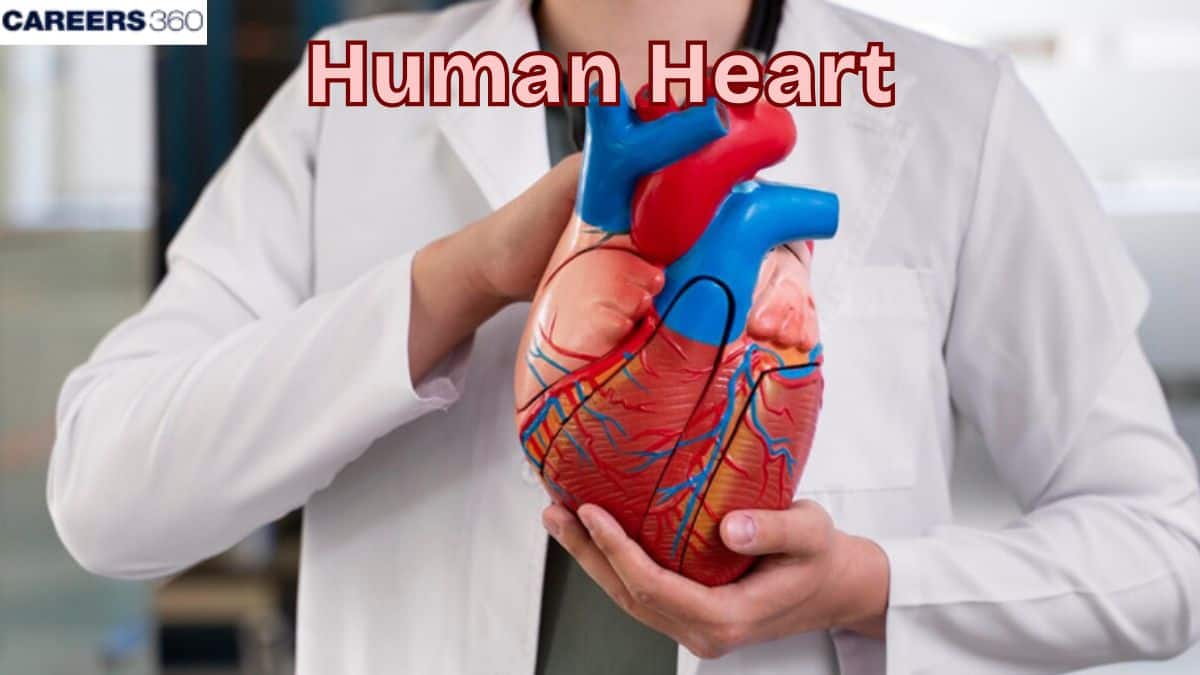
The human heart is about the size of a fist, yet it controls the entire body's fluid and circulation. Learn the human heart’s anatomy, where the heart is located, the function of the human heart, the conduction system, cardiac cycle and clinical relevance — presented with exam-ready diagrams and NEET practice. Includes quick MCQs, downloadable diagrams, and study tips for Class 11–12 and NEET aspirants.
Human Heart
The human heart is one of the human organs providing vital support to the flow of blood in the human body through the circulation of blood to deliver new oxygen and nutrients to the tissues and organs. In return, it removes the waste products from these tissues and organs. It is basic to understand the function and significance of the heart, considering that it pumps blood and keeps the blood circulation within acceptable limits.
Structurally, the heart has four sections:
- Two upper chambers, or the atrium
- Two lower chambers, known as the ventricles
These valves control the direction of blood circulation. These contractile movements are due to the creation of muscular walls, and commands of electrical impulses also help the heart to be a perfect pump that will supply the health and proper functioning of the entire body system.
Anatomy of the Human Heart
The anatomy of the human heart is discussed below-
Location And Size
The human heart is situated in the mediastinum, more specifically in the thoracic cavity and in front of the lungs, in coordination with the left side of the sternum axis.
It is situated behind the sternum and above the diaphragm.
An average human heart is as large as a fist and weighs between 250 and 350 g (9-12oz) in an adult.
Pericardium
The overall structure in which the heart is surrounded is called the pericardium and is made up of two elementary structures, the fibrous pericardium and the serous pericardium.
Serous pericardium gets subdivided into the parietal and visceral layers, whereas the latter is referred to as the epicardium.
The pericardium acts as a shield to the heart; it holds the heart in position and acts as a constraint to the heart’s ventricular filling.
Heart wall
The epicardium is the first layer of protection for giving protection to the inner part.
Myocardium is the middle, the muscular layer characterised by the power of contraction and performing the act of pumping.
The endocardium is the inner layer that faces the blood flow in the heart chambers and over the valves.
Human Heart Chambers and Valves
The major parts of the heart include:
Atria and Ventricles
The two right and left atria are the upper chambers of the heart that receive the blood coming to the heart. The last two chambers of the heart are the ones that pump blood out of the heart. These are the right and left ventricles.
Valves
The human heart is muscular and relatively small in size, including four valves that ensure one-way blood circulation.
Atrioventricular Valves: These two are the tricuspid valve, belonging to the right side of the heart and the mitral valve on the left side of the heart.
Semilunar Valves: This includes the pulmonary valve at the right side and the aortic valve at the left side.
Blood Vessels of the Heart
The blood vessels of the heart include:
Arteries
Aorta: The largest artery; carries oxygenated blood from the left ventricle through the aortic arch and onto the body.
Pulmonary Arteries: Transport deoxygenated blood from the right ventricle and take it to the lungs.
Veins
Superior and Inferior Vena Cava: Pump deoxygenated blood from the body back to the right atrium.
Pulmonary Veins: Pump oxygenated blood from the lungs and deliver it to the left atrium.
Cardiac Conduction System of Human Heart
The cardiac conduction system includes:
SA Node (Sinoatrial Node)
The heart also contains a small organ called the pacemaker.
It is sited in the right atrium to determine the rate of contraction.
AV Node (Atrioventricular Node)
It is located between the atria and the ventricles.
It gets impulses for the stimulation of the contractions from the SA node and conveys them to the ventricles.
Bundle of His and Purkinje Fibers
The bundle is His is an avenue for electrical impulses originating from the AV node to the ventricles.
Purkinje fibers are a bundle of nerves that convey electrical stimulus to other chambers of the heart, namely the ventricles, to make them contract.
Functions of the Human Heart
The functions of the human heart are discussed below:
Maintaining Blood Pressure
The force and rate of the contractions of the heart help to avoid inadequate blood flow in the body to meet the necessary needs of the human body.
The circulation system involves blood vessels, which can narrow or expand to assist in the regulation of blood pressure.
More specifically, arteries are in charge of providing a rather constant pressure and blood flow in this regard.
Supplying Oxygen And Nutrients
Oxygenated blood is developed for the process of respiration where the cells get their required oxygen for the production of energy.
The circulatory system transports material such as glucose and amino acids in their developed forms to cells and removes products such as carbon dioxide and urea.
Endocrine Function
It also plays the role of an endocrine gland because it has the capability of secreting hormones that control other activities in the body.
Atrial Natriuretic Factor (ANF) is released from the atria of the heart when blood volume and pressure are high.
ANP aids in the prevention of an increase in blood volume by promoting sodium and water elimination in the urine.
ANP has significant effects on controlling the blood pressure and regulating the fluid volume in the body hence it is involved in the body’s homeostasis.
Cardiac Cycle
The mechanisms of the cardiac cycle may be divided into two major stages:
Systole
The heartbeat cycle, the period that describes the contraction of the heart muscle, is followed by pumping blood out of the atrial or ventricular chambers into the arteries.
Diastole
The period in which the heart muscle is at rest, during which the chambers receive blood.
Coronary Circulation
Nutrients cannot diffuse quickly from the blood in the chambers of the heart to supply all the cells of the heart wall. For this reason, the myocardium has its own network of blood vessels, the coronary circulation or cardiac circulation. Coronary circulation includes coronary arteries that supply oxygenated blood to the myocardium and coronary veins that carry deoxygenated blood away from the heart muscle.
The coronary arteries branch from the ascending aorta and encircle the heart like a crown encircles the head. While the heart is contracting, little blood flows in the coronary arteries because they are squeezed shut. When the heart relaxes, however, the high pressure of blood in the aorta propels blood through the coronary arteries, into the capillaries, and then into the coronary veins.
Heart Facts and Normal Values
Some of the heart facts and normal values are:
The human heart rate is determined by the number of times it beats per minute; this ranges from 60 to 100 bpm when a person is at rest.
Pulse can be felt by lightly palpating arteries underneath the skin, specifically the radial pulse at the wrist or the carotid pulse on the neck.
Cardiac output is defined as the volume of blood that is pumped by the heart within one minute.
It plays a very important role in the provision of oxygen and nutrients to all body tissues.
Cardiac output is affected by physical activity, the size of the body and the overall health of a person.
Heart Health — diseases & prevention
Caring for our hearts is among the core values for the quality of life free from diseases, mishaps, and untimely deaths.
Diseases
Coronary Artery Disease: A condition that affects the blood vessels called the coronary arteries, leading into the heart muscle, and which get blocked, thus limiting the amount of blood that is delivered to the muscle.
Heart Attack: This happens when a section of the heart does not get an adequate amount of blood and nutrients, hence becoming damaged.
Heart Failure: A state in which the heart is not able to pump blood as it should, hence accumulating fluids within the body.
Preventive measures
Diet: A healthy diet characterised by increased consumption of fruits and vegetables, whole grain products, lean meats, and healthy fats helps to maintain healthy bones and muscles.
Exercise: Physical activity in postmenopausal women has been established to be beneficial as it enhances the working capacity of the heart muscle, and circulation and keeps the body lean.
Lifestyle Changes: Not smoking, taking a moderate amount of alcohol, learning how to handle stress and getting checkups are important in the promotion of heart health.
Human Heart NEET MCQs (With Answers & Explanations)
Types of questions asked about this topic are:
Anatomy of the Human Heart
Cardiac Conduction System
Disorders of the Circulatory System
Practice Questions for NEET
Q1. The human heart is derived from
Ectoderm
Mesoderm
Endoderm
Both 1 and 3
Correct answer: 2) Mesoderm
Explanation:
Early embryonic mesoderm gives rise to the heart through a region known as the cardiogenic mesoderm. Initially, the heart is shaped as two separate tubes which merge to create a single tubular structure. This tube undergoes folding and dividing processes to develop into the atria and ventricles, along with other heart components. The mesoderm is the primary origin of the heart's tissue and structure during embryonic development.
Hence, the correct answer is option 2) Mesoderm.
Q2. The right aortic arch is found in
Mammals
Mammals and reptiles
Birds
Amphibians
Correct answer: 2) Mammals and reptiles
Explanation:
The aortic arch, the arch of the aorta or the transverse aortic arch is a part of the aorta between the ascending and descending aorta. The arch travels backwards so that it ultimately runs to the left of the trachea.
The right-sided aortic arch is a rare anatomical variant in which the aortic arch is on the right side rather than on the left.
Hence, the correct answer is option 2) Mammals and reptiles.
Q3. The pericardium and the pericardial fluid help in
Protecting the heart from friction, and shocks and keeping it moist
Pumping the blood
Receiving the blood from various parts of the body
None of these
Correct answer: 1) Protecting the heart from friction, and shocks and keeping it moist
Explanation:
The pericardium is a double-layered membrane surrounding the heart, consisting of an outer fibrous layer and an inner serous layer. It protects the heart, anchors it within the chest cavity, and prevents overexpansion during blood volume changes. The pericardial fluid, found between the serous layers, acts as a lubricant to reduce friction as the heart beats. This fluid also helps distribute mechanical forces evenly across the heart. Together, the pericardium and pericardial fluid ensure the heart functions efficiently within a stable and protective environment.
Hence, the correct answer is option 1) Protecting the heart from friction, and shocks and keeping it moist.
Frequently Asked Questions (FAQs)
The heart muscle efficiently sends oxygenated blood to the body and deoxygenated blood through the pulmonary artery and/or sends blood pressure and nutrients, and removes waste products from the body.
While the heart has two atria and two ventricles, the valves include tricuspid, pulmonary, mitral and aortic; layers of the heart walls comprise epicardium, myocardium, and endocardium.
The SA node initiates the heartbeat, the AV node passes the impulse, and the Bundle of His conducts the impulse till the ventricles and Purkinje fibres distribute the impulse to the Ventricle to contract.
Some of the diseases include; coronary artery disease, myocardial infarction also known as heart attack, and heart failure.
The human heart is located in the chest cavity, also called the thoracic cavity. It lies behind the sternum (breastbone), above the diaphragm, and slightly tilted toward the left side of the body. This position protects the heart and allows smooth blood circulation.