KCC Institute of Legal and Higher Education, Greater Noida
Law Admissions 2026 Open | Avail Merit-Based Scholarships


Photoperiodism is the physiological response of organisms to the relative lengths of day and night, especially controlling flowering in plants. It is regulated by photoreceptors like phytochrome and cryptochrome, which measure dark periods with high precision. Understanding photoperiodism is essential for NEET, plant physiology, and crop adaptation studies.
This Story also Contains
Photoperiodism is the biological response of any living thing toward the comparative length of the light periods. It is a fundamental mechanism by which organisms synchronise their growth and development to environmental cycles resulting from seasonal changes. The photoperiodic control in plants mainly regulates flowering and is, therefore, referred to as photoperiodic flowering.
Plants have specialised photoreceptor proteins called phytochromes and cryptochromes which enable them to keep track of the periodic changes in duration of light and darkness.
Phytochrome – sensitive to red (R) & far-red (FR) light
Cryptochrome – sensitive to blue light
Law Admissions 2026 Open | Avail Merit-Based Scholarships
BBA/MBA/PGDM Early Bird Applications Deadline 19th Oct '26. Apply now using coupon code CAREER250 and get ₹250 off the application fee
These photoreceptors measure night length which is the true determinant of flowering.
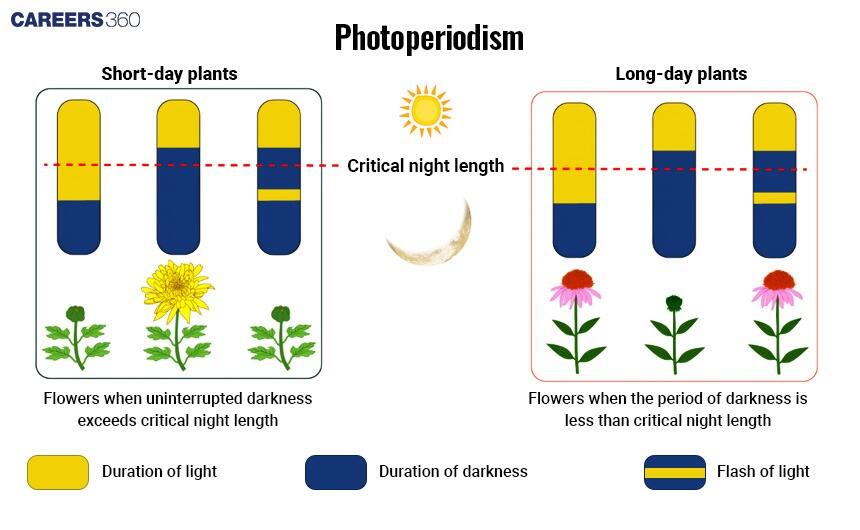
Three broad categories can thus be made based on their response to photoperiod:
Flowering is induced with a longer exposure to light.
Examples: Radish, Spinach, Sugar beet
Flowering is induced with a shorter exposure to light.
Examples: Sunflower, Rice, Soybeans, Tobacco
Flower irrespective of day length.
Flowering depends on other factors, such as age or an external stimulus
Examples: Rose, Tomato, Cucumber
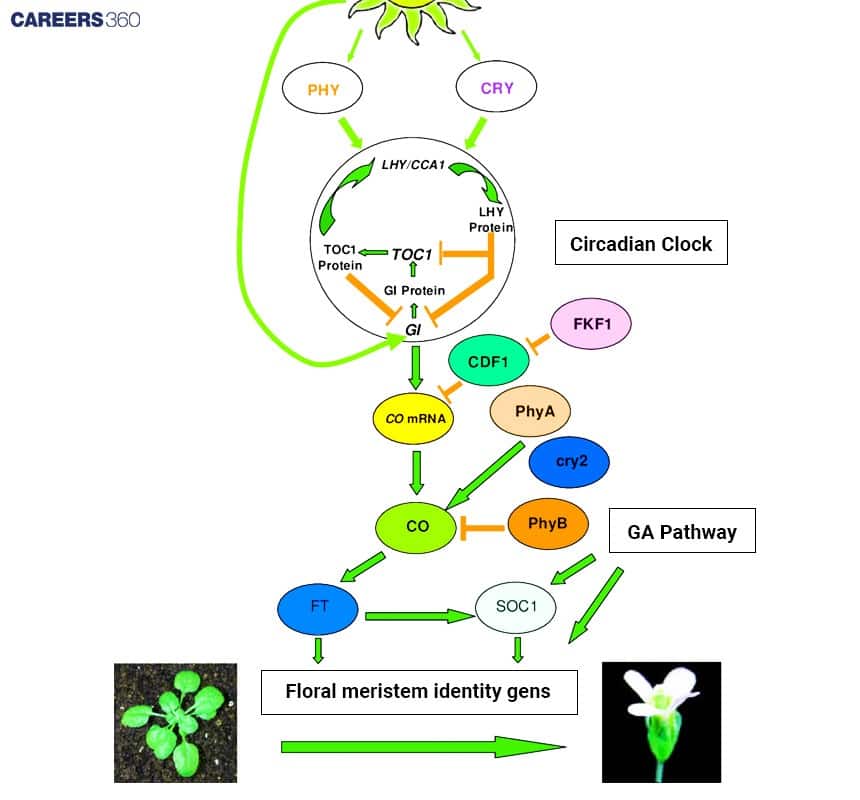
The mechanism of photoperiodic flowering involves the following process:
Light/dark signal perception by photoreceptors
Activation of phytochrome-cryptochrome photoreceptors
Synthesis of the florigen (FT protein)
Transport of florigen to the shoot apical meristem
Activation of flowering genes and the development of flowers
Conversion of vegetative meristem to floral meristem.
Animals use photoperiod to regulate:
In photoperiodism, seasonal changes induce modifications of behaviour and developmental strategies in many animals, especially at higher latitudes.
Other animals turn on their behaviour according to the season for certain behaviours less obvious than in plants.
Such animals include seasonally breeding animals, singing birds during longer days, and insects in a dormant state known as diapause.

The significance of photoperiodism in plants and animals is:
Photoperiodism is a process critical to an organism's very survival and adaptation to its environment.
This gives plants the ability to flower at the appropriate time of the year so that successful reproduction and seed production occurs.
In animals also, photoperiodism helps regulate behaviour where it will coincide with activities such as migration, hibernation, and reproduction with seasons.
Difference between long-day plants (LDP), short-day plants (SDP) and day-neutral plants (DNP) is given in the table below:
Feature | LDP | SDP | DNP |
Requirement | Lond day / SHort night | Short day / Long night | No requirement |
Night interruption | No effect | Inhibits flowering | No effect |
Examples | Spinach | Rice | Tomato |
Critical Factors | Photoperiod > CDL | Photoperiod < CDL | Independent |
Important topics for NEET are:
Types of Plants based on photoperiodic response
Long-day plants vs Short-day plants vs Day-neutral plants
Mechanism of Photoperiodic flowering
Q1. Which of the following plants belong to long short Day plants (LSDP)?
Hyoscyamus niger
Bryophyllum cestrum
Oryza sativa
Zea mays
Correct answer: 2) Bryophyllum cestrum
Explanation:
Long short Day plants (L-SDP) -
Plants require long photoperiods for floral initiation and short photoperiods for blossoming. When they get more than 12 hours of light per day—typically 14–16 hours—they bloom. Another name for them is short night plants. Plants flower between summer and autumn. Eg. Bryophyllum Cestrum
Hence, the correct answer is option 2) Bryophyllum cestrum.
Q2. Photoperiodism is the
Response of plants to the changing environmental conditions
Response of plant to the low temperature treatment expressed in the form of flowering
Response of plants to the photoperiod expressed in the form of flowering
Response of plants to the quality of light expressed in the form of seed germination
Correct answer: 4) Response of plants to the photoperiod expressed in the form of flowering
Explanation:
The response of plants to the photoperiod expressed in the form of flowering is called photoperiodism. Photoperiodism is controlled by photoreceptor proteins like phytochromes and cryptochromes, which sense the duration of light and dark periods. Plants are classified based on their flowering response into short-day, long-day, and day-neutral plants. This mechanism helps plants synchronize their reproductive cycles with favorable environmental conditions.
Hence, the correct answer is option 3) the response of plants to the photoperiod expressed in the form of flowering.
Q3. Long day plants produces flowers when they exposed to
Any duration of light
Light period longer than a critical day length
Light period longer than 12 hours
Light period shorter than a critical day length
Correct answer: 2) Light period longer than a critical day length
Explanation:
The critical photoperiod is the length of time that must be exposed to light for some plants to flower. This varies among species and is important for their reproduction.
Key Terms
Long-Day Plants: These plants need a light period longer than a certain number of hours (the critical photoperiod) to begin flowering. They tend to bloom in late spring or early summer when days are longer.
Examples: Some common long-day plants are:
Spinach
Lettuce
Some Wheat Types
Light exposure past the critical photoperiod causes these plants to begin producing flowering hormones, causing the transition from vegetative growth to flowering. Knowledge of critical photoperiods is critical for agriculture as it determines the timing of planting schedules and crop yields.
Hence, the correct answer is option 2) Light period longer than a critical day length.
Also Read:
Frequently Asked Questions (FAQs)
Florigen is the floral stimulus produced in leaves, then transported to the shoot apical meristem to initiate flowering.
Photoperiodism helps animals synchronise seasonal changes of behaviours like seasonal breeding, migration, hibernation, and singing.
Photoperiodism is the response of plants and animals to the length of day compared to night.
There are three basic groups of plants: Long-day plants, LDP; Short-day plants, SDP; Day-neutral plants, DNP.
Changes in the duration of light period or darkness are perceived by the plants through specialised photoreceptor proteins called phytochromes and cryptochromes.


Law Admissions 2026 Open | Avail Merit-Based Scholarships
BBA/MBA/PGDM Early Bird Applications Deadline 19th Oct '26. Apply now using coupon code CAREER250 and get ₹250 off the application fee
Ranked #36 amongst institutions in Management by NIRF | 100% Placement
Globally Recognized by AACSB (US) & AMBA (UK) | 18 LPA Avg. CTC for PGPM 2026
Leading Design College | 95% Placement Record | Merit-cum-Means Scholarships for Deserving Students
NEET PG All India & State College Predictor with Admission Process Guide