Global Institute of Business Studies, Bengaluru
BBA/MBA/PGDM Early Bird Applications Deadline 19th Oct '26. Apply now using coupon code CAREER250 and get ₹250 off the application fee


Phytochrome is a red/far-red light photoreceptor that enables plants to detect light quality, duration, and direction. It regulates major processes such as seed germination, de-etiolation, photoperiodism, and shade avoidance. Understanding phytochrome is essential for NEET as it forms the molecular basis of plant–light interactions.
This Story also Contains
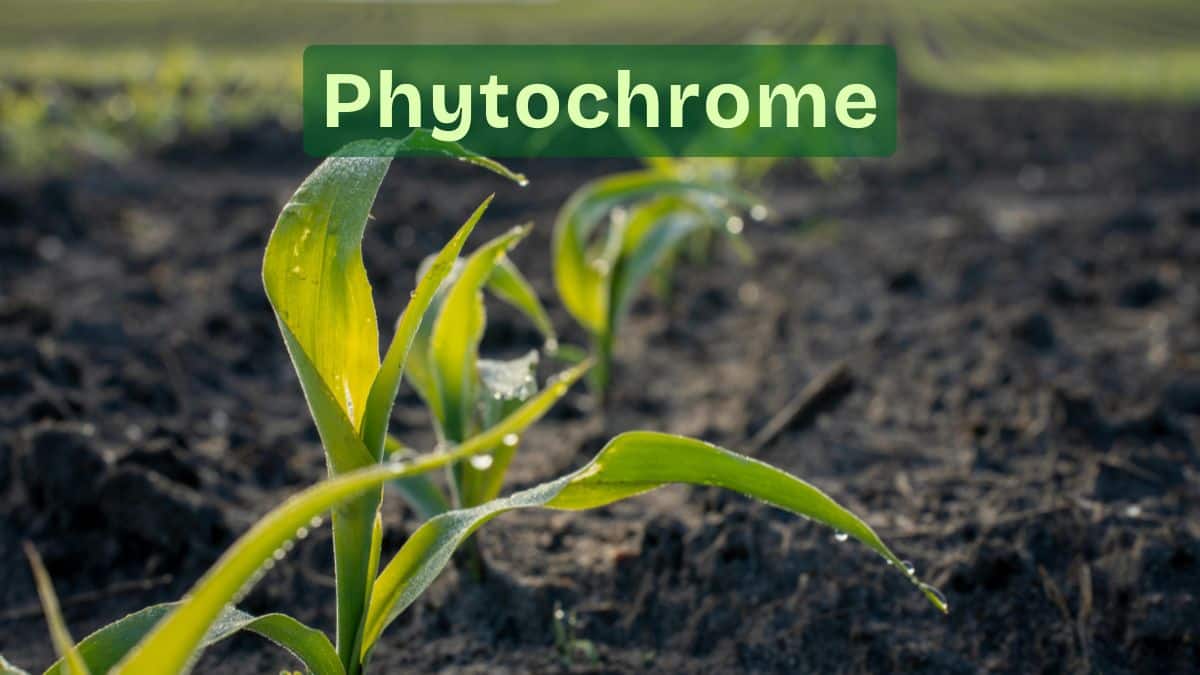
Phytochrome is a photoreceptor pigment of plants, absorbing chiefly the red and far-red wavelengths of visible light and is involved in the control of most numerous particularities of plant growth and development. It controls photomorphogenesis, a development process in plants by which form and structure are determined by light. It is needed for the germination of seeds, elongation of stems, and the expansion of leaves and regulates the time of flowering. This way it will help plants adapt to the light environment to have appropriate growth and reproduction as well.
The structure of phytochrome is described below-
The phytochromes are a family of photoreceptors made up of a protein moiety linked to a light-absorbing chromophore called phytochromobilin.
The two interconvertible forms of the phytochromes are the red light-absorbing form.
Pr (inactive) – absorbs red (660 nm)
Pfr (active) – absorbs far-red (730 nm)
This mechanism controls several light-dependent processes in plants.
Pr to Pfr
Promotes germination, leaf expansion, flowering (in LDP)
Pfr to Pr
Promotes elongation (shade-avoidance response)
Pfr slowly reverts to Pr in darkness
The types of phytochrome is described below-
This phytochrome is most sensitive to continuous far-red light. It plays a critical role in seedling development under shade from the canopy.
PhyB normally absorbs red light and performs different regulatory activities such as seed germination and shade avoidance.
The phytochromes C, D, and E have partly overlapping functions with PhyA and PhyB, thus giving an idea about the fine-tuning effects on the response of plants toward light.
The functions of phytochrome are described below-
It refers to how phytochromes perceive the light signals for seed germination, where Pr is converted into Pfr which will break dormancy and promote growth.
Etiolation and De-Etiolation: In dark situations, phytochromes are in the Pr form and promote etiolation, i.e., greater elongation of the stem. On exposure to light, Pr is converted into Pfr, and de-etiolation is followed by normal growth of the stem.
Phytochromes regulate the expansion and unfolding of leaves. So, therefore, it is done by regulating the size and shape of leaves according to light.
The role of phytochromes as major regulators of time to flowering allows the plant to have a way it can be capable of flowering at the right moment through regulating the length of a day, photoperiod.
Plants' response to the changes in light quality created by shading because of their phytochromes is by elongation of stems and leaves to grow above other plants to receive more light.
The difference between Pr and Pfr is given in the table below:
Feature | Pr | Pfr |
State | Inactive | Active |
Light Absorbed | Red | Far-red |
Color | Blue | Yellow-green |
Movement | Cytosolic | Moves to nucleus |
Effect | No germination, etiolation | Germination, normal growth |
The difference between Pr and Pfr is given in the table below:
Manipulating flowering time
Controlling seed germination
Shade-tolerant crop development
Greenhouse light management
Important topics for NEET are:
Types of Plants based on photoperiodic response
Long-day plants vs Short-day plants vs Day-neutral plants
Mechanism of Photoperiodic flowering
Q1. Which of the following plants belong to long short Day plants (LSDP)?
Hyoscyamus niger
Bryophyllum cestrum
Oryza sativa
Zea mays
Correct answer: 2) Bryophyllum cestrum
Explanation:
Long short Day plants (L-SDP) -
Plants require long photoperiods for floral initiation and short photoperiods for blossoming. When they get more than 12 hours of light per day—typically 14–16 hours—they bloom. Another name for them is short night plants. Plants flower between summer and autumn. Eg. Bryophyllum Cestrum
Hence, the correct answer is option 2) Bryophyllum cestrum.
Q2. Photoperiodism is the
Response of plants to the changing environmental conditions
Response of plant to the low temperature treatment expressed in the form of flowering
Response of plants to the photoperiod expressed in the form of flowering
Response of plants to the quality of light expressed in the form of seed germination
Correct answer: 4) Response of plants to the photoperiod expressed in the form of flowering
Explanation:
The response of plants to the photoperiod expressed in the form of flowering is called photoperiodism. Photoperiodism is controlled by photoreceptor proteins like phytochromes and cryptochromes, which sense the duration of light and dark periods. Plants are classified based on their flowering response into short-day, long-day, and day-neutral plants. This mechanism helps plants synchronize their reproductive cycles with favorable environmental conditions.
Hence, the correct answer is option 3) the response of plants to the photoperiod expressed in the form of flowering.
Q3. Long day plants produces flowers when they exposed to
Any duration of light
Light period longer than a critical day length
Light period longer than 12 hours
Light period shorter than a critical day length
Correct answer: 2) Light period longer than a critical day length
Explanation:
The critical photoperiod is the length of time that must be exposed to light for some plants to flower. This varies among species and is important for their reproduction.
Key Terms
Long-Day Plants: These plants need a light period longer than a certain number of hours (the critical photoperiod) to begin flowering. They tend to bloom in late spring or early summer when days are longer.
Examples: Some common long-day plants are:
Spinach
Lettuce
Some Wheat Types
Light exposure past the critical photoperiod causes these plants to begin producing flowering hormones, causing the transition from vegetative growth to flowering. Knowledge of critical photoperiods is critical for agriculture as it determines the timing of planting schedules and crop yields.
Hence, the correct answer is option 2) Light period longer than a critical day length.
Also Read:
Frequently Asked Questions (FAQs)
The phytochrome comes in two interconvertible forms: the red light-absorbing form, Pr, and the far-red light-absorbing form, Pfr. This conversion by red and far-red light respectively will then trigger the genetic and physiological responses.
The main ones are PhyA, PhyB, PhyC, PhyD, and PhyE, each with definite roles/ functions in plant development.
Phytochrome helps seeds sense light and hence break dormancy to ensure they germinate in the conditions that are most favorable for growth.
Phytochrome affects the time of flowering by sensing the length of the day, photoperiodism is one of the mechanisms crucial for seasonal adaptation in plants.
Phytochrome is a photoreceptor present in plants and helps the functions through which light-driven regulatory and developmental control in plants happens.


BBA/MBA/PGDM Early Bird Applications Deadline 19th Oct '26. Apply now using coupon code CAREER250 and get ₹250 off the application fee
Ranked #36 amongst institutions in Management by NIRF | 100% Placement
Globally Recognized by AACSB (US) & AMBA (UK) | 18 LPA Avg. CTC for PGPM 2026
Leading Design College | 95% Placement Record | Merit-cum-Means Scholarships for Deserving Students
NEET PG All India & State College Predictor with Admission Process Guide
Top B-School: Ranked #9 in NIRF Management Rankings 2025.