KCC Institute of Legal and Higher Education, Greater Noida
Law Admissions 2026 Open | Avail Merit-Based Scholarships


Calcium carbonate is an inorganic chemical compound. The chemical formula of calcium carbonate CaCO3 or CaCO3 where calcium formula is Ca. Calcium carbonate is a chemical compound that is one of the most commonly seen chemical compounds. It can also be found in the earth's crust. It can also be found in a variety of different materials, such as marbles and limestone. Despite the fact that they come in numerous forms, they are chemically similar and only differ physically. Calcium carbonate, which is non-toxic, odorless which occurs naturally in the form of limestones, chalks, marbles, as well as pearls. The limestone formula or limestone chemical formula is the same as CaCO3.
This Story also Contains
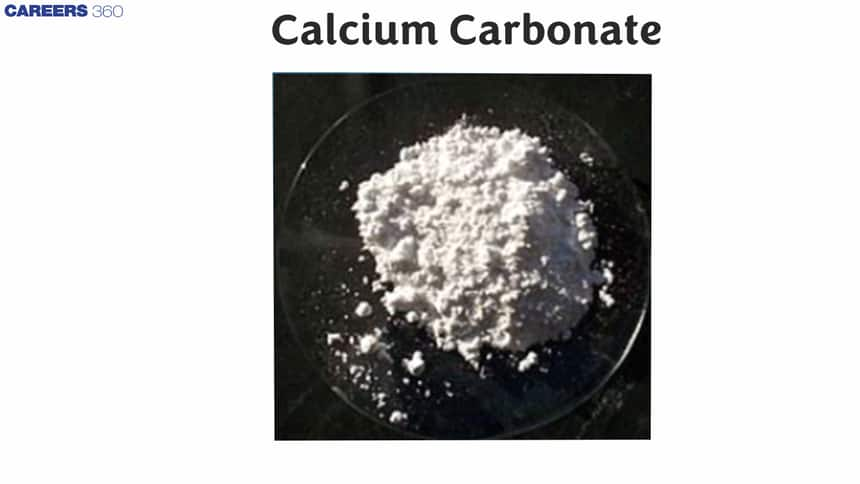
The active element in agricultural lime is calcium carbonate, which is formed when calcium ions combine with carbonate ions in hard water to generate limescale. It can be used as a calcium supplement or an antacid in the medical setting, although excessive ingestion can be harmful and lead to poor digestion. Since the chemical name of chalk is calcium carbonate thus calcium carbonate common name is chalk.
Under normal conditions, CaCO3 (the mineral calcite) has a thermodynamically stable hexagonal shape. Other forms, such as denser 2.83g/cm3 orthorhombic CaCO3 as well as hexagonal CaCO3, are possible. It is feasible to prepare aragonite at temperatures exceeding 85°C along with vaterite at 60°C, for example. Calcite has calcium atoms coordinated with six oxygen atoms, while aragonite has nine oxygen atoms coordinated. The vaterite's chemical composition is unknown.
Law Admissions 2026 Open | Avail Merit-Based Scholarships
BBA/MBA/PGDM Early Bird Applications Deadline 06th Nov'26. Apply now using coupon code CAREER250 and get ₹250 off the application fee
Magnesium carbonate (MgCO3) has a calcite structure, but strontium carbonate (SrCO3) and barium carbonate (BaCO3) have an aragonite structure, which reflects their greater ionic radii.
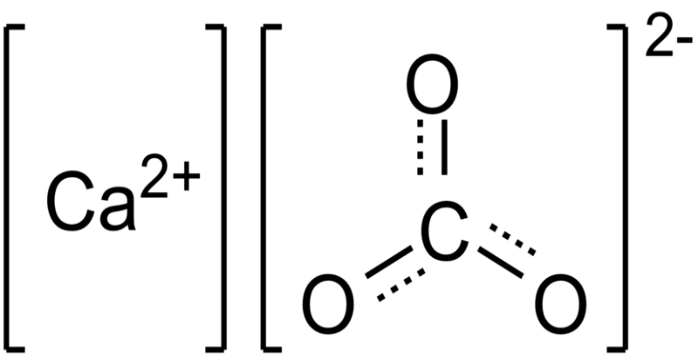
Calcium carbonate is an ionic compound made up of calcium ions ($\mathrm{Ca}^{2+}$) and carbonate ions ($\mathrm{CO}_3{ }^{2-}$).
Carbonate Ion ($\mathrm{CO}_3{ }^{2-}$) Structure
The carbonate ion has a trigonal planar geometry.
One carbon atom lies at the center and is bonded to three oxygen atoms.
All C–O bonds are equivalent due to resonance, giving partial double-bond character.
The bond angle between O–C–O is 120°.
The ion is planar and carries an overall –2 charge.
Arrangement in Calcium Carbonate
$\mathrm{Ca}^{2+}$ ions and $\mathrm{CO}_3{ }^{2-}$ ions are held together by strong electrostatic (ionic) forces.
Each calcium ion is surrounded by carbonate ions, forming a stable crystal lattice.
Crystal Forms
Calcium carbonate exists mainly in two crystalline forms:
Calcite (most stable form)
Each $\mathrm{Ca}^{2+}$ ion is coordinated by six oxygen atoms from different carbonate ions.
Aragonite (less stable)
Nine oxygen atoms coordinate each $\mathrm{Ca}^{2+}$ ion.
Also read -
Adding sodium carbonate to calcium chloride is another way to produce calcite.
$\begin{aligned} & \mathrm{Ca}(\mathrm{OH})_2+\mathrm{CO}_2 \rightarrow \mathrm{CaCO}_3+\mathrm{H}_2 \mathrm{O} \\ & \mathrm{CaCl}_2+\mathrm{Na}_2 \mathrm{CO}_3 \rightarrow \mathrm{CaCO}_3+2 \mathrm{NaCl}\end{aligned}$
$\mathrm{Ca}(\mathrm{OH})_2+\mathrm{CO}_2 \rightarrow \mathrm{CaCO}_3+\mathrm{H}_2 \mathrm{O}$
Commercially available calcium carbonate comes in two grades. In the industrial world, both classes compete primarily on particle size and product attributes.
$\mathrm{CaCO}_3+\mathrm{H}_2 \mathrm{SO}_4 \rightarrow \mathrm{CaSO}_4+\mathrm{H}_2 \mathrm{O}+\mathrm{CO}_2$
PCC has smaller particles, is purer, is less abrasive, and has a brighter appearance than GCC.
$\mathrm{CaCO}_3(\mathrm{~s}) \xrightarrow{\Delta} \mathrm{CaO}(\mathrm{s})+\mathrm{CO}_2(\mathrm{~g})$
Calcium carbonate produces carbon dioxide when it reacts with dilute acids.
$\mathrm{CaCO}_3+2 \mathrm{HCl} \rightarrow \mathrm{CaCl}_2+\mathrm{H}_2 \mathrm{O}+\mathrm{CO}_2$
Also check-
Question 1: 4 gm of impure $\mathrm{CaCO}_3$ on treatment with excess HCl produces $0.88 \mathrm{gm} \mathrm{CO}_2$. What is the percent purity of the $\mathrm{CaCO}_3$ sample?
1) 75
2) 25
3) 90
4) (correct) 50
Solution:
Ratio of elements in $\mathrm{CaCO}_3$ :
Ca: 1, C: 1, $0: 3$
$\text { Molar mass }=1 \times 40+1 \times 12+3 \times 16=100$
$\mathrm{CaCO}_3 \xrightarrow{\Delta} \mathrm{CaO}+\mathrm{CO}_2$
$\begin{aligned}
& \% \text { purity }=\frac{\text { mass of pure product }}{\text { mass of impure product obtained }} \times 100 \% \\
& \therefore \mathrm{x}=\frac{0.88}{44} \mathrm{~mol}=0.02 \mathrm{~mol}=2 \mathrm{gm} \\
& \therefore \% \text { purity }=\frac{2}{4} \times 100=50
\end{aligned}$
Hence, the answer is option (4).
Question 2: In curing cement plaster, water is sprinkled from time to time. This helps in:
1) keeping it cool
2) (correct) developing interlocking needle-like crystals of hydrated silicates
3) Hydrating sand and gravel mixed with cement
4) converting sand into silicic acid.
Solution:
Water helps in the hydration of calcium aluminates and calcium silicates which change into their colloidal gels by developing interlocking needle-like crystals of hydrated silicates.
The hydrolysis leads to the formation of calcium hydroxide which is useful in binding the particles of calcium silicate together.
Hence, the answer is option (2).
Question 3: Which one of the following alkaline earth metal sulfates has its hydration enthalpy greater than its lattice enthalpy?
1) $\mathrm{CaSO}_4$
2) (correct) $\mathrm{BeSO}_4$
3) $\mathrm{BaSO}_4$
4) $\mathrm{SrSO}_4$
Solution:
We know that
Solubility of sulfates of alkaline metals -
Solubility in water decreases from Be to Ba
Solubility order
$\Rightarrow \mathrm{BeSO}_4>\mathrm{MgSO}_4>\mathrm{CaSO}_4>\mathrm{SrSO}_4>\mathrm{BaSO}_4$
Hence, the answer is option (2).
Question 4: The solubilities of carbonates decrease down the magnesium group due to a decrease in
1) lattice energies of solids
2) (correct) hydration energies of cations
3) inter-ionic attraction
4) entropy of solution formation.
Solution:
In the alkaline earth metal group, the hydration energy of metal carbonates decreases down the group, which means that carbonates become more stable down the group.
Hence, the answer is option (2).
Practice more questions with the link given below
Frequently Asked Questions (FAQs)
It can be used as a calcium supplement or an antacid to treat stomach discomfort, heartburn, and acid indigestion in medical settings.
Limestone is a sedimentary rock that is predominantly composed of calcium carbonate (CaCO3).
CaCO3 is the chemical formula for calcium carbonate and chemical formula for calcium bicarbonate is CaHCO3.
The chemical name of CaCO3 is calcium carbonate.

Law Admissions 2026 Open | Avail Merit-Based Scholarships
BBA/MBA/PGDM Early Bird Applications Deadline 06th Nov'26. Apply now using coupon code CAREER250 and get ₹250 off the application fee
Ranked #36 amongst institutions in Management by NIRF | 100% Placement
Globally Recognized by AACSB (US) & AMBA (UK) | 18 LPA Avg. CTC for PGPM 2026
NEET PG All India & State College Predictor with Admission Process Guide
Top B-School: Ranked #9 in NIRF Management Rankings 2025.