
KCC Institute of Legal and Higher Education, Greater Noida
Law Admissions 2026 Open | Avail Merit-Based Scholarships


Isomerism is the phenomenon in which more than one compound has the same chemical formula but different chemical structures. Chemical compounds that have identical chemical formulas but differ in properties and the arrangement of atoms in the molecule are called isomers. Therefore, the compounds that exhibit isomerism are known as isomers. There are two primary types of isomerism, which can be further categorized into different subtypes. These primary types are Structural Isomerism and Stereoisomerism.
This Story also Contains
When two molecules have exactly the same number of the same kinds of atoms, yet they have different chemical and physical properties, this is known as isomerism. Isomerism also takes into account timing and energy. Molecules are mobile entities that go through various rotating motions that change their shape, all of which require energy. As a result, specific molecules might be identical on one timeline or set of energy circumstances while being different or isomeric on another. Finally, an isomer must be an energy minimum; it must be found in a well of energy.
In this article, we will cover the topic (Isomerism). This topic falls under the broader category of (Some Basic Principles of Organic Chemistry), which is a crucial chapter in (Class 11 Chemistry).
Also read -
Compounds having the same molecular formula but different structures (manners in which atoms are linked) are classified as structural isomers. Some typical examples of different types of structural isomerism are given below:

Law Admissions 2026 Open | Avail Merit-Based Scholarships
BBA/MBA/PGDM Early Bird Applications Deadline 19th Oct '26. Apply now using coupon code CAREER250 and get ₹250 off the application fee

It is the type of isomerism in which the compounds possessing same molecular formula differ in their properties due to the difference in their geomtery that is, due to the difference in the direction of attachment of same atoms or groups in their molecule. It is not shown by single bonded compounds like(C-C) due to free rotation.
Geometrical isomerism is shown by$[>\mathrm{C}=\mathrm{C}<],[>\mathrm{C}=\mathrm{N}-],\left[-\mathrm{N}=\mathrm{N}_{-}\right]$and cyclo alkanes.
Also read :
Cis
Trans
Related Topics link
 It cannot show geometrical isomerism as one carbon atom has two similar species 'A'.
NCERT Chemistry Notes:
Q.1 The number of chiral centers in penicillin is:
(1) 3
(2) 4
(3) 5
(4) 6
Solution:
As we have learned
An asymmetric carbon atom (chiral carbon) is a carbon atom that is attached to four different types of atoms or groups of atoms.
As shown in the figure below, there are 3 chiral carbons in penicillin.

Therefore, option (1) is correct
Q.2 In the following structure, the double bonds are marked as I, II, III and IV

Geometrical isomerism is not possible at site (s) :
(1) III
(2) I
(3) I and II
(4) III and IV
Solution:
As we have learned
Geometrical isomerism is not possible at Site I as two identical methyl groups are attached to the same carbon bearing the double bond.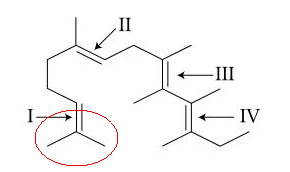
Hence, the answer is Option (2)
Q.3 Which of the following compounds will exhibit geometrical isomerism ?
(1) 1 - Phenyl - 2 - butene
(2) 3 - Phenyl - 1 - butene
(3) 2 - Phenyl - 1 - butene
(4) 1, 1 - Diphenyl - prop-1-ene
Solution:
As we have learned
Out of the given structures, only 1 - Phenyl - 2 - butene is capable of showing geometrical isomerism because it will show Cis–trans isomerism. Other structures have alkene at terminal carbon which does not show geometrical isomerism.

Hence, the correct answer is Option (1)
Isomerism is a key concept in chemistry that highlights the diversity and complexity of molecular structures. It occurs when compounds share the same molecular formula but differ in atom arrangement.
Isomerism arises from the fact that the atoms in a molecular formula can be organized in multiple ways to produce compounds with varied physical and chemical properties, known as isomers. Two main forms of isomerism are structural or constitutional isomerism, in which bonds between the atoms differ; and stereoisomerism or spatial isomerism, in which the bonds are the same but the relative positions of the atoms differ.
Frequently Asked Questions (FAQs)
There are two common types of isomers. The Constitutional isomer is a molecule of different connections — like given simple bracelets where the arrangement of red and green beads is different. The second type are stereoisomers. For stereoisomers the connection is the same, but the components are oriented differently in space.
Isomerism is a disorder in which more than one compound has the same chemical formula but different chemical properties. Chemical compounds have the same chemical formulas but differ in the structure and arrangement of atoms in this molecule called isomers.
Enantiomers are chiral particles that are visual and cannot be elevated. Diastereomers are stereomer compounds with molecules that are invisible to each other's images and cannot be contradicted. There are no mirror images above each other.
You can distinguish them by their combination patterns and how they take up space with three. Identify the isomers of the structure (constitutional) with their integration patterns. The chemical atoms are the same but are connected in such a way that they form different functional isomerism groups
Functional isomerism occurs when substances have the same molecular formula but different functional groups. There are three functional group isomers of which you need to be aware: alcohols and ethers. aldehydes and ketones.
On Question asked by student community
Geometrical Isomerism is a form of Stereo Isomerism. Stereo Isomerism are molecules that have the same molecular formula and the same sequence of bonded atoms, but different in the 3D orientations of their atoms in space. The key requirement for this is restricted rotation (i.e., C=C) , each carbon in
Hello,
The complex [cocl2(en)2] shows geometrical isomerism .
It has a cis and trans form due to the different possible spatial arrangements of the two chloride ligands around the central cobalt atom. The cis-isomer has both chlorides next to each other, while the trans-isomer has them opposite to each other.
Hello Gagan!
Sachin Rana's YouTube playlist (62 videos) or NS Sir's organic chemistry on the Mohit Tyagi Channel that you will follow for JEE Advanced depends on your needs and the constraints of time left for the examination.
Sachin Rana's Playlist:
Hello aspirant,
Here's a breakdown of your options and factors to consider:
Option 1: Continue with Sachin Rana's videos
Advantages:
Completing organic chemistry (OC) from the Samarpan batch of MKA Sir on YouTube can be a good option for you, especially if you have already covered the basics of GOC and Isomerism. However, there are a few things to consider:

Law Admissions 2026 Open | Avail Merit-Based Scholarships
BBA/MBA/PGDM Early Bird Applications Deadline 19th Oct '26. Apply now using coupon code CAREER250 and get ₹250 off the application fee
Ranked #36 amongst institutions in Management by NIRF | 100% Placement
Globally Recognized by AACSB (US) & AMBA (UK) | 18 LPA Avg. CTC for PGPM 2026
Leading Design College | 95% Placement Record | Merit-cum-Means Scholarships for Deserving Students
NEET PG All India & State College Predictor with Admission Process Guide


