


Derivation of Equation of Motion - 3 Equations of Motion
The equations of motion help us understand how an object moves with time. They tell us about the speed, distance, and acceleration of an object while it is moving. These three equations are used to study motion in a straight line and also help in understanding motion in other directions. Learning how these equations are derived is very important because it clears basic concepts of motion. Many questions in JEE and NEET are directly based on these equations and their derivations. In this article, we will learn how to derive the first, second, and third equations of motion using simple methods like algebra, graphs, and calculus.
This Story also Contains
- Definition of Equations of Motion
- Derivation of Equations of Motion
- Derivation of First Equation of Motion
- Derivation of Second Equation of Motion
Definition of Equations of Motion
Equations of Motion in physics describe how a body moves with uniform acceleration. These equations show the relationship between displacement (s), velocity (u,v), acceleration (a), and time (t).
There are three equations of motion:
First Equation of Motion
$v=u+a t$
It gives the final velocity of an object.
Second Equation of Motion
$s=u t+\frac{1}{2} a t^2$
It gives the displacement of an object.
Third Equation of Motion
$v^2=u^2+2 a s$
It relates velocity and displacement without involving time.
Derivation of Equations of Motion
The equations of motion describe the motion of an object moving with uniform acceleration. These equations can be derived using different approaches, depending on the level of understanding and mathematical tools used.
The equations of motion are derived by the following three methods:
- Simple Algebraic Method – Uses basic definitions of velocity and acceleration.
- Graphical Method – Uses velocity–time graphs to obtain equations.
- Calculus Method – Uses differentiation and integration for a more advanced derivation.
Derivation of First Equation of Motion
The first equation of motion is:
$
v=u+a t
$
where
$u=$ initial velocity
$v=$ final velocity
$a=$ acceleration
$t=$ time
1. Derivation by Algebraic Method
Acceleration is defined as the rate of change of velocity.
$
\begin{gathered}
a=\frac{\text { change in velocity }}{\text { time }} \\
a=\frac{v-u}{t}
\end{gathered}
$
Rearranging,
$
\begin{aligned}
& v-u=a t \\
& v=u+a t
\end{aligned}
$
2. Derivation by Graphical Method
Draw a velocity-time graph for uniform acceleration.
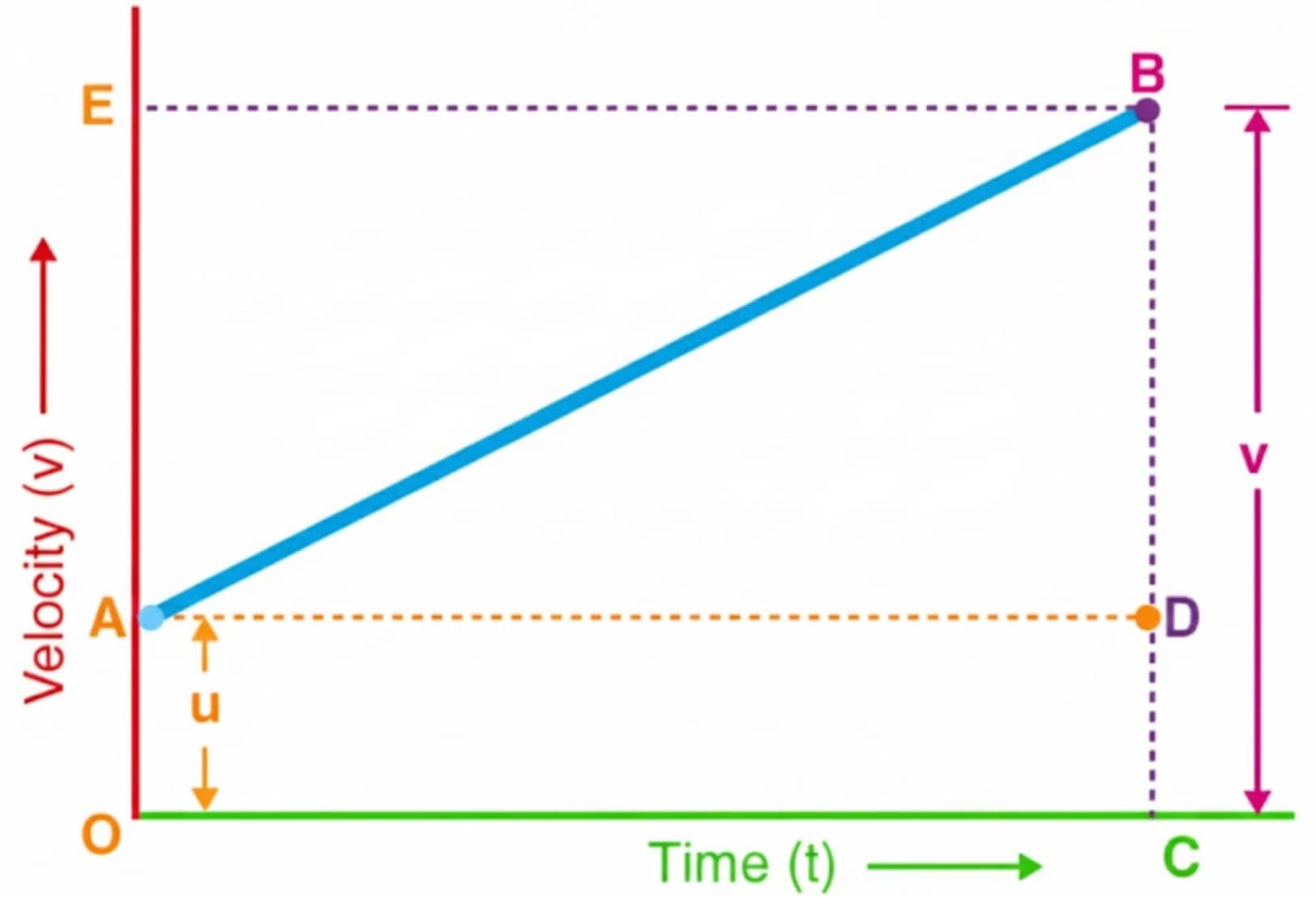
Initial velocity $=u$
Final velocity $=v$
Time $=t$
From the graph, slope = acceleration
$
\text { slope }=\frac{v-u}{t}
$
But slope $=$ acceleration $a$
$
\begin{aligned}
& a=\frac{v-u}{t} \\
& v=u+a t
\end{aligned}
$
3. Derivation by Calculus Method
Acceleration is defined as:
$
\begin{aligned}
a & =\frac{d v}{d t} \\
d v & =a d t
\end{aligned}
$
Integrating both sides,
$
\begin{gathered}
\int d v=\int a d t \\
v=a t+C
\end{gathered}
$
When $t=0, v=u$
$
\begin{gathered}
u=C \\
v=u+a t
\end{gathered}
$
NCERT Physics Notes :
Derivation of Second Equation of Motion
The second equation of motion is:
$
s=u t+\frac{1}{2} a t^2
$
where
$s=$ displacement
$u=$ initial velocity
$a=$ acceleration
$t=$ time
1. Derivation by Algebraic Method
Average velocity for uniform acceleration:
$
v_{\text {avg }}=\frac{u+v}{2}
$
Displacement:
$
\begin{aligned}
s & =v_{\text {avg }} \times t \\
s & =\frac{u+v}{2} \times t
\end{aligned}
$
From first equation of motion:
$
v=u+a t
$
Substitute $v$ :
$
\begin{gathered}
s=\frac{u+(u+a t)}{2} \times t \\
s=\frac{2 u+a t}{2} \times t \\
s=u t+\frac{1}{2} a t^2
\end{gathered}
$
2. Derivation by Graphical Method
Draw a velocity-time graph.
Initial velocity $=u$
Final velocity $=v$
Time $=t$
Displacement = area under velocity-time graph
Area $=$ area of rectangle + area of triangle
$
s=(u \times t)+\frac{1}{2}(v-u) t
$
Using $v-u=a t$ :
$
s=u t+\frac{1}{2} a t^2
$
3. Derivation by Calculus Method
Velocity:
$
v=\frac{d s}{d t}
$
From first equation:
$
\begin{gathered}
v=u+a t \\
\frac{d s}{d t}=u+a t \\
d s=(u+a t) d t
\end{gathered}
$
Integrating both sides:
$
\begin{gathered}
\int d s=\int(u+a t) d t \\
s=u t+\frac{1}{2} a t^2+C
\end{gathered}
$
When $t=0, s=0$
$
\begin{gathered}
C=0 \\
s=u t+\frac{1}{2} a t^2
\end{gathered}
$
|
Related Topics, |
Derivation of Third Equations of Motion:
The third equation of motion is:
$
v^2=u^2+2 a s
$
where
$u=$ initial velocity
$v=$ final velocity
$a=$ acceleration
$s=$ displacement
1. Derivation by Algebraic Method
From the first equation of motion:
$
v=u+a t
$
Rearranging:
$
t=\frac{v-u}{a}
$
From the second equation of motion:
$
s=u t+\frac{1}{2} a t^2
$
Substitute $t$ :
$
s=u\left(\frac{v-u}{a}\right)+\frac{1}{2} a\left(\frac{v-u}{a}\right)^2
$
Simplifying:
$
\begin{aligned}
2 a s= & 2 u(v-u)+(v-u)^2 \\
& 2 a s=v^2-u^2 \\
& v^2=u^2+2 a s
\end{aligned}
$
2. Derivation by Graphical Method
Draw a velocity-time graph.
Displacement $s=$ area under the graph
$
s=\frac{1}{2}(u+v) t
$
From acceleration:
$
a=\frac{v-u}{t} \Rightarrow t=\frac{v-u}{a}
$
Substitute $t$ :
$
\begin{aligned}
s= & \frac{1}{2}(u+v)\left(\frac{v-u}{a}\right) \\
& 2 a s=v^2-u^2 \\
& v^2=u^2+2 a s
\end{aligned}
$
3. Derivation by Calculus Method
Acceleration:
$
a=\frac{d v}{d t}
$
But,
$
v=\frac{d s}{d t}
$
So,
$
\begin{gathered}
a=v \frac{d v}{d s} \\
v d v=a d s
\end{gathered}
$
Integrating both sides:
$
\begin{gathered}
\int v d v=\int a d s \\
\frac{v^2}{2}=a s+C
\end{gathered}
$
When $s=0, v=u$
$
\begin{gathered}
C=\frac{u^2}{2} \\
v^2=u^2+2 a s
\end{gathered}
$
Also, check-
Frequently Asked Questions (FAQs)
19m
3:5
Fly off along the tangent to its circular path.
8.3s
10s