


Velocity - Definition, Example, Types, FAQs
Motion means movement and to describe it we use terms like speed, velocity and acceleration. When an object moves, we usually ask about the distance covered, time taken, and direction. These three together describe the velocity of the object, which measures the rate of change of displacement. Speed and velocity both tell us how fast an object is moving. If two objects move in the same direction, it’s easy to see which is faster. But if they move in opposite directions, it becomes harder. In such cases, velocity, which includes direction, helps us understand motion better. In this article, you will learn about the meaning, unit, formulas, examples, and difference between speed and velocity which is the base of mechanics and very important for competitive exams like JEE Mains and NEET.
This Story also Contains
- What is Meant by Velocity?
- Units of Velocity
- Difference between speed and velocity
- Example of Velocity
- Applications of Velocity:
Also read -
What is Meant by Velocity?
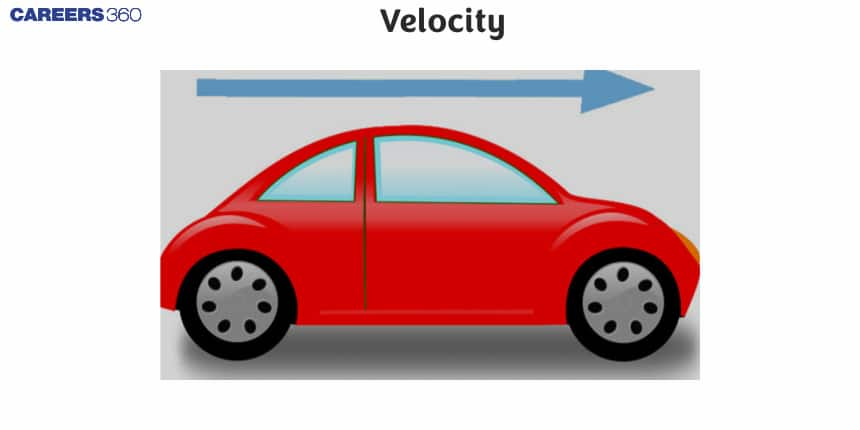
Velocity is the rate of change of displacement with time. It tells us how fast and in which direction an object is moving.
In simple words, velocity is speed with direction.
$
\text { Velocity }=\frac{\text { Displacement }}{\text { Time }}
$
- Velocity is a vector quantity (it has both magnitude and direction).
- The SI unit of velocity is metre per second (m/s).
- If an object moves in a straight line without changing direction, its speed and velocity are the same.
Units of Velocity
Velocity is the rate of change of displacement with time, so its units depend on distance and time units.
| System | Unit of Velocity | Symbol |
| SI (MKS) | metre per second | m/s |
| CGS | centimetre per second | cm/s |
| FPS (British system) | foot per second | ft/s |
Velocity Formula
The formula for velocity is:
$
\text { Velocity }(\mathrm{v})=\frac{\text { Displacement }(\mathrm{s})}{\text { Time }(\mathrm{t})}
$
Where:
- $\mathbf{v}=$ velocity
- $\mathbf{s}=$ displacement (change in position)
- $\mathbf{t}=$ time taken
Instantaneous Velocity Formula
Instantaneous velocity is the velocity of an object at a specific instant of time. It shows both the speed and direction of motion at that exact moment.
The formula is:
$
v=\frac{d s}{d t}
$
Where:
- $\mathbf{v}=$ instantaneous velocity
- $\mathbf{s}=$ displacement
- $\mathbf{t}=$ time
- $\mathbf{d s} / \mathbf{d t}=$ derivative of displacement with respect to time
Angular Velocity Formula
Angular velocity measures how fast an object rotates or revolves around a fixed axis. It tells us the angle rotated per unit time.
$
\omega=\frac{\theta}{t}
$
Where:
- $\omega=$ angular velocity
- $\theta=$ angular displacement (in radians)
- $t=$ time
SI Unit:
- radian per second (rad/s)
Relation with Linear Velocity:
If an object moves along a circular path of radius $r$,
$
v=\omega \cdot r
$
Where $v$ is the linear velocity.
Average Velocity Formula
Average velocity is the total displacement divided by the total time taken.
$
\text { Average Velocity }\left(v \_ \text {avg }\right)=\frac{\operatorname{Total} \text { Displacement }(\Delta x)}{\operatorname{Total} \operatorname{Time}(\Delta t)}
$
Where:
- $v_{\text {avg }}=$ average velocity
- $\Delta x=$ total displacement
- $\Delta t=$ total time
Difference between speed and velocity
|
Speed
|
Velocity
|
|
Speed is a measure of how far an object travel in relation to time.
|
Velocity is a measure of how far an object travel with respect to time in one of direction.
|
|
It is scalar quantity.
|
It is a vector quantity.
|
|
Because speed is a scalar quantity, it can never be negative.
|
Velocity can be negative, and even zero.
|
|
It is also known as the rate at which distance changes.
|
It is also known as the rate at which displacement changes.
|
Example of Velocity
1. A car travels $\mathbf{1 0 0}$ metres east in $\mathbf{2 0}$ seconds.
$
\text { Velocity }=\frac{\text { Displacement }}{\text { Time }}=\frac{100 \mathrm{~m} \text { east }}{20 \mathrm{~s}}=5 \mathrm{~m} / \mathrm{s} \text { east }
$
2. A train moves 200 km north in 4 hours.
$
\text { Velocity }=\frac{200 \mathrm{~km} \text { north }}{4 \mathrm{~h}}=50 \mathrm{~km} / \mathrm{h} \text { north }
$
Applications of Velocity:
- Vehicles: Helps know how fast and in which direction cars, trains, or planes are moving.
- Sports: Used to measure athletes’ speed and direction in running, cycling, or swimming.
- Traffic: Helps plan travel time and control traffic.
- Navigation: Ships and airplanes use velocity to reach places correctly.
- Weather: Wind velocity is used to predict storms and weather.
Related Topics Link,
- Unit of Velocity
- Unit of Distance
- Difference Between Speed and Velocity
- Relative Velocity
- Measurement of Speed
Also check-
- NCERT Exemplar Class 11th Physics Solutions
- NCERT Exemplar Class 12th Physics Solutions
- NCERT Exemplar Solutions for All Subjects
NCERT Physics Notes:
Frequently Asked Questions (FAQs)
Velocity is the rate of change of displacement with time. It shows how fast and in which direction an object is moving. Its SI unit is metre per second (m/s).
Velocity is used to describe motion, solve problems on displacement, speed, and acceleration, and understand concepts in mechanics. It is important for Class 9, 10, 11, and 12 Physics exams.
Speed is a scalar quantity (only magnitude), while velocity is a vector quantity (magnitude + direction). Velocity tells how fast and in which direction an object moves.
Velocity can be classified into:
Uniform Velocity – same displacement in equal time.
Variable (Non-uniform) Velocity – unequal displacement in equal time.
Average Velocity – total displacement ÷ total time.
Velocity is the rate of change of displacement with time. It tells us how fast an object is moving and in which direction.
Questions related to
On Question asked by student community
Hi Akhila
Instantaneous velocity is the velocity of an object at a particular instant of time. It is the rate of change of displacement with respect to time.
Instantaneous velocity is determined graphically from the slope of the tangent to the displacement-time (position-time) graph at that particular instant. In simple
Speed is the distance travelled by an object per unit time. It is a scalar quantity.
Velocity is the displacement of an object per unit time. It is a vector quantity and includes direction.
https://www.careers360.com/physics/difference-between-speed-and-velocity-topic-pge
Hello Student,
You can refer to this article given below for detailed information on V–T graphs, including their concepts and interpretation:
https://www.careers360.com/physics/vt-graphs-topic-pge
Hello
I hope you are absolutely fine. As per your mentioned query, speed is a scalar quantity which tells you how the object is moving fast. Whereas velocity is a vector quantity which tells you about the speed as well as direction.
I hope this helps you!
Revert for further
Hii,
If two objects are attached at the ends of a rigid body (like a rod or wheel), yes, their angular velocity remains the same.
Here's why:
-
Angular velocity refers to how fast something is rotating (angle per unit time), not how fast it's moving in a straight line.
-
In