


Tensile Stress - Definition, Meaning, Formula, Example, FAQs
Tensile Stress is an important concept in the chapter Mechanical Properties of Solids in Class 11 Physics. It refers to the force applied per unit cross-sectional area of a material that causes it to stretch or elongate. When a pulling force acts on a body, tensile stress develops along the direction of the applied force. It is mathematically expressed as σ = F/A, and its SI unit is Pascal (Pa). Learning tensile stress is important for analysing the strength of materials used in bridges, cables, buildings, and engineering structures. This concept is frequently asked in board exams as well as competitive exams like JEE and NEET. In this article, learn the definition, formula, unit, examples, and differences related to tensile stress.
What is Tensile Stress?
The external force per unit area of the material that causes the substance to stretch. The strength of structures of equal cross-sectional area loaded in tension is independent of the shape of the cross-section.
Also read -
- NCERT Solutions for Class 11 Physics
- NCERT Solutions for Class 12 Physics
- NCERT Solutions for All Subjects
Tensile strength and tensile stress
Tensile stress is a type of stress that occurs when the length of the material increases in the direction of the applied force.
Let's look at the many types of stress:
- Normal stress
The force created over a unit area of a body when a force works perpendicularly over an area of that body is called the Normal stress. - Tensile stress (T)
One of the types of normal stress is tensile stress.
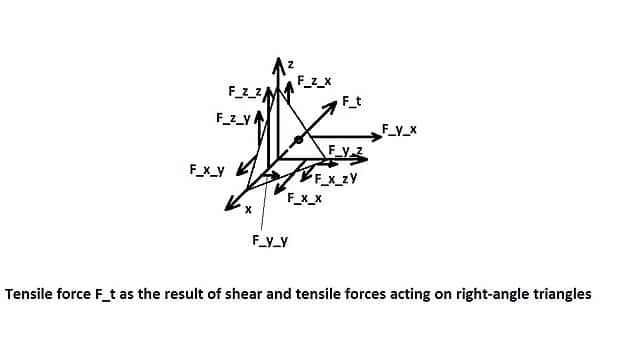
An applied force or load that leans to stretch the material in the direction or axis of the force applied causes tensile stress.
Tensile Stress Formula
Tensile stress is defined as the force applied per unit cross-sectional area of a material when it is stretched.
Formula: $\text { Tensile Stress }=\frac{F}{A}$
Where:
$\mathbf{F}=$ Applied force (in Newton, N)
$\mathbf{A}=$ Cross-sectional area (in $\mathrm{m}^2$ )
SI Unit: $\mathrm{N} / \mathrm{m}^2=\text { Pascal }(\mathrm{Pa})$
Dimensional Formula: $\left[M L^{-1} T^{-2}\right]$
Real-Life Example of Tensile Stress
A rope pulling a bucket from a well experiences tensile stress.
Cables of a suspension bridge are under tensile stress.
A rubber band stretched by hand experiences tensile stress.
|
Related Topics, |
Difference Between Tensile Stress and Tensile Strength
|
Sl. No. |
Tensile stress |
Tensile strength |
| 1. | It is defined as a force per unit area that is related to stretching and denoted by the symbol σ. | The amount of tensile stress a material can bear before breaking is indicated by the letter s. |
| 2. | σ = F/A is the tensile stress in tensile stress in tensile stress in tensile stress F is the acting force. A refers to the area. | s = P/a is the formula. Where, The tensile strength is denoted by the letter s. P is the force required to break A is the cross-sectional area |
Difference Between Tensile Stress and Compressive Stress
| Tensile Stress | Compressive Stress |
| Produced when a body is stretched by a pulling force. | Produced when a body is compressed by a pushing force. |
| Force acts away from the body. | Force acts towards the body. |
| Causes increase in length (elongation). | Causes decrease in length (shortening). |
| Body becomes longer and thinner. | Body becomes shorter and thicker. |
| Example: Stretching a rubber band or pulling a rope. | Example: Pressing a spring or a building column under load. |
| Formula: $( \frac{F}{A} )$ | Formula: $( \frac{F}{A} )$ |
| SI Unit: Pascal (Pa) | SI Unit: Pascal (Pa) |
Also, check-
- NCERT Exemplar Class 11th Physics Solutions
- NCERT Exemplar Class 12th Physics Solutions
- NCERT Exemplar Solutions for All Subjects
NCERT Physics Notes:
Frequently Asked Questions (FAQs)
Tensile stress occurs when an applied load causes the material to stretch in the direction of the applied load, or in other words, when the material is pulled.
Stress continues to rise during necking while the actual cross-sectional area decreases. When stress is estimated using the original cross-sectional area (nominal curve), however, stress appears to be reduced.
Tungsten has the highest tensile strength of any pure metal, with a tensile strength of up to 500,000 pounds per square inch at room temperature. It possesses the maximum tensile strength, even at temperatures above 1,500°C.
Tensile stress is positive in physics and engineering, while compressive stress is negative.
The force necessary to pull something like a rope, wire, or a structural beam to the point of failure is known as tensile strength. A material's tensile strength is the highest amount of tensile stress it can withstand before failing, such as breaking.
The force per unit area induced in the body in response to an externally applied force that tends to elongate or stretch the body is known as tensile stress.