


Water Absorption In Plants: Mechanisms, Processes, And Importance
Water absorption in plants is the process by which roots take up water from the soil and transport it through the xylem to various plant parts. It occurs through both active and passive mechanisms. This process is vital for nutrient transport, maintaining turgor pressure, and supporting photosynthesis and growth. Understanding water absorption is fundamental to the study of Plant Water Relations.
This Story also Contains
- Definition of Water Absorption in Plants
- Mechanisms of Water Absorption
- Structures Involved in Water Absorption
- Processes Supporting Water Absorption
- Factors Affecting Water Absorption
- Difference Between Active and Passive Water Absorption
- Importance of Water Absorption
- Water Absorption NEET MCQs (With Answers & Explanations)
- Recommended video on "Water Absorption In Plants"
Definition of Water Absorption in Plants
Water absorption is a process by which water is taken up from the soil through roots into the plant. Water thus becomes essential for the survival of a plant because it takes part in many vital physiological activities of plants, such as carrying nutrients, conducting photosynthesis and regulating turgor pressure within cells. It contributes to turgidity, growth, and development. It helps in cooling through transpiration and acts like a solvent for the biochemical reactions inside the plant. Active water absorption ensures the health and productivity of the plants in its totality.
Mechanisms of Water Absorption
The mechanism of water absorption includes:
Passive Transport
Passive transport is the process of water entering the plant roots without the utilisation of energy. It mainly relies on concentration gradients to drive the movement.
Osmosis is the major passive way of water absorption where this movement is from an area of low solute concentration, i.e. the soil, to one of higher concentration, i.e. the root cells through a semi-permeable cell membrane.
Active Transport
In active transport, both water and nutrients move against their concentration gradient. Since this transport progresses against the gradient, it needs energy in the form of ATP.
Ongoing uptake of water and minerals into root cells by active processes is mediated by specific membrane proteins, including aquaporins and ion channels, to meet the nutritional and hydration requirements of the plant.
Structures Involved in Water Absorption
The structures involved in the water absorption are:
Root Structure
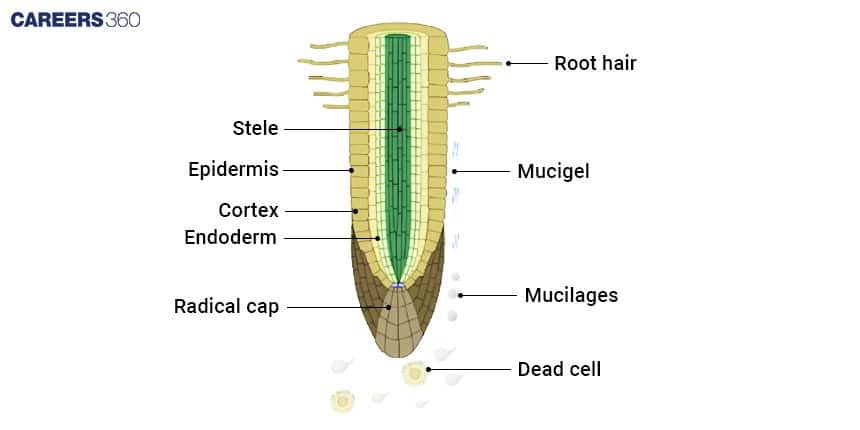
Root hairs are small, microscopic extensions of root epidermal cells. Thereby increasing the surface area between the root and the soil in water and nutrient uptake.
The root cortex is tissue found between the epidermis and the vascular tissue. This tissue makes it possible for water to be transported from the root hair to the xylem.
Xylem Tissue
The xylem tissue is responsible for the transpiration stream, defined as the upward movement of water, along with the dissolved minerals, from the root to the rest of the plant.
This is a collective result of capillary attraction, root pressure, and transpiration pull.
Types of Xylem Cells
Tracheids are long, slender cells with pointed ends and pits that allow water to pass easily.
Vessel elements are the wider and shorter cells connected to form continuous tubes for a faster flow of water.
Processes Supporting Water Absorption
The water absorption processes involve:
Root Pressure
Root pressure is the osmotic pressure in root system cells that pushes sap up a plant stem to the leaves.
This is a result of water being taken in by the root hairs from the soil exerting pressure pushing the water up through the xylem.
Capillary Action
Water can move through small spaces because of the cohesive and adhesive features of water without the application of an external force.
This becomes very significant in the ability to pull water through the fine vessels of the plants starting right from the roots to the leaves.
Transpiration Pull
Transpiration pull is the primary force elevating water up plants.
It occurs whenever there is some amount of evaporation of water from the surface of the leaves, creating tension in the xylem, which pulls water up from the roots.
Factors Affecting Water Absorption
There are several factors that affect the water absorption in plants:
Soil Water Content
Moist and well aerated soil promotes maximum uptake of water, while dry soil reduces the absorption.
Temperature and Light intensity
Higher temperature and light intensity increases the transpiration, enhancing water absorption.
Root Surface Area
A larger root surface area has more contact with soil and hence greater absorption.
Rate of Transpiration
Increased transpiration pull creates more negative pressure in xylem, creating more upward movement of water and promoting absorption.
Presence of Salts
High salt concentration in soil reduces the water potential, making it difficult for roots to absorb water.
Root Hair Health and Density
The more the number of root hairs, the more is the surface area for absorption
Difference Between Active and Passive Water Absorption
The difference between active and passive water absorption is:
Feature | Active Absorption | Passive Absorption |
Energy | Requires ATP | No energy |
Direction | Against the gradient | Along the gradient |
Major force | Osmotic pressure | Water potential difference |
Occurence | Low transpiration | High transpiration |
Example | Night time absorption | Daytime absorption |
Importance of Water Absorption
The importance of water absorption in plants is:
Maintains turgor pressure and cell expansion
Enables photosynthesis and respiration
Supports nutrient transport
Maintains transpiration stream for cooling
Regulates plant water balance and homeostasis
Water Absorption NEET MCQs (With Answers & Explanations)
The key concepts to be covered under this topic for different exams are:
Mechanism of Water Absorption
Factors Affecting Water Absorption
Practice Questions for NEET
Q1. Which one of the following statements is not correct for the Casparian strip?
It breaks the continuity of water movement through the apoplast pathway.
It is formed in the growing part of the root.
It is formed several millimetres or several centimetres behind the root tip.
It is a band within the radial cell walls of the endodermis that is impregnated with lignin
Correct answer: 2) It is formed in the growing part of the root.
Explanation:
The Casparian strip is not formed in the growing part of the root. It is a specialized region in the mature region of the root, specifically in the endodermal cells. The Casparian strip is a band of suberin and lignin impregnated in the radial cell walls of the endodermis, which surrounds the vascular tissue. Its main function is to create a waterproof barrier that blocks the movement of water and solutes through the apoplast pathway. The Casparian strip forces water and solutes to pass through the selectively permeable plasma membranes of the endodermal cells, allowing for regulation and control of nutrient uptake and transport in plants.
Hence, the correct answer is option 2) It is formed in the growing part of the root.
Q2. Which of the following physical force is responsible for the movement of water from cortex to the xylem elements?
Osmotic pressure
Diffusion
Suction pressure
Imbibition
Correct answer: 3) Suction pressure
Explanation:
There should be cell-to-cell movement for water in a plant starting in the root hair cells where this water is drawn from the soil. Then from the cortical cells, it keeps moving into xylem elements. This type of movement moves along a gradient of water potential, and so it is activated by suction forces created by leaf transpiration and the evaporation of water drawing negative pressure pulling water upwards, which enables effortless transport within a plant.
Hence, the correct answer is option 3) Suction pressure
Q3. Which of the following is impervious to water?
Cortical cells with suberised walls
Endodermal cells with suberised walls
Endodermal cells with cellulosic walls
Cortical cells with cellulosic walls
Correct answer: 2) Endodermal cells with suberised walls
Explanation:
The innermost layer of the cortex in plant roots is known as the endodermis. This layer comprises endodermal cells, and these cells carry suberized Casparian strips, meaning that they prevent water and solutes from moving through. Therefore, this creates a special filter that allows entry of nutrients essential for the plants while keeping undesirable substances away.
Hence, the correct answer is option 2) Endodermal cells with suberised walls.
Also Read:
Recommended video on "Water Absorption In Plants"
Frequently Asked Questions (FAQs)
Water absorption in plants is the process by which plants take up water from their environment, primarily through their roots. This process is crucial for plant survival, growth, and various physiological functions.
Water absorbed by roots is carried to the rest of the plant through vessels of the xylem. Apart from this, it serves as the supporting structure of plants.
Xerophytes are drought-adapted plants and hydrophytes are aquatic plants.
The process of transpiration develops tension within the plants and, therefore, provides a driving force for the pulling of water from the roots upwards through the xylem.
The process of osmosis is the absorption of water into the root hair. Water moves from highly concentrated in the soil to areas of low concentration in root cells.