


Respiration in Plants
Respiration in plants is a fundamental NEET Class 11 Biology topic. It explains how plants release energy through aerobic respiration and anaerobic respiration. It lacks lungs or specialised organs. Plants respire through stomata, lenticles and root hairs. In cellular respiration, glucose breaks down into carbon dioxide, water and ATP. This process includes Glycolysis, Kreb Cycle, and the Electron Transport Chain (ETC). These pathways are essential for plant growth, repair and metabolism.
This Story also Contains
- What Is Respiration in Plants?
- Do Plants Breathe?
- Types of Respiration in Plants
- Respiration in Different Plant Parts
- Cellular Respiration in Plants
- Factors Affecting Respiration in Plants
- Photosynthesis vs Respiration in Plants
- Plant Adaptations for Efficient Respiration
- Respiration NEET MCQs (With Answers & Explanations)
- Recommended Video on Respiration in Plants

Respiration in plants is the biochemical process by which glucose is broken down to release ATP energy. It occurs in roots, plant stems and leaves. Roots absorb oxygen from the soil air spaces. Stems use lenticels, and leaves exchange gases through stomata. Factors like temperature, oxygen concentration, water, light and nutrients affect respiration. Comparing photosynthesis vs respiration shows how plants balance energy production. For NEET preparation, students must practice MCQs on respiration in plants, aerobic vs anaerobic respiration, cellular respiration steps, and the amphibolic pathway to strengthen concepts.
What Is Respiration in Plants?
Respiration in plants is the process by which cells gain chemical energy. It occurs by consuming oxygen and releasing carbon dioxide. The respiration in plants involves oxygen and carbon dioxide, just like animal cells. Since plants do not have specific organs that allow for gas exchange, every part of the plant- roots, stems and leaves performs breathing. Gas exchange in plants happens through stomata, lenticels, and root hairs. In woody stems, lenticels are tiny pores on the bark that allow breathing. The respiration equation is.
C6H12O6+ 6O2 → 6CO2 + 6H2O + ATP
This shows that respiration in plants consumes oxygen and releases carbon dioxide while producing ATP energy for growth, repair, and metabolism.
Also Read:
Do Plants Breathe?
Plants do not breathe because they lack lungs or any other visible breathing system like animals. However, plants do breathe, but in a different way. Here are some important points to explain the respiration in plants concept further.
Plants "breathe" in the sense that they are capable of exchanging gases with the environment.
Gas exchange is required for respiration and photosynthesis.
Plants take up oxygen and give out carbon dioxide through stomata, lenticels, and root cells.
Breathing ensures the supply of oxygen for cellular respiration.
Efficient gas exchange is important for metabolic activities going on in a plant and overall plant health.
Types of Respiration in Plants
Like all living organisms, plants need energy for life processes. They obtain this energy through respiration in plants. There are two main forms of respiration in plants, i.e. aerobic respiration and anaerobic respiration.
Aerobic Respiration
Involves the presence of oxygen.
Steps: glycolysis pathway, the Krebs cycle, and the electron transport chain.
It results in the production of carbon dioxide, water, and a significant portion of ATP.
The amount of ATP obtained is utilised in accomplishing the activities essential for living organisms.
This is the most efficient form of cellular respiration in plants.
Anaerobic Respiration
It can happen in the absence of or low oxygen.
Commonly found in waterlogged soils or during intense metabolic activity.
Produce far less ATP compared to aerobic respiration.
Forms waste products like ethanol and lactic acid, which can be toxic if accumulated.
Seen in germinating seeds and stressed plant tissues.
Respiration in Different Plant Parts
Unlike animals, plants do not possess specialised respiratory organs. Respiration in plants occurs through different tissues such as roots, stems and leaves.
Root Respiration
The root system is responsible for respiration in plants. Soil contains oxygenated air and root hair helps absorb oxygen into the roots.
Air diffuses between soil particles, allowing oxygen to enter root hairs. During respiration, oxygen is transported from the root hairs to all parts of the roots.
Then the root hairs produce carbon dioxide gas during respiration, in the opposite direction from the roots.
Plants are prone to dying if they are watered too much for a long period of time. Water blocks the air between soil particles
Hence, the roots cannot perform aerobic respiration because oxygen is not freely available.
Germinating seeds have a seed coat that prevents oxygen from entering them, so they respire anaerobically during the early stages of seed germination.
Stem Respiration
Woody stems respire through lenticels on the bark.
Herbaceous stems exchange gases directly through epidermal cells.
Oxygen diffuses inward, while carbon dioxide diffuses outward.
Stem respiration provides energy for growth and the transport of nutrients.
Leaf Respiration
Gas exchange in leaves is controlled by the stomata.
The thin, flat nature of the leaves allows for efficient gas diffusion in plants.
During the day, the stomata are open. This allows the uptake of carbon dioxide needed for photosynthesis and oxygen to be released.
Oxygen is absorbed for respiration, and carbon dioxide is released as a byproduct.
Cellular Respiration in Plants
Cellular respiration in plants is a process by which glucose is broken down to release ATP energy. This energy is used for various purposes like growth, repair, and nutrient transport. In NEET Class 11 Biology, cellular respiration is a key topic because it explains how plants convert chemical energy into usable energy. The details are given below:
Glycolysis
Glycolysis occurs in the cytoplasm.
Glucose is broken down into two molecules of pyruvate.
Yields a net gain of 2 ATP and 2 NADH molecules.
It is an anaerobic process.
Krebs Cycle (Citric Acid Cycle)
Krebs cycle occurs in the mitochondrial matrix
Pyruvate is first converted into acetyl-CoA, which subsequently enters the cycle.
Yields CO2, NADH, FADH2 and 2 ATP per glucose molecule.
Completes oxidation of glucose derivatives.
Electron Transport Chain (ETC)
The electron transport chain occurs in the inner mitochondrial membrane
NADH and FADH2 donate electrons to the chain.
Electrons pass through protein complexes, driving proton pumping.
Protons flow back through ATP synthase, generating 34 ATP molecules.
Factors Affecting Respiration in Plants
The rate of respiration in plants is always constant. It is affected by different internal and external factors. Understanding these factors is important in NEET Class 11 Biology to know the health of a plant and its responses to environmental stress. Several factors can influence the process of respiration in plants:
Temperature
An increase in temperature normally increases respiration rates to a certain optimum value.
Very high temperatures can cause the denaturation of enzymes involved in respiration.
Oxygen Concentration
Oxygen should be optimally present for aerobic respiration.
Low oxygen conditions promote anaerobiosis.
Water Availablity
Water should be optimally present to carry out enzymatic activities and other cellular activities.
Drought stress reduces the ability of the plant cells to respire.
Light
It indirectly affects respiration, as light is essential for photosynthesis and consequently determines the level of carbohydrate availability.
Plants respire at all times, but they will only photosynthesise in the light.
Nutrients
Nutrients like nitrogen, potassium, and phosphorus are vital for metabolism.
Deficiency of nutrients limits respiration and plant growth.
Photosynthesis vs Respiration in Plants
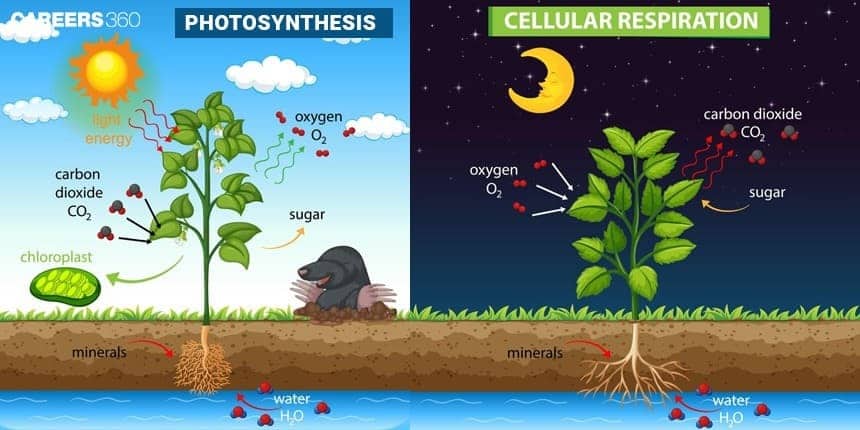
Both photosynthesis and respiration in plants are essential processes in NEET Class 11 Biology. Photosynthesis converts light energy into chemical energy, while respiration breaks down glucose to release ATP energy. The table below shows the difference between photosynthesis and respiration:
Feature | Photosynthesis | Respiration |
|---|---|---|
Occurs in | Chloroplasts | Mitochondria |
Energy Source | Light | Glucose |
Reactants | Carbon dioxide, water, light | Glucose, oxygen |
Products | Glucose, oxygen | Carbon dioxide, water, ATP |
Function | Converts light energy to chemical energy | Converts chemical energy to usable energy |
Time of Occurrence | Only in the presence of light | Continuously, day and night |
Electron Carrier Molecules | NADP+ | NAD+ and FAD |
Plant Adaptations for Efficient Respiration
Plants lack any specialised respiratory organs like animals. To survive in different environments, they develop adaptations for respiration in plants. Hence, they depend on various structures and physiological mechanisms to ensure smooth gas exchange and cellular respiration.
Aerenchyma tissues in roots allow the exchange of gases in waterlogged soils. The large surface area of roots readily absorbs oxygen.
Laterally flattened types of leaves increase the time for gas exchange.
In aquatic plants, leaves float on the water surface while air-filled cavities above ground ensure oxygen supply.
Desert plants have reduced stomata openings with thick cuticles to reduce loss of water and promote respiration.
Mangrove trees respire with the help of pneumatophores.
Respiration in plants occurs day and night, releasing carbon dioxide continuously.
Respiration NEET MCQs (With Answers & Explanations)
Important topics for NEET are:
Types of respiration
Respiration in different plant parts
Cellular respiration in plants
Practice Questions for NEET
Q1. The structures present in plants for the purpose of gaseous exchange are
Lenticels
Stomata
Nostrils
Both a and b
Correct answer: 4) Both a and b
Explanation:
Unlike animals, plants do not have specialized organs for gaseous exchange. Instead, they rely on structures like stomata, tiny openings found on the surfaces of leaves, and lenticels, small pores present on stems and woody parts. These structures allow the exchange of oxygen, carbon dioxide, and water vapour, enabling plants to carry out processes like photosynthesis and respiration effectively.
Hence, the correct option is 4) Both a and b
Q2. Respiratory pathway is called as amphibolic pathway because
It includes catabolic reactions
It includes anabolic reactions
It includes catabolic and anabolic reactions both
None of these
Correct answer: 4) None of these
Explanation:
Catabolic Role: In the respiration context, catabolism is the breakdown of glucose and other substrates for energy (ATP) through glycolysis, citric acid cycle, or oxidative phosphorylation. That energy would play an important role in lots of cell functions.
Anabolic Role: The respiratory pathway supplies intermediates for anabolic processes, such as amino acid synthesis, fatty acid synthesis, and nucleotide synthesis. These can be diverted out of the ways of catabolic reactions to be used in support of the synthesis of complex molecules needed for cell growth and repair.
It will then be possible to consider that as an amphibolic pathway, therefore, the respiratory pathway is an essential part of maintaining cellular metabolism through the production of energy and biosynthesis processes. This further provides a holistic view of metabolic flexibility within biochemical pathways and their interrelations.
Hence, the correct answer is option 4) None of these.
Q3. Which of the following exhibits the highest rate of respiration?
Growing shoot apex
Germinating seed
Root tip
Leaf bud
Correct answer: 2) Germinating seed
Explanation:
Germination is the process that has the maximum growth rate as compared to other options and has the highest respiration rate. During germination, the seed undergoes rapid metabolic activity to support cell division and elongation, resulting in a high growth rate. The increased respiration rate provides the necessary energy (ATP) for these intense developmental processes.
Hence, the correct answer is option 2) Germinating seed.
Also Read:
Recommended Video on Respiration in Plants
Frequently Asked Questions (FAQs)
Plants respire through stomata in leaves, lenticels in stems, and root hairs in roots, enabling gas exchange with the environment.
Aerobic respiration uses oxygen and produces high ATP, while anaerobic respiration occurs in low oxygen conditions, producing ethanol or lactic acid with less ATP.
Cellular respiration includes glycolysis, Krebs cycle, and the electron transport chain, yielding up to 38 ATP molecules per glucose.
It is amphibolic because it involves both catabolic (energy release) and anabolic (biosynthesis) reactions.
