KCC Institute of Legal and Higher Education, Greater Noida
Law Admissions 2026 Open | Avail Merit-Based Scholarships


The pituitary gland is a pea-sized endocrine gland located at the base of the brain and is often called the master gland. It regulates growth, metabolism, stress response, and reproduction by controlling other endocrine glands through hormone secretion. This guide explains the structure, hormones, functions, disorders, and NEET-focused MCQs on the pituitary gland.
This Story also Contains
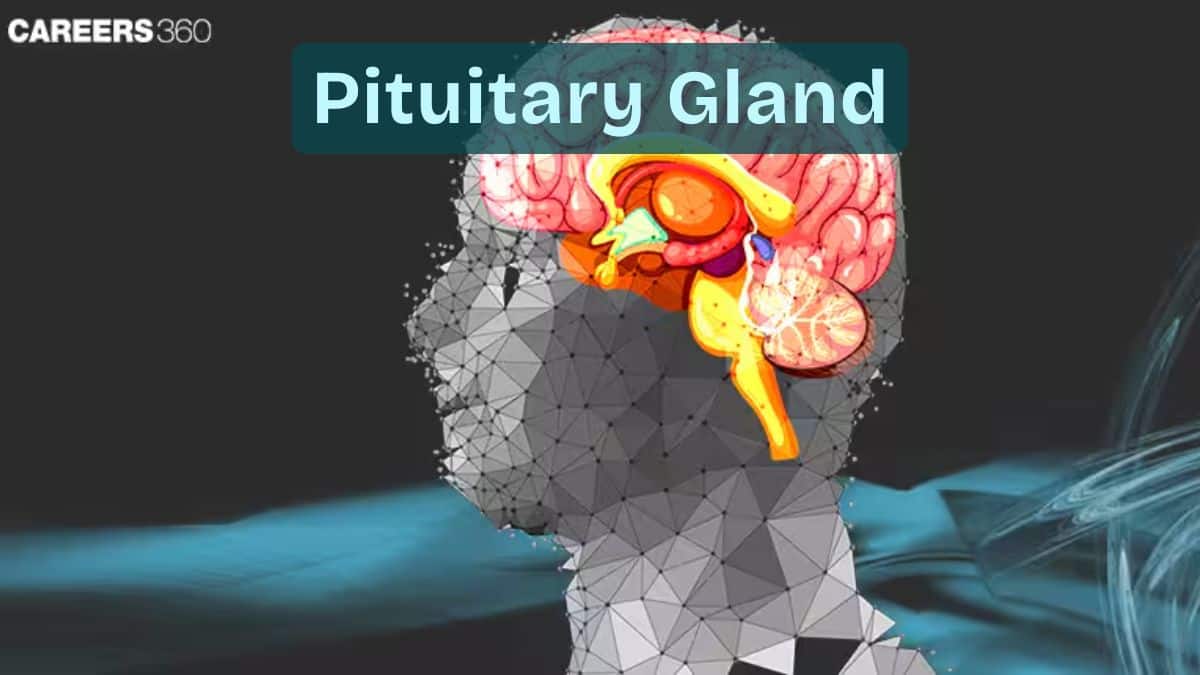
The pituitary gland is a very tiny, pea-sized endocrine organ. It is located at the bottom of the human brain within a small space called sella turcica, underneath the hypothalamus. This endocrine organ is often known as the "master gland." The function of the pituitary gland has to do with the secretion of several hormones that regulate the other endocrine glands as well as the most crucial body functions.
It has two anatomically and functionally separate portions: the anterior pituitary and the posterior pituitary.
Glandular tissue
Produces several trophic hormones
Law Admissions 2026 Open | Avail Merit-Based Scholarships
BBA/MBA/PGDM Early Bird Applications Deadline 19th Oct '26. Apply now using coupon code CAREER250 and get ₹250 off the application fee
Neural tissue
Stores and releases hypothalamic hormones
The pituitary gland has a broad regulatory function in various bodily functions:
Controls the performance of other endocrine glands through the production and secretion of a variety of hormones
Regulation of growth and development
Controls metabolism
Regulates stress response
Influences reproductive functions
The following hormones are secreted by the anterior lobe of the pituitary gland:
| Hormones | Description |
|---|---|
Growth hormone (GH) | Promotes growth, tissue repair, and protein synthesis for overall development. |
Thyroid-stimulating hormone (TSH) | Controls the release of T3 and T4 hormones from the thyroid gland, affecting metabolism, energy, and growth. |
Adrenocorticotropic hormone (ACTH) | Stimulates the adrenal cortex to release cortisol, important for stress response, metabolism, and inflammation. |
Prolactin (PRL) | Maintains milk production in mammary glands |
Follicle-stimulating hormone (FSH) | Involved in the development of ovarian follicles in women and spermatogenesis in men. |
Luteinizing hormone (LH) | Involved in ovulation and sex hormone production in both males and females. |
There are two main hormones secreted by the posterior lobe of the pituitary gland, namely:
Stimulates uterine contractions during the process of labour and facilitates milk ejection when breastfeeding. Additionally, it influences social attachment.
Regulation of other endocrine glands includes:
TSH from the anterior pituitary will stimulate the thyroid gland in the production of thyroid hormones. These take responsibility for the regulation of metabolism and energy.
ACTH stimulates the adrenal cortex to secrete cortisol. It acts on stress response and metabolism.
FSH and LH act on reproductive activity by the production of sex hormones and gamete, acting on fertility and secondary sexual characteristics.
Some common disorders of the pituitary gland include:
Condition related to minimal secretion of pituitary hormones
Symptoms like fatigue, weight loss, delayed growth
Treatment is hormone replacement so that the hormonal levels return to normal.
Condition caused by excessive secretions of hormones.
High GH levels leads to acromegaly or gigantism
Excessive secretion of Prolactin causes galactorrhea.
Treatment can usually be medication, radiation therapy, or rarely surgery.
Known as hypophysial adenomas, these may either function or non-function.
May cause headache, vision problems
Treatment includes surgical intervention, radiation therapy or medication.
Important questions asked in NEET from this topic are:
Hypothalamic hormones and their functions
Anatomy of Hypothalamus
Q1. The pituitary gland lies in the
Sella turcica
Buccal cavity
Diencephalon
None of these
Correct answer: 1) Sella turcica
Explanation:
The pituitary gland develops from the ectoderm. It is located just below the hypothalamus located in a bony cavity called Sella turcica of the sphenoid bone of the skull. It is attached to the brain by a stalk called the infundibulum which is in continuation with the hypothalamus. The pituitary gland is made up of two main lobes of different origin.
Hence, the correct answer is option 1) Sella turcica.
Q2. The hormone responsible for the stimulation of the growth of bones, cartilage, muscles, visceral organs and the body as a whole is
Adrenocorticotropic hormone
Somatotrophic hormone
Luteinizing hormone
Prolactin
Correct answer: 2) Somatotrophic hormone
Explanation:
Somatotrophic hormone (STH) is another name for growth hormone. It promotes the development of muscles, cartilage, bones, visceral organs, and the body overall. Moreover, it stimulates glycogenolysis, intestinal calcium absorption, and protein synthesis.
Hence, the correct answer is option 2) The hormone responsible for the stimulation of the growth of bones, cartilage, muscles, visceral organs and the body as a whole is the somatotrophic hormone.
Q3. Which part of Pituitary Gland originates as Rathke's Pouch?
Anterior Pituitary
Posterior Pituitary
Intermediate Lobe
Entire Gland
Correct answer: 1) Anterior Pituitary
Explanation:
Adenohypophysis / Anterior Pituitary/ Pars Distalis originates as Rathke's Pouch while Neurohypophysis originates from the floor of the diencephalon. Both of these regions of the pituitary gland have their distinct functions. The anterior pituitary secretes various hormones while the posterior pituitary stores and releases hormones produced by the hypothalamus.
Hence, the correct answer is option1) Anterior Pituitary.
Also Read:
Frequently Asked Questions (FAQs)
The diagnosis is usually made by measuring the hormonal levels in the blood using immunological techniques, imaging techniques like CT or MRI, and stimulation tests. The treatments for these conditions include medication, surgery, and radiation therapy.
Most physiological functions are controlled by the pituitary hormone with its roles in growth, metabolism, and reproduction.
The anterior pituitary secretes several hormones, mentioning but a few: the growth hormone and luteinizing hormone, LH.
The hypothalamic-pituitary control is mediated through the releasing and inhibiting hormones forming a feedback loop and therefore serves to regulate the level of hormones.
Common disorders are hypopituitarism, hyperpituitarism, and pituitary tumours. Each one leads to impaired production of the hormones and hence impinges on health.


Law Admissions 2026 Open | Avail Merit-Based Scholarships
BBA/MBA/PGDM Early Bird Applications Deadline 19th Oct '26. Apply now using coupon code CAREER250 and get ₹250 off the application fee
Ranked #36 amongst institutions in Management by NIRF | 100% Placement
Globally Recognized by AACSB (US) & AMBA (UK) | 18 LPA Avg. CTC for PGPM 2026
Leading Design College | 95% Placement Record | Merit-cum-Means Scholarships for Deserving Students
NEET PG All India & State College Predictor with Admission Process Guide