KCC Institute of Legal and Higher Education, Greater Noida
Law Admissions 2026 Open | Avail Merit-Based Scholarships


Spermatogenesis is the biological process of sperm cell formation inside the testes. It begins with special cells called spermatogonia. Spermatogonia are fully matured into spermatozoa, called sperm cells. The definition of spermatogenesis explains how male gametes are produced through mitosis and meiosis. This process is essential for sexual reproduction, and understanding spermatogenesis stages is important for NEET biology and Class 12 board exam preparation.
This Story also Contains
The process of spermatogenesis occurs in seminiferous tubules under the control of hormones like FSH, LH, and testosterone. It includes stages such as spermatogonial multiplication, meiosis, and spermiogenesis. Each stage ensures proper development of functional sperm cells. The hormonal control of the male reproductive system maintains continuous sperm production in males. This topic links reproduction, endocrinology, and genetics, making it a high-yield concept for exams.
Spermatogenesis is the process of forming sperm cells in the bodies of male organisms. The process is in connection with the need for sexual reproduction and the propagation of genetic material from one generation to the next.
In the case of the male reproductive system, a rather complex series of steps is involved in developing a primordial germ cell into a mature and motile spermatozoon, potentially fertilizable by an egg. Hence, it is a very important process that can influence male fertility and the propagation of species.
Law Admissions 2026 Open | Avail Merit-Based Scholarships
BBA/MBA/PGDM Early Bird Applications Deadline 19th Oct '26. Apply now using coupon code CAREER250 and get ₹250 off the application fee
Spermatogenesis is a process by which sexual reproduction is realised through the provision of male gametes for fertilisation. In the absence of effective production and maturation of the sperm, successful reproduction is not possible. Thus, it is indispensable for the survival of the species.
Spermatogenesis happens inside the seminiferous tubules of the testes. Tightly coiled, they provide a special environment where the sperm cells develop and mature with the help of different cell types and hormones. After sperm are produced in the seminiferous tubules, they pass through the male sex accessory ducts for maturation and transport.
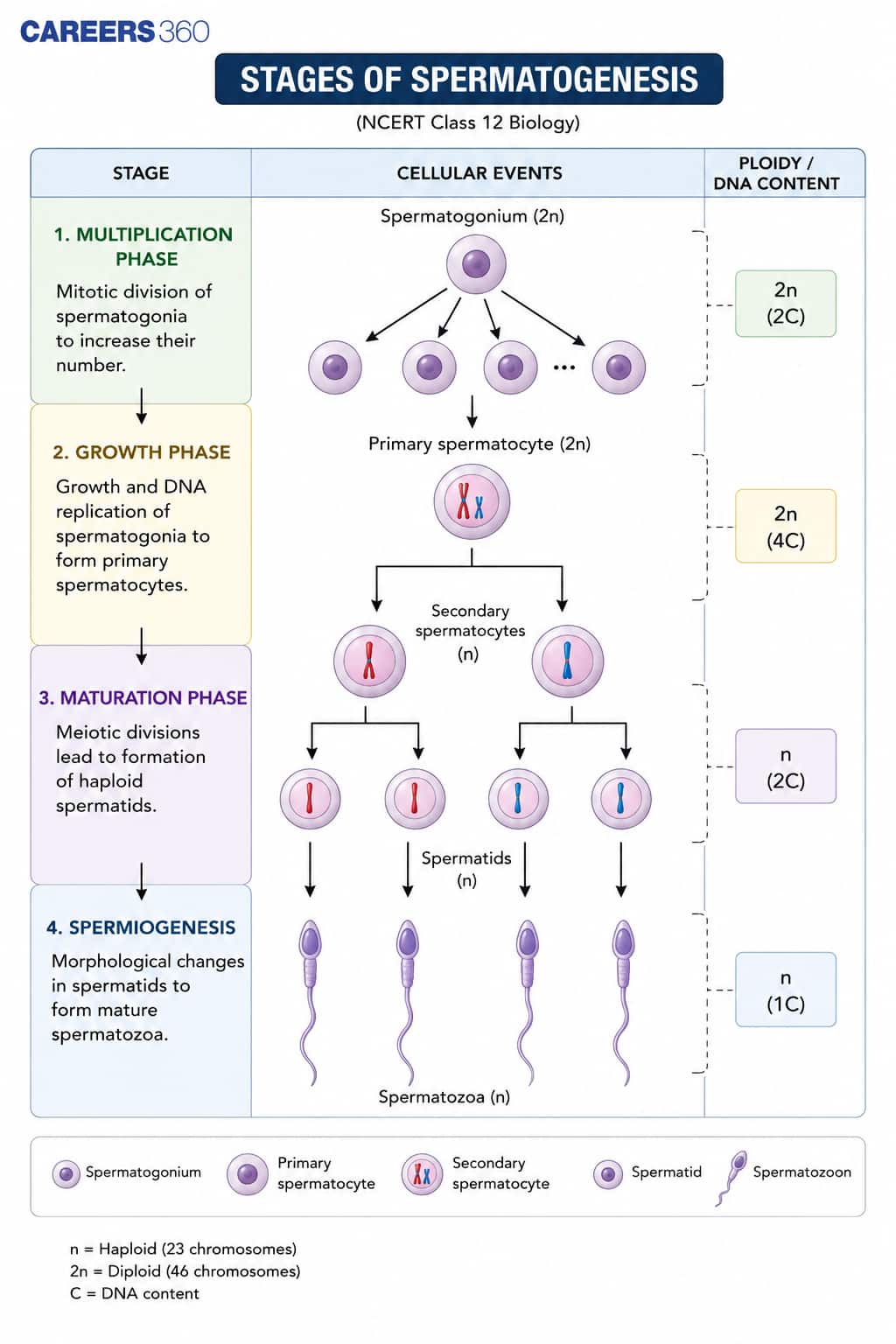
Spermatogenesis constitutes all processes that ultimately result in the transformation of spermatogonia into mature spermatozoa. It is regulated by hormones from male accessory glands and hormones like FSH, LH, and Testosterone. The stages of Spermatogenesis are listed below:
Spermatocytogenesis
Diploid stem cells are located in the seminiferous tubules.
Divide by mitosis to produce more spermatogonia and cells that will differentiate into sperm.
Types of spermatogonia (A and B).
Primary spermatocytes to secondary spermatocytes.
Secondary spermatocytes to spermatids.
Spermiogenesis
Spermatid differentiation to mature spermatozoa
Spermiogenesis Morphological changes
During the spermatogenesis process, the structure of sperm is formed in the final stage, having a head, midpiece, and tail for movement.
Spermatogonia → Primary Spermatocytes → Secondary Spermatocytes → Spermatids → Spermatozoan
Spermatogonia (2n): Divide by mitosis.
Primary spermatocytes (2n): Enter meiosis I.
Secondary spermatocytes (n): Enter meiosis II.
Spermatids (n): Immature haploid cells.
Spermatozoan (n): Mature functional sperm cells.
The control of spermatogenesis depends on hormones like FSH, LH, and testosterone. These hormones work together through hypothalamic and pituitary regulation to maintain sperm production. The hormonal control is listed below-
FSH (Follicle-Stimulating Hormone)
Causes stimulation of the Sertoli cells within the seminiferous tubules, helping spermatogenesis
Providing nourishment to developing sperm cells.
LH (Luteinizing Hormone)
Causes stimulation of Leydig cells to produce testosterone.
This then causes initiation and maintenance of spermatogenesis.
Testosterone
Causes developing sperm cells to mature and maintain libido
It also generally supports the process of spermatogenesis.
Hypothalamic Regulation
The hypothalamus releases the gonadotropin-releasing hormone GnRH.
This GnRH goes on to cause the anterior pituitary to release FSH and LH.
Pituitary Gland Feedback
High levels of testosterone and inhibin feed back to the hypothalamus to prevent GnRH release, and to the pituitary to prevent FSH/LH release.
This forms the basis for the homeostatic regulation of hormone levels and spermatogenesis.
Spermatogenesis is vital for male fertility and human reproduction. It ensures the formation of haploid sperm cells through meiosis. The process maintains genetic stability and supports species survival.
Spermatogenesis produces functional sperm cells for fertilisation.
It maintains chromosome number by forming haploid gametes.
Hormones like FSH, LH, and testosterone regulate the process.
It ensures genetic diversity and stability in offspring.
Continuous sperm production supports male fertility.
Many factors affect spermatogenesis. Genetics, heat, chemicals, and poor habits can lower sperm count. Good food and vitamins help keep sperm healthy. It can be affected by several factors, thereby affecting its efficiency and effectiveness.
Mutations can affect normal sperm production or function and lead to infertility or another type of reproductive issue. The molecular basis of mutation explains how changes at the DNA level can disrupt genes responsible for spermatogenesis.
Examples include disorders like Klinefelter syndrome or even Y-chromosome microdeletion, which are common disorders of the human reproductive system that affect spermatogenesis and fertility.
Temperature: Elevated temperatures due to tight clothing or prolonged exposure to heat negatively affect spermatogenesis.
Exposure to Toxic Agents and Chemicals: Toxins and chemicals, examples of which include pesticides, heavy metals, industrial pollutants, etc., have very bad effects on the production and quality of sperm.
Lifestyle Factors: Smoking, excessive drinking, and use of recreational drugs all these habits decrease sperm count and motility.
Impact of Diet and Nutrients: The overall impact is that a balanced diet works for the well-being of the body as a whole and produces healthy sperm.
The deficiency of some of the key nutrients hampers spermatogenesis.
Importance of Vitamins and Minerals: Vitamins C and E, zinc, and folic acid play a very important role in maintaining healthy sperm production and function.
Question: Spermiation is a process of
Spermatozoa production.
Transform secondary spermatocytes to spermatids.
Release of spermatozoa from seminiferous tubules.
Transform spermatids to spermatozoa.
Answer: In the testis, the immature male germ cells (spermatogonia) produce sperm by spermatogenesis that begins at puberty.
The spermatogonia (sing. spermatogonium) present in the inside wall of seminiferous tubules multiply by mitotic division and increase in numbers.
Each spermatogonium is diploid and contains 46 chromosomes.
Some of the spermatogonia called primary spermatocytes periodically undergo meiosis. A primary spermatocyte completes the first meiotic division (reduction division) leading to the formation of two equal, haploid cells called secondary spermatocytes, which have only 23 chromosomes each.
Secondary spermatocytes undergo the second meiotic division to produce four equal, haploid spermatids, so option 2 is incorrect.
Spermatids are transformed into spermatozoa (sperm) by a process called spermiogenesis. Hence, options 1 and 4 are incorrect.
After spermiogenesis, sperm heads become embedded in the Sertoli cells and are finally released from the seminiferous tubules by spermiation.
Hence, the correct answer is option 3) Release of spermatozoa from seminiferous tubules.
Question: Spermatozoa are produced from ____?
Secondary spermatocytes
Spermatids
Spermatogonia
Spermiation
Answer: Some of the spermatogonia called primary spermatocytes periodically undergo meiosis. A primary spermatocyte completes the first meiotic division (reduction division), leading to the formation of two equal, haploid cells called secondary spermatocytes, which have only 23 chromosomes each. Hence, option 3 is incorrect.
The secondary spermatocytes undergo the second meiotic division to produce four equal, haploid spermatids. Hence option 1 is incorrect.
The spermatids are transformed into spermatozoa (sperm) by a process called spermiogenesis. Hence option 2 is correct.
After spermiogenesis, sperm heads become embedded in the Sertoli cells and are finally released from the seminiferous tubules by the process called spermiation. So, 4 is incorrect.
Hence, the correct answer is option 2) Spermatids.
Question: How many haploid spermatids are produced from a diploid spermatogonium?
One
Two
Three
Four
Answer: During spermatogenesis, a diploid spermatogonium divides into four haploid spermatids. The spermatogonium first divides mitotically to produce diploid primary spermatocytes. Each main spermatocyte then proceeds through the first meiotic division, producing two haploid secondary spermatocytes. These secondary spermatocytes undertake the second meiotic division, which produces four haploid spermatids.
Hence, the correct answer is option 4) Four.
Frequently Asked Questions (FAQs)
Spermatogenesis is the process of sperm cell formation inside the testes through mitosis and meiosis that occurs in the seminiferous tubules of the testes.
Stages include spermatogonial multiplication, meiosis, and spermiogenesis, leading to mature spermatozoa.
Spermatogonia → Primary Spermatocytes → Secondary Spermatocytes → Spermatids → Spermatozoan
Hormones involved in this include FSH, LH, and testosterone, whose actions are properly regulated by negative feedback mechanisms involving the hypothalamus and pituitary gland.
Genetic mutations, temperature, toxins, advanced paternal age, bad diet, smoking, and alcohol all have impacts on spermatogenesis.
The common disorders may be azoospermia and oligospermia. Diagnosis is by semen analysis. Treatment varies from hormonal therapy to ART.


Law Admissions 2026 Open | Avail Merit-Based Scholarships
BBA/MBA/PGDM Early Bird Applications Deadline 19th Oct '26. Apply now using coupon code CAREER250 and get ₹250 off the application fee
Ranked #36 amongst institutions in Management by NIRF | 100% Placement
Globally Recognized by AACSB (US) & AMBA (UK) | 18 LPA Avg. CTC for PGPM 2026
Leading Design College | 95% Placement Record | Merit-cum-Means Scholarships for Deserving Students
NEET PG All India & State College Predictor with Admission Process Guide