KCC Institute of Legal and Higher Education, Greater Noida
Law Admissions 2026 Open | Avail Merit-Based Scholarships


Aerobic respiration is the complete breakdown of glucose in the presence of oxygen to produce 36–38 ATP, carbon dioxide, and water. It is the most efficient energy-yielding pathway in plants, animals, and microorganisms. Understanding glycolysis, Krebs cycle, and oxidative phosphorylation is essential for NCERT Class 11 and NEET.
This Story also Contains
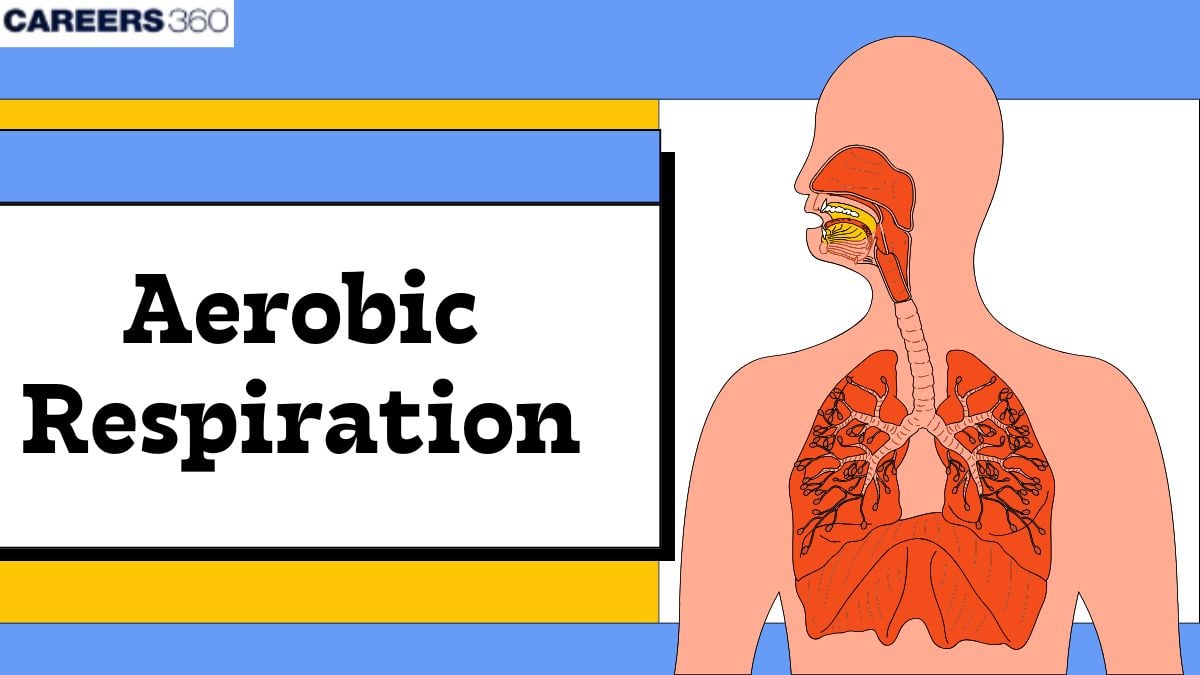
Cellular respiration can be classified into aerobic and anaerobic forms. Aerobic respiration is also known as aerobic metabolism or oxidative metabolism. It is a chemical process where oxygen is utilised to form energy from carbohydrates. It can be represented by the equation:
Glucose (C6H12O6) + Oxygen 6(O2) → Carbon-dioxide 6(CO2) + Water 6 (H2O) + Energy (ATP)
Some basic points about aerobic respiration are discussed below:
Aerobic respiration is performed in the presence of oxygen where organisms use oxygen to convert fats and sugar to convert it into chemical energy.
Aerobic respiration generally produces high amounts of energy which is typically between 36-38 ATP.
The energy released is 2900kJ and further this is used to generate energy in the form of ATP.
The byproducts of aerobic respiration are carbon dioxide (CO2) and water (H2O)
There is long-term sustenance of energy which keeps us energy for long periods.
This oxygen is entered into the stomata of plant cells and reaches the epidermis cell present in the leaf and stem. This is done during the respiration process.
During photosynthesis, the energy is released in the form of food.
Four steps are occurring in the respiration process:
Glycolysis occurs in the cytosol where glucose is broken down into two molecules of ATP and two molecules of NADH.
Law Admissions 2026 Open | Avail Merit-Based Scholarships
BBA/MBA/PGDM Early Bird Applications Deadline 19th Oct '26. Apply now using coupon code CAREER250 and get ₹250 off the application fee
Pyruvate is oxidized in mitochondria.
This forms a 2-carbon Acetyl group. This is further combined with coenzyme A.
In Krebs cycle, oxaloacetate binds to acetyl coenzyme A and citric acid is produced.
Two molecules of CO2 and one ATP are formed.
The reduced form of NADH and FADH is formed.
Involves multiple reactions which produce CO2 and one ATP.
A large amount of energy is released in the form of ATP.
ETC takes place due to the transfer of electrons from NADH and FADH.
It results in 34 ATP Molecules from one glucose molecule.
Different processes yield different amount of ATP:
Step | ATP |
Glycolysis | 2 |
Krebs Cycle | 2 |
ETC | 32-34 |
Total | 36-38 ATP |
Differences between aerobic and anaerobic respiration are given below:
Aspect | Aerobic respiration | Anaerobic respiration |
Oxygen | Required | Not required |
Energy Yields | 36-38 ATP per Molecules | 2 ATP per Molecules |
Byproducts | Carbon dioxide and water | Lactic acid in animals and ethanol in yeast |
Location | Cytoplasm and mitochondria | |
Duration of process | Suitable for sustainable sources of energy. | Short bursts of energy. |
The importance of aerobic respiration can be discussed as follows:
Energy production for all processes in cells.
ATP production leads to other important functions like growth, repair, and maintenance.
ATP provides energy for the sodium-potassium pump, which helps in movement, thinking, and coordinating with the outer world, for example.
ATP also provides energy for proteins and enzymes to function.
The aerobic respiration process is connected to weight loss due to the high metabolic rate that comes with it. Due to this, high calories are burnt during workouts and energy is restored from the fats stored in the body. Some important mechanisms are discussed below in the points.
The carbon atoms released as carbon dioxide come from the food we eat, which is sugar or fat.
We tend to breathe heavily while exercising and engaging in calorie burning activities. This is when the body burns out more oxygen and sugar at a faster rate than normal, and there is more production of ATP for energy generation. More carbon dioxide is emitted.
When the body uses ATP at a faster rate than normal, to compensate for the need for more oxygen molecules for the cells, the cells start performing anaerobic respiration to supply oxygen at a fast rate.
As a result, this process burns more sugar and fat in the body, causing the body to lose weight.
Important topics for NEET are:
Steps of Aerobic respiration
ATP yield in Anaerobic respiration
Aerobic vs Anaerobic respiration
Q1. Identify the step in the tricarboxylic acid cycle that does not involve oxidation of the substrate.
Malic acid → Oxaloacetic acid
Succinic acid → Malic acid
Succinyl-CoA → Succinic acid
Isocitrate → alpha-ketoglutaric acid
Correct answer: 3) Succinyl-CoA → Succinic acid
Explanation:
Oxidation does imply the loss of electrons, often in the form of hydrogen, from a molecule, thereby increasing its oxidation state. Often this process is associated with the transfer of electrons to an electron acceptor, which is reduced.
The most fundamental oxidation-independent key reaction of the TCA cycle is the transmutation of succinyl CoA to succinate. Succinyl-CoA synthetase catalyzes the step, where it results in the release of CoA and forms succinate while generating GTP or ATP by substrate-level phosphorylation.
Hence, though most reactions in the TCA cycle are oxidation reactions, this reaction of succinyl CoA being reduced to succinate is the exception, in which the acceptor molecule does not get oxidized but instead takes part in substrate-level phosphorylation for the release of energy.
Hence, the correct answer is Option 3) Succinyl-CoA → Succinic acid
Q2. The ultimate electron acceptor of respiration in an aerobic organism is
Cytochrome
Oxygen
Hydrogen
Glucose
Correct answer: 2) Oxygen
Explanation:
Oxygen is the final electron acceptor in the electron transport chain during aerobic respiration.
This process involves the transmission of electrons via a sequence of protein complexes in the mitochondrial membrane, which eventually combine with protons and oxygen to produce water (H2O).
Because of its high electronegativity, oxygen is very good at taking up electrons, which promotes oxidative phosphorylation, which produces ATP.
The electron transport chain would stop working in the absence of oxygen, forcing aerobic organisms to rely on less effective energy-producing mechanisms like fermentation or anaerobic respiration.
Hence, the correct answer is option 2) Oxygen.
Q3. The breaking of the C-C bonds of complex compounds through oxidation within the cells, leading to the release of a considerable amount of energy is called
Photosynthesis
Glycolysis
Cellular respiration
Breathing
Correct answer: 3) Cellular respiration
Explanation:
The breaking of the C-C bonds of complex compounds through oxidation within the cells, leading to the release of a considerable amount of energy is called respiration. Respiration occurs in multiple steps including glycolysis, the Krebs cycle, and the electron transport chain, and can be classified as aerobic or anaerobic.
Hence, the correct answer is option 3) Cellular respiration.
Also Read:
Frequently Asked Questions (FAQs)
There are 4 different kinds of aerobes: obligate aerobes, facultative aerobes, and microaerophiles.
The mitochondrial matrix of the cell is the location where aerobic respiration takes place. where anaerobic respiration takes place in the fluid region of the cytoplasm.
The end products of aerobic respiration are carbon dioxide, water, and ATP molecules.
The steps of aerobic respiration are glycolysis, formation of acetyl coenzyme A, the citric acid cycle, and the electron transport chain.
ATP is referred to as the "currency" of the cell because it utilises the energy preserved in its phosphate bonds for chemical reactions inside the cell.


Law Admissions 2026 Open | Avail Merit-Based Scholarships
BBA/MBA/PGDM Early Bird Applications Deadline 19th Oct '26. Apply now using coupon code CAREER250 and get ₹250 off the application fee
Ranked #36 amongst institutions in Management by NIRF | 100% Placement
Globally Recognized by AACSB (US) & AMBA (UK) | 18 LPA Avg. CTC for PGPM 2026
Leading Design College | 95% Placement Record | Merit-cum-Means Scholarships for Deserving Students
NEET PG All India & State College Predictor with Admission Process Guide