


Coefficient of Viscosity - Definition, Formula, Types, Application, FAQs
Viscosity is defined as the degree to which a fluid resists flow when subjected to a force; it is calculated by dividing the tangential friction force acting per unit area by the velocity gradient under streamlined flow circumstances. Viscosity is an important rheological measurement that is directly related to flow resistance. A fluid's viscosity is defined as its resistance to flow.
This Story also Contains
- Viscosity Measurement
- The Coefficient of Viscosity Formula
- Numerically
- Applications of Viscosity
- Some Solved Examples
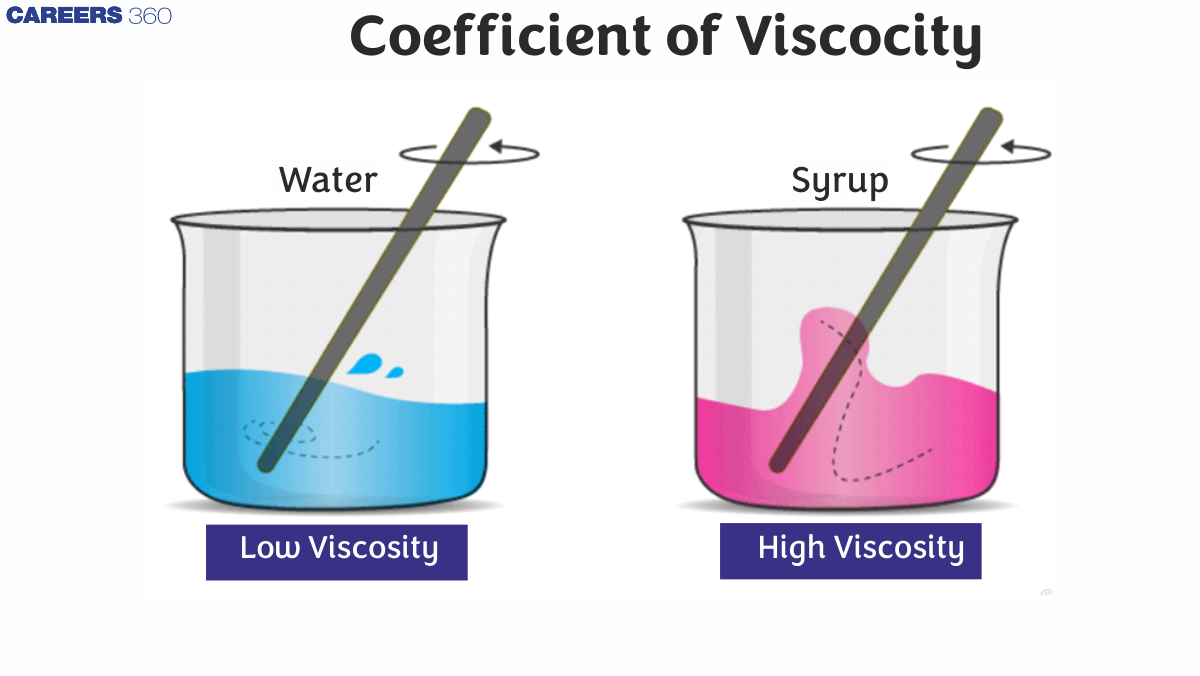
The coefficient of viscosity of liquids such as the coefficient of viscosity of water, alcohols, petrol, and others flow more readily and quickly than glycerin solution, honey, and oil. This is due to its viscosity, which is a physical attribute. It illustrates the fluid's flow resistance in simple terms.
Viscosity Measurement
The coefficient of viscosity is used to calculate the viscosity. It is constant for a liquid and is determined by the type of the liquid. When a liquid flows through a tube at varied pressures, Poiseuille's method is formally employed to estimate the coefficient of viscosity.
Fluid's coefficient of viscosity decreases as temperature rises, whereas gases' coefficient of viscosity rises in the opposite direction. The coefficient of viscosity of gases increases as the temperature rises. The fluid's temperature rises, loosening the connections between molecules. These bonds are directly related to viscosity, resulting in a drop in the coefficient.
The Coefficient of Viscosity Formula
The coefficient of viscosity is the ratio of the shearing force to the fluid's velocity gradient.
The symbol of the coefficient of viscosity is η. As a result, the viscosity coefficient is given by,
$\eta=F . d / A . v$
Here, F is the tangential force needed to maintain a unit velocity gradient between two parallel liquid layers of equal area.
v stands for velocity.
A stands for the area.
d is the distance between the two liquid layers skidding over one another.
The velocity gradient is defined as the differential in velocity between neighboring layers of a fluid stream.
Also read :
Numerically
Coefficient of viscosity (η) = Fd/Av, where F denotes extraneous power, d denotes layer separation, and v denotes speed.
Force Dimensional Formula = $M^1 L^1 T^{-2}$
Area Dimensional Formula = $\mathrm{M}^{\circ} \mathrm{L}^2 \mathrm{~T}^{\circ}$
Distance Formula in Dimensions = $M^0 L^1 T^0$
$M^0 L^1 T^{-1}$ is the dimensional formula for velocity.
Combining these traits in the preceding criteria, we get
$[\eta]=\left[M^1 L^1 T^{-2}\right]\left[M^0 L^1 T^0\right] /\left[M^0 L^2 T^0\right]\left[M^0 L^1 T^{-1}\right]=\left[M^1 L^{-1} T^{-1}\right]$
Types of Viscosity
Dynamic and kinematic viscosities are the two distinct estimates of viscosity used to depict fluids.
These depict the growth of the liquid in various ways viscosity depends on how they are approximated; nevertheless, if the liquid viscosity is known, they are compatible.
Unique viscosity and kinematic viscosity v are the two types of viscosity that are commonly used.
Dynamic Viscosity
The shear worry to shear rate for a liquid is measured using dynamic viscosity.
The condition μ = ρν where ρ is the viscosity of the liquid, identifies dynamic viscosity with kinematic viscosity.
The centipoise is the unit of dynamic viscosity is μ. If liquid viscosity is measured in grams per cubic centimeter, kinematic viscosity is measured in centistoke.
As a result, 1 centistoke becomes 1 centipoise when separated by 1 g/cc.
Kinematic Viscosity
The ratio of viscous power to inertial power on a liquid is measured by kinematic viscosity.
The diffusivity of mass as well as warmth which is the diffusivity of energy, can be compared to kinematic viscosity.
Applications of Viscosity
- Vehicles with oil
When it comes to putting oil in the car or truck, one should be aware of its viscosity. This is because factors affecting viscosity grating, and erosion factors affecting viscosity heat as a result.
Some oils have a constant viscosity, while others respond to heat or cold; if the oil's viscosity list is low, it may become thinner as it warms, causing problems when the car is working on a hot summer day.
-
Cooking
Viscosity plays an important role in the preparation and serving of food. Cooking oils' viscosity can alter as they heat, and many become significantly more viscous as they cool.
When fats are warmed, they become viscous, but when they are cold, they become powerful. The viscosity of sauces, soups, and stews also influences different cooking styles.
-
Assembling
To run smoothly, adequate oil is required while assembling hardware. Oils that are excessively thick can clog pipelines and cause them to shut down. Ointments that are excessively thin provide insufficient protection for moving parts.
-
Gel Medicine (Medication)
As liquids are injected into the body intravenously, viscosity is crucial in medicine.
Blood viscosity is a significant problem: excessively thick blood might form dangerous internal clusters, but blood that is too thin won't clump, resulting in dangerous blood misfortune and even death.
Also read -
Some Solved Examples
Question 1:The SI unit of coefficient of viscosity is:
A. $\mathrm{N} \mathrm{m}^{-1} \mathrm{~s}$
B. $\mathrm{N} \mathrm{s} \mathrm{m}^{-2}$
C. $\mathrm{kg} \mathrm{m}^{-1} \mathrm{~s}^{-2}$
D. $\mathrm{m}^2 \mathrm{~s}^{-1}$
Solution:
Viscosity is defined as:
$\eta=\frac{\text { shearing stress }}{\text { velocity gradient }}$
SI unit:
$\eta=\frac{\mathrm{Nm}^{-2}}{\mathrm{~s}^{-1}}=\mathrm{N} \mathrm{~s} \mathrm{~m}^{-2}$
Hence, the correct answer is option (B)
Question 2: Which of the following liquids has the highest coefficient of viscosity at room temperature?
A. Water
B. Benzene
C. Glycerol
D. Ether
Solution:
Stronger intermolecular forces → higher viscosity.
Glycerol has extensive hydrogen bonding.
Hence, the correct answer is option (C)
Question 3: The coefficient of viscosity of a liquid:
A. Increases with increase in temperature
B. Decreases with increase in temperature
C. Is independent of temperature
D. First increases then decreases
Solution :
For liquids:
- Increase in temperature → reduced intermolecular attraction
- Hence viscosity decreases
Hence, the correct answer is option (B)
Question 4: If the velocity gradient between two layers of a liquid is doubled, the viscous force will:
A. Become half
B. Become double
C. Become four times
D. Remain unchanged
Solution :
Solution:
Viscous force ∝ velocity gradient
Doubling velocity gradient → viscous force doubles.
Hence, the correct answer is option (B)
Frequently Asked Questions (FAQs)
The coefficient of viscosity is typically expressed in units of Pascal-seconds (Pa·s) in the SI system. In the CGS system, it is expressed in poise (P), where 1 P = 0.1 Pa·s. Additionally, the centipoise (cP) is a commonly used unit, where 1 cP = 0.001 Pa·s.
The coefficient of viscosity is a measure of a fluid's resistance to flow. It quantifies how thick or sticky a fluid is. Higher values indicate greater resistance to flow, while lower values indicate a more fluid behavior.
Thesintermolecular interactions hinder the fluid's shearing movement, and the strength of these forces is related to the fluid's viscosity. Internal friction increases when the force of attraction between the molecules in the liquid becomes stronger. As a result, the viscosity of a fluid is named after the property of friction. It's usually measured in centipoise (cP), which is equal to 1 metre of pressure (millipascal second).
There are some real-life examples that can be used to explain viscosity.
i. Viscous items (dishwasher or hand wash) are used in daily life since the viscosity of the fluid determines how successful it is at washing hands and utensils.
ii. Another example is oil, which, when a drop of it falls on the surface, forms a tiny spherical shape on the surface.
The ratio of viscous power to inertial power on a liquid is measured by kinematic viscosity.
The diffusivity of mass as well as warm which is diffusivity of energy, can be compared to kinematic viscosity.