


Electric charges and fields
The Class 12 Physics curriculum includes Electric Charges and Fields, one of the fundamental chapters of the curriculum, which is the building block of electrostatics. We also learn in this chapter the origin of electric charge, which produces electric forces and electric fields, which enable us to explain natural phenomena in a quantitative and scientific way. Physics explains nature in terms of measurement, comparison, and mathematical associations, and this is the key to the explanation of electric interactions.
Electric charge is a physical quantity, and it is essential to discuss how it is measured before comparing its effects. As an illustration, we can say that a given body is more charged than another is, but not complete unless we say how much charge it possesses. Likewise, the effect of a charged object cannot be explained in a precise manner without the consideration of the concept of an electric field, which informs us about the manner in which the electric force operates in space. By using standard units like the coulomb for charge and well-defined laws such as Coulomb's law, we can precisely compare and calculate electric effects. Physics makes use of universally accepted units and definitions to ensure that people in different parts of the world understand it in the same way. All electrical quantities are represented by a numerical value and a standard unit, which allows making meaningful calculations and communicating in a meaningful way. Therefore, Chapter Electric Charges and Fields establishes the basis to comprehend electrostatics and higher-level knowledge of electricity and magnetism.
Important Topics of Electric Charges and Fields
The important topics of Electric Charges and Fields cover the key concepts that students must master to understand electrostatic interactions clearly. These topics involve discussing the properties of the electric charge, the behaviour of electric fields and the laws of the electric forces. A good understanding of these concepts assists in the accurate solving of numerical problems and also enhances performance in board exams and in competitive exams such as JEE and NEET.
1. Introduction to Electric Charges and Fields
The chapter Electric Charges and Fields presents the fundamentals of electrostatics in Class 12 Physics. It describes the way in which electric charge is the cause of electric forces and interactions in nature. This topic provides the mathematical background of the concept of electric fields and forces. It focuses on the importance of charge as one of the basic physical quantities. The principles acquired here are vital in higher chapters of electricity and magnetism. Conceptual and numerical problems can be solved with the help of a clear understanding.
2. Electric Charge and Its Properties
Electric charge is one of the fundamental properties of matter that brings interaction with electricity. It discusses the nature of charges (positive and negative) and their basic properties, including quantisation, conservation and additivity. It describes the interaction between charges and the overall charge being constant in an isolated system. There is also a discussion on the concept of elementary charge. Electrostatics is based on these properties. This topic has questions that appear in board and competitive examinations.
3. Conductors and Insulators
This topic describes the actions of substances when they are exposed to an electric charge. Conductors are those materials that permit the free flow of charges, and insulators are those that inhibit the flow of charges. It also talks of the charging by conduction and induction. The study of material behaviour is useful in understanding the phenomenon of electric shielding and the distribution of charges.
4. Coulomb’s Law
Coulomb's Law is used to explain the electrostatic force between two point charges. According to it, the force is proportional to the product of the charges and inversely proportional to the square of the distance between these charges. The law has been described in mathematical and vector forms. It provides the foundation for the calculation of electric forces. The law of Coulomb is central to electrostatics. This topic contains a lot of numerical problems, which are very frequent in exams.
5. Superposition Principle
The principle of superposition states that the net electric force on a charge due to multiple charges is the vector sum of individual forces. This principle is used in order to simplify complex charge systems. It is applied in determining forces and fields when in multi-charge configurations. The principle of superposition only holds in linear systems.
6. Electric Dipole and Dipole Moment
An electric dipole is a pair of charges of the same size but opposite in nature, which is separated by a small distance. The strength of the dipole is indicated by the dipole moment. In this topic, an electric field caused by a dipole at the axial and equatorial points is explained. Dipoles play a significant role in the study of the polarity of molecules. Physics and chemistry have their uses in the concept.
7. Torque on an Electric Dipole in a Uniform Electric Field
This topic describes the behaviour of a dipole in a homogeneous electric field. The dipole experiences a torque which attempts to align it with the field. The unstable equilibrium positions and stable equilibrium positions are discussed. Mechanics are related to this notion with electrostatics. Conceptual questions are important.
8. Gauss's Law
Gauss's Law relates electric flux through a closed surface to the charge enclosed. It offers a strong way of determining the electric fields in symmetrical systems. The law is mathematically and conceptually explained. It simplifies complex field calculations.
9. Applications of Gauss’s Law
The topic uses Gauss's law to derive electric fields of various distributions of charges. It comprises an infinite line charge, an infinite plane sheet and a spherical shell. Such applications bring out the strength of symmetry in physics. Gauss's law is used to derive direct formulas. Numerical problems are often asked on this topic. It plays a very important role in competitive exam preparation.
Important Formulas of Electric Charges and Fields
The symbols and mathematical relations are summarised in important Formulas of Electric Charges and Fields. They contain the idea of electric charge, electric field, the law of Coulomb, electric flux, and Gauss's law, which are important to handle numerical and conceptual problems. The revision of such formulae assists the student to become more accurate and confident towards exams.
1. Electric Force (Coulomb’s Law):
$\begin{aligned} F & =k \frac{q_1 q_2}{r^2} \\ k & =\frac{1}{4 \pi \varepsilon_0}\end{aligned}$
2. Electric Field Intensity:
$E=\frac{F}{q}$
3. Electric Field Due to a Point Charge:
$E=k \frac{q}{r^2}$
4. Superposition Principle (Electric Field):
$\vec{E}_{n e t}=\vec{E}_1+\vec{E}_2+\vec{E}_3+\ldots$
5. Electric Dipole Moment:
$p=q \times 2 a$
6. Electric Field Due to a Dipole (Axial Point):
$E_{\text {axial }}=k \frac{2 p}{r^3}$
7. Electric Field Due to a Dipole (Equatorial Point):
$E_{\text {equatorial }}=k \frac{p}{r^3}$
8. Torque on Electric Dipole in Uniform Electric Field:
$\tau=p E \sin \theta$
9. Potential Energy of Electric Dipole:
$U=-p E \cos \theta$
10. Electric Flux:
$\Phi=\vec{E} \cdot \vec{A}=E A \cos \theta$
11. Gauss’s Law:
$\oint \vec{E} \cdot d \vec{A}=\frac{q_{e n c}}{\varepsilon_0}$
12. Electric Field Using Gauss’s Law:
- Infinite Line Charge
$
E=\frac{\lambda}{2 \pi \varepsilon_0 r}
$
- Infinite Plane Sheet
$
E=\frac{\sigma}{2 \varepsilon_0}
$
- Outside Spherical Shell
$
E=k \frac{q}{r^2}
$
- Inside Conducting Spherical Shell
$
E=0
$
Electric Charges and Fields: Previous Year Questions
Past questions Yearly questions on Electric Charges and Fields are also instructive in the format of the exam and concepts of electrostatics that are commonly tested. The answers to these questions allow the students to realize the difficulty of the level, better manage their time, and find out the significant formulas and topics. PYQs are highly effective in scoring in board exams, JEE, and NEET by practising them on a regular basis.
Question 1:
Two point charges A and B, having charges Q and - Q respectively, are placed at a certain distance apart, and a force acting between them is F. If 25 % charge of A is transferred to B, thenthe force between he charges becomes :
Solution:
$
F=\frac{k Q^2}{r^2}
$
If $25 \%$ of charge of $A$ transferred to $B$ then
$
\begin{aligned}
& q_A=Q-\frac{Q}{4}=\frac{3 Q}{4} \text { and } q_B=-Q+\frac{Q}{4}=\frac{-3 Q}{4} \\
& F_1=\frac{k q_A q_B}{r^2} \\
& F_1=\frac{k\left(\frac{3 Q}{4}\right)^2}{r^2} \\
& F_1=\frac{9}{16} \frac{k Q}{r^2} \\
& F_1=\frac{9 F}{16}
\end{aligned}
$
Question 2:
Two parallel infinite line charges with linear charge densities $+\lambda C / m$ and $-\lambda C / m$ are placed at a distance of 2R in free space. What is the electric field midway between the two line charges?
Solution:
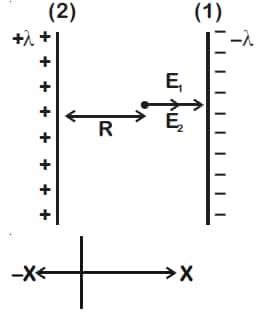
Electric field due to line charge (1)
$
\vec{E}_1=\frac{\lambda}{2 \pi \varepsilon_0 R} \hat{i} N / C
$
Electric field due to line charge (2)
$
\begin{aligned}
& \vec{E}_2=\frac{\lambda}{2 \pi \varepsilon_0 R} \hat{i} N / C \\
& \vec{E}_{n e t}=\vec{E}_1+\vec{E}_2 \\
& =\frac{\lambda}{2 \pi \varepsilon_0 R} \hat{i}+\frac{\lambda}{2 \pi \varepsilon_0 R} \hat{i} \\
& =\frac{\lambda}{\pi \varepsilon_0 R} \hat{i} N / C
\end{aligned}
$
Question 3:
An electron of mass $m_e$ initially at rest, moves through a certain distance in a uniform electric field in time $t_1$. A proton of mass $m_p$, also initially at rest, takes time $t_2$ to move through an equal distance in this uniform electric field. Neglecting the effect of gravity, the ratio $t_2 / t_1$ is nearly equal to
Solution:
Force acting on a charged particle in a uniform electric field is given by $F=q E$
The acceleration imparted to the particle is
$
a=\frac{q E}{m}
$
The distance travelled by the particle in time $t$ is
$
\begin{aligned}
& d=\frac{1}{2} a t^2=\frac{1}{2}\left(\frac{q E}{m}\right) t^2 \\
& (\because u=0)
\end{aligned}
$
For the given problem, we have $d_p=d_e$
$
\begin{aligned}
& \therefore \frac{t_p^2}{m_p}=\frac{t_e^2}{m_e} \text { or } \\
& \frac{t_p}{t_e}=\left(\frac{m_p}{m_e}\right)^{1 / 2} \text { or } \\
& \frac{t_2}{t_1}=\left(\frac{m_p}{m_e}\right)^{1 / 2}\left(\because q_e=q_p\right)
\end{aligned}
$
Electric Charges and Fields in Different Exams
Electric Charges and Fields is a high-weightage unit of electrostatics, which is not just present in board exams, but also in major competitive exams. The chapter challenges the students in terms of clarity of the concepts, use of formulas, and problem-solving skills, but with a different focus area, with different mark distributions in different exams.
| Exam | Focus Areas | Common Questions Asked | Marks / Questions Weightage | Preparation Tips |
|---|---|---|---|---|
| JEE Main | Coulomb’s law, Electric field, Gauss’s law, Dipole | Numerical problems on electric field, flux, Gauss’s law | 1–2 questions (4–8 marks) | Practice numericals, focus on symmetry and formula application |
| JEE Advanced | Gauss’s law applications, Dipole torque & energy, Superposition | Multi-step conceptual + numerical problems | 1 question (6–12 marks, sometimes mixed) | Master derivations, symmetry-based field calculations |
| NEET | Definitions, formulas, dipole, and electric flux | Direct formula-based MCQs | 1–2 questions (4–8 marks) | Memorise NCERT formulas, units, and practice MCQs |
| UPSC CDS / NDA | Basic concepts of charge, electric field, and Coulomb’s law | Theory-based or simple numericals | 1 question (2–4 marks) | Revise definitions and basic formulas |
| State-Level Exams (WBJEE, MHT CET, etc.) | Coulomb’s law, Electric field, Gauss’s law | Numerical + conceptual questions | 1–2 questions (4–8 marks) | Practice standard problems and NCERT examples |
| GATE | Electric field, Gauss’s law, Flux | Conceptual + numerical engineering-based questions | 1 question (2–5 marks) | Focus on derivations and dimensional understanding |
| School-Level (CBSE, ICSE, State Boards) | Entire chapter (theory + numericals) | Short answers, derivations, and numericals | 6–10 marks | Learn derivations, practice NCERT questions thoroughly |
| CUET | Conceptual understanding, basic formulas | Assertion–reason, MCQs | 1–2 questions (4–6 marks) | Strengthen concepts and revise the NCERT theory |
| SSC & Banking Exams | Basic electric quantities and units | Match the following one-liners | 1 question (1–2 marks) | Revise basic terms like charge, field, uand nit (Coulomb) |
Related Topics,
Important Books and Resources for Class 12 Electric Charges and Fields
In order to succeed in the chapter Electric Charges and Fields and obtain a high level of conceptual clarity, we need to consult the appropriate study materials. Class 12 Physics recommended books and resources include the following, with detailed explanations, solved problems, and sufficient practice questions, specific to board exams and competitive tests such as JEE and NEET.
| Book Title | Author / Publisher | Description |
|---|---|---|
| NCERT Class 12 Physics (Part I) | NCERT | Official textbook covering fundamental concepts, laws, derivations, and NCERT-based numericals for Electric Charges and Fields. |
| NCERT Exemplar Physics (Class 12) | NCERT | Contains higher-order thinking questions and application-based problems for electrostatics, useful for boards and competitive exams. |
| Concepts of Physics – Volume 2 | H.C. Verma | Excellent for building conceptual clarity with well-structured theory and challenging numerical problems on electric fields and forces. |
| Understanding Physics: Electrostatics | D.C. Pandey (Arihant) | Topic-wise detailed explanations, solved examples, and practice problems tailored for JEE and NEET preparation. |
| Physics for Class 12 | R.D. Sharma | Provides step-by-step explanations and a wide range of solved and unsolved numerical problems from electrostatics. |
| Arihant All-In-One Physics (Class 12) | Arihant | Comprehensive resource with theory summaries, solved examples, practice questions, and previous year questions for exams. |
| MTG Chapterwise Previous Year Questions – Physics | MTG | Helps students practice and analyse previous year questions related to Electric Charges and Fields across various exams. |
NCERT Resources for Electric Charges and Fields
NCERT content on Electric Charges and Fields offers concept-based content in a well-organised manner that wholly adheres to the most current CBSE Class 12 Physics syllabus. The NCERT textbook, exemplar problems, and solutions are used to learn the basics, master numericals, and prepare for exams not only to pass the board but also to compete in exams such as JEE and NEET.
NCERT Subjectwise Resources
NCERT subject-wise materials are organised and syllabus-based learning content on various subjects, which assists students in developing a good conceptual basis. They consist of textbooks, exemplar problems, and solutions and can thus be very helpful in the preparation for the board exams and even competitive exams such as JEE and NEET.
Practice Questions based on Electric Charges and Fields
Problem Solving on Electric Charges and Fields assists students in understanding the concept of electric charges and fields better and in enhancing their problem-solving abilities in the field of electrostatics. These questions discuss important areas such as the law of Coulomb, electric field, the law of Gauss, and the electric dipoles, which are common in board and competitive tests. Practice makes one more accurate, faster and confident in the exams.
Conclusion
The chapter Electric Charges and Fields provides a strong background in the explanation of electrostatics and the action of electric interaction in nature. Students can develop a good conceptual clarity by regularly practising core concepts, significant formulas and methods of solving problems associated with electric fields, the Gauss law and electric dipoles. This preparation improves confidence, and it is also useful in the board examinations and competitive exams like JEE Main, JEE Advanced, and NEET.
Frequently Asked Questions (FAQs)
Electrostatic force between two and more charges: Coulomb’s law; Continuous charge distribution; Electric field and electric field lines; Application of Gauss theorem in the calculation of electric field and Electric Potential due to a point charge.
On average one question i.e., weightage of around 6 to 8% is asked in NEET exam from electric charges and fields.
The Electrostatics chapter has two subtopics i.e. Electric charges and fields and Electrostatic Potential and Capacitance.
The main concepts which students will study in electric charges and fields are electric field, electric field lines, electric field due to a point charge, torque on a dipole in uniform electric field, gauss theorem and its application.
Like charges repel while unlike charges attract each other.
Charge is transferable.
Charge is a scal
Electric charges and fields are an important chapter/topic in understanding of electric fields; electric flux, equipotential surface. Electric charges and fields describe the pulling or pushing force in a distance between charges. Also, from a competitive exam point of view, electric charges and fields are an important chapter.

Questions related to
On Question asked by student community
Hello Mrunali,
Here are the links you asked for.