


Frictional Force - Formula, Examples, Types, FAQs
Friction force plays a very important role in our daily life and in many physical processes. It is the force that opposes the relative motion between two surfaces in contact, yet without friction, normal activities would become impossible. Applications of friction can be seen everywhere, from simple actions like walking, writing, and holding objects to complex systems such as braking in vehicles and motion of tyres on roads. Friction helps us maintain grip, control motion, and perform work safely and efficiently. Understanding the applications of friction force is essential for school physics, especially for Class 9 and Class 11 students, as it forms the foundation for concepts related to motion, force, and energy. This topic is frequently asked in exams.
This Story also Contains
- What is Friction?
- Laws of Friction
- Causes of friction
- Types of Friction
- What is Frictional Force?
- Frictional Force Examples
- How to Reduce Friction
- Applications of Friction Force
- Work done by Frictional Force
What is Friction?
When a body is placed on the surface of another body, then due to the irregularities in their surfaces, the contact between them occurs at a large number of points. at each point of contact, a small area of the two surfaces comes in contact with each other. At these points of contact, the atoms and molecules of the two surfaces come very close to each other and they attract strongly. When we try to move a body places over the other body, the bonds of attraction oppose the motion. This opposing force is recognized as the force of friction.
Definition of Friction
"Friction is a force that opposes a motion of one surface sliding or moving over another surface. It is caused by the roughness of the surface and always acts in opposite direction to the movement."
Laws of Friction
- The friction of the moving object is proportional to the normal force( numerically equal to the pressing force).
$f \propto N$ - The friction experienced by the object is dependent on the nature of the surface it is in contact with.
- Friction is independent of the area of contact as long as there is an area of contact(as for solid apparent area is not equal to the actual area of contact).
- It acts tangentially along with the contact.
- The direction of friction is always opposite to the direction of relative motion.
- It can be also defined as the component of contact force which is parallel to the surfaces in contact.
Friction is a dissipative force that is in most of the cases due to the frictional force there is the liberation of heat.
Also Read-
- NCERT Exemplar Solutions for All Subjects
- NCERT Notes For All Subjects
- NCERT Solutions for All Subjects
Causes of friction
Irregularities on Surfaces: All surfaces have small irregularities. These irregularities interlock and oppose motion.
Intermolecular Attraction: Attractive forces act between the molecules of the two surfaces in contact, producing friction.
Deformation of Surfaces: Soft surfaces get deformed when force is applied, increasing friction.
Nature of Surfaces: Rough surfaces produce more friction than smooth surfaces.
Force Pressing the Surfaces Together: Greater the force pressing the surfaces together, greater is the friction.
Types of Friction
There are different types of frictional forces depending upon the surfaces in contact they are. Let's discuss each type in brief:
Fluid friction
It is the friction that occurs between the layers of the fluids moving relative to the ground, it depends upon the type of fluid and is determined by using a term called viscosity the more viscous fluid have more friction and hence moves less slowly compared to a less viscous fluid.
Dry friction
If the motion between two hard solid surfaces is considered it is called dry friction.it is again divided as static friction and sliding friction based on the state as the objects whether it is moving or not, which will be discussed in detail in the next session.
Lubricated friction
It is the case where a lubricant is present in between the two solid surfaces
Internal friction
It is such a type of frictional force that can be seen in between the elements of a solid material; it can be molecular or atomic in nature.
Sliding friction
Sliding friction is the opposing force that occurs when one body attempts to slide across another's surface.
Static friction
Static friction is the friction between two solids that are not in relative motion with each other. The force that stops a vehicle wheel from sliding as it rolls on the ground is an example of static friction.
Dynamic friction
The friction that acts when a body is actually sliding over the surface of another body. Dynamic friction has another name called kinetic friction.
What is Frictional Force?
Frictional force is experienced due to the friction, it acts parallel to the surface in contact and opposes the relative motion.
S.I. Unit of Frictional force is Newton as it is also a kind of force.
Frictional force Formula
$F=\mu \times N$
Where,
where $\mu$ is the coefficient of friction and $N$ is the normal force.
How to Calculate Frictional Force?
Now let us consider a situation where we can see how to calculate the frictional force.
Suppose there is a block of wood that weighs 5 kg resting on a table to be pushed from the rest. Considering the coefficient of friction as 0.5 then calculate the frictional force.
Solution:
The Normal reaction , $\mathrm{N}=5 \mathrm{Kg} \times 9.8 \mathrm{~N} / \mathrm{kg}=49 \mathrm{~N} / \mathrm{Kg}$
Given, the coefficient of friction equal to, $\mu=0.5$
Then , the frictional force, $\mathrm{F}=49 \mathrm{~N} / \mathrm{Kg} \times 0.5=24.5 \mathrm{~N}$
We can define the coefficient of friction as the frictional force acting against a unit normal body
Frictional Force Examples
- Rubbing of hands
- The motion of a vehicle on the road
- Dragging a box
- Pushing a chair through the ground
- Breaking system of cars
- Viscous force on an object moving inside a fluid
How to Reduce Friction
By Polishing: Polishing makes surfaces smooth and reduces irregularities.
By Lubrication: Oil, grease, or graphite forms a thin layer between surfaces and reduces friction.
By Using Rollers or Wheels: Rolling friction is less than sliding friction.
By Streamlining: Streamlined shapes reduce friction due to air or water.
By Using Ball Bearings: Ball bearings convert sliding friction into rolling friction.
Applications of Friction Force
Walking: Friction between our feet and the ground helps us to walk without slipping.
Writing: Friction between the pen or pencil and paper makes writing possible.
Brakes: Friction between brake pads and wheels helps to stop vehicles.
Holding Objects: Friction helps us to hold objects firmly in our hands.
Driving Vehicles: Friction between tyres and the road allows vehicles to move and turn.
Lighting a Matchstick: Friction produces heat to ignite the matchstick.
Work done by Frictional Force
Case 1: Assume a person is walking on the ground forward then we have to find the work done by the frictional force on the person’s foot,

Equation of work is force times displacement
$\mathrm{W}=\mathrm{F} \times \mathrm{S}$
Here the person lifts his foot on walking and there is no displacement with respect to the ground when considering the relative motion so the work done by the friction, in this case, is zero
Ie, S = 0
Hence W = 0
Recommended Topic Video
Case 2: Now assume the case of a box sliding over a rough surface then there is a frictional force acting opposite to the motion of the box
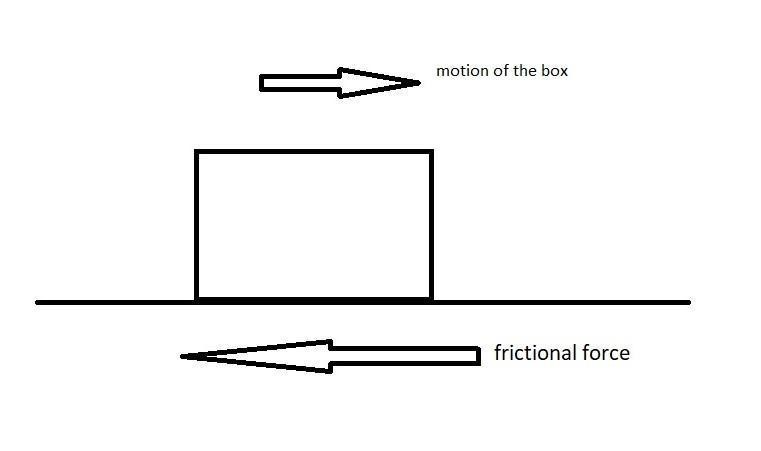
Here if we consider it as static friction, then the displacement is zero and hence the work done is also zero(work done by a force is dot product of force and displacement)
Now if the box is actually moving then the case here is of sliding friction,
Here, work, $W=-F \times S \times \operatorname{Cos} \theta$
$W=F_{\mathrm{t}} \times S \times \operatorname{Cos}$ (1800) since the force and the displacement are in the opposite direction
$
\begin{aligned}
& W=F_t \times S \times(-1) \\
& =-\left(F_t \times S\right)
\end{aligned}
$
Where $F_t$ is the frictional force and $S$ is the displacement of the box relative to the relative motion between the box and the surface.
Frequently Asked Questions (FAQs)
It is the resistance that occurs opposite to the motion due to the relative motion between two surfaces.
It means that the body do not have enough force to act above the frictional force provided by the surface and the body is at rest.
Unit of force is Newton (N). A Newton is a force required to give a mass of 1 kilogram (1 kg) an acceleration of 1 meter per second squared (1 m/s²). SI unit of mass is kilogram (kg) and acceleration is meter per second squared (m/sec²) hence it is written as kg m/sec² which is denoted by Newton.
The application of force can be represented by a line of action. It is the geometric representation of the force. Line of action is referred to as the characteristic line that is associated with each force.