KCC Institute of Legal and Higher Education, Greater Noida
Law Admissions 2026 Open | Avail Merit-Based Scholarships


Tension Force is an important concept in Physics, especially in the chapter Laws of Motion for Class 11. It is a contact force transmitted through a string, rope, wire, or cable when it is pulled tight by forces acting at opposite ends. Tension always acts as a pulling force and works along the length of the string, away from the object. Understanding tension is essential for solving problems related to hanging bodies, pulleys, elevators, and connected systems. The basic formula in equilibrium is T = mg, where tension balances the weight of the object. This concept is frequently asked in board exams as well as competitive exams like JEE and NEET. In this article, learn the definition, formula, units, direction, examples, and common misconceptions about tension force.
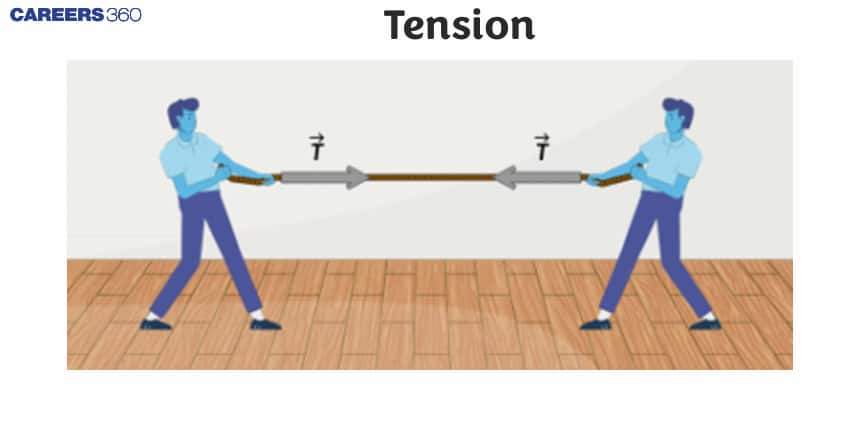
Tension in physics is a contact force. The tightness of a rope or string when you try to stretch it is called tension.
Tension is the force transmitted through a string, rope, wire, or cable when it is pulled tight by forces acting from opposite ends. It is a pulling force that acts along the length of the object and always acts away from the body to which it is applied.
Tension Force -Example
A stone is suspended with the help of a thread and its free end is fastened to the ceiling, as shown in Figure
Gravity pushes a stone attached to a string down all the time, but the stone does not fall since it is held by the string. As a result, there is a force that pulls the stone upward to support it against gravity.
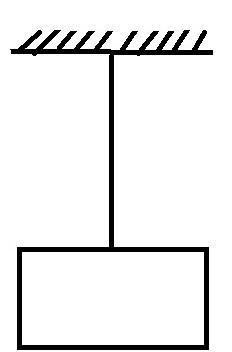
(Image drawn using Microsoft paint)
The upward tension force balances the gravitational force in the case above, as seen in the diagram below.
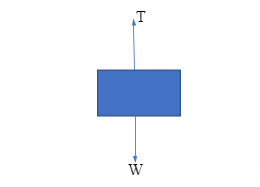
(Image drawn using Microsoft word)
Also read -
A very common misconception is that tension can act as both a pulling and pushing force. In reality, tension is only a pulling force. Ropes, strings, and cables cannot push effectively. If you try to push a rope, it simply becomes loose or slack and loses its tension.
This confusion often appears while drawing free-body diagrams. Students sometimes show the tension force acting toward the object as if it is pushing it. However, tension always acts away from the object, along the length of the rope or string.
Law Admissions 2026 Open | Avail Merit-Based Scholarships
BBA/MBA/PGDM Early Bird Applications Deadline 19th Oct '26. Apply now using coupon code CAREER250 and get ₹250 off the application fee
Since tension is a force, it has the same units and dimensions as force.
When an object is hanging at rest or moving with constant velocity, the system is in equilibrium (acceleration $=0$ ). In this case, the upward tension ( $\mathbf{T}$ ) in the string or cable is equal to the downward weight (mg) of the object.
$
T=m g
$
Where:
$\mathbf{T}=$ Tension (in newtons, N)
$\mathbf{m}=$ Mass of the object (in kilograms, kg)
$\mathbf{g}=$ Acceleration due to gravity $\left(9.8 \mathrm{~m} / \mathrm{s}^2\right)$
| Related Topics Link, |
This "pull" is a force we refer to as tension. As a result, tension will point away from the mass and toward the string. The string, in the instance of the hanging mass, pulls it up, exerting an upward force on mass, along with tension upwards..
Also Read:
Why is the Tension of a Massless String Constant?
Because a string is extended and non-rigid, tension exists throughout the thread rather than being applied at a single location, the concept of tension in a string might be difficult to grasp.
What is the Importance of Tension Force?
All physical things that come into contact with one another can exert forces on one another. It's vital to remember that tension is a pulling force because ropes can't effectively push. When you try to pull anything with a rope, it becomes slack and loses the tension that allowed it to pull in the first place.
Also check-
NCERT Physics Notes:
Frequently Asked Questions (FAQs)
The pull, which is called tension, is the direction of tension. A thread pulls the mass upwards in the case of a hanging mass, hence the string/rope exerts an upper force on the mass and the tension is on the upper side.
The string has a tensile force of 10 N.
The gravitational force acts in the opposite direction of tension. If an object is suspended, tension must be used to keep it balanced; otherwise, gravity will cause it to fall.
Because the rope works as a force transfer agent, there should never be a situation when two items connected by one rope are subjected to tension forces of different magnitudes.
The amount of work done is determined by both force and displacement. Although tension is a force, it does not result in any displacement. In the case of tension, W = F 0 = 0 if the work done is given by the equation W = FS where F is the force and S is the displacement. As a result, tension produces little work.

On Question asked by student community
Scoring well in NEET requires right strategy and consistency. Here are few practices you can follow:
If you made a mistake in your NIOS class 12 exam OMR sheets such as marking the wrong set code you should not worry because examiners are trained to handle such issues during evaluation. Your roll ,Subject code and other details help them match your paper correctly so one small
Hello Paramesha,
The deadline extension for NEET UG is in complete discretion of competitive authority i.e. National Testing Agency. If you have valid genuine reason you may raise. You may raise your concern on below NTA website by contacting on number or dropping them a email.
https://www.nta.ac.in/contactus
Hope this will
Correct Answer: All of the above
Solution : The correct option is All of the above.
The phrase "Cold War" refers to the geopolitical tension and competition that prevailed in the wake of World War II, particularly between the United States and its Western allies (commonly referred to as the
Correct Answer: surface tension of oils is much smaller than that of water.
Solution : The correct option is surface tension of oil is less than that of water.
The surface tension of water causes oil droplets to disperse over it. Water has a higher surface tension than oil,

Law Admissions 2026 Open | Avail Merit-Based Scholarships
BBA/MBA/PGDM Early Bird Applications Deadline 19th Oct '26. Apply now using coupon code CAREER250 and get ₹250 off the application fee
Ranked #36 amongst institutions in Management by NIRF | 100% Placement
Globally Recognized by AACSB (US) & AMBA (UK) | 18 LPA Avg. CTC for PGPM 2026
NEET PG All India & State College Predictor with Admission Process Guide
Top B-School: Ranked #9 in NIRF Management Rankings 2025.