


Kinetic Theory - Topics, Formulas, Notes, Books, FAQs
Kinetic Theory of Gases is another important chapter of the Class 11 Physics syllabus that describes the behaviour of gases in relation to the microscopic movement of gas molecules. This chapter makes students learn the origin of the macroscopic properties of pressure, temperature, and volume due to the random movement of gas molecules. Physics explains these properties by providing molecular models that can be used to relate the behaviour of gases that are observed to the reality or the movement of particles.
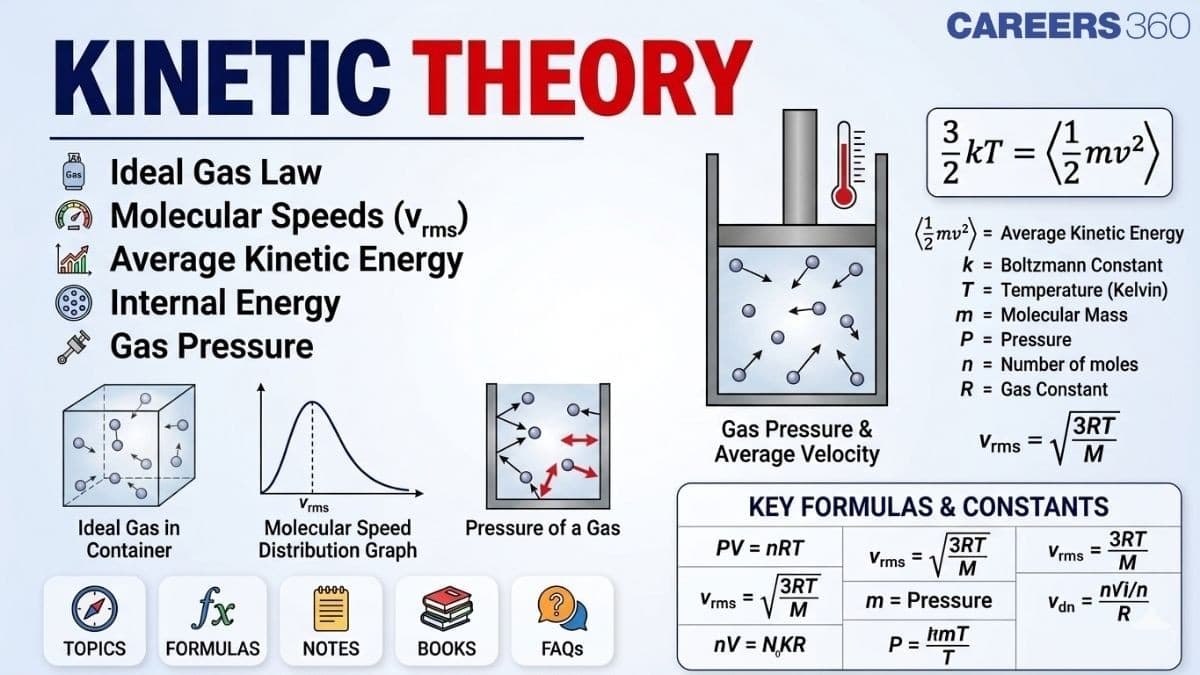
Molecular speed, kinetic energy, temperature, pressure, and number density are some of the quantities that need to be defined clearly to be able to study the kinetic theory of gases. It is not possible to simply observe gas behaviour and not further explain the molecular processes that cause it without identifying and quantitatively describing them. On the same note, without the introduction of relations between the motion of the molecules and the pressure and temperature, it is impossible to comprehend the gas laws. It can be analysed by using standard assumptions and well-tested equations to analyse the gaseous behaviour in an accurate and systematic manner. Moreover, this chapter explains significant concepts like assumption of kinetic theory, gas pressure, average and root mean square velocity, degree of freedom, law of equipartition of energy and mean free path. It emphasises the ways in which experimental observations can help prove these concepts and how they were used in the explanation of real gases and thermal phenomena. Learning the kinetic theory of gases enables the students to connect the microscopic molecular movements with the macroscopic characteristics of gases, and it forms an excellent base for subsequent study in thermodynamics and statistical physics.
Overview of Kinetic Theory of Gases
Before starting this chapter, you should know that it is a comparatively easier topic than studying properties of solids or liquids because, in a gas, molecules are far from each other and their mutual interactions are negligible except when two molecules collide. Also, this chapter is going to be important because the next chapter you will be reading is Thermodynamics, and many concepts of this chapter will be used there. This chapter mainly talks about the properties of ideal gases, and an ideal gas follows some set of assumption and also follows ideal gas equation which is given by, PV =nRT where P is the pressure in the container in which the gas is kept, V is the volume of the container, T is the temperature of gas, n is the number of moles of gas and R is a gas constant whose value is fixed.
The assumptions of the ideal gas are mentioned below for your better understanding of this chapter :
-
The gas consists of a large number of molecules, which are in random motion and obey Newton's laws of motion.
-
The volume of the molecules is negligibly small compared to the volume occupied by the gas
-
No forces act on the molecules except during elastic collisions of negligible duration.
Although no real gas follows these assumptions, they also don't follow the ideal gas equation. For real gases, some changes are made in the ideal gas equation. But for the intermediate class, the syllabus is limited to ideal gases only. You will also read about the Law of equipartition of energy, which states that in equilibrium, the total energy is equally distributed in all possible energy modes, with each mode having average energy equal $\frac{1}{2} K_B T$, where $K_B$ is Boltzmann’s constant. This law will also help you to understand the concept of degrees of freedom. You will get various questions in which you have to deal with Root mean square velocity, Average speed and most probable speed of a molecule of gas. It also tells us that the temperature of an ideal monatomic gas is proportional to the average kinetic energy of its atoms.
Important Topics of Kinetic Theory of Gases
The important topics of the chapter Kinetic Theory of Gases explain the microscopic behaviour of gases in terms of the motion of their molecules. These topics connect macroscopic properties such as pressure, temperature, and volume with molecular motion. The concepts aid in the explanation of gas laws and thermal behaviour in a molecular way. The knowledge of these subjects establishes an interface between thermodynamics and molecular physics.
1. Assumptions of Kinetic Theory of Gases:
The kinetic theory of gases is founded on a number of assumptions concerning the behaviour of gas molecules. It supposes that a gas is made up of many identical molecules in continuous chaotic movement. The size of a single molecule is insignificant compared to the size of the container. Intermolecular forces are not taken into account except at collisions. Molecular collisions and collisions of the molecules with the walls of containers are perfectly elastic. These are the assumptions which make it easy to analyse the behaviour of gas.
2. Pressure of a Gas:
The gas pressure is caused by the constant collisions of molecules of gas with the sides of the container. Each collision exerts a force on the walls, and the collective effect of many collisions produces pressure. The pressure varies depending on the number of molecules, their velocity, and the volume of the container. An increase in molecular speed or density results in an increase in pressure. This is the concept that explains the increase in pressure with temperature. It gives a microscopic meaning of pressure.
3. Kinetic Energy of Gas Molecules:
The gas molecules have kinetic energy because of their random movement. The mean kinetic energy of gas molecules is only dependent on the temperature of the gas. With an increase in temperature, the kinetic energy and molecular speed increase. This is the reason as to why, on heating, gases expand. The value of kinetic energy does not depend on the volume and pressure of a gas at a constant temperature. This subject introduces a direct correlation between the temperature and the molecular movement.
4. Root Mean Square (RMS) Speed:
RMS speed represents an effective average speed of gas molecules. It gives more weight to faster molecules and is useful for calculations involving kinetic energy. RMS speed is a good average speed of gas molecules. It assigns more weight to high-speed molecules and is applicable in calculations that deal with kinetic energy. RMS speed varies with the temperature and the mass of gas molecules. The molecules that have lower masses travel faster than those that have higher masses at the same temperature. This is the reason why oxygen diffuses more slowly than hydrogen. RMS speed is used to compare the motion of molecules in various gases.
5. Degrees of Freedom:
The number of independent ways in which a molecule may store energy is called the degrees of freedom. Gas molecules may possess the degrees of freedom of translational, rotational, and vibrational degrees of freedom. Monoatomic gases have fewer degrees of freedom than diatomic and polyatomic gases. Degrees of freedom affect the internal energy and heat capacity of gases. This theory describes variation in the thermal behaviour of gases. It has significance in the distribution of energy.
6. Law of Equipartition of Energy:
According to the law of equipartition of energy, the energy is equally distributed amongst all degrees of freedom of the molecule that are available in thermal equilibrium. Each degree of freedom contributes an equal amount of energy. This law is used to determine the internal energy of gases. It states that the reason heat capacity is dependent on molecular structure. The law works under normal temperatures. It gives a theoretical explanation of gas behaviour.
7. Mean Free Path:
The mean distance covered by a molecule of gas between two consecutive collisions is known as the mean free path. It is dependent on the size of the molecules and the concentration of the gas. At reduced pressure, longer distances are covered by the molecules without collisions. Mean free path is useful in explaining gas diffusion and viscosity. It is also found out why gases act differently at low and high pressures. This notion plays a role in transport phenomena and kinetic theory.
Important Formulas of Kinetic Theory of Gases
The formulas of the chapter Kinetic Theory of Gases connect the macroscopic properties of gases with the microscopic motion of their molecules. These are needed in numerical problems and in the understanding of the behaviour of gases at the molecular level.
1. Pressure of an Ideal Gas:
$
P=\frac{1}{3} \rho \overline{c^2}
$
where
$\rho=$ density of the gas,
$\overline{c^2}=$ mean square speed of gas molecules.
2. Root Mean Square (RMS) Speed:
$c_{\mathrm{rms}}=\sqrt{\overline{\overline{c^2}}}=\sqrt{\frac{3 R T}{M}}$
3. Average Speed:
$c_{\mathrm{avg}}=\sqrt{\frac{8 R T}{\pi M}}$
4. Most Probable Speed:
$c_{\mathrm{mp}}=\sqrt{\frac{2 R T}{M}}$
5. Relation between Speeds:
$c_{\mathrm{rms}}>c_{\mathrm{avg}}>c_{\mathrm{mp}}$
6. Kinetic Energy of One Mole of Gas:
$\bar{K}=\frac{3}{2} R T$
7. Average Kinetic Energy of One Molecule:
$
\bar{K}=\frac{3}{2} k T
$
where $k=$ Boltzmann constant.
8. Degrees of Freedom:
$f=3$ (monoatomic), $\quad f=5$ (diatomic at ordinary temperatures)
9. Law of Equipartition of Energy:
$E=\frac{f}{2} R T$
10. Mean Free Path:
$
\lambda=\frac{1}{\sqrt{2} \pi d^2 n}
$
where
$d=$ diameter of a molecule,
$n$ = number density.
11. Ideal Gas Equation:
$P V=n R T$
Related Topics,
Kinetic Theory of Gases: Previous Year Questions
Previous year questions from the chapter Kinetic Theory of Gases mainly focus on the application of molecular motion concepts such as pressure due to molecular collisions, average kinetic energy, molecular speeds, and the law of equipartition of energy. These questions enable the students to know the pattern of the exam and which formulas and areas of concepts are always tested. Their practice enhances the ability to solve numbers and the clarity of concept. This part comes in very handy when one wants to revise and prepare well to take exams.
Question 1:
Two moles of helium gas are mixed with three moles of hydrogen molecules (taken to be rigid). What is the molar specific heat (in J/mol K) of the mixture at constant volume? (R=8.3 J/mol K)
Solution:
$\begin{aligned} & C_{v \text { mix }}=\frac{n_1 C_{v_1}+n_2 C_{v_2}}{n_1+n_2} \\ & =\frac{2 \times \frac{3}{2} R+3 \times \frac{5}{2} R}{2+3} \\ & =\frac{3 R+15 \frac{R}{2}}{5} \\ & =\left(\frac{21}{10}\right) R=\frac{21}{10} \times 8.314 \\ & =17.4 \mathrm{~J} / \mathrm{molK}\end{aligned}$
Question 2:
Two moles of an ideal gas with $C_p=\frac{5}{3}$ are mixed 3 moles of another ideal gas with $\frac{C_p}{C_v}=\frac{4}{3}$. The value of $\frac{C_p}{C_v}$ for the mixture is:-
Solution:
For ideal gas:- $C_p-C_v=R$
For the first case:-
$\frac{C_{p 1}}{C_{v 1}}=\frac{5}{3}$ and $C_{p 1}-C_{v 1}=R$
$C_{p 1}=\frac{5}{3} C_{v 1}$ and $\frac{5}{3} C_{v 1}-C_{v 1}=R \Rightarrow \frac{2}{3} C_{v 1}=R \Rightarrow C_{v 1}=\frac{3}{2} R$
So, $C_{p 1}=\frac{5}{2} R$
For the second case:-
$\frac{C_{p 2}}{C_{v 2}}=\frac{4}{3}$ and $C_{p 2}-C_{v 2}=R$
$C_{p 2}=\frac{4}{3} C_{v 2}$ and $\frac{4}{3} C_{v 2}-C_{v 2}=R \Rightarrow C_{v 2}=3 R$ and $C_{p 2}=4 R$
Now, $Y_{\operatorname{mix}}=\frac{n_1 C_{p 1}+n_2 C_{p 2}}{n_1 C_{v 1}+n_2 C_{v 2}}=\frac{2 \times \frac{5}{2} R+3 \times 4 R}{2 \times \frac{3}{2} R+3 \times 3 R}=1.417=1.42$
Question 3:
70 cal heat is required to raise the temperature of 2 moles of an ideal gas at constant pressure from 25 oC to 30 oC, then the amount of heat required to raise the temperature of the same gas through the same rise of temp. at constant volume is
Solution:
The heat required to raise the temperature of a gas, at constant volume ( $C_V$ ), is
$
Q_V=C_V \Delta T \ldots \text { (i) }
$
and at constant pressure is
$
Q_P=C_P \Delta T
$
$
\text { Also, } \gamma=\frac{C_P}{C_V} \ldots
$
From Eqs. (i), (ii) and (iii), we get
$
\frac{Q_V}{Q_P}=\frac{C_P}{C_V}=\frac{1}{\gamma}
$
For a diatomic gas $\gamma=\frac{7}{5}$
$
\therefore Q_V=\frac{5}{7} \times 70=50 \mathrm{cal}
$
Kinetic Theory of Gases in Different Exams
The chapter Kinetic Theory of Gases is an important scoring topic in Class 11 Physics and is frequently tested across board and competitive examinations. Questions from this chapter focus on molecular motion, gas pressure, kinetic energy, degrees of freedom, and related numerical applications. A clear understanding of concepts and formulas helps students solve both conceptual and calculation-based questions efficiently.
| Exam | Focus Areas | Common Questions Asked | Marks / Questions Weightage | Preparation Tips |
|---|---|---|---|---|
| JEE Main | RMS speed, kinetic energy, pressure of gas, equipartition theorem | Numerical MCQs, formula-based problems | 1–2 questions (4–8 marks) | Memorise formulas, practice numericals |
| JEE Advanced | Molecular motion, degrees of freedom, and conceptual KTG | Conceptual + multi-step numerical problems | Rare / 1 question | Focus on assumptions and deep concepts |
| NEET | Average kinetic energy, gas pressure, and speeds of molecules | Direct NCERT-based MCQs | 1–2 questions (4–8 marks) | Revise the NCERT theory and standard results |
| UPSC CDS / NDA | Basic kinetic theory concepts | One-liners, simple numericals | 1 question (2–4 marks) | Revise definitions and assumptions |
| State-Level Exams (WBJEE, MHT-CET, etc.) | Molecular speeds, gas laws | Conceptual + numerical MCQs | 1–2 questions (4–8 marks) | Practice PYQs and speed-based questions |
| GATE | Kinetic theory basics | Conceptual questions (limited) | Low/rare | Focus on fundamentals only |
| School-Level (CBSE, ICSE, State Boards) | Entire chapter | Theory questions, numericals | 4–6 marks | Master NCERT derivations and examples |
| CUET | Conceptual understanding | MCQs, assertion–reason | 1–2 questions (4–6 marks) | Focus on molecular interpretation |
| SSC & Banking Exams | Basic gas behaviour | One-liners, matching type | 1 question (1–2 marks) | Revise key facts and applications |
Important Books and Resources for Class 11 Kinetic Theory of Gases
In order to master the chapter Kinetic Theory of Gases, the students are advised to go through reliable textbooks, reference books and practice guides, which explain the interpretation of gases in terms of molecules, speed of molecules, kinetic energy, equipartition of energy and the related formulas. These sources are useful in developing a good conceptual clarity and numerical problem-solving ability required in board examinations and competitive examinations such as JEE Main, JEE Advanced, NEET and other entrance examinations.
| Book Title | Author / Publisher | Description |
|---|---|---|
| NCERT Class 11 Physics (Part I) | NCERT | The official textbook covering foundational concepts of the Kinetic Theory of Gases with clear explanations, derivations, and examples. |
| NCERT Exemplar Physics (Class 11) | NCERT | Offers higher-order and application-based questions on molecular speeds, pressure, kinetic energy, and related ideas for deeper practice. |
| Concepts of Physics – Volume 1 | H. C. Verma | Excellent for strengthening basic concepts and solving challenging numerical problems related to kinetic theory and gas behaviour. |
| Understanding Physics: Mechanics & Thermal Physics | D. C. Pandey (Arihant) | Detailed topic-wise explanations, solved examples, and practice questions focused on kinetic theory and its applications. |
| Physics for Class 11 | R. D. Sharma | Step-by-step theory with a variety of solved and unsolved problems on gases, molecular speeds, and related calculations. |
| Arihant All-In-One Physics (Class 11) | Arihant | Comprehensive guide with concise theory summaries, formula sheets, solved examples, and plenty of practice questions from this chapter. |
| MTG Chapter-wise Previous Year Questions – Physics | MTG | Helps students analyse and practice past board and competitive exam questions, specifically from the Kinetic Theory of Gases chapter. |
NCERT Resources for Kinetic Theory of Gases
NCERT resources for the chapter Kinetic Theory of Gases provide a clear and concept-oriented explanation of gas behaviour based on molecular motion. The NCERT textbook and the example problems describe the fundamental concepts like pressure caused by the collisions between the molecules of a gas, kinetic energy of the molecules of a gas, the speed of the molecules and the law of equipartition of energy using simple theory and derivation. A deep study of the NCERT can be used to develop good conceptual clarity. They are necessary in Class 11 board exams and competitive examinations such as JEE Main and NEET since most of the questions are NCERT-based.
NCERT Subject-Wise Resources
NCERT subject-wise materials are organised and syllabus-based learning content on various subjects, which assists students in developing a good conceptual basis. They consist of textbooks, exemplar problems, and solutions and can thus be very helpful in the preparation for the board exams and even competitive exams such as JEE and NEET.
Practice Questions based on Kinetic Theory of Gases
Practice questions from the chapter Kinetic Theory of Gases help students strengthen their understanding of molecular motion and its connection to macroscopic gas properties. The concepts that are used to answer these questions are gas pressure as a result of the collision of the molecules, the average kinetic energy, the speed of the molecules, degrees of freedom and the equipartition of energy. Practice enhances the ability to solve problems in numbers, conceptual clarity and accuracy. It is necessary to solve such questions in order to prepare well for Class 11 examinations and competitive exams such as JEE Main and NEET.
Conclusion
The Kinetic Theory of Gases chapter offers an excellent conceptual ground on which the microscopic behaviour of gases can be considered and how it is related to macroscopic aspects, including pressure, temperature, and volume. With frequent revision of fundamental concepts, significant formulas, and rules concerning molecular movement, kinetic energy, molecular speeds, degrees of freedom, and the law of equipartition of energy, students should be able to form strong analytical and numerical problem-solving skills. The confidence and accuracy are built by a systematic and consistent approach to practice. It is a very effective preparation that will allow one to perform well in Class 11 exams and also in competitive exams like JEE Main and NEET.
