


System of Particles and Rotational Motion - Topics, Characteristics, Notes, Books, FAQs
System of Particles and Rotational Motion is a basic chapter of the Class 11 Physics syllabus, which is the study of the motion of systems containing a large number of particles and rigid bodies. This chapter teaches the students about the collective motion of particles, which can be represented in terms of the centre of mass, and the rotational motion of rigid bodies due to the influence of forces. Physics describes these motions in terms of well-defined principles that are useful in the analysis of both translational and rotational behaviour in real-life systems.
This Story also Contains
- Overview of Rotational Motion
- Important Topics of the System Of Particles And Rotational Motion
- Important Formulas of the System of Particles and Rotational Motion
- System of Particles and Rotational Motion: Previous Year Questions
- System of Particles and Rotational Motion in Different Exams
- Important Books and Resources for Class 11 System of Particles and Rotational Motion
- NCERT Resources for System of Particles and Rotational Motion
- NCERT Subject-Wise Resources
- Practice Questions based on System of Particles and Rotational Motion
- Conclusion
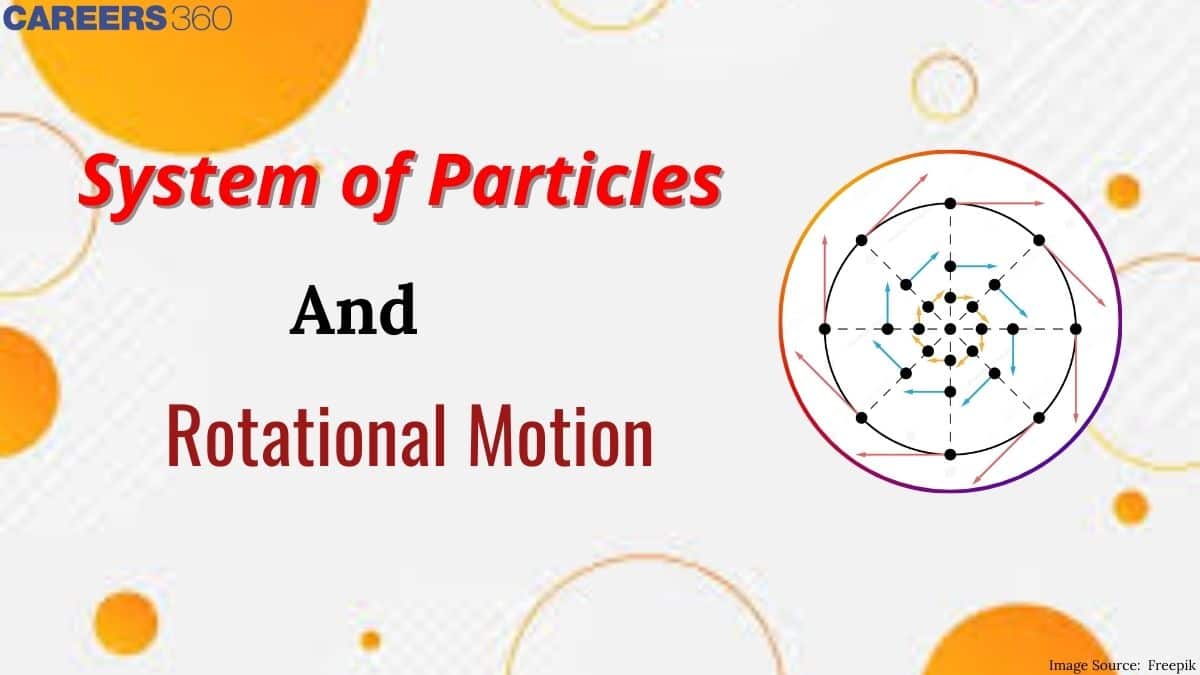
In order to study this chapter successfully, one has to clearly define the terms centre of mass, linear momentum, angular momentum, torque, moment of inertia and angular acceleration. One can always describe the motion of individual particles, but it is incomplete without considering the motion of the system and the distribution of mass. On the same note, rotational motion cannot be studied without introducing relations that relate torque, angular acceleration and energy. Complicated systems can be precisely and reliably studied using standardised definitions and established equations. Moreover, the concepts of motion of the centre of mass, conservation of linear and angular momentum, rotational kinematics and dynamics, moment of inertia of various bodies and rolling motion are also discussed in this chapter. It emphasises the use of experimental observations to justify these principles and how they are applied to a wide variety of physical cases of systems of particles and rotating bodies. Understanding this chapter helps students relate theoretical ideas to real-life phenomena and provides a strong foundation for advanced topics in mechanics and classical physics.
Overview of Rotational Motion
Rotational motion refers to the movement of a body around a fixed axis. Unlike linear motion, where an object moves in a straight line, rotational motion involves circular paths of particles around an axis. Every point in the body follows a circular trajectory, and all points complete one rotation in the same time. This type of motion is seen in many real-life objects such as wheels, fans, planets, and rotating machinery.
To describe rotational motion clearly, physical quantities like angular displacement, angular velocity, angular acceleration, moment of inertia, torque, and angular momentum are used. Understanding rotational motion helps students relate linear concepts to rotational systems and forms the foundation for studying rigid body dynamics in physics.
Important Topics of the System Of Particles And Rotational Motion
The important topics of the chapter System of Particles and Rotational Motion explain how the motion of multiple particles and rigid bodies can be analysed using translational and rotational principles. The topics present major concepts of centre of mass, torque, angular momentum and moment of inertia. They aid in the explanation of the influence of forces and mass distribution on the movement of systems. Knowledge of these topics is fundamental to solving complex problems in mechanics.
1. The Motion Of A Rigid Body
When the particle is rotating or rotating plus translating, the different particles P1, P2, P3, and P4 have different linear displacement, velocity, and acceleration.
.png)
Characteristics of Rotational Motion
In rotational motion, the particles of the rigid body follow a circular path around the rotational axis. The rotational axis could be fixed, or it could be unfixed. An example of fixed-axis rotational motion is the rotation of a fan, in which each particle on the blade follows a circular path around the axle of the motor of the fan. An example of an unfixed axis of rotational motion is the spinning top. In the spinning top, the tip of the top is an unfixed axis around which all the particles are following a circular path.
2. Centre Of Mass
The centre of mass of a body or system is a point where the whole mass of the body or system is supposed to be concentrated, and forces are directly applied to this point of translational motion.
Consider a system of particles of masses m1, m2,..., mn whose position vectors are given by r1,r2,..., rn respectively. but $\sum_{i=1}^n m_i = M$, mass of system then
$R_{c m}=\frac{\sum_{i=1}^n m_i r_i}{M}$
where miri is the moment of the particle with mass mi.
The centres of mass of some regular rigid bodies are given in the table:
| • Rigid Body | • Centre Of Mass |
| • Rod lying along the x-axis | • (L/2, 0, 0) |
| • Semicircular ring | • $\frac{2R}{\pi}$ |
| • Semicircular disc | • $\frac{4R}{3\pi}$ |
| • Solid hemisphere | • $\frac{3R}{8}$ |
| • Hollow hemisphere | • $\frac{R}{2}$ |
| • Solid sphere | • At its centre |
| • Square or rectangle | • At its centre |
| • Solid cone | • $\frac{H}{4} $ from base of the cone |
| • Hollow cone | • $\frac{H}{3}$ from base of the cone |
3. Comparison Between Translational And Rotational Motion
| Feature | Translational Motion | Rotational Motion |
| Centre of mass | • The motion of a rigid body includes the motion of its centre of mass. | • A rigid body can also move while its centre of mass is fixed |
| Defnition | • Movement of an object along a straight line or curved path | • Movement of an object around an axis |
| Parameters | • Displacement, velocity, acceleration | • Angular displacement, angular velocity, angular acceleration |
| Force | • Linear force is applied to change motion | • Torque is applied to cause motion |
| Inertia | • Mass ($m$) resists changes | • Moment of inertia ($I$) resists changes |
| Kinetic energy | • $K E$ $=\frac{1}{2} m v^2$ | • $K E$ $=\frac{1}{2} \omega^2$ |
| Example | • A ball rolling in a straight line | • A spinning top |
4. Equilibrium Of Rigid Bodies
The equilibrium of a rigid body is a state where a rigid body is not changing its linear momentum or angular momentum, meaning no net force or net torque is acting on it. It is one of the important topics in the system of particles and rotational motion.
Types Of Equilibrium
Static Equilibrium: A rigid body is in static equilibrium when it is at rest and remains at rest.
For example, a book lying on a table

Dynamic Equilibrium: A rigid body is in dynamic equilibrium when it moves with a constant velocity(not accelerating).
For example, a satellite in orbit around the Earth

5. Rigid Body Rotation

When a rigid body rotates, all points in the body move in circular paths around a fixed axis.
1. Axis of rotation
It is the line about which the rigid body rotates.
2. Angular Displacement ($\theta$)
The angle through which a point or line has been rotated in a specified sense about a specified axis
3. Angular Velocity
It is the rate of change of angular displacement.
$\omega \equiv \frac{d \theta}{d t}$
4. Angular Acceleration
The rate of change of angular velocity is called angular acceleration
$\alpha=\frac{\mathrm{d} \omega}{\mathrm{dt}}$
6. Equations Of Rotational Motion
The three equations of rotational motion :
1. First Equation
$\omega=\omega_0+\alpha t$
2. Second Equation
$\Delta \theta=\omega_0 t+\frac{1}{2} \alpha t^2$
3. Third Equation
$\omega^2=\omega_0^2+2 \alpha \Delta \theta$
where,
- $\omega_0$ = initial angular velocity
- $t$ = time
- $\theta$ = angular displacement
- $\alpha$= angular acceleration
- $\omega$ = final angular velocity
- Relation between linear and angular velocities, $v=r \omega$
- Relation between linear and angular acceleration, $a=\alpha \mathrm{r}$
7. Moment Of Inertia
It is the measure of the body's resistance to angular acceleration about a given axis.

For a system of point masses, the moment of inertia is:
$I=\sum m_i r_i^2$
where,
- $m_i$ = mass of each point mass
- $r_i$ = distance of each mass from the axis of rotation
For a continuous body,
$I=\int r^2 d m$
where,
- $dm$ = infinitesimal mass element
- $r$ = distance from the axis of rotation
8. Theorem Related To Moment Of Inertia
1. Parallel Axis Theorem

The parallel axis theorem states that the moment of inertia of a body about an axis parallel to an axis passing through the centre of mass is equal to the sum of the moment of inertia of a body about an axis passing through the centre of mass and the product of mass and the square of the distance between the two axes.
$I_{\|}=I_{c m}+m d^2$
where d is the distance between the two axes
2. Perpendicular Axes Theorem

The moment of inertia about an axis perpendicular to the plane is equal to the sum of moments of inertia about two perpendicular axes in the plane.
$I_z=I_x+I_y$
9. Radius Of Gyration

The radius of gyration is the distance from an axis of rotation where the entire mass of a body is assumed to be concentrated, such that the moment of inertia about that axis remains unchanged.
$k=\sqrt{\frac{I}{m}}$
where,
- $k$= radius of gyration
- $I$ = moment of inertia about the given axis
- $m$= total mass of the body
10. Values Of $I$ For Simple Geometrical Objects
The values of some important geometrical objects are given in the table:
| Geometrical Objects | Value of moment of inertia |
| • Hollow Cylinder Thin-walled | • $I=M r^2$ |
| • Thin Ring | • $I=\frac{1}{2} \mathrm{Mr}^2$ |
| • Hollow Cylinder |
• $I=\frac{1}{2}M\left(r_2^2+r_1^2\right)$ |
| • Solid Cylinder | • $\mathrm{I}=\frac{1}{2} \mathrm{Mr}^2$ |
| • Uniform Disc | • $\mathrm{I}=\frac{1}{4} \mathrm{Mr}^2$ |
| • Hollow Sphere | • $\mathrm{I}=\frac{2}{3}\mathrm{Mr}^2$ |
| • Solid Sphere | • $\mathrm{I}=\frac{2}{5} \mathrm{Mr}^2$ |
| • Spherical Shell | • $I=\frac{2}{3} {Mr}^2$ |
| • Thin rod (at the centre) | • $\mathrm{I}=\frac{1}{12} \mathrm{Mr}^2$ |
| • Thin rod ( at the end of the rod) | • $\mathrm{I}=\frac{1}{3}\mathrm{Mr}^2$ |
Important Formulas of the System of Particles and Rotational Motion
The formulas in the chapter System of Particles and Rotational Motion describe the mathematical relationships governing the motion of particles and rigid bodies. These relations are essential for analysing translational motion, rotational dynamics, and rolling motion.
1. Centre of Mass:
- The centre of mass (CM) of a system is the point where the entire mass of the system appears to be concentrated.
- For two particles:
$\vec{R}=\frac{m_1 \overrightarrow{r_1}+m_2 \overrightarrow{r_2}}{m_1+m_2}$
- Motion of the COM represents the overall motion of the system.
2. Motion of Centre of Mass:
- The CM of a system moves as if all external forces acted at that point.
- Total external force $=$ total mass × acceleration of CM.
- Internal forces do not affect the motion of the CM.
3. Linear Momentum of a System of Particles:
- Total linear momentum = vector sum of momenta of all particles.
- For a system:
$\vec{P}_{\text {total }}=M \vec{v}_{C M}$
- Conserved when the net external force is zero.
4. Vector Product (Cross Product):
$\vec{A} \times \vec{B}=A B \sin \theta \hat{n}$
- Used to define torque and angular momentum.
- Direction given by the Right-Hand Rule.
5. Angular Velocity and Its Relation with Linear Velocity:
- Angular velocity $(\omega)$ is the rate of change of angular displacement.
- Linear velocity (v) of a rotating body:
$v=\omega r$ - Every point on a rigid rotating body has the same $\omega$ but different v.
6. Torque and Angular Momentum:
- Torque -Turning effect of a force.
$\vec{\tau}=\vec{r} \times \vec{F}$
7. Angular Momentum:
For a particle:
$\vec{L}=\vec{r} \times \vec{p}$
- Related to torque:
$\vec{\tau}=\frac{d \vec{L}}{d t}$
8. Equilibrium of a Rigid Body:
A rigid body is in equilibrium when:
1. Net external force $=0$
2. Net external torque $=0$
Two types:
Translational equilibrium
Rotational equilibrium
9. Moment of Inertia: Rotational inertia of a body.
$I=\sum m_i r_i^2$
- Depends on the mass distribution and the axis of rotation.
- Greater distance from axis → larger I.
10. Parallel Axis Theorem:
$I=I_{C M}+M d^2$
11. Perpendicular Axis Theorem:
$I_z=I_x+I_y$
System of Particles and Rotational Motion: Previous Year Questions
Past year questions in the chapter System of Particles and Rotational Motion are mostly based on centre of mass, conservation of momentum, torque, moment of inertia, and angular momentum. These exams enable the students to have a feel of the pattern of the exam and also the concepts and types of questions that are tested very often. Practising them improves problem-solving skills and accuracy in numerical calculations. This part proves to be very helpful when effective revision and test preparation are required.
Question 1:
The net external torque on a system of particles about an axis is zero. Which of the following are compatible with it?
a) The forces may be acting radially from a point on the axis
b) the forces may be acting on the axis of rotation
c) the forces may be acting parallel to the axis of rotation
d) The torque caused by some forces may be equal and opposite to that caused by other forces
Solution:
Torque is given by $\vec{\tau}=\vec{r} \times \vec{F}$
Or
$\tau=r F \sin \theta \widehat{n}$ where $\theta$ is the angle between both the vectors and $\widehat{n}$ is the unit vector perpendicular to the plane of $\vec{r}$ and $\vec{F}$
1. When the force is acting radially in the direction of $\vec{r}, \theta=0$
$
\tau=r F \sin 0^{\circ}=0
$
2. When the forces are acting on the axis of rotation, then $\theta=0$ and thus $\tau=0$
3. The component of forces in the plane of $\vec{r}$ and $\vec{F}$ when they are parallel to the axis of rotation is $F \cos 90^{\circ}$ which is equal to 0 . Hence $\tau=0$
4. When torques are equal in magnitude but opposite in direction, the net resultant is 0.
Hence, the correct answers are the options (a) and (b).
Question 2:
The density of a non-uniform rod of length 1 m is given by $\rho(x)=a\left(1+b x^2\right)$ where a and b are constants and $o \leq x \leq 1$. The centre of mass of the rod will be at
Solution:
Given: $\rho(x)=a\left(1+b x^2\right)$
As we know;
$
X_{C O M}=\frac{\int_0^1 x d m}{\int_0^1 d m}
$
Here we have; $d m=\rho=a\left(1+b x^2\right) d x$
→ Now, on putting this value in equation (1) we have;
$
\begin{aligned}
& X_{C O M}=\frac{\int_0^1\left(a\left(1+b x^2\right)\right) x . d x}{\int_0^1 a\left(1+b x^2\right)} \\
& \Rightarrow X_{C O M}=\frac{\int_0^1\left(a\left(x+b x^3\right)\right) . d x}{\int_0^1 a\left(1+b x^2\right)} \\
& \Rightarrow X_{C O M}=\frac{\left[\left(a\left(\frac{x^2}{2}+b \frac{x^4}{4}\right)\right)\right]_0^1 d x}{\left[a\left(x+b \frac{x^3}{3}\right)\right]_0^1} \\
& \Rightarrow X_{C O M}=\frac{a\left(\frac{1}{2}+b \frac{1}{4}\right)}{a\left(1+b \frac{1}{3}\right)} \\
& \Rightarrow X_{C O M}=\frac{3(2+b)}{4(3+b)}
\end{aligned}
$
Question 3:
A wheel of mass 2 kg, having practically all the mass concentrated along the circumference of a circle of radius 20 cm, is rotating on its axis with an angular velocity of 100 rad/s. The rotational kinetic energy of the wheel is
Solution:$
\begin{aligned}
& K_{\text {rot }}=\frac{1}{2} I \omega^2=\frac{1}{2} m r^2 \omega^2 \\
& K_{\text {rot }}=\frac{1}{2} \times 2 \times 400 \times 10^{-4} \times 100 \times 100 \\
& K_{\text {rot }}=400 \mathrm{~J}
\end{aligned}
$
System of Particles and Rotational Motion in Different Exams
System of Particles and Rotational Motion is a significant and high-weightage chapter in most school-level and competitive tests because of its level-of-conceptual understanding and numerical analysis. This chapter is examined by different exams in which the problems are related to the centre of mass, torque, moment of inertia, and angular momentum. The knowledge of rotational dynamics and conservation laws enables students to tackle the questions of different levels of difficulty. The chapter is important in developing an effective foundation in mechanics to learn more about physics.
| Exam | Focus Areas | Common Questions Asked | Marks / Questions Weightage | Preparation Tips |
|---|---|---|---|---|
| JEE Main | Centre of mass, torque, moment of inertia | Numerical MCQs, formula-based problems | 1–2 questions (4–8 marks) | Strong grip on formulas and standard results |
| JEE Advanced | Rotational dynamics, angular momentum, rolling motion | Conceptual + multi-step numerical problems | 1 question (variable marks) | Focus on concepts and derivations |
| NEET | Centre of mass, torque, angular momentum | Direct formula-based MCQs | 1–2 questions (4–8 marks) | Memorise formulas and NCERT examples |
| UPSC CDS / NDA | Basics of centre of mass and rotation | One-liners, simple numericals | 1 question (2–4 marks) | Revise definitions and basic relations |
| State-Level Exams (WBJEE, MHT-CET, etc.) | Moment of inertia, torque, rolling motion | Conceptual + numerical MCQs | 1–2 questions (4–8 marks) | Practice PYQs and speed-based problems |
| GATE | Rotational mechanics fundamentals | Conceptual questions (limited) | Low/rare | Focus on fundamentals and derivations |
| School-Level (CBSE, ICSE, State Boards) | Entire chapter | Numericals, derivations, diagrams | 6–10 marks | Master NCERT theory and derivations |
| CUET | Conceptual understanding | MCQs, assertion–reason | 1–2 questions (4–6 marks) | Focus on core concepts and formulas |
| SSC & Banking Exams | Basic mechanics concepts | One-liners, matching type | 1 question (1–2 marks) | Revise key definitions and applications |
Important Books and Resources for Class 11 System of Particles and Rotational Motion
In order to study the chapter System of Particles and Rotational Motion, the students are advised to use good textbooks, reference guides and practice materials that provide the conceptual and numerical aspects of centre of mass, torque, moment of inertia, angular momentum and rolling motion. These sources assist in developing a good background knowledge and problem-solving skills to be able to write school exams and also competitive exams such as JEE Main, JEE Advanced and NEET.
| Book Title | Author / Publisher | Description |
|---|---|---|
| NCERT Class 11 Physics (Part I) | NCERT | The official textbook covers topics such as centre of mass, rotational motion, torque, moment of inertia, angular momentum, and their examples with clear theory and diagrams. |
| NCERT Exemplar Physics (Class 11) | NCERT | Offers higher-order and application-based questions on centre of mass, rotational kinematics, and angular momentum for deeper conceptual practice. |
| Concepts of Physics – Volume 1 | H.C. Verma | Excellent for building strong conceptual clarity and solving challenging problems related to systems of particles and rotational dynamics. |
| Understanding Physics: Mechanics | D.C. Pandey (Arihant) | Detailed topic-wise explanations, solved examples, and practice questions focused on rotational motion, moment of inertia, and angular momentum. |
| Physics for Class 11 | R.D. Sharma | Step-by-step theory with a wide variety of solved and unsolved problems on centre of mass and rotational motion. |
| Arihant All-In-One Physics (Class 11) | Arihant | Comprehensive guide with concise theory summaries, formula sheets, and practice questions, including past exam problems from this chapter. |
| MTG Chapter-wise Previous Year Questions – Physics | MTG | Helps students practice and analyse past questions specifically from the System of Particles and Rotational Motion chapter across board and competitive exams. |
NCERT Resources for System of Particles and Rotational Motion
NCERT resources for the chapter System of Particles and Rotational Motion are the most reliable and exam-oriented materials for mastering the concepts as per the Class 11 Physics syllabus. The NCERT textbook and the examples of problems cover the important concepts of centre of mass, torque, moment of inertia, angular momentum and rolling motion through clear theory, diagrams and examples. Comprehensive preparation based on NCERT is useful in the development of a solid conceptual background and problem-solving. These materials are important to study in order to achieve good scores in board exams and competitive exams such as JEE Main and NEET because many of the questions asked in both are directly related to NCERT concepts.
NCERT Subject-Wise Resources
NCERT subject-wise materials are organised and syllabus-based learning content on various subjects, which assist students in developing a good conceptual basis. They consist of textbooks, exemplar problems, and solutions and can thus be very helpful in the preparation for the board exams and even competitive exams such as JEE and NEET.
Practice Questions based on System of Particles and Rotational Motion
Practice questions from the chapter System of Particles and Rotational Motion help students strengthen their understanding of both translational and rotational dynamics. The concepts of centre of mass, torque, moment of inertia, angular momentum, and rolling motion are used in answering these questions. Frequent practice enhances the ability to solve numbers, clarity of concepts and precision. Answering such questions is a prerequisite to a good performance in school examinations and other competitive exams such as JEE Main and NEET.
Conclusion
The chapter System of Particles and Rotational Motion offers a very powerful conceptual basis for studying the motion of systems of particles and rotating rigid bodies. The students can master good analytical and numerical problem-solving skills by continually reviewing the key concepts, key formulae and key principles used in solving problems like the centre of mass, torque, moment of inertia and the principle of conservation of angular momentum. A systematic and consistent practice approach helps build confidence and accuracy. This study is very effective in preparing for Class 11 examinations and also in competitive exams like JEE Main and NEET.
Frequently Asked Questions (FAQs)
Rotational motion is the motion of an object that revolves around a fixed axis, characterized by the rotation of its mass at various distances from that axis.
A rigid body is a body that can rotate with all the parts locked together and without any change in its shape.
A top spinning is an example of rotational motion.
Ocean currents, cyclones, and tornadoes are examples of rotational motion.
kg⋅m2 is the unit of inertia.
