KCC Institute of Legal and Higher Education, Greater Noida
Law Admissions 2026 Open | Avail Merit-Based Scholarships


Thermodynamics is a major chapter in the Class 11 Physics syllabus, which addresses the relationship between heat, work and internal energy of a system. This chapter teaches students about the transfer of energy in the form of heat and work and their influence on the state of a system. Physics describes these processes with the help of some basic laws, which assist in the analysis of energy conversion of natural and engineered systems.
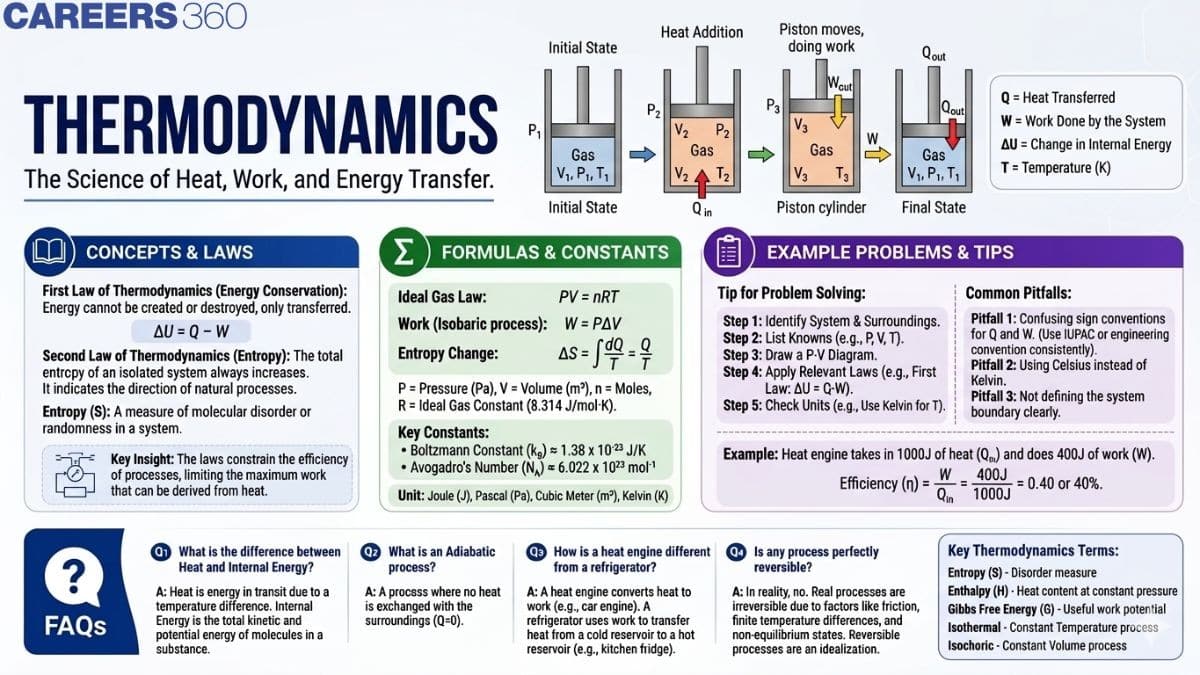
In order to study thermodynamics, one should specify clearly the following quantities: internal energy, heat, work, temperature, and state variables. It is not enough to observe changes in temperature or energy, but it is important to spell out how energy is exchanged and transformed. Likewise, thermal processes cannot be studied without bringing in relations that relate heat, work and variations in internal energy. An accurate and systematic study of the thermodynamic processes is made possible by the use of standard definitions and well-defined laws. Moreover, other key concepts covered in this chapter include thermodynamic systems, thermal equilibrium, the zeroth law, the first law of thermodynamics, and thermodynamic processes. It points out the fact that experimental observations confirm the existence of these laws, and describes how they are applied in the broad variety of practical applications, including heat engines and refrigerators, and the natural processes of energy cycles. Thermodynamics assists students in connecting the theoretical material with the practical energy systems in the real world and offers a good base of further studies in physics, engineering and applied sciences.
The significant concepts of the chapter Thermodynamics describe the ways energy can be exchanged in terms of heat and work and influence the state of a system. These topics bring in the laws of thermal equilibrium, energy conservation and the direction of natural processes. Knowing them will enable one to understand how engines, refrigerators and lots of natural phenomena work. These topics are crucial in developing an effective grounding in terms of thermal physics.
A given portion of the universe that is selected to be studied is a thermodynamic system, and the rest, which make up the surroundings, are referred to as the surroundings. The exchange of mass and energy can be used to classify systems into the open, closed and isolated. A proper definition of the system assists in the proper analysis of energy transfer. This is the concept of all thermodynamic analysis. It is necessary to apply the laws of thermodynamics properly.
A thermodynamic state of a system is described by measurable state variables like pressure (P), volume (V), temperature (T), and mass.
These variables define the macroscopic condition of the system.
When the system changes from one state to another, these variables also change.
For an ideal gas, the relation among the state variables is given by the Equation of State:
$
P V=n R T
$
State variables are concerned only with the present state of the system, but not with the path that the system followed to arrive at a specific state. This concept assists in differentiating between path and state-dependent quantities. It is very important in the study of thermodynamic processes.
Thermal equilibrium is a term used to refer to the inability of two systems in contact to exchange heat. The zeroth law holds that when two systems are in thermal equilibrium with some third system, then they are in thermal equilibrium with one another. This law furnishes a standard of measurement of temperature. It defines temperature as a basic and quantifiable value. The zeroth law facilitates uniformity of temperature scales.
Two ways of energy transfer between a system and its surroundings are heat and work. Heat transfer takes place because of the difference in temperature, and work transfer because of the macroscopic forces. Heat and work are dependent on the route that is taken in a process. They are not properties of the system but describe energy in transit. To use the first law of thermodynamics, it is necessary to understand heat and work.
Heat (Q): The energy transferred because of the temperature difference between the system and its surroundings. It flows from the hot to the cold body.
Work (W): The energy transferred when a force is applied, and displacement occurs (e.g., expansion or compression of a gas).
The first law is the law of conservation of energy applied to a thermodynamic system. It states that: "Energy can neither be created nor destroyed, it can only change from one form to another."
In thermodynamics, the change in internal energy of a system $(\boldsymbol{\Delta} \mathbf{U})$ is equal to the heat supplied to the system (Q) minus the work done by the system (W):
$
\Delta U=Q-W
$
The total microscopic energy of a system as a result of the movement and interactions of molecules in the system is known as internal energy. It contains the kinetic energies and the potential energies at the molecular scale. Internal energy is dependent on the system only. Alterations in internal energy are a result of heat exchange or work. This principle aids in explaining the changes in temperatures and the storage of energy in the systems.
A path through which a system can change state to another one is known as a thermodynamic process. Widely known processes are isothermal, adiabatic, isobaric and isochoric. The different processes possess unique features in terms of heat and work exchange. Knowledge of these processes makes problem-solving simple. They are often applied in conceptual and numerical questions.
The second law describes the natural course of the thermodynamic processes. According to it, without any work, a body can not allow heat to flow spontaneously to a hot body when it is colder than that body. This law brings about the notion of irreversibility. It gives the reason why some of the processes are irreversible. The second law is the basis of the interpretation of heat engines and refrigerators.
The Carnot engine is an ideal heat engine proposed by Sadi Carnot. It works between two temperature reservoirs and gives the maximum possible efficiency for a heat engine.
Working principle: It operates on the Carnot cycle, which consists of four reversible processes:
1. Isothermal expansion
2. Adiabatic expansion
3. Isothermal compression
4. Adiabatic compression
Efficiency of Carnot engine: $\eta=1-\frac{T_2}{T_1}$
Related topics,
The chapter Thermodynamics contains formulas that describe quantitative relations of the following terms in different thermodynamic processes: heat, work, internal energy and temperature. These relations are important in solving numerical problems and the mechanics of heat engines, refrigerators, and thermal systems.
1. Zeroth Law of Thermodynamics:
If two systems are in thermal equilibrium with a third system, they are in thermal equilibrium with each other.
2. First Law of Thermodynamics:
$
\Delta U=Q-W
$
where
$\Delta U=$ change in internal energy,
$Q=$ heat supplied to the system,
$W$ = work done by the system.
3. Work Done in Thermodynamic Processes:
$W=\int P d V$
4. Isothermal Process (Constant Temperature):
$
\Delta U=0
$
$
W=n R T \ln \left(\frac{V_2}{V_1}\right)
$
5. Adiabatic Process (No Heat Exchange):
$
Q=0
$
$
T V^{\gamma-1}=\mathrm{constant}
$
$
P V^\gamma=\mathrm{constant}
$
6. Isobaric Process (Constant Pressure):
$
W=P\left(V_2-V_1\right)
$
$
Q=n C_p \Delta T
$
7. Isochoric Process (Constant Volume):
$
W=0
$
$
Q=n C_v \Delta T
$
8. Relation between Heat Capacities:
$
C_p-C_v=R
$
$
\gamma=\frac{C_p}{C_v}
$
9. Internal Energy of an Ideal Gas:
$
U=\frac{f}{2} n R T
$
where $f=$ degrees of freedom.
10. Efficiency of a Heat Engine:
$\eta=\frac{W}{Q_H}$
11. Carnot Engine Efficiency:
$\eta=1-\frac{T_C}{T_H}$
Past year questions of the chapter Thermodynamics are primarily aimed at the application of the zeroth, first, and second laws of thermodynamics, thermodynamic processes, and heat engines. These questions will make students aware of the exam pattern, and they will know which concepts and formulas are mostly tested. Their practice enhances the ability to define concepts and solve numerical problems. This part is very helpful in effective revision and examination-oriented preparation.
Question 1:
An ideal gas is taken via the path as shown in the figure. The net work done in the whole cycle is

Solution:
Work done is the area enclosed.
$
\begin{aligned}
& W \text { ork done }=\frac{1}{2}\left(3 V_1-V_1\right)\left(4 P_1-P_1\right) \\
& W=-3 P_1 V_1
\end{aligned}
$
Question 2:
When 30J of work was done on the gas, 20J of heat energy was released. If the initial energy of the gas was 40J, what is the final internal energy (In J)?
Solution:
$
\Delta U=Q-W=(-20)-(-30)=10 J
$
$\Delta U$ is positive, so internal energy is increasing.
$
\begin{aligned}
& \Delta U=U_f-U_i=10 \Rightarrow U_f-40=10 \\
& U_f=50 J
\end{aligned}
$
Question 3:
One mole of an ideal monoatomic gas undergoes a process described by the equation $P V^3=$ constant. The heat capacity (in terms of R ) of the gas during this process is
Solution:
$
P V^3=C(N=3)
$
Specific heat in a polytropic process
$
\begin{aligned}
& P V^N=K \\
& C=C_V+\frac{R}{1-N} \\
& =\frac{3}{2} R+\frac{R}{1-3} \\
& =\frac{3}{2} R-\frac{R}{2}=R
\end{aligned}
$
Thermodynamics is an essential and scoring chapter in most of the level school-level and competitive exams because of its firm conceptual foundation and numerical activities. This chapter is examined by different tests that include questions about the thermodynamic laws, processes, heat engines, and refrigerators. The clarity of concepts, assumptions, and formulae will allow the students to cope with a wide range of questions of different problems.
| Exam | Focus Areas | Common Questions Asked | Marks / Questions Weightage | Preparation Tips |
|---|---|---|---|---|
| JEE Main | First law, thermodynamic processes, heat engines | Numerical MCQs, formula-based problems | 1–2 questions (4–8 marks) | Revise formulas, practice numericals |
| JEE Advanced | Conceptual thermodynamics, Carnot cycle | Multi-step conceptual + numerical problems | 1 question (variable marks) | Focus on assumptions and derivations |
| NEET | First law, processes, heat engines | Direct NCERT-based MCQs | 1–2 questions (4–8 marks) | Memorise definitions and standard results |
| UPSC CDS / NDA | Basics of thermodynamic laws | One-liners, simple numericals | 1 question (2–4 marks) | Revise laws and applications |
| State-Level Exams (WBJEE, MHT-CET, etc.) | Laws of thermodynamics, processes | Conceptual + numerical MCQs | 1–2 questions (4–8 marks) | Practice PYQs and speed-based questions |
| GATE | Thermodynamics fundamentals | Conceptual questions (limited) | Low/rare | Focus on core principles |
| School-Level (CBSE, ICSE, State Boards) | Entire chapter | Numericals, derivations | 5–8 marks | Master NCERT theory and examples |
| CUET | Conceptual understanding | MCQs, assertion–reason | 1–2 questions (4–6 marks) | Focus on laws and processes |
| SSC & Banking Exams | Basic thermal concepts | One-liners, matching type | 1 question (1–2 marks) | Revise key definitions |
To master the chapter Thermodynamics, students should refer to reliable textbooks, reference books, and practice materials that clearly explain thermodynamic laws, processes, and applications, such as heat engines and refrigerators. These resources help build strong conceptual clarity and numerical problem-solving skills required for school exams and competitive exams like JEE Main, JEE Advanced, and NEET.
| Book Title | Author / Publisher | Description |
|---|---|---|
| NCERT Class 11 Physics (Part I) | NCERT | The official textbook covering zeroth, first, and second laws of thermodynamics, thermodynamic processes, and applications, with clear theory and examples. |
| NCERT Exemplar Physics (Class 11) | NCERT | Contains higher-order and application-based questions on thermodynamic laws and processes for deeper conceptual understanding. |
| Concepts of Physics – Volume 1 | H.C. Verma | Excellent for developing strong conceptual clarity and solving challenging numerical problems related to thermodynamics. |
| Understanding Physics: Thermodynamics & Kinetic Theory | D.C. Pandey (Arihant) | Detailed topic-wise explanations, solved examples, and practice questions focused on thermodynamic processes and laws. |
| Physics for Class 11 | R.D. Sharma | Step-by-step theory with a wide range of solved and unsolved numerical problems on thermodynamics. |
| Arihant All-In-One Physics (Class 11) | Arihant | Concise theory summaries, formula sheets, solved examples, and exam-oriented practice questions from thermodynamics. |
| MTG Chapter-wise Previous Year Questions – Physics | MTG | Helps students practice and analyse past board and competitive exam questions, specifically from the Thermodynamics chapter. |
The NCERT material on the chapter Thermodynamics gives a clear and exam-oriented form of understanding of the laws of heat, work, and transfer of energy. Concepts like thermodynamic systems, laws of thermodynamics, processes, and heat engines are introduced at a simple level, which is presented by the NCERT textbook and exemplar problems through diagrams and solved examples. Proper study of the NCERT contributes to the development of good conceptual knowledge and numerical solving skills. Such resources are the basis of board exams in Class 11 and even competition exams such as JEE Main and NEET.
NCERT subject-wise materials are organised and syllabus-based learning content on various subjects, which assists students in developing a good conceptual basis. They consist of textbooks, exemplar problems, and solutions and can thus be very helpful in the preparation for the board exams and even competitive exams such as JEE and NEET.
Practice questions from the chapter Thermodynamics help students strengthen their understanding of thermodynamic laws, energy transfer, and various thermodynamic processes. These problems include the use of the zeroth, first, and second laws of thermodynamics, heat-work relations and heat engines. Frequent practice enhances clarity of concept, numerical-solving speed, as well as problem-solving speed. The answers to such questions are crucial in a good performance during Class 11 examinations and competitive tests such as JEE Main and NEET.
The chapter Thermodynamics is a powerful conceptual base for the understanding of the relationship between work, heat and internal energy in physical systems. Students are able to acquire good analytical and numerical problem-solving skills by constantly revising important concepts, key formulas, and fundamental principles that constitute the laws of thermodynamics, thermodynamic processes, heat engines, and refrigerators. The systematic and consistent approach towards practice will be useful in developing confidence and accuracy. This is a well-prepared preparation that goes a long way in giving one good results in Class 11 examinations and even competitive exams like JEE Main and NEET.
.


Law Admissions 2026 Open | Avail Merit-Based Scholarships
BBA/MBA/PGDM Early Bird Applications Open 2027. Apply now using coupon code CAREER250 and get ₹250 off the application fee
Ranked #36 amongst institutions in Management by NIRF | 100% Placement
Globally Recognized by AACSB (US) & AMBA (UK) | 18 LPA Avg. CTC for PGPM 2026
NEET PG All India & State College Predictor with Admission Process Guide
Top B-School: Ranked #9 in NIRF Management Rankings 2025.