KCC Institute of Legal and Higher Education, Greater Noida
Law Admissions 2026 Open | Avail Merit-Based Scholarships


Bar and atmosphere (atm) are important pressure units in physics. Pressure means force acting per unit area. Both bar and atm are commonly used to measure pressure in topics like thermodynamics, fluid mechanics, and gas laws. Atmospheric pressure (atm) represents the pressure exerted by air at sea level, while bar is a standard unit that is very close to atmospheric pressure. One bar is slightly less than one atm, so conversions between these units are often required while solving numerical problems. Understanding the relation between bar and atm helps students compare pressure values easily and avoid mistakes in calculations. Learning how to convert bar into atm and atm into bar makes problem-solving faster and more accurate, especially in physics and chemistry applications.
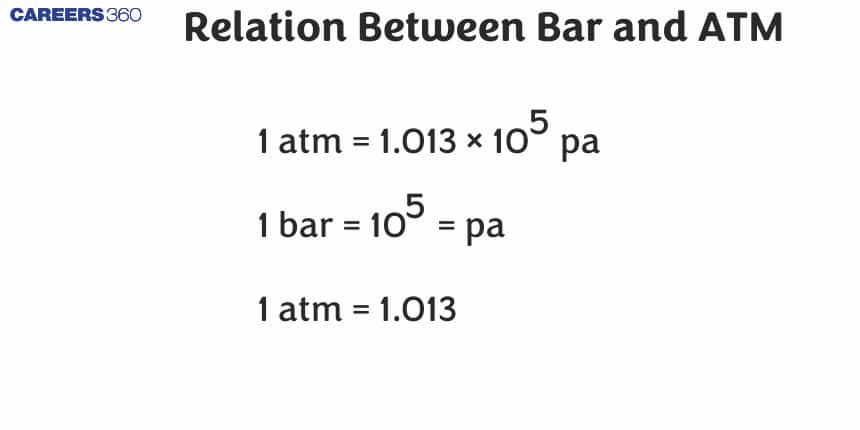
Pressure is defined as force per unit area:
$
\text { Pressure }=\frac{\text { Force }}{\text { Area }}
$
The commonly used units of pressure are bar and atmosphere (atm).
Bar to atm
$
1 \mathrm{bar}=0.986923 \mathrm{~atm}
$
Atm to bar
$
1 \mathrm{~atm}=1.01325 \mathrm{bar}
$
| Quantity | Definition | Symbol | Value | SI Unit |
| 1 atm | Pressure exerted by the atmosphere at sea level | atm | $(1 \text{ atm} = 101.325 \text{ kPa})$ | $( \text{N/m}^2 = \text{kg m}^{-1}\text{s}^{-2} )$ |
| 1 bar | Unit of pressure nearly equal to atmospheric pressure | bar | $(1 \text{ bar} = 100{,}000 \text{ N/m}^2)$ | $( \text{N/m}^2 = \text{kg m}^{-1}\text{s}^{-2} )$ |
Also, read
|
Related Topics |
Leading Design College | Highest CTC: ₹12 LPA | Average CTC: ₹7.5 LPA | Scholarships for Deserving Students
Highest Package 29.30 LPA | 12 LPA Median CTC | 230+ Recruiters | AACSB Accredited | Ranked 51 in Asia by QS International
Bar to Atm conversion
Conversion from Bar to atm helps solve problems. See the table given below for some of the most commonly used pressure values in the Bar scale and its equal value in the atm scale.
Conversion of BAR to ATM
1 Bar =0.986923 atm
ATM to BAR conversion
1 atm =1.01325 bar
Symbol Formula unit Basic
1 atm Pressure found in column air at sea. atm
$\begin{aligned} & 1 \mathrm{~atm}=101.325 \mathrm{kPa} \mathrm{atm} \\ & 1 \mathrm{bar}=100,000 \mathrm{~N} / \mathrm{m}^2\end{aligned}$
Frequently Asked Questions (FAQs)
A drying unit called a metric unit of pressure but not part of the SI International System of Units. We can say that it is defined to be exactly equal to 100,000 Pa per 100 kPa or we can say that it is slightly smaller than the pressure of the current atmospheric pressure on planet Earth at sea at approximately 1.013 bar.
It is generally said to correspond to the pressure exerted by a vertical column of mercury such as a 760 mm barometer which is also 29,9213 inches high. One of the most common cases is called the single state equal to 101,325 pascals or we can say that the new energy per square meter is about 14.7 kilograms per inch.
A pascal equal to Pa is a standard unit of pressure. That would mean that the normal atmospheric pressure is known as 1 atm of pressure and is equal to 760 mmHg and 101.3 kPa. The pressure that is atmospheric pressure is also often referred to as pounds or not to a square inch called psi. The so-called atmospheric pressure is 14.7 psi.
As a general guideline we have learned we can say that almost all sea level pressures live between 950 milligrams and 1050 milligrams with high sea level pressure i.e. reading drops between 980 milligrams and 1040 milligrams.
Both bar and torr are pressure units. 1 torr = 1 mm. Of Hg col. :. 1 bar = 760 torr.
It has long been known that air has a weight. The atmosphere weighs 14.7 pounds by six inches [6 cm] of ocean power. This means that an air column 1 inch long as air, can weigh 14.7 pounds. We usually call this 1 Atmosphere of pressure, or 1 ATM.


Law Admissions 2026 Open | Avail Merit-Based Scholarships
Get Job Ready in Healthcare | Employability-Focused Programs
Leading Design College | Highest CTC: ₹12 LPA | Average CTC: ₹7.5 LPA | Scholarships for Deserving Students
Highest Package 29.30 LPA | 12 LPA Median CTC | 230+ Recruiters | AACSB Accredited | Ranked 51 in Asia by QS International
BBA/MBA/PGDM Early Bird Applications Deadline 19th Oct '26. Apply now using coupon code CAREER250 and get ₹250 off the application fee
Ranked #36 amongst institutions in Management by NIRF | 100% Placement