


Cell Cycle and Cell Division - Topics, Definition And Phases of Cell Cycle
The Cell Cycle and Cell Division are fundamental processes in biology. It shows how cells grow, develop and divide. The cell division process is important to understanding how living organisms mature, grow, and reproduce. Cell cycle has two phases: the interphase and the mitotic (M) phase. During interphase, the cell prepares for cell division through the G1, S, and G2 phases. In the M-phase, the cell undergoes cell division either via mitosis or meiosis. These cell cycle stages ensure proper DNA replication and successful cytokinesis.
This Story also Contains
- History of Cell Cycle and Cell Division
- Cell Cycle Phases and Key Features
- Cell Cycle Stages: Interphase and M Phase
- Interphase: G1 Phase, S Phase, G2 Phase
- Mitosis (M Phase): Stages of Cell Division
- Meiosis: Stages of Cell Division and Genetic Variation
- Cytokinesis: Final Step of Cell Cycle
- Cell Division Importance
- Cell Cycle and Cell Division MCQs
- Recommended Video on Cell Cycle and Cell Division
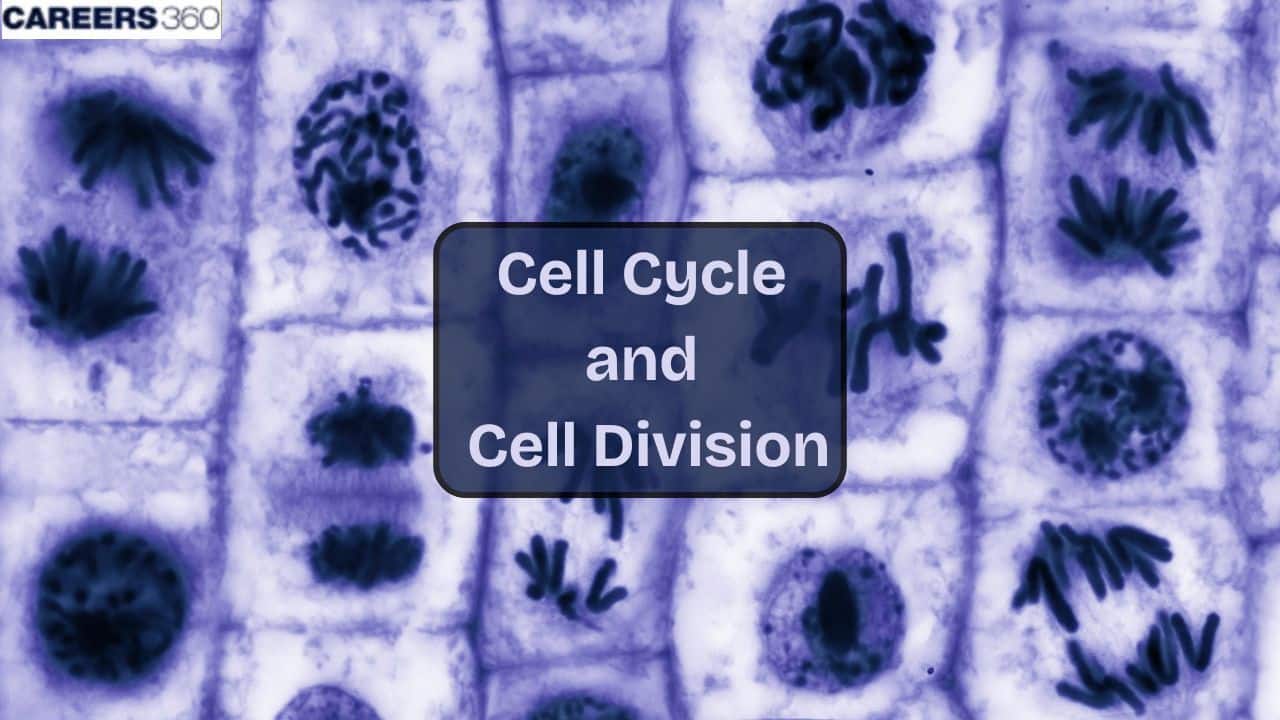
In Class 11 Biology, the chapter Cell Cycle and Cell Division covers the basis of life continuity in living organisms. This article covers the history of the cell cycle, the role of cell cycle checkpoints and the importance of cell division. It explains the mitosis for identical daughter cells and meiosis for gamete formation. It highlights how karyokinesis and cytokinesis complete the process. Understanding the cell cycle phases and cell cycle stages helps students grasp the basics of biology, with the difference between mitosis and meiosis in cell division
History of Cell Cycle and Cell Division
The history of the cell cycle and cell division explains how scientists discovered the process of cell growth and reproduction. A frog zygote was studied by Prevost and Dumas (1824) while they discovered the cell cycle. It is a series of steps through which the cell passes to divide and produce new cells. It is the entire process by which a population of cells grows and develops with the help of a single parent cell. Some of the important historical context about the cell cycle stages, mitosis and meiosis is discussed below in the table:
| Years | Events |
|---|---|
1824 | Prevost and Dumas first observed cell division in frogs. |
1830s | Schleiden and Schwann proposed Cell Theory, which states that all life is made up of cells. |
1855 | Rudolf Virchow stated, "Omnis cellula e cellular", which means the cells arise from pre-existing cells. |
1879 | Walter Fleming described mitosis for the first time |
20th Century | Molecular biology discovered DNA and its regulatory proteins that control the cell cycle. |
Also Read:
Cell Cycle Phases and Key Features
The cell cycle is a series of events that control cell division. It is a process by which a cell divides into daughter cells. It ensures proper distribution of genetic material and cytoplasm. Some of the key features of the cell cycle are mentioned below:
The longest phase of the cell cycle is interphase, in which DNA replication occurs.
Interphase has three phases: G1 Phase, S Phase and G2 Phase.
In the M phase, the cell divides into two daughter cells either by mitosis or meiosis.
The G0 phase is the resting or quiescent phase, where the cell either exits the cycle temporarily or permanently. It remains metabolically active but does not divide.
The cell cycle is essential for growth, tissue repair and asexual reproduction in unicellular organisms.
An average human cell cycle lasts about 24 hrs.
Cell cycle checkpoints are present at G1, G2 and metaphase to ensure DNA replication. This prevents errors like DNA damage or error-free cell division.
Cell Cycle Stages: Interphase and M Phase
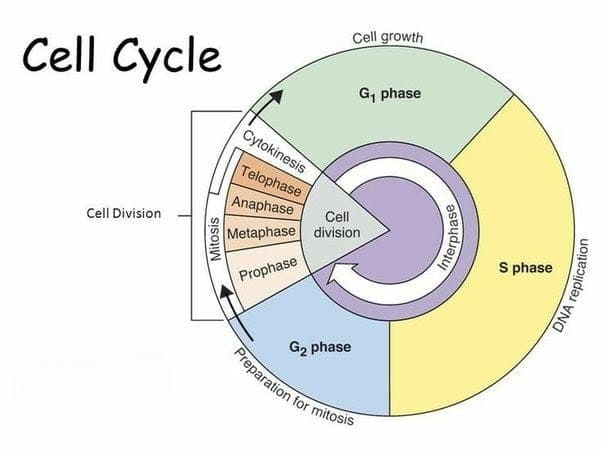
The cell cycle is the basis of cell division. For successful cell division, a cell must fulfil certain criteria: it must grow, duplicate its genetic material (DNA), and physically split into two sister cells. These steps occur in an organised manner by the cells known as the cell cycle. The cell cycle stages are divided into two major phases: interphase and the mitotic (M) phase. Some of the important stages are mentioned below:
G1 Phase: The cell grows, doubles its organelles and prepares itself for DNA replication.
S Phase: DNA replication occurs with the formation of two sister chromatids.
G2 Phase: The cell continues to grow for the final preparation of mitosis.
M Phase: Mitosis takes place, which is followed by cytoplasmic division (cytokinesis).
Interphase: G1 Phase, S Phase, G2 Phase
The cell cycle and cell division class 11 chapter explains the chain of events that ensure growth and reproduction. The cell cycle phases in interphase are G1 phase, S phase, and G2 phase. These steps are essential for accurate DNA replication and successful mitosis or meiosis. All the important events and their significance in the DNA replication process are discussed below in the table:
| Events | Explanation |
|---|---|
G1 Phase (Gap 1) |
|
S Phase (Synthesis phase) |
|
G2 Phase (Gap 2) |
|
Mitosis (M Phase): Stages of Cell Division
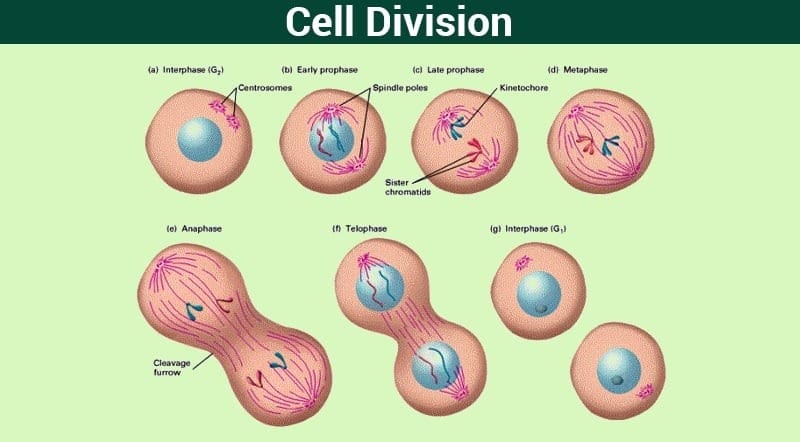
Mitosis is a type of cell division that results in two genetically identical daughter cells. It is used for growth, repair and tissue maintenance. During the M phase of the cell cycle, the cell divides into two nuclei, and the chromosomes are separated by spindle fibres. The process of mitosis is divided into 4 stages:
Prophase: Chromatin condenses into visible chromosomes. The nuclear envelope begins to disintegrate. Spindle fibres start forming from the centrosomes.
Metaphase: Chromosomes align at the cell's equatorial (metaphase) plate. Spindle fibres attach to the centromeres of each chromosome.
Anaphase: Sister chromatids are pulled apart toward opposite poles of the cell. The cell elongates as microtubules shorten, separating the chromatids.
Telophase: Chromatids reach the poles and decondense back into chromatin. Nuclear envelopes form around the two sets of chromosomes.
Finally, cytokinesis follows mitosis, dividing the cytoplasm and completing cell division.
Meiosis: Stages of Cell Division and Genetic Variation
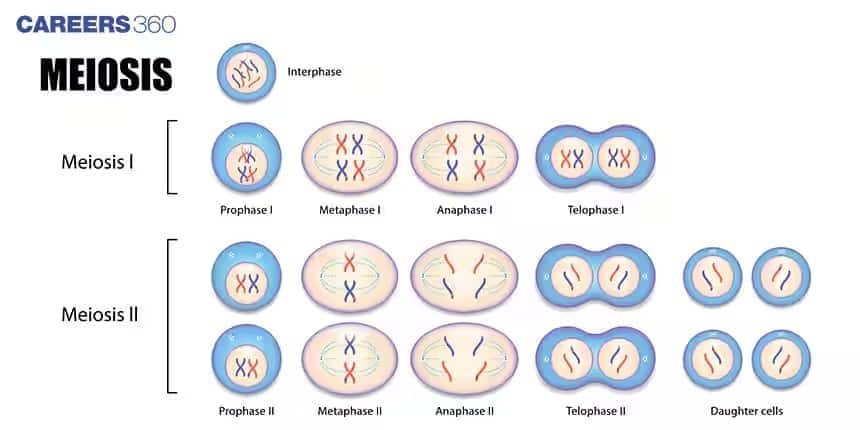
Meiosis is a special type of cell division. It reduces the chromosome number by half and produces four genetically different gametes. This cell division process is important for sexual reproduction to increase genetic variations. Unlike mitosis, which creates identical daughter cells, meiosis ensures diversity in offspring. These are the stages of meiosis given below:
Prophase I: Chromosomes condense. Homologous chromosomes pair up (synapsis). Crossing over occurs, increasing genetic variation.
Metaphase I: Homologous pairs align at the metaphase plate.
Anaphase I: Homologous chromosomes (not chromatids) are pulled to opposite poles.
Telophase I: Two haploid nuclei form. Cytokinesis follows, resulting in two haploid cells.
Prophase II: Chromosomes condense again in each haploid cell. The spindle forms.
Metaphase II: Chromosomes line up at the equator.
Anaphase II: Sister chromatids are separated and move to opposite poles.
Telophase II: Chromatids reach poles. Nuclear envelopes reform. Cytokinesis occurs, producing four genetically unique haploid cells.
Cytokinesis: Final Step of Cell Cycle
Cytokinesis is the final step of the cell cycle and completes cell division. The cytoplasm divides into two daughter cells. A cleavage furrow is formed in Animal cells, while a cell plate is formed in plant cells. This provides proper separation of cytoplasm and organelles. It guarantees that each daughter cell receives equal cytoplasm and organelles. Together, karyokinesis and cytokinesis complete the cell cycle stages. This step is essential for growth, repair, and reproduction in living organisms.
Cell Division Importance
Cell division takes place through mitosis and meiosis. It is one of the very important events for the growth and repair of the body tissues and muscles. Apart from this, it is also very important for reproduction in organisms. Some of the major importance of cell division is discussed below:
In mitosis, diploid daughter cells are produced with identical genetic material.
In meiosis, gametes are formed, such as sperm and eggs.
It supports growth and tissue repair.
The cell division also ensures that there is the growth of multicellular organisms and the restoration of the nucleus to cytoplasm ratio.
Due to cell division, damaged and dead cells are replaced with healthy ones. This is usually done by the skin, gut lining and blood cells.
Due to cell division, there is continuous plant growth through lateral and apical meristematic tissues.
Due to cell division, there is also preservation of chromosomes. This is usually done in sexually reproducing organisms and increases the genetic variation.
Cell Cycle and Cell Division MCQs
Question 1: Interphase is
A phase in cell cycle
A phase in cell division
Both a and b
None of these
Correct Answer: 1) A phase in cell cycle
Explanation:
All cells reproduce by dividing into daughter cells, and this process is known as the cell cycle. The cell cycle refers to an orderly set of stages that occur when a cell divides, and the daughter cells subsequently divide as well. It encompasses the sequence of events through which a cell duplicates its genome, synthesizes the necessary components, and ultimately divides into two daughter cells. The cell cycle is divided into two main phases:
Interphase: The phase where the cell grows, replicates its DNA, and prepares for division.
Division phase: This phase involves the actual process of cell division, which includes mitosis (or meiosis in reproductive cells) and cytokinesis, where the cell's contents are evenly distributed between two daughter cells.
These phases ensure that cells grow, function, and reproduce efficiently, maintaining the organism's cellular integrity.
Hence, the correct answer is option (1) Interphase is a phase in the cell cycle.
Question 2: Cell cycle is
An orderly set of stages that take place between a cell divide and then the daughter cells also divide
The sequence of events by which a cell prepares itself for division
Both a and b
None of these
Correct Answer: 3) Both a and b
Explanation:
The cell cycle, a vital eukaryotic process, involves stages leading to cell growth and division. It's divided into interphase and mitosis. Interphase has three key phases: G1, where cells grow and produce proteins; S phase, when DNA replication occurs; and G2, for final preparations before division. Mitosis consists of prophase, metaphase, anaphase, and telophase, followed by cytokinesis. This process is tightly controlled by checkpoints and specific proteins to guarantee precise cell division and function.
Hence, the correct answer is option 3) Both a and b
Question 3: Read the following statements given below:
The great majority of cell divisions that happens in our body involves meiosis.
Condensation of chromosomes start during the metaphase stage of cell division.
Sister chromatids separate from each other and move towards the pole in anaphase.
Mitotic spindle starts dissolving during metaphase stage of cell division.
Dissolution of nuclear membrane occurs in prophase stage of cell cycle.
How many of the above statements are incorrect?
2
3
1
5
Correct Answer: 2) 3
Explanation:
The statements mentioned above are based on the mitosis process. There are three incorrect statements 1,2 and 4. The majority of cell division that happens in our body occurs in somatic cells undergoing mitosis. Condensation of chromosomes takes place in the prophase stage of cell division and spindle fibers start dissolving at the telophase stage of cell division.
Hence, the correct answer is option 2) 3.
Also Read:
Recommended Video on Cell Cycle and Cell Division
Frequently Asked Questions (FAQs)
Mitosis produces two genetically identical diploid daughter cells, while meiosis produces four genetically unique haploid gametes.
The cell cycle has two major phases: Interphase (G1, S, G2) and M phase (mitosis or meiosis followed by cytokinesis).
Checkpoints at G1, G2, and metaphase ensure proper DNA replication and prevent errors during cell division.
During the 19th century, Walther Flemming discovered the cell cycle. The professor at the Institute of Anatomy was responsible for this discovery.