KCC Institute of Legal and Higher Education, Greater Noida
Law Admissions 2026 Open | Avail Merit-Based Scholarships


The cell cycle is the sequence of growth and division of a cell. It allows cells to duplicate and produce identical daughter cells. This is important in an organism's growth, development, and repair. Every living thing depends on the cell cycle to maintain health and stability. The cell cycle is divided into distinct stages that accurately duplicate the genetic material and distribute it equally between daughter cells.
This Story also Contains
The major steps involved in the cell cycle include the interphase, mitosis and cytokinesis. During interphase, the cell grows and prepares for division. In mitosis, chromosomes are separated into two identical sets. Cytokinesis completes the process by dividing the cytoplasm, forming two daughter cells. The cell cycle also has checkpoints that monitor DNA and prevent errors. Cell cycle is a crucial topic for NEET and Class 11 Biology under the Cell Cycle and Cell Division chapter.
The cell cycle is the way a cell grows and divides. A cell reproduces by carrying out an orderly sequence of events in which it duplicates its contents and then divides into two. This cycle of duplication and division is known as the cell cycle. It is the essential mechanism by which all living things reproduce. The cell cycle is divided into four major phases:
Law Admissions 2026 Open | Avail Merit-Based Scholarships
BBA/MBA/PGDM Early Bird Applications Deadline 19th Oct '26. Apply now using coupon code CAREER250 and get ₹250 off the application fee
G1 Phase: Cells synthesise RNAs and proteins, preparing for S phase.
S Phase: DNA synthesis and chromosome replication
G2 Phase: The cell grows further and checks if it is ready for the process of mitosis.
M Phase: The cell divides its chromosomes and cytoplasm into two identical daughter cells.
Regulating the cell cycle is very important in ensuring that an organism, in general, grows, develops, and maintains health.
The cell cycle is a biological process with fundamental activity in the growth and division of cells. It consists of a series of well-defined phases that allow for the precise duplication and distribution of the genetic material into two daughter cells. These cell cycle phases involve interphase and the mitotic phase, which is divided into several stages
Cells spend most of their time in interphase and perform usual functions.
In the interphase cell grows in size and prepares itself for the next division.
Interphase is the most active phase of the cell cycle.
The interphase lasts more than 95% of the cell cycle.
It was earlier regarded as a resting phase because the metabolic activities performed by the cell were not visible under a microscope.
The M phase, or mitotic phase, is an important part of the cell cycle in which the cell undergoes cell division to give two genetically identical daughter cells. It comprises two central processes:
Karyokinesis - Division of the nucleus.
Cytokinesis - Division of the cytoplasm.
The cell cycle spends most of its time in interphase. In this phase, the cell grows, copies DNA, and prepares for division. Howard and Pelc classified interphase into three sub-stages:
The cell increases in size, doubles its organelles (such as mitochondria and ribosomes) and accumulates materials that will be used for DNA synthesis.
Cells are constantly performing their usual functions, including communicating with other cells, secreting substances, and carrying out cellular respiration.
In addition to being a bustling period of metabolic activity, G1 is an important point of decision-making for the cell. Based on the environment, the cell-cycle control machinery can either hold the cell transiently in G1 (or in G0) or allow it to prepare for entry into the S phase.
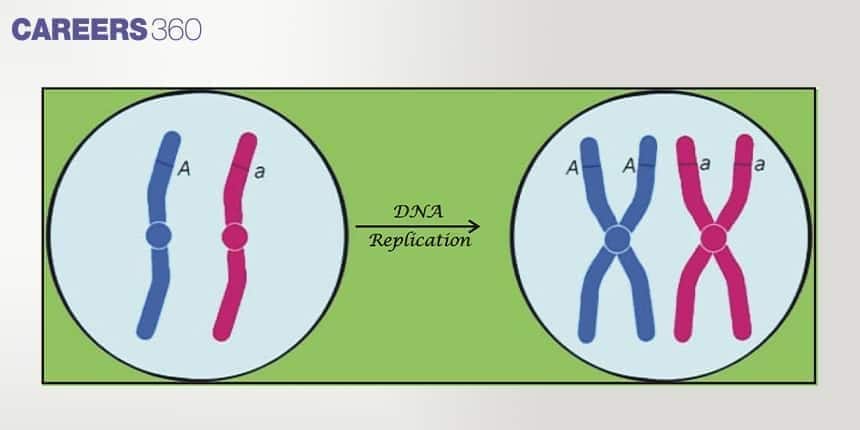
Before a cell divides, it must replicate its DNA. This replication must occur with extreme accuracy to minimise the risk of mutations in the next generation.
At the beginning of the S stage, each chromosome is composed of one DNA double helix.
Following DNA replication, each chromosome is composed of two identical DNA double helix molecules and each double helix is called a chromatid.
At this stage, the proteins that will be helpful during cell division are synthesised.
For example, proteins that form microtubules will be synthesised.
Once a cell has successfully replicated its DNA in S phase and progressed through G2, it is ready to enter M phase.
Mitosis is also called the equational division (because the daughter cells have an equal number of chromosomes as that of the parents) and somatic cell division (because it occurs in somatic cells). Mitosis was first observed by Strasburger in 1875. The term mitosis was given by Fleming in 1882. The two major stages of mitosis are:
Karyokinesis means the division of the nucleus. It is further divided into four stages:
Prophase
During this stage, the chromatin condenses, and the chromosomes are visible.
The nucleolus disappears and the nuclear envelope fragments.
With the disappearance of the nuclear membrane, the centrioles migrate to the opposite end, and the spindle formation occurs.
During late prophase or prometaphase, kinetochores appear on each side of the centromere.
The sister chromatids are attached to the so-called kinetochore spindle fibres with the help of the kinetochore.
Metaphase
Chromosomes become fully condensed and distinct.
Chromosomes move towards the equatorial plane of spindles or metaphase plates.
Chromosomes are arranged with their arms directed towards the poles and the centromere towards the equator.
Anaphase
The centromere splits, and the two chromatids of the duplicated chromosomes separate from each other.
Each chromatid now becomes a daughter chromosome.
Daughter chromosomes, each with a centromere and a single chromatid, appear to move toward opposite poles.
It is the shortest phase of mitosis.
Telophase
During this phase, the spindle disappears, and new nuclear envelopes develop around the daughter chromosomes.
Each daughter nucleus contains the same number and kinds of chromosomes as the original parent cell.
The chromosomes become diffuse chromatin, and the nucleolus reappears.
It is followed by the division of the cytoplasm.
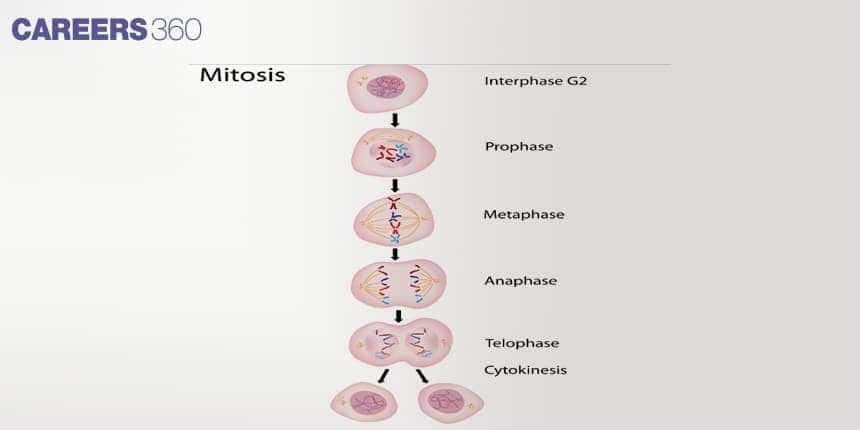
At the end of mitosis, cytokinesis is the process by which the cytoplasm of the parent cell divides into two daughter cells. Cytokinesis ensures that each daughter cell receives a complete set of organelles and cytoplasm. Thus, the cell cycle is completed, and two daughter cells are produced, one genetically identical to the other.
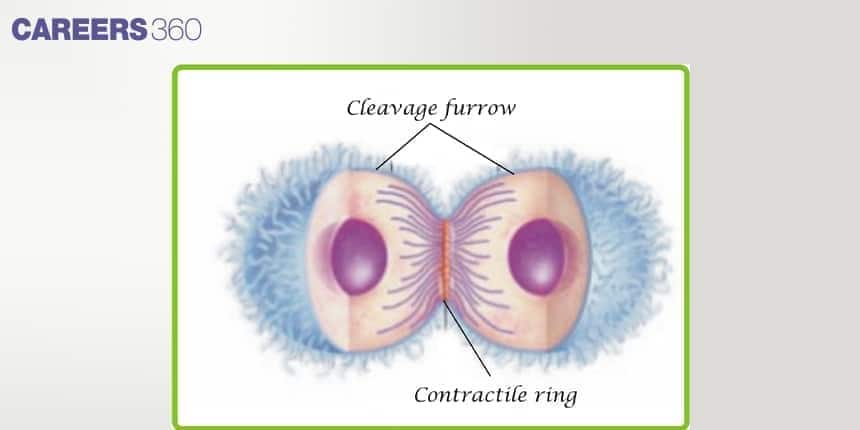
In animal cells, cytokinesis occurs through the formation of the cleavage furrow.
The cleavage furrow represents the indentation of the cell membrane between the two daughter nuclei.
A band of actin filaments called the contractile ring starts to form the circular constriction between the two daughter nuclei.
Due to the action of the contractile ring, the furrow deepens continuously, and ultimately, a cell divides into two daughter cells.
Cytokinesis in the animal cell occurs centripetally, that is, from the periphery to the centre
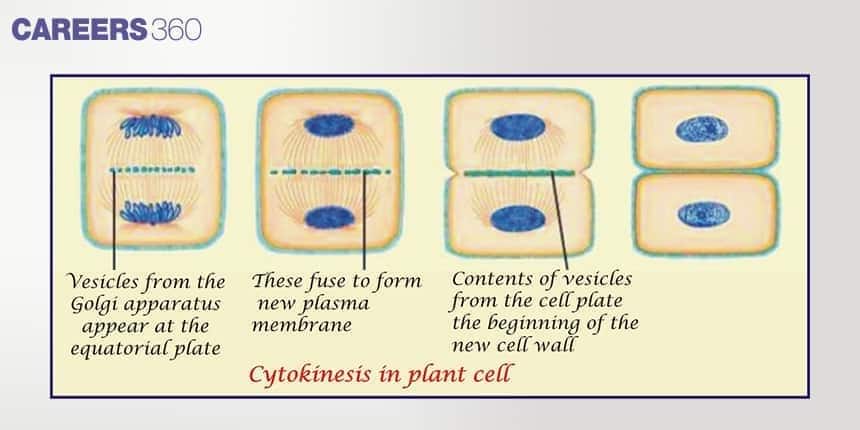
In plant cells, the presence of a rigid cell wall prevents furrow formation.
Therefore, a new cell wall is formed between the daughter nuclei to complete cytokinesis.
Many Golgi vesicles and spindle microtubules arrange themselves on the equator to form phragmoplasts.
The membrane of Golgi vesicles fuses to form a plate-like structure called a cell plate.
Golgi vesicles secrete calcium and magnesium pectate.
The further cell plate is modified into the middle lamella.
In plants, cytokinesis occurs in centrifugal order, i.e., the cell plate is formed from the centre to the periphery.
The cell cycle control system regulates progression through the cell cycle at three main transition points. The checkpoints in the cell cycle check for errors, stop the cell cycle in case of any fault and continue if there is no fault.
G1/S Checkpoint
At the transition from G1 to S phase, the control system confirms that the environment is favourable for proliferation before committing to DNA replication. Cell proliferation requires sufficient nutrients and specific signal molecules in the extracellular environment.
If the conditions are unfavourable, cells can delay progress through G1 and may even enter a specialised resting state known as G0 (G zero). In animals, the transition from G1 to S phase is especially important as a point in the cell cycle where the control system is regulated.
G2/M Checkpoint
At the transition from G2 to M phase, the control system confirms that the DNA is undamaged and fully replicated, ensuring that the cell does not enter mitosis unless its DNA is intact.
Spindle Checkpoint
Finally, during mitosis, the control machinery ensures that the duplicated chromosomes are properly attached to a cytoskeletal structure, called the mitotic spindle, before the spindle pulls the chromosomes apart and segregates them into the two daughter cells.
The cell cycle is controlled by signals inside and outside the cell. These signals tell the cell when to divide and when to stop. If more cells are needed for growth or repair, signals stimulate division. If cells are not needed, signals block division. This balance keeps tissues healthy and stable.
The cell cycle control system checks conditions before allowing progress. At the G1 to S transition, extracellular signals decide if the cell should continue or pause. If the control system fails, cells may divide without stopping. This uncontrolled division leads to cancer. Proper regulation of the cell cycle is therefore essential for growth, development, and maintaining health.
Important topics for the NEET exam are:
Phases of Cell Cycle
Mitotic Phase
3 Cell Cycle Checkpoints (G1/S, G2, M)
Q1. Interphase is
A phase in the cell cycle
A phase in cell division
Both a and b
None of these
Correct answer: 1) A phase in the cell cycle
Explanation:
All cells reproduce by dividing into daughter cells, and this process is known as the cell cycle. The cell cycle refers to an orderly set of stages that occur when a cell divides, and the daughter cells subsequently divide as well. It encompasses the sequence of events through which a cell duplicates its genome, synthesises the necessary components, and ultimately divides into two daughter cells. The cell cycle is divided into two main phases:
Interphase: The phase where the cell grows, replicates its DNA, and prepares for division.
Division phase: This phase involves the actual process of cell division, which includes mitosis (or meiosis in reproductive cells) and cytokinesis, where the cell's contents are evenly distributed between two daughter cells.
These phases ensure that cells grow, function, and reproduce efficiently, maintaining the organism's cellular integrity.
Hence, the correct answer is option 1) Interphase is a phase in the cell cycle.
Q2. The cell cycle is
An orderly set of stages that take place between a cell division and then the daughter cells also divide
The sequence of events by which a cell prepares itself for division
Both a and b
None of these
Correct answer: 3) Both a and b
Explanation:
The cell cycle, a vital eukaryotic process, involves stages leading to cell growth and division. It's divided into interphase and mitosis. Interphase has three key phases: G1, where cells grow and produce proteins; S phase, when DNA replication occurs; and G2, for final preparations before division. Mitosis consists of prophase, metaphase, anaphase, and telophase, followed by cytokinesis. This process is tightly controlled by checkpoints and specific proteins to guarantee precise cell division and function.
Hence, the correct answer is option 3) Both a and b.
Q3. In a unicellular organism, cell division results in
Growth
Reproduction
Repairment
All of these
Correct answer: 2) Reproduction
Explanation:
The primary purpose of cell division in unicellular organisms is reproduction. These organisms are made up of a single cell, and when that cell divides, a new, autonomous organism is created. Binary fission, budding, or multiple fission are some of the mechanisms that enable this procedure, which is referred to as asexual reproduction. For example, in yeast, budding is the creation of a tiny bud that expands and finally separates, but in bacteria, binary fission results in the splitting of one cell into two identical daughter cells. numerous fission generates numerous daughter cells at the same time in certain protists, such as Plasmodium.
Hence, the correct answer is option 2) Reproduction.
Frequently Asked Questions (FAQs)
The cell cycle is the process by which cells grow, copy DNA, and divide into two daughter cells.
The cell cycle is important for growth, repair, and reproduction. Without it, organisms cannot survive.
The cell cycle is controlled by checkpoints and signals. They stop division if the DNA is damaged or the conditions are not right.
The four major stages of mitosis are prophase, metaphase, anaphase and telophase.
Interphase: The cell grows and copies DNA.
Mitosis: The cell divides into two identical daughter cells.

Directions for question:
The bar-graph given below shows the foreign exchange reserves of Nepal (in million Rupees) from 2014 to 2021. Answer the following questions based on the graph :

Question:
What was the percentage increase (rounded to the nearest integer, if deemed necessary) in the foreign exchange reserves in

Law Admissions 2026 Open | Avail Merit-Based Scholarships
BBA/MBA/PGDM Early Bird Applications Deadline 19th Oct '26. Apply now using coupon code CAREER250 and get ₹250 off the application fee
Ranked #36 amongst institutions in Management by NIRF | 100% Placement
Globally Recognized by AACSB (US) & AMBA (UK) | 18 LPA Avg. CTC for PGPM 2026
Leading Design College | 95% Placement Record | Merit-cum-Means Scholarships for Deserving Students
NEET PG All India & State College Predictor with Admission Process Guide