KCC Institute of Legal and Higher Education, Greater Noida
Law Admissions 2026 Open | Avail Merit-Based Scholarships


The human circulatory system is a vital transport network that delivers oxygen, nutrients, and hormones to every cell while removing waste products. It works through a coordinated system of the heart, blood vessels, and blood to maintain homeostasis and support life processes. Understanding the circulatory system is essential for NEET and Class 11–12 Biology, as it forms the core of the “Body Fluids and Circulation” chapter.
This Story also Contains
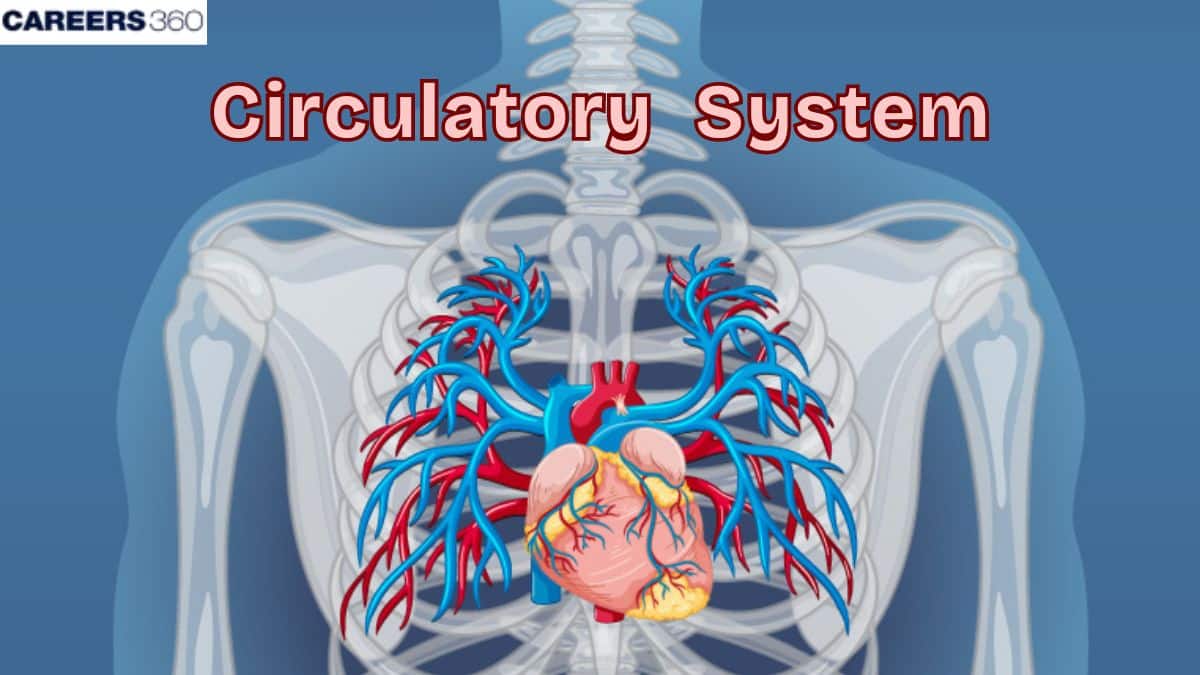
The circulatory or cardiovascular system belongs to the indispensable set of vessels through which blood, and therefore nutrients, gases, and metabolic waste products, is transported to and from all cells of the entire body. The circulatory system consists of the heart, blood vessels, and blood, which provide the various tissues with all the necessary nutrients and oxygen and get rid of carbon dioxide and metabolic waste products. The system is very important in supporting homeostasis and other functions of the body, such as temperature regulation and some immune responses.
The primary components or parts of the circulatory system are the heart, blood vessels, and blood. All these play crucial roles in the overall functioning and efficiency of the circulatory system.
The structure of the heart:
Four chambers: two atria (upper chambers) and two ventricles (lower chambers)
Valves: tricuspid, bicuspid (mitral), pulmonary, and aortic valves
Walls: endocardium (the inner layer), myocardium (the muscle layer), epicardium (the outer layer)
Law Admissions 2026 Open | Avail Merit-Based Scholarships
BBA/MBA/PGDM Early Bird Applications Deadline 19th Oct '26. Apply now using coupon code CAREER250 and get ₹250 off the application fee
The function of heart:
A pump that provides a continuous circulation of blood throughout the body.
Blood pressure maintenance and blood flow
Carrying oxygen and nutrition, and carrying waste products to and from tissues, respectively.
Types: Arteries, Veins, Capillaries
Pulmonary Arteries and Veins: The arteries convey deoxygenated blood, while the veins convey oxygenated blood
Capillaries: Microscopic blood vessels through which the exchange of nutrients and wastes between the blood and tissue fluid occurs
The structure and function of the blood vessels is discussed below:
Arteries: These vessels are thick-walled and elastic which is necessary due to the high blood pressure
Veins: The 'walls' of veins are much thinner, possessing valves to prevent backflow
Capillaries: Thin-walled (one cell thick) to assist in the process of diffusion for substances.
Composition: Plasma, Red Blood Cells, White Blood Cells, Platelets
Plasma: Liquid component consisting of water, proteins, hormones, and waste products.
Red Blood Cells (Erythrocytes): Contain haemoglobin, an oxygen-carrying pigment
White Blood Cells (Leukocytes): Part of the immune system that fight infection
Platelets (Thrombocytes): Involved in blood clotting and repair of wounds.
The functions of various components are:
Plasma: Transports nutrients, hormones, and waste products
Red Blood Cells: Transport oxygen from lungs to body tissues and back Carbon dioxide
White Blood Cells: Defense against disease-causing microorganisms provides immunity
Platelets: Involved in blood coagulation to arrest the loss of blood.
The human heart is a strong and muscular organ whose major function is to pump blood in the vascular system. This unending task involves sending oxygenated blood to several tissues of the body while deoxygenated blood is sent to the lungs.
Phases: systole and diastole
Systole: The contraction phase that results in blood being pumped out of the chambers.
Diastole: The phase of the heartbeat when the chambers fill with blood.
Electrical conduction system: SA Node, AV Node, Bundle of His, Purkinje Fibers.
SA Node: A small mass of muscle tissue in the wall of the right atrium that initiates the heartbeat, acting as the heart's natural pacemaker.
AV Node: Delays the impulse, allowing the atria to contract before the ventricles.
Bundle of His and Purkinje Fibers: The impulses reach the ventricles and result in their contraction.
The two most important pathways in the circulation of blood are systemic and pulmonary circulation. They both are very important in supplying oxygen and nutrients and removing waste.
Systemic Circulation
Path of Heart to Body and the Heart back.
Path: Left ventricle → Aorta → Arteries→ Capillaries→ Veins→ Right atrium
Functions
Supplies body tissues with oxygen and nutrients
Eliminates carbon dioxide and metabolic waste
Pulmonary Circulation
Pathway from Heart to Lungs and Back
Path: Right ventricle → Pulmonary artery→ Lungs →Pulmonary veins→ Left atrium
Functions
Oxygenates deoxygenated blood
Removes carbon dioxide from blood
Diseases and disorders of the circulatory system can have a major impact on health, so early diagnosis and treatment are important to prevent serious complications.
Signs and symptoms: Often has no symptoms but can lead to headaches, shortness of breath
Causes: Genetic, poor diet, lack of exercise, stress
Symptoms: Chest pain, fatigue, shortness of breath
Causes: High cholesterol, Smoking, hypertension, diabetes
Symptoms: Chest pain, shortness of breath, sweating, nausea
Causes: Blockage of coronary arteries
Symptoms: Sudden weakness, confusion, trouble speaking, vision problems.
Causes: Blockage or rupture of blood vessels in the brain.
ECG (Electrocardiogram) records the electrical activity of the heart
Echocardiogram is an ultrasonic test used to visualise the heart's structure and its functioning
Angiography is a technique in which blood vessels are imaged in this technique.
Medications: Blood pressure medicines cholesterol-lowering drugs and anticoagulants
Lifestyle Changes: Good diet, regular exercise, quitting smoking, stress management
Surgical Interventions: Angioplasty (a mechanical/wide-ranging intervention comprising inflating a balloon in a partially blocked artery, generally accompanied by the temporary insertion of a balloon or wire) and bypass surgery and placing a stent.
Different species have implemented circulatory systems in ways they have appropriate to their particular requirements and environments. In addition, circulatory systems also vary amongst other vertebrates.
Organism | Circulatory System |
Fish | Single circulatory system, two-chambered heart |
Double circulatory system, three-chambered heart: two atria, one ventricle. | |
Double circulatory system, three-chambered heart, partial septum in the ventricle. | |
Double circulatory system, four-chambered heart (as same as human beings). |
Insecta: Open circulatory system hemolymph instead of blood
Mollusca: Some open circulatory systems, but others like the cephalopods are closed.
Types of questions asked from this topic are:
Cardiac cycle
Disorders of the Circulatory System
Q1. In most molluscs
Blood flows in larger blood vessels but at the tissue level vessels are absent
Blood flows in blood sinuses or lacunae or open spaces
The closed circulatory system is seen
Both a and c
Correct answer: 1) blood flows in larger blood vessels but at the tissue level vessels are absent
Explanation:
Generally in molluscs, it is larger blood vessels carrying blood, but at tissue levels, vessels are absent. Blood directly bathes tissues. This is characteristic of the open circulatory system with blood, known as hemolymph, flowing into opened spaces called sinuses where it supplies oxygen and nutrients to tissues. Exceptions in this regard are cephalopods, such as squids and octopuses, which have a closed system with capillaries of good blood flow.
Hence, the correct answer is option 1) blood flows in larger blood vessels but at the tissue level vessels are absent.
Q2. Choose the incorrect statement
The closed circulatory system increases the efficiency of circulation and regulates blood flow.
In the closed circulatory system, blood does not come in direct contact with tissue cells.
In the open circulatory system, the blood comes in direct contact with tissue cells.
The open circulatory system is found in annelids, echinoderms, some molluscs and all vertebrates
Correct answer: 4) The open circulatory system is found in annelids, echinoderms, some molluscs and all vertebrates
Explanation:
Types of the circulatory system
The two basic types of circulatory systems that have evolved in animals are open circulatory system (in many invertebrates) and closed circulatory system (in vertebrates).
These circulatory systems can be differentiated by the presence or absence of capillaries at tissue level
Open circulatory system
In this system, the blood comes in direct contact with tissue cells.
Blood may or may not flow in larger blood vessels
When vessels are completely absent, blood flows in blood sinuses or lacunae or open spaces e.g arthropods
In most molluscs, blood flows in larger blood vessels but at tissue level vessels are absent
Closed circulatory system
In this system, blood does not come in direct contact with tissue cells.
In this circulation, fine blood vessels called capillaries are present at the tissue level to prevent direct connectivity of tissue and blood, e.g. in annelids, echinoderms, some molluscs and all vertebrates
The closed circulatory system increases the efficiency of circulation and regulates blood flow.
Hence, the correct answer is option 4) The open circulatory system is found in annelids, echinoderms, some molluscs and all vertebrates.
Q3. A single circulation circuit is seen in fish which have
One atrium and two ventricle
Two atrium and one ventricle
One atrium and one ventricle
Two atrium and two ventricle
Correct answer: 3) One atrium and one ventricle
Explanation:
The atrium is responsible for receiving deoxygenated blood from the body, while the ventricle functions to pump this blood towards the gills. Upon oxygenation at the gills, the oxygenated blood is directly distributed to the body tissues, circumventing the need for a pulmonary circuit. This configuration is denoted as single circulation due to the absence of a secondary loop, such as the pulmonary circulation present in higher vertebrates including amphibians, reptiles, birds, and mammals. This efficient mechanism facilitates the immediate delivery of oxygenated blood to the systemic circulation following the single passage through the heart.
Hence, the correct answer is option 3) One atrium and one ventricle.
Read more:
Frequently Asked Questions (FAQs)
The heart is in a position to pump blood by a combination of the rhythmic contraction it exerts through the cardiac cycle and electrical firing by the SA node, first into the contractile atria and ventricles.
Arteries carry blood away from the heart, veins return it, and capillaries enable the wafer-thin movement of oxygen, nutrients, and waste between blood and tissues.
Blood pressure is the force of blood circulation upon the walls of blood vessels. The control of the artery pressure differs in the regulation of blood pressure by controlling independent factors like cardiac output, blood, resistance, baroreceptors, and the renin-angiotensin system.
The disorders include among these common disorders, hypertension, atherosclerosis, heart attacks, and strokes. These have been diagnosed using ECG and angiography, and treated through medicinal, behavioural, and surgical means.
The circulatory system of the body conducts blood, nutrients, oxygen, carbon dioxide, and hormones. It entails the heart, blood, and blood vessels.


Law Admissions 2026 Open | Avail Merit-Based Scholarships
BBA/MBA/PGDM Early Bird Applications Deadline 19th Oct '26. Apply now using coupon code CAREER250 and get ₹250 off the application fee
Ranked #36 amongst institutions in Management by NIRF | 100% Placement
Globally Recognized by AACSB (US) & AMBA (UK) | 18 LPA Avg. CTC for PGPM 2026
Leading Design College | 95% Placement Record | Merit-cum-Means Scholarships for Deserving Students
NEET PG All India & State College Predictor with Admission Process Guide