KCC Institute of Legal and Higher Education, Greater Noida
Law Admissions 2026 Open | Avail Merit-Based Scholarships


The urea cycle converts toxic ammonia into urea in the liver, ensuring safe nitrogen excretion and maintaining metabolic balance. It involves five key enzymes operating across mitochondrial and cytosolic compartments of hepatocytes. This guide covers steps, enzymes, regulation, genetic disorders, hyperammonemia, diagrams, FAQs, and NEET MCQs.
This Story also Contains
.jpg)
The urea cycle is the metabolic process by which toxic ammonia is converted into urea, which the kidneys can excrete safely. Because of this, it plays a very important role in detoxifying ammonia which is the byproduct of protein metabolism and in maintaining nitrogen balance in the body. The cycle works through the concerted actions of several key enzymes and intermediates for the conversion of ammonia to urea.
The discovery of the urea cycle was made in 1932 by Hans Krebs and Kurt Henseleit. This breakthrough gave very substantial insight into detoxification mechanisms for ammonia and nitrogen metabolism. Their work founded the base from which the understanding of metabolic diseases related to the urea cycle has grown and has thus driven medical research and advancement in treatment for related disorders.
Law Admissions 2026 Open | Avail Merit-Based Scholarships
BBA/MBA/PGDM Early Bird Applications Deadline 19th Oct '26. Apply now using coupon code CAREER250 and get ₹250 off the application fee
The urea cycle is one of the most important metabolic pathways taking place in liver cells, showing the conversion of highly toxic ammonia to urea, which later will be excreted. It does so through many enzymatic reactions occurring both in the mitochondria and the cytosol of liver cells.
Cellular location: Mitochondria and cytosol of hepatocytes.
Tissue specificity: Mainly liver.
The detailed steps of the urea cycle are given below:
Carbamoyl phosphate formation from ammonia and bicarbonate
Activation by N-acetylglutamate.
Conversion of carbamoyl phosphate and ornithine into citrulline.
Formation of argininosuccinate from citrulline and aspartate.
Cleavage of argininosuccinate into arginine and fumarate.
Hydrolysis of arginine into urea and ornithine.
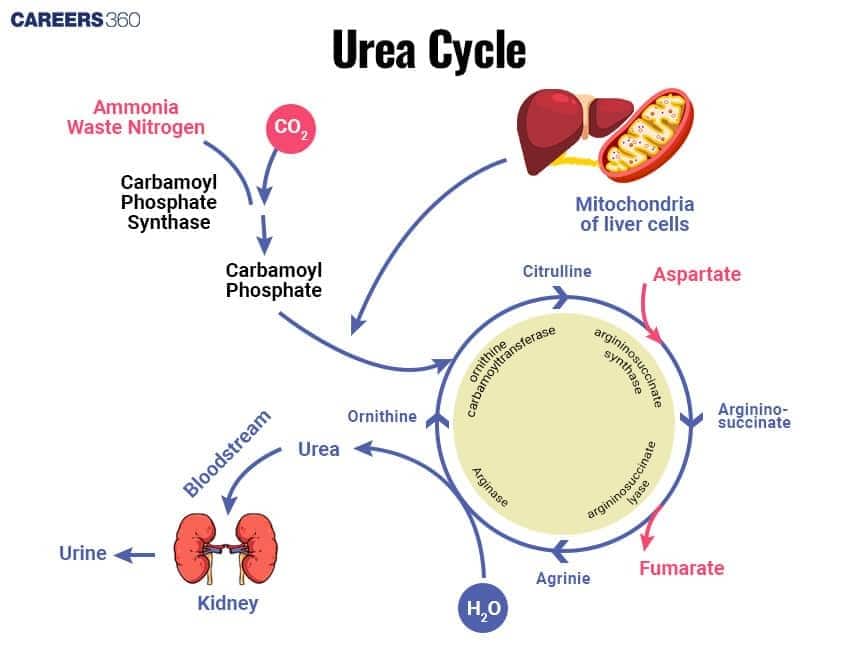
The cycle comprises different significant intermediates and enzymes involved in the pathway of conversion of ammonia to urea.
It is synthesised from ammonia and bicarbonate.
Enzyme: Carbamoyl phosphate synthetase I.
Co-factor is N-acetylglutamate is required to activate carbamoyl phosphate synthetase I.
It is produced from carbamoyl phosphate and ornithine.
Enzyme: Ornithine transcarbamylase.
Moved from the mitochondria to the cytosol.
Formed from citrulline and aspartate.
Enzyme: Argininosuccinate synthetase.
ATP is utilised in this step.
Produced by the cleavage of argininosuccinate.
Enzyme: Argininosuccinate lyase.
By-product is during the reaction, fumarate is formed.
Product of arginine hydrolysis.
Enzyme: Arginase.
Ornithine is transported back into the mitochondria for further rounds of the cycle.
The urea cycle is rather strictly regulated to provide an effective detoxification system for ammonia.
Role of N-acetylglutamate.
Mechanisms of feedback inhibition.
Genes which encode the urea cycle enzymes.
Control at the level of transcription.
Influence of diet and protein intake.
Hormonal influences: Glucagon and insulin.
UCDs are inherited metabolic disorders in which defects in the urea-cycle enzymes prevent the body from converting toxic ammonia into urea, leading to its dangerous accumulation in blood.
CPS I deficiency – A defect in carbamoyl phosphate synthetase-I prevents the first step of ammonia incorporation, leading to hyperammonemia.
OTC deficiency (X-linked) – Lack of ornithine transcarbamylase reduces citrulline formation, affecting males.
AS deficiency – This enzyme deficiency (Citrullinemia) blocks the conversion of citrulline to argininosuccinate.
ASL deficiency – Argininosuccinate lyase deficiency prevents cleavage of argininosuccinate, causing buildup of ammonia.
Arginase deficiency – Defective arginase affects the final step of urea formation and leads to high arginine levels along with neurological issues.
Lethargy, vomiting, seizures, and hyperventilation occur due to high ammonia levels, affecting the brain and lead to neurological deterioration if untreated.
Diagnosis involves measuring blood ammonia, analyzing enzyme defects, and checking mutations through genetic testing.
Low-protein diet – Reduces ammonia production by decreasing nitrogen load.
Sodium benzoate – Helps remove nitrogen via alternate pathways.
Phenylbutyrate – Converts to phenylacetate, which binds glutamine and aids ammonia excretion.
Dialysis in crises – Rapidly clears excess ammonia during severe hyperammonemic episodes.
The details of hyperammonemia is discussed below:
Hyperammonemia can result from urea cycle disorders, severe liver failure, certain medications, or infections that impair the body’s ability to convert ammonia into urea.
Excess ammonia is toxic to the central nervous system and can lead to brain swelling, altered consciousness, seizures, and coma.
Treatment involves IV nitrogen-scavenging drugs, ammonia removal through dialysis, and dietary protein restriction to reduce ammonia production.
Important questions asked in NEET from this topic are:
Steps of the Urea cycle
Regulation of Urea cycle
Q1. The cleavage of argininosuccinate to give arginine and fumarate reversibly is catalyzed by
Arginase
Arginosuccinase
Argininosuccinate synthetase
Fumarase
Correct answer: 2) Arginosuccinase
Explanation:
The enzyme argininosuccinate lyase catalyzes the cleavage of argininosuccinate to produce fumarate and arginine, which is an essential step in the urea cycle (also known as the ornithine cycle).
This cycle, which mostly takes place in the liver, is essential for clearing the body of excess ammonia, a hazardous consequence of protein breakdown. Citrulline and aspartate combine to make argininosuccinate, which is then broken down by argininosuccinate lyase to yield fumarate, which enters the citric acid cycle, and arginine, which is then transformed into urea for excretion. This procedure keeps the body's nitrogen balance stable and stops ammonia from building up.
Hence, the correct answer is option 2) Arginosuccinate
Q2. Assertion: The formation of urea is an essential step in the Krebs-Henseleit cycle.
Reason: The Krebs-Henseleit cycle is a metabolic pathway in the liver that converts toxic ammonia into non-toxic urea, which can be safely excreted from the body.
Assertion and reason are both true, and reason is an accurate account of assertion.
Both assertion and reason are accurate, but reason does not adequately explain assertion
The assertion is correct, but the reasoning is incorrect.
Both the assertion and reason are incorrect.
Correct answer: 1) Assertion and reason are both true, and reason is an accurate account of assertion.
Explanation:
The Krebs-Henseleit cycle, also known as the urea cycle or the ornithine cycle, is a series of biochemical reactions that occur in the liver and some other organs of the body. The primary function of this cycle is to convert toxic ammonia, which is produced during the breakdown of proteins and nucleic acids, into non-toxic urea, which can be excreted in the urine. The formation of urea is, therefore, an essential step in this process.
The assertion is true because without the formation of urea, the Krebs-Henseleit cycle cannot be completed, and toxic ammonia will accumulate in the body, leading to a condition called hyperammonemia. Hyperammonemia can cause a range of symptoms, including neurological problems, lethargy, vomiting, and in severe cases, coma and death.
The reason is also true because the primary purpose of the Krebs-Henseleit cycle is to convert toxic ammonia into non-toxic urea, which can be excreted from the body. The cycle involves five enzymatic reactions, which occur in the mitochondria and cytosol of liver cells. These reactions convert ammonia into urea, using several intermediate compounds, including ornithine, citrulline, and arginine.
In summary, the formation of urea is an essential step in the Krebs-Henseleit cycle, which is a metabolic pathway in the liver that converts toxic ammonia into non-toxic urea. The assertion and the reason are both true, and they support each other in explaining the importance of the urea cycle in maintaining ammonia homeostasis in the body.
Hence, the correct answer is option 1) Assertion and reason are both true, and reason is an accurate account of assertion.
Q3. In the Ornithine cycle, what is transported from Mitochondria to the cytosol
Ornithine
Citrulline
Arginine
Argininosuccinate
Correct answer: 2) Citrulline
Explanation:
In the Urea cycle, also known as the Ornithine cycle, citrulline plays a key role in moving from mitochondria to cytosol. This vital process occurs primarily in the liver to convert toxic ammonia into urea for body excretion.
The cycle unfolds in two main stages:
1. Mitochondrial Phase:
- Ammonia reacts with carbamoyl phosphate and ornithine to create citrulline.
- Citrulline, being non-charged, passes through the mitochondrial membrane into the cytosol.
2. Cytosolic Phase:
- Citrulline combines with aspartate, resulting in argininosuccinate.
- Argininosuccinate is then transformed into arginine.
- Arginine undergoes breakdown to produce urea, which is expelled from the body, and ornithine is regenerated.
- The regenerated ornithine re-enters mitochondria to maintain the cycle's continuity.
This efficient system detoxifies harmful ammonia, ensuring cellular health and homeostasis.
Hence, the correct answer is option 2) Citrulline.
Also Read:
Frequently Asked Questions (FAQs)
N-acetyl glutamate serves as an essential activator of carbamoyl phosphate synthetase I, the first enzyme of the urea cycle.
The urea cycle's major role encompasses the detoxification of highly toxic ammonia into urea, which is then removed through excretion by the kidneys.
The cycle takes place in the mitochondria and cytosol of the liver cells, the hepatocytes.
Somnolence, vomiting, seizure, and in severe cases, coma resulting from hyperammonemia.
The breakdown of amino acids and other nitrogenous compounds results in the formation of ammonia.


Law Admissions 2026 Open | Avail Merit-Based Scholarships
BBA/MBA/PGDM Early Bird Applications Deadline 19th Oct '26. Apply now using coupon code CAREER250 and get ₹250 off the application fee
Ranked #36 amongst institutions in Management by NIRF | 100% Placement
Globally Recognized by AACSB (US) & AMBA (UK) | 18 LPA Avg. CTC for PGPM 2026
Leading Design College | 95% Placement Record | Merit-cum-Means Scholarships for Deserving Students
NEET PG All India & State College Predictor with Admission Process Guide