


Nitrogen Metabolism: Definition, Process, Examples, Types, & Facts
Nitrogen metabolism is a process by which nitrogen is converted into usable forms. It links key pathways such as nitrogen fixation, nitrate assimilation, amino acid synthesis, and the urea cycle, forming a vital bridge between plant, microbial, and animal physiology. Understanding it is crucial in biology as nitrogen is fundamental to proteins, nucleic acids, and overall life processes.
This Story also Contains
- What Is Nitrogen Metabolism?
- The Nitrogen Cycle – Overview
- Nitrogen Fixation
- Assimilation
- Ammonification
- Denitrification
- Nitrogen Metabolism In Animals
- Biological & Agricultural Significance
- Nitrogen Metabolism NEET MCQs (With Answers & Explanations)
What Is Nitrogen Metabolism?
Nitrogen metabolism incorporates all the processes that convert nitrogen to assorted chemical forms, enabling its assimilation into living organisms. Nitrogen is important for living organisms because it is a part of the amino acids, nucleic acids, and other cell constituents.
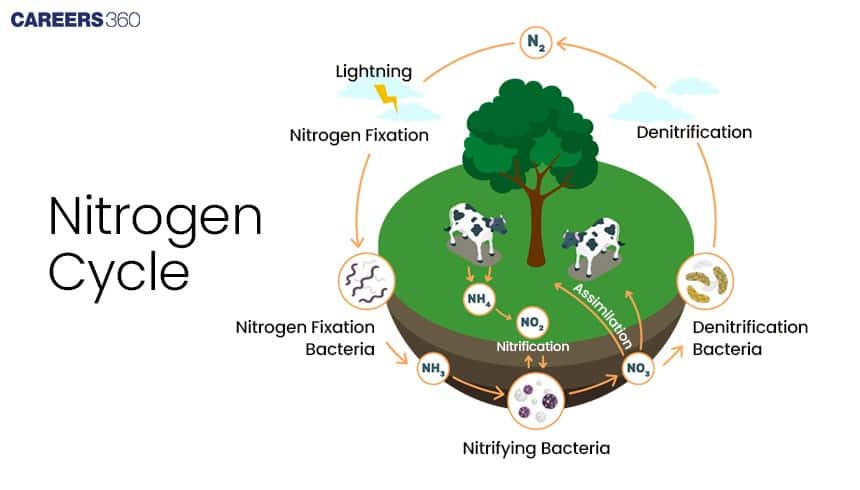
The nitrogen cycle encompasses all the processes involved in the conversion of nitrogen in the environment, which includes nitrogen fixation carried out by the bacteria, assimilation by the plants, and incorporation into the tissue of the animals while returning to the atmosphere through the excretion of the animals and denitrification. This cycle subsequently renews all the reservoirs from which many life forms can access, hence indicating that it is highly fundamental to the life-sustaining process of the ecosystems.
The Nitrogen Cycle – Overview
The major steps or components of the Nitrogen Cycle are:
Step | Process | Organism Involved |
Nitrogen fixation | Atmospheric nitrogen converted into ammonia | Rhizobium, Azotobacter |
Nitrification | Ammonia oxidized to nitrate | Nitrosomonas Nitrobacter |
Assimilation | Converts inorganic nitrogen to amino acids | Plants |
Ammonification | Returns nitrogen to soil | Decomposers |
Denitrification | Return nitrogen to atmosphere | Pseudomonas, Clostridium |
Nitrogen Fixation
Nitrogen fixation is classified into:
Biological Nitrogen Fixation
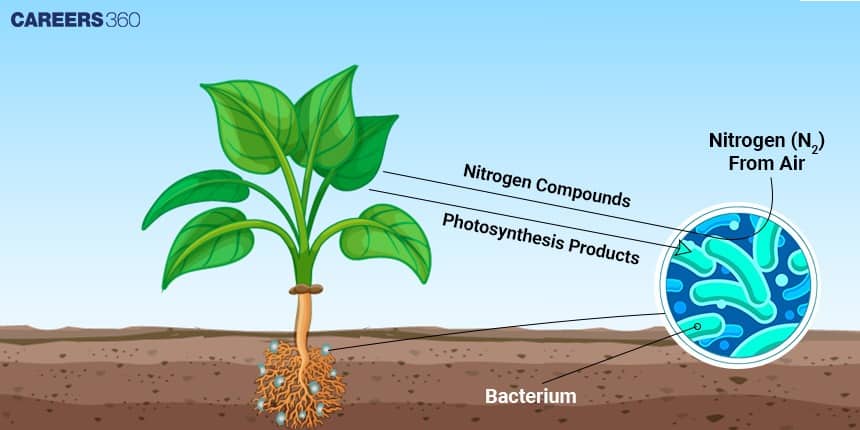
The bacteria Rhizobia enter into symbiosis with legumes, which inhabit the root nodules where they convert atmospheric nitrogen (N₂) to ammonia (NH₃).
The process of nitrogenase enzyme includes:
Nitrogen-fixing bacteria have the nitrogenase enzyme complex, which catalyzes the reduction process of N₂ to NH₃.
Being very energy-consuming, it normally requires chemical energy provided by ATP.
Abiotic Nitrogen Fixation
Abiotic nitrogen fixation can be done by:
Lightning: The lightning splits the triple bond of N₂, so nitrogen can be combined with oxygen to form nitrogen oxides NOx, a substance that can be dissolved in rain to form nitrate.
Industrial fixation (Haber-Bosch process): The Haber-Bosch process combines atmospheric nitrogen and hydrogen gas at high pressure and temperature with the help of an iron catalyst, producing ammonia. It is an essential step in the formation of fertilizer.
Assimilation
Assimilation involves roots taking up nitrates (NO3-) from the soil and converting these into plant proteins and nucleic acids. The conversion is a type of process through which the activity of inorganic nitrogen occurs into organic molecules and helps the plants grow and develop. It is also an important process for allowing nitrogen to enter the food web and into several trophic levels.
Ammonification
Ammonification is the breakdown of organic matter by decomposers, primarily bacteria or fungi, inside dead plants or animals, and then converting it back into ammonia (NH3) or ammonium ions (NH4+). The recycling of nitrogen in the ecosystem and again taken up by this process, ensures nitrogen enters the soil in useful form.
Denitrification
Denitrification is the microbiological reduction of nitrates to nitrogen gas and then releasing it into the atmosphere. It is carried out by anaerobic denitrifying bacteria, such as Pseudomonas and Clostridium. This step completes the nitrogen cycle, returning nitrogen to the atmosphere.
Nitrogen Metabolism In Animals
The nitrogen metabolism in animals includes:
Protein Metabolism
Proteins are broken down into amino acids via proteolytic enzymes present in the stomach and small intestine.
Thereafter, these amino acids are transferred to the bloodstream through intestinal walls.
Amino acids undergo deamination in the liver in that the amino group is removed. This leads to the formation of ammonia (NH₃) and a keto acid.
Ammonia is very poisonous and cannot be directly excreted.
Urea Cycle (Ornithine Cycle)
The urea cycle, also known as the ornithine cycle, is an ammonia detoxification process taking place in the liver to change ammonia into urea.
The urea is a less toxic compound, can then be carried in the blood safely out of the body to the kidneys to be removed.
The liver synthesized urea carried in blood to the kidneys to be excreted from the body in urine.
The overall equation is: 2NH3 + CO2 + 3ATP → Urea + H2O + 3ADP + 3Pi

Biological & Agricultural Significance
The biological and agricultural significance of nitrogen metabolism is:
It enables recycling of nitrogen in ecosystems.
It supports the fertility of the soil and ultimately enhances crop yield.
It reduces reliance on synthetic fertilizers and promotes the use of biofertilizers.
It maintains ecological balance through microbial activity.
Nitrogen Metabolism NEET MCQs (With Answers & Explanations)
The key concepts to be covered under this topic for different exams are:
Steps of the Nitrogen cycle
Nitrogen metabolism in plants
Practice Questions for NEET
Q1. Which of the following bacteria is involved in conversion of NH3 into nitrates?
Azotobacter and Nitrosomonas
Nitrosomonas and Nitrobacter
Azotobacter and Achromobacter
Pseudomonas and Nitrobacter
Correct answer: 2) Nitrosomonas and Nitrobacter
Explanation:
Nitrate formation -
Prokaryotic microorganisms known as nitrogen-fixing bacteria can convert atmospheric nitrogen gas into "fixed nitrogen" molecules that plants may use, such as ammonia. Nitrite is oxidised to nitrate by Nitrobacter, Nitrocystis
- wherein
2NO₂⁻ + O₂ → 2NO₃⁻ + Energy
Nitrosomonas Nitrobacter
NH₃ → NO₂⁻ → NO₃⁻
Hence, the correct answer is option 2) Nitrosomonas and Nitrobacter
Q2. Which of the following organisms does not fix nitrogen?
Azotobacter
Nostoc
Spirogyra
Anabaena
Correct answer: 3) Spirogyra
Explanation:
Spirogyra is a genus of green algae that is not capable of fixing atmospheric nitrogen. Other than some cyanobacteria, other algae, for example, have the necessary enzyme, known as nitrogenase and the nif gene for fixation of nitrogen, Spirogyra lacks such. This places it on the disadvantageous side when it comes to contribution to the provision of nitrogen to an aquatic ecosystem, meaning it gets most of its nitrogen from external sources instead of fixing atmospheric nitrogen.
Hence, the correct answer is Option (3) Spirogyra.
Q3. Minerals involved in carbohydrate translocation, maintaining ribosome structure and activation of nitrogenase respectively are
Mn, B, Ca
Ca, Mg, Mo
B, Mn, Mo
Cu, mg, B
Correct answer: 3) B, Mn, Mo
Explanation:
Minerals involved in carbohydrate translocation, maintaining ribosome structure, and activation of nitrogenase respectively are boron, manganese, and molybdenum.
Hence, the correct option is 3) B, Mn, Mo.
Also Read:
Frequently Asked Questions (FAQs)
The urea cycle detoxifies ammonia produced from amino acid deamination in the liver, converting it to urea, which will be excreted by the kidneys.
Too much nitrogen in fertilizers and industrial activities can result in eutrophication. Eutrophication is, in layman's terms the overloading of nutrients that brings algal blooms causes oxygen depletion in water bodies and eventually kills or affects the water's fauna.
Nitrogen metabolism is defined as the conversion processes of nitrogen that take place in its circulation among the atmosphere and terrestrial and marine ecosystems. It is highly involved in the synthesis of amino acids, proteins, and nucleic acids.
Biological Nitrogen Fixation due to some Bacteria (like Rhizobium) which contain nitrogenase enzyme used for converting atmospheric nitrogen into Ammonia which is an assimilated form of plants.
The main steps of the nitrogen cycle include
Nitrogen fixation.
Nitrification.
Assimilation.
Ammonification.
Denitrification .
