KCC Institute of Legal and Higher Education, Greater Noida
Law Admissions 2026 Open | Avail Merit-Based Scholarships


Urine formation is a key process in the human excretory system. It takes place in the kidneys through filtration, reabsorption, and secretion. The nephron is the functional unit that performs urine formation. This process removes wastes like urea and uric acid. It also maintains water balance, electrolyte balance, and blood pressure, making urine formation vital for survival. This guide covers urine formation stages, nephron functions, Loop of Henle mechanisms, hormone roles, negative feedback, diagrams, FAQs, and NEET MCQs.
This Story also Contains
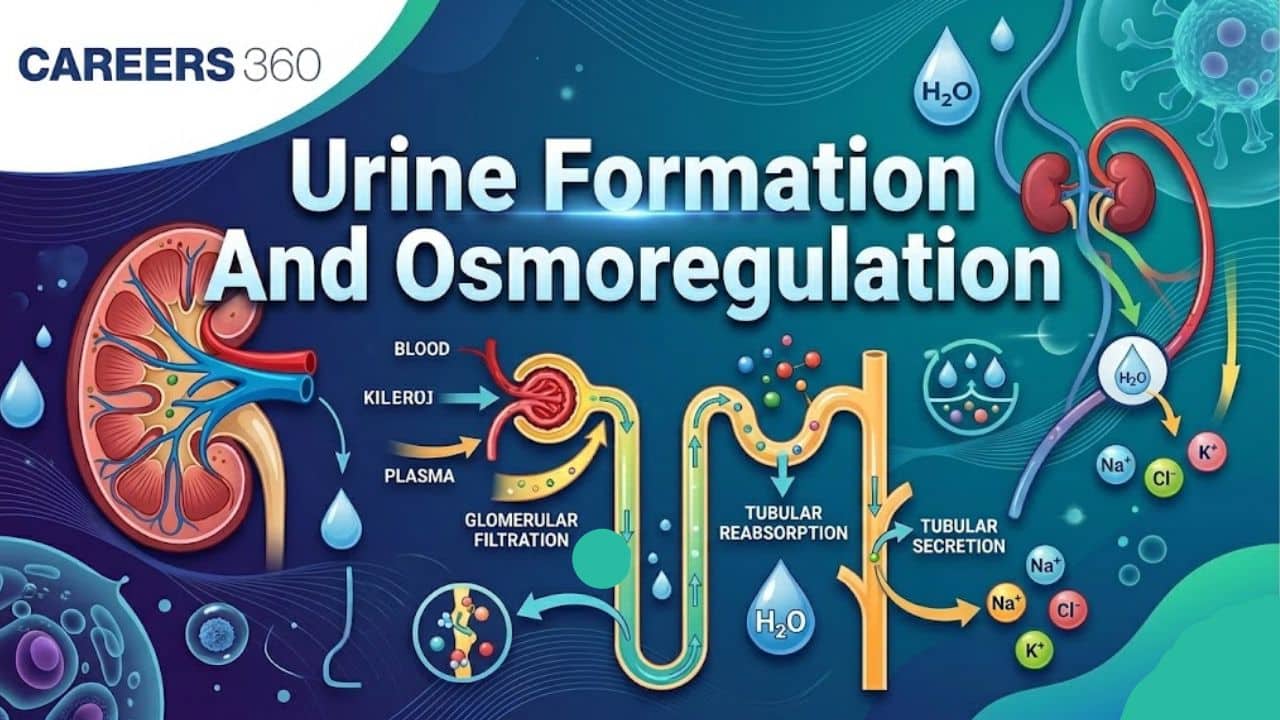
Osmoregulation is the regulation of water and solute balance in the body. It ensures homeostasis by controlling fluid concentration. The kidneys play the main role in osmoregulation through selective reabsorption. Hormones like ADH and aldosterone adjust urine volume and concentration. Understanding urine formation and osmoregulation is important for Class 11 Biology Excretory Products and Their Elimination and competitive exams like NEET. It explains how the body maintains internal stability.
The formation of urine is an important physiological function of the kidneys, significant to maintaining fluid balance, electrolyte levels in the body, and the removal of wastes from the body. The urinary system includes the kidneys, ureters, bladder, and urethra, which are very critical to how homeostasis within the body is maintained. Filtration of the blood is done by the kidneys to form urine. In its entire process, there is, in that order, glomerular filtration, tubular reabsorption, and tubular secretion.
Law Admissions 2026 Open | Avail Merit-Based Scholarships
BBA/MBA/PGDM Early Bird Applications Deadline 19th Oct '26. Apply now using coupon code CAREER250 and get ₹250 off the application fee
This complex mechanism ensures that metabolic waste products are excreted while useful nutrients and water are retained to maintain the body's internal environment. Osmoregulation, or achieving a balance between fluids and electrolytes in the body, is a part of the kidney's function in maintaining the osmotic pressure of body fluids within a stable range, which is best for overall health.
The human excretory system is well-developed and efficient in human beings. It filters wastes from the blood and excretes them so that the homeostasis of the body stays intact.
The components of the urinary system are:
Kidneys
Ureters
Urinary bladder
Urethra
Urine formation is a vital process in the human excretory system. It occurs in the kidneys inside the nephron. The process includes three main steps: filtration, reabsorption, and secretion. These steps remove wastes, maintain water balance, regulate electrolytes, and ensure homeostasis. The process related to the urine formation is:
Glomerular filtration is the initiation of the urinary process where blood plasma is filtered through the glomerulus into the Bowman's capsule. It entails the removal of water, ions, and small molecules from the blood while keeping larger molecules like proteins and blood cells retained. The formed filtrate is the urine precursor.
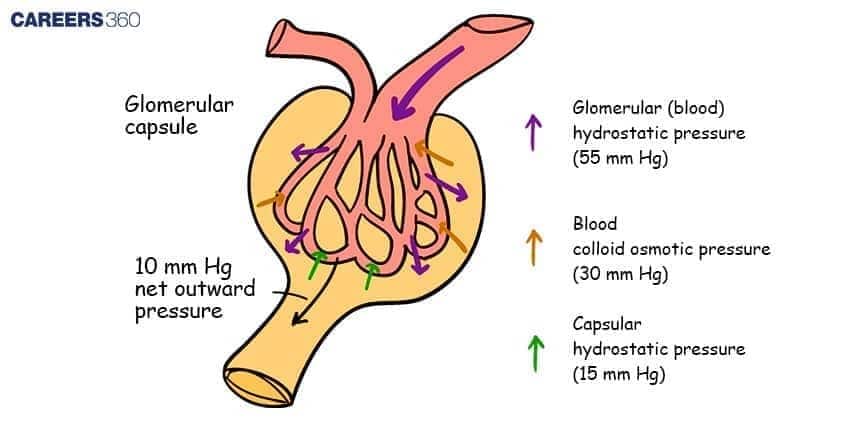
Tubular reabsorption is the process of reabsorption from the filtrate into the bloodstream of nutrients, water, and ions. This becomes an important step in maintaining the fluid balance in the body and preventing the loss of useful entities from the body.
Substances reabsorbed are:
Water: It gets reabsorbed all along the nephron; nearly the major share is reabsorbed by the proximal convoluted tubule and loop of Henle.
Glucose and Amino Acids: These are absorbed in the proximal convoluted tubule actively.
Ions: Sodium is reabsorbed in the proximal tubule; potassium, calcium, and chloride, otherwise, will be reabsorbed in other parts of the nephron. A nephron's regions involve, for the most part, the PCT, the Loop of Henle, and the DCT.
It is a process wherein additional waste products and extra ions from the blood are secreted into the tubular fluid. As such, it enables the excretion of substances which were not filtered by the glomerulus and plays a crucial role in acid-base balance.
Substances secreted:
Іons: роtаssіum and hydrogen іоns.
Drugs and Toxins: Several drugs and metabolic end products.
Сreatinine: Metabolic waste product of muscle breakdown.
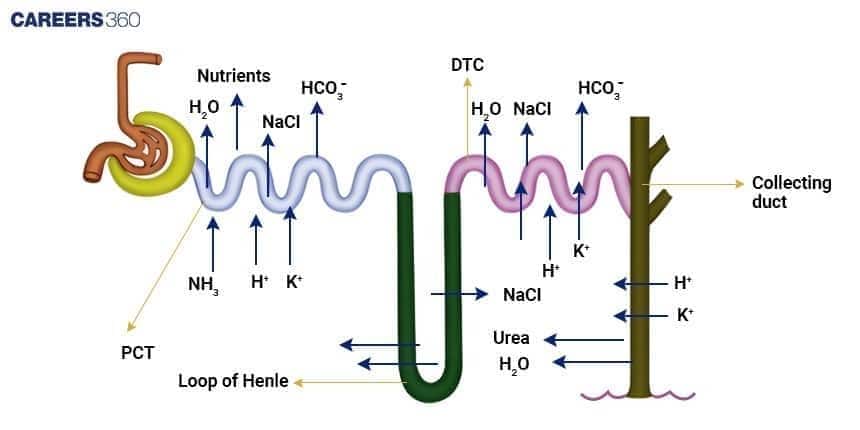
Crucially, the Henle loop participates in concentrating urine through the creation of an osmotic gradient in the renal medulla that helps in water and sodium reabsorption.
This is a system where the descending and ascending limbs of the Loop of Henle act together to keep a high osmolarity within the medullary interstitium. Since it is a solute gradient, it allows the kidneys to reabsorb water from the collecting ducts.
The collecting duct then refines the concentration of urine. ADH controls the amount of water to be reabsorbed by enhancing the permeability of collecting ducts to water, whereby concentrated urine results.
The process through which body levels of water and electrolytes are maintained in balance is called osmoregulation. This is very important in helping to maintain homeostasis despite changes going on in the external environment. The maintenance of this equilibrium is important for normal cellular activity and general good health.
They are the central organs of osmoregulation because they filter the blood, reabsorb that which is needed, and discharge excess water and electrolytes in the urine. They maintain the blood volume and its osmolarity by varying the concentration of urine depending on the requirement of the body's requirements
The kidneys change the amount of water reabsorbed in various segments of the nephrons (proximal tubule, Loop of Henle, Distal tubule, and Collecting duct) depending on whether the body is dehydrated or over-hydrated.
Electrolytes such as sodium, potassium, calcium, and chloride are regulated through differential reabsorption and secretion in the parts of the nephron.
The hormonal control in osmoregulation is discussed below:
The posterior pituitary produces ADH, which increases the permeability of the collecting ducts to water, increasing water reabsorption and ensuing concentrated urine.
Aldosterone is produced by the adrenal glands. It enhances the reabsorption of sodium ions in the distal convoluted tubule and collecting duct and hence water reabsorption, leading to increased blood pressure.
Osmoregulation is a self-balancing mechanism with negative feedback. For example, in response to an increase in blood osmolarity, ADH is released, resulting in increased water reabsorption. The blood becomes diluted, and the osmolarity returns to normal. Vice versa, if blood osmolarity falls, the secretion of ADH diminishes, causing more dilute urine to be excreted. Negative feedback in this system helps to maintain homeostatic balance.
Important questions asked in NEET from this topic are:
Steps of Urine Formation
Role of Kidneys in Osmoregulation
Q1. Assertion: The kidneys are responsible for the excretion of other waste products besides urine.
Reason: The kidneys filter blood to remove waste products such as urea, creatinine, and uric acid.
Both Assertion (A) and Reason (R) are true, and Reason (R) is a correct explanation of Assertion (A).
Both Assertion (A) and Reason (R) are true but Reason (R) is not a correct explanation of Assertion (A).
Assertion (A) is true and Reason (R) is false.
Assertion (A) is false and Reason (R) is true.
Correct answer: 2) Both Assertion (A) and Reason (R) are true but Reason (R) is not a correct explanation of Assertion (A).
Explanation:
While the kidneys do filter blood to remove waste products such as urea, creatinine, and uric acid, these waste products are not excreted solely through urine.
In addition to urine, the kidneys are also responsible for the excretion of other waste products such as excess water, electrolytes, and foreign substances such as drugs and toxins. These waste products are eliminated from the body through various pathways, including urine, faeces, sweat, and breath.
Therefore, while the kidneys are responsible for filtering blood and removing waste products, the assertion that the kidneys are responsible for the excretion of other waste products besides urine requires a broader explanation that includes the various pathways through which these waste products are eliminated from the body.
Hence, the correct answer is option 2) Both Assertion (A) and Reason (R) are true but Reason (R) is not a correct explanation of Assertion (A).
Q2. Among the options provided, which blood vessel in mammals contains the minimal quantity of urea?
Hepatic portal vein
Hepatic vein
Dorsal aorta
Renal vein
Correct answer: 4) Renal vein
Explanation:
The renal vein, which carries blood away from the kidneys, contains the least amount of urea among the given options. This is because the kidneys are responsible for filtering waste products, including urea from the blood. As the filtration and reabsorption processes occur in the kidneys, water and essential nutrients are reabsorbed while waste products like urea remain in the tubular fluid. Consequently, the remaining fluid, known as urine, flows out of the kidneys and into the renal vein. Compared to other blood vessels involved in filtration, such as the hepatic portal vein and hepatic vein, the renal vein has a lower concentration of urea. Thus, the renal vein contains a minimal quantity of urea.
Hence, the correct answer is option 4) Renal vein.
Q3. The counter-current mechanism involves ____?
Vasa recta and PCT
Vasa recta and DCT
Vasa recta and loop of Henle
Vasa recta and collecting duct
Correct answer: 3) Vasa recta and loop of Henle
Explanation:
The flow of filtrate in the two limbs of Henle’s loop is in opposite directions and thus forms a counter current. The flow of blood through the two limbs of the vasa recta is also in a counter-current pattern.
This mechanism helps to maintain a concentration gradient in the medullary interstitium, thereby concentrating the filtrate( urine).
Hence, the correct answer is option 3) Vasa recta and loop of Henle.
Frequently Asked Questions (FAQs)
Urine formation is the process in the kidneys where blood is filtered to remove wastes like urea and uric acid. It involves filtration, reabsorption, and secretion inside the nephron.
The three steps are: glomerular filtration, tubular reabsorption, and tubular secretion. These steps maintain water balance, electrolyte balance, and homeostasis.
Osmoregulation is the regulation of water and solute concentration in the body. It ensures homeostasis by controlling fluid balance through the kidneys.
ADH (antidiuretic hormone) increases water reabsorption in collecting ducts. Aldosterone enhances sodium reabsorption, indirectly increasing water retention and blood pressure.
The nephron is the functional unit of the kidney. It performs filtration, reabsorption, and secretion, ensuring waste removal and fluid balance.


Law Admissions 2026 Open | Avail Merit-Based Scholarships
BBA/MBA/PGDM Early Bird Applications Deadline 19th Oct '26. Apply now using coupon code CAREER250 and get ₹250 off the application fee
Ranked #36 amongst institutions in Management by NIRF | 100% Placement
Globally Recognized by AACSB (US) & AMBA (UK) | 18 LPA Avg. CTC for PGPM 2026
Leading Design College | 95% Placement Record | Merit-cum-Means Scholarships for Deserving Students
NEET PG All India & State College Predictor with Admission Process Guide