KCC Institute of Legal and Higher Education, Greater Noida
Law Admissions 2026 Open | Avail Merit-Based Scholarships


Have you ever wondered how carbon dioxide dissolved in water forms an acid? What is the structure of the weak acid responsible for acidity in rainwater and blood buffering systems? you will find these answers by reading this article on carbonic acis. Carbonic acid has a chemical formula $\mathrm{H}_2 \mathrm{CO}_3$. There is a small amount of this compound in the solution of carbon dioxide in water. Since the compound contains one carbon-oxygen double bond, its chemical formula is (H2CO3). The carbon dioxide chemical formula is CO2. As the only acid exhaled in its gaseous state by the lungs, carbonic acid is often described as a respiratory acid. Carbonate and bicarbonate salts are formed by it; it is a weak acid.
This Story also Contains
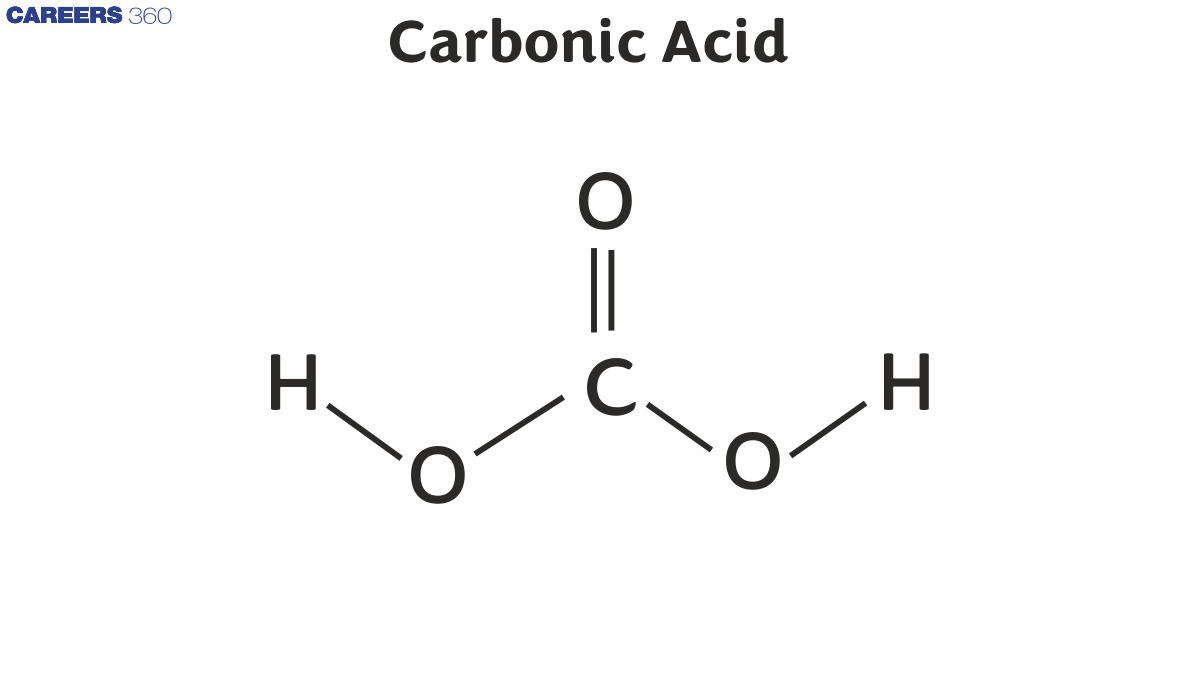
Carbonic acid has a trigonal planar arrangement around the carbon atom.
$\mathrm{HO}-\mathrm{C}(=\mathrm{O})-\mathrm{OH}$
Carbonic acid is unstable in free form and usually exists in equilibrium with carbon dioxide and water:
$\mathrm{H}_2 \mathrm{CO}_3 \rightleftharpoons \mathrm{CO}_2+\mathrm{H}_2 \mathrm{O}$
As demonstrated by the illustration above, carbonic acid has a structure that includes a carbon-oxygen double bond and two carbon-oxygen single bonds. One Hydrogen atom is attached to each oxygen atom participating in a single bond with the carbon.
Also read :
Law Admissions 2026 Open | Avail Merit-Based Scholarships
BBA/MBA/PGDM Early Bird Applications Deadline 06th Nov'26. Apply now using coupon code CAREER250 and get ₹250 off the application fee
Under this subsection, you will find a list of some of the significant physical and chemical properties of carbonic acid.
With a wide range of uses, $\mathrm{H}_2 \mathrm{CO}_3$ is a very useful compound. Carbonic acid is also used in the following ways.
oceans are believed to have shifted the pH of the ocean water by approximately 0.1 due to the absorption of excess carbon dioxide from the atmosphere (primarily caused by human activities). Ocean water reacts with carbon dioxide to form hydrogen carbonate. Ocean acidification is a common term used to describe this process.
Also check-
Question 1: Carbonic acid exists in aqueous solution mainly due to:
A. Strong hydrogen bonding
B. High stability of $\mathrm{H}_2 \mathrm{CO}_3$
C. Equilibrium between $\mathrm{CO}_2$ and $\mathrm{H}_2 \mathrm{O}$
D. Complete ionization in water
Solution:
Carbonic acid is unstable and exists only in equilibrium:
$\mathrm{CO}_2+\mathrm{H}_2 \mathrm{O} \rightleftharpoons \mathrm{H}_2 \mathrm{CO}_3$
Hence, it survives only due to continuous formation from $\mathrm{CO}_2$ and water.
Hence, the correct answer is option (3)
Question 2: The hybridization and geometry of carbon atom in carbonic acid are:
A. $\mathrm{sp}^3$, tetrahedral
B. $\mathrm{sp}^2$, trigonal planar
C. sp, linear
D. $\mathrm{sp}^3$, pyramidal
Solution:
Carbon forms:
Total $3 \sigma$ bonds $\rightarrow \mathrm{sp}^2$ hybridization, giving trigonal planar geometry.
Hence, the correct answer is option (2)
Question 3: Which of the following correctly represents the structure of carbonic acid?
A. $\mathrm{O}=\mathrm{C}(\mathrm{OH})_2$
B. $\mathrm{HO}-\mathrm{C} \equiv \mathrm{O}-\mathrm{OH}$
C. $\mathrm{HO}-\mathrm{C}(-\mathrm{OH})=\mathrm{O}$
D. $O-C(=O)-O$
Solution:
Carbonic acid structure is:
$\mathrm{HO}-\mathrm{C}(=\mathrm{O})-\mathrm{OH}$
Hence, the correct answer is option (1)
Question 4: Carbonic acid behaves as:
A. Monobasic acid
B. Dibasic acid
C. Tribasic acid
D. Neutral compound
Solution:
Carbonic acid has two replaceable hydrogen atoms, hence it is a dibasic (diprotic) acid:
$\mathrm{H}_2 \mathrm{CO}_3 \rightarrow \mathrm{HCO}_3^{-} \rightarrow \mathrm{CO}_3^{2-}$
Hence, the correct answer is option (2)
Frequently Asked Questions (FAQs)
Besides soft drinks, artificially carbonated sparkling wines, and other bubbly beverages, carbonic acid is also used to make artificially carbonated sparkling wine. Bicarbonates (or hydrogen carbonates) and carbonates are the salts of carbonic acid.
Carbonic acid is a hydroxide that contains substituted hydroxyl groups. Additionally, it is a polyprotic acid. Since this compound has two protons, it is diprotic and therefore belongs to a group of chemicals called diprotic compounds. The dynamics of dissociation can be described using two constants, where the first is for dissociation into the bicarbonate ion.
Carbon dioxide is expelled from the body by bicarbonate, a chemical intermediate. Generally, CO2 does not hydrate fast without a catalyst, but red blood cells release a substance known as carbonic anhydrase, which speeds up the metabolism of CO2, forming dissolved bicarbonate (HCO3– ) in the blood plasma.
A strong acid is a carbonic acid, not carbonic acid itself. Weak acids such as H2CO3 are dissociated into proton-containing cations (H+ cations) and bicarbonate-containing anion-forming cations (HCO3– cations). The compound does not completely dissociate in water. As a matter of fact, the bicarbonate ion of carbonic acid, which is the conjugate base of carbonic acid, is a relatively good base. Due to these reasons, carbonic acid is classified as a weak acid rather than as a strong acid.
Carbonic acid is formed when carbon dioxide gas dissolves in water. The reaction can be represented as:
[$ \text{CO}_2 + \text{H}_2\text{O} \rightleftharpoons \text{H}_2\text{CO}_3 $]
This equilibrium can shift based on factors like pressure and temperature.

Law Admissions 2026 Open | Avail Merit-Based Scholarships
BBA/MBA/PGDM Early Bird Applications Deadline 06th Nov'26. Apply now using coupon code CAREER250 and get ₹250 off the application fee
Ranked #36 amongst institutions in Management by NIRF | 100% Placement
Globally Recognized by AACSB (US) & AMBA (UK) | 18 LPA Avg. CTC for PGPM 2026
NEET PG All India & State College Predictor with Admission Process Guide
Top B-School: Ranked #9 in NIRF Management Rankings 2025.