What gives vinegar its sharp smell and sour taste? Why does ethanoic acid play such an important role in our kitchens, laboratories, and industries? You will find these answers by reading this article on ethanoic acid. Ethanoic acid, commonly known as acetic acid, is an important organic compound widely found in everyday life and in chemical industries. It is best known as the main component of vinegar, which gives it a characteristic sour taste and pungent smell.
This Story also Contains
Formula of Ethanoic Acid
Structure of Ethanoic Acid:
Properties of Ethanoic Acid
Methods of Preparation of Ethanoic Acid
Reactions of Ethanoic Acid
Uses of Ethanoic Acid
Some Solved Examples
Ethanoic Acid
Formula of Ethanoic Acid
Ethanoic acid, commonly known as acetic acid, is a member of the carboxylic acid family. This family includes methanoic acid (a one-carbon carboxylic acid) and ethanoic acid, which contains two carbon atoms.
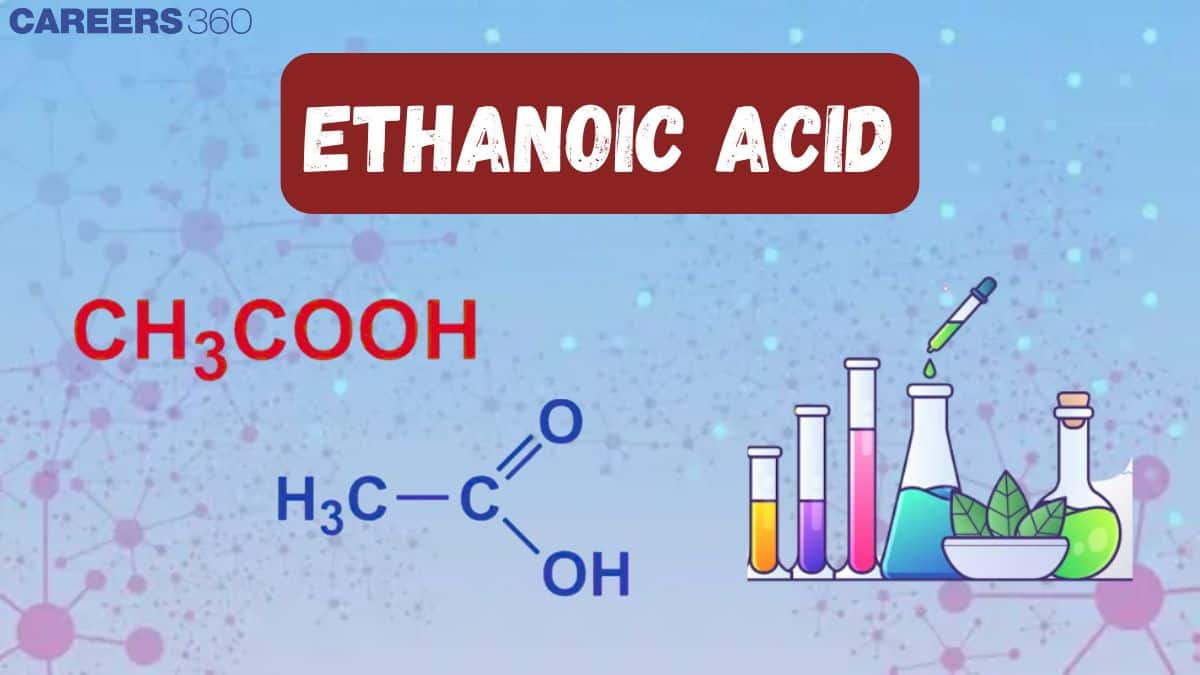
The chemical formula of ethanoic acid is $\mathrm{CH}_3 \mathrm{COOH}$.
It is a common household substance.
A dilute aqueous solution of ethanoic acid (about 5–8%) is known as vinegar.
Vinegar is widely used in cooking and food preservation.
In laboratories, pure ethanoic acid is commonly used as a chemical reagent.
During winter, ethanoic acid can freeze and form ice-like crystals.
Due to its glacier-like appearance in solid form, it is called glacial acetic acid.
Structure of Ethanoic Acid:
The structural formula of ethanoic acid is $\mathrm{CH}_3 \mathrm{COOH}$.
Its molecular formula is $\mathrm{C}_2 \mathrm{H}_4 \mathrm{O}_2$.
The molar mass of ethanoic acid is 60.05 g mol⁻¹.
It consists of a methyl group $\left(-\mathrm{CH}_3\right)$ attached to a carboxylic acid group (–COOH).
The carboxyl group contains a carbonyl group (C=O) and a hydroxyl group (–OH).
The carbon atoms in the carboxyl group are $\mathrm{sp}^2$ hybridized.
Ethanoic acid has a planar structure around the –COOH group.
In liquid and vapour states, ethanoic acid molecules form dimers.
Dimer formation occurs due to intermolecular hydrogen bonding between oxygen and hydrogen atoms.
Properties of Ethanoic Acid
Appearance:Ethanoic acid is a colourless, clear liquid with a sharp, pungent (vinegar-like) odour.
Melting Point: 16.6 °C; below this temperature, it solidifies, forming ice-like crystals (glacial acetic acid).
Boiling Point: 118.1 °C at atmospheric pressure.
Density: $1.05 \mathrm{~g} \mathrm{~cm}^{-3}$ at 25 °C.
Flash Point: Approximately 39 °C.
Solubility: Completely miscible with water in all proportions.
Solubility in Organic Solvents: Soluble in ethanol, ether, acetone, benzene, and glycerol.
Hydrogen Bonding: Forms intermolecular hydrogen bonds and exists as dimers in liquid and vapour states.
Vapour Pressure: About 15.7 mmHg at 25 °C.
pH: A 1.0 M solution of ethanoic acid has a pH of about 2.4.
pKa Value: 4.76 at 25 °C, indicating weak acidic nature.
Storage Conditions: Stable under normal laboratory conditions and stored in tightly closed containers.
Ethanoic acid is commonly prepared by the oxidation of ethanol using oxidising agents such as acidified potassium dichromate $\left(\mathrm{K}_2 \mathrm{Cr}_2 \mathrm{O}_7\right)$ or potassium permanganate $\left(\mathrm{KMnO}_4\right)$.
Ethanol is first oxidised to ethanal and then to ethanoic acid.
This method is widely used in laboratories.
NEET Highest Scoring Chapters & Topics
This ebook serves as a valuable study guide for NEET exams, specifically designed to assist students in light of recent changes and the removal of certain topics from the NEET exam.
Carboxylic acids react with alcohols in the presence of a catalyst (usually concentrated sulphuric acid) to form esters. This reaction is known as esterification.
Example:
When ethanoic acid reacts with ethanol, it forms ethyl ethanoate, an ester with a pleasant fruity smell.
Esters react with strong bases (alkalis) such as sodium hydroxide to form soap and alcohol. This reaction is called saponification and is commonly carried out using higher molecular mass esters (fats and oils).
Question 1: Ethanoic acid exists as dimers in liquid and vapour phases mainly due to:
A. Covalent bonding
B. Van der Waals forces
C. Intramolecular hydrogen bonding
D. Intermolecular hydrogen bonding
Solution:
Two ethanoic acid molecules form dimers via intermolecular hydrogen bonding between the –OH hydrogen and the carbonyl oxygen.
Hence, the correct answer is option (D)
Question 2: The hybridisation of the carbon atoms present in the -COOH group of ethanoic acid is:
A. $s p^3$
B. $\mathrm{sp}^2$
C. $s p$
D. One $s p^2$ and one $s p^3$
Solution:
Both carbon atoms in the carboxyl group are sp² hybridised.
Hence, the correct answer is option (B)
Question 3: Which of the following statements about ethanoic acid is incorrect?
A. It has a melting point of about 16.6°C
B. It is miscible with water in all proportions
C. It has a fruity smell in pure form
D. It is called glacial acetic acid in the solid state
Solution :
Fruity smell is a property of esters, not ethanoic acid.
Hence, the correct answer is option (C)
Question 4: Ethanoic acid reacts with sodium carbonate to form:
A. Sodium ethanoate, hydrogen, water
B. Sodium ethanoate, CO₂, water
C. Sodium acetate, oxygen, water
D. Sodium acetate only
As part of printing processes, acetates like metal and vinyl are used; cellulose acetate, used in textiles and photographic films, is made of acetate; and volatile organic esters are made from acetate.
Q: Food can be preserved with ethanoic acid?
A:
Salad dressings are not the only application for acetic acid. Various foods are preserved with this ingredient as natural preservatives and antibacterial, such as vegetable pickles and edible films.
Q: What is the difference between ethanol and vinegar?
A:
Acetic acid, also known as ethanoic acid, is simply ethanoic acid diluted in water. The majority of ethanoic acid is now synthesized and used in the production of plastics and other fundamental materials.
Q: What makes ethanol an acid that is weak?
A:
Weak acids, such as ethanoic acid (acetic acid), are those in which their hydrogen has not been completely released into water. This results in a partial dissociation and equilibrium with its conjugate base.
Q: What is the reason for the sweet smell of esters?
A:
Acetic acid and ethanol produce a sweet aroma with their ester. Esters interact modestly with each other. A smaller intermolecular force of attraction makes ester compounds volatile. - Esters do not have hydrogen bonds.