KCC Institute of Legal and Higher Education, Greater Noida
Law Admissions 2026 Open | Avail Merit-Based Scholarships


Aerobic and anaerobic respiration are two pathways through which cells break down glucose to produce ATP, the universal energy currency. Aerobic respiration uses oxygen and yields 36–38 ATP, while anaerobic respiration occurs without oxygen and produces only 2 ATP along with lactic acid or ethanol. Distinguishing these pathways is key for NEET Chemistry & Biology, especially for understanding metabolism and muscle physiology.
This Story also Contains
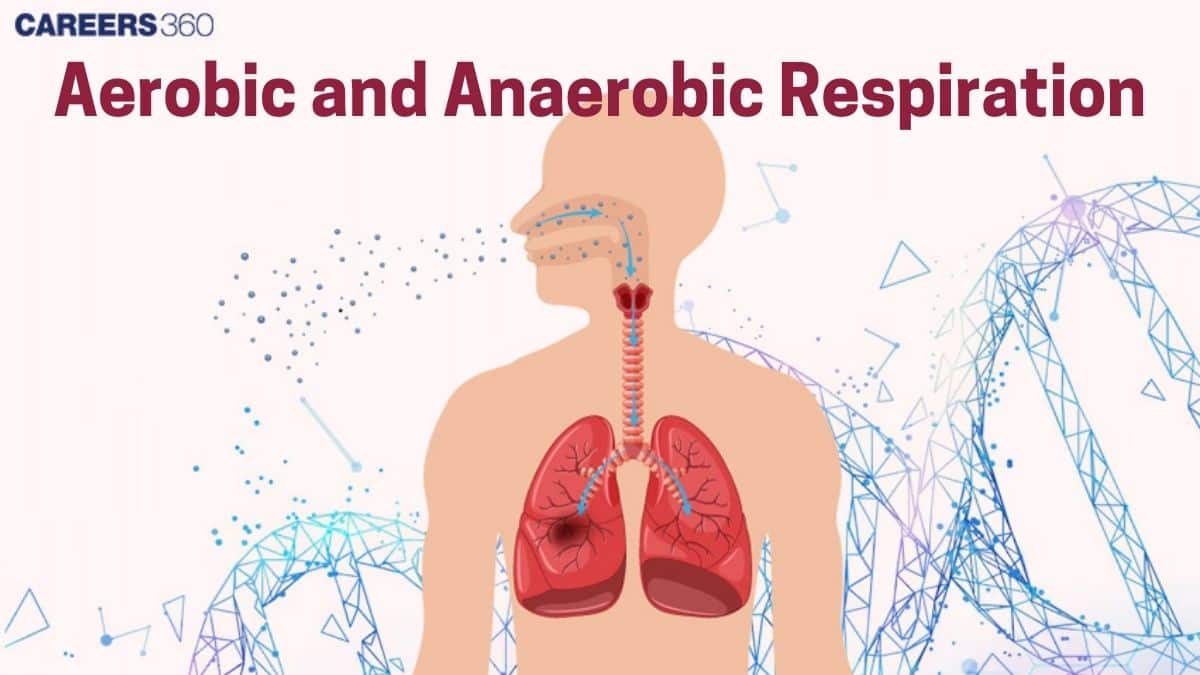
Respiration is one of the metabolic processes by which organisms synthesize energy, carbon dioxide and water from oxygen and glucose. This process is crucial for all aerobic organisms because energy is produced that is paramount for cellular activities and physiological processes. In living organisms, respiration is not only identified to provide energy for metabolic functions but also has a significant role in regulating the body’s internal environment and supporting growth and development besides repair functions.
Aerobic respiration is a catabolic process in which all the cells in the body use glucose and oxygen to produce carbon dioxide, water and energy. It occurs in the presence of oxygen and it is the main means through which aerobic organisms generate ATP, or Adenosine triphosphate, the energy currency of cells.
Law Admissions 2026 Open | Avail Merit-Based Scholarships
BBA/MBA/PGDM Early Bird Applications Deadline 06th Nov'26. Apply now using coupon code CAREER250 and get ₹250 off the application fee
The process of aerobic respiration is given below:
Glycolysis takes place in the cytoplasm of the cell.
Steps Involved:
Glucose combines with a phosphate group to release vitamins and forms glucose-6-phosphate.
Glucose-6-phosphate is oxidatively decarboxylated to give fructose-6-phosphate.
The next step involves the phosphorylation of fructose-6-phosphate to undergo fructose-1,6-bisphosphate.
Fructose-1,6-bisphosphate is cleaved into 2 three-carbon molecules of glyceraldehyde-3-phosphate and dihydroxyacetone phosphate.
G3P is oxidised, and NAD+ is reduced to NADH In this process, there is the oxidation of G3P and NAD+ while NADH is reduced.
This is carried out through substrate-level phosphorylation.
Pyruvate accumulates as the terminal product of this process.
Products Formed:
The products formed are 2 molecules of pyruvate.
2 ATP (net gain)
2 NADH
The Krebs cycle occurs in the matrix part of the mitochondria.
Steps Involved:
Citrate forms from acetyl-CoA by combining it with oxaloacetate.
Citrate is then oxidised to isocitrate.
Isocitrate is oxidised to alpha-ketoglutarate and simultaneously generates NADH.
AKG is converted to succinyl-CoA giving rise to NADH.
Succinyl-CoA is converted to succinate and in the process ATP (or GTP) is produced Many of the complexes are reviewed as follows;
Succinate is oxidised to fumarate yielding FADH2.
Fumarate is reduced to malate.
Malate is oxidised to oxaloacetate while generating NADH.
Products Formed:
2 ATP (in each glucose molecule, these ATPs are produced through the process of substrate-level phosphorylation).
6 NADH
2 FADH2
4 CO2
The electron transport chain is located within the inner layer of the mitochondria compartments known as the cristae membrane.
Steps Involved:
NADH and FADH2 pass on their electrons to the electron transport chain.
Electrons are transferred through a sequence of protein structures.
The energy liberated from the electron is utilised in putting protons across the inner membrane with the creation of a proton gradient.
Protons move back through ATP synthase to synthesise ATP.
Role of Oxygen:
Oxygen is the final receptor of electrons, with which it combines to form water through the addition of protons.
Products Formed:
Approximately 34 ATP
Water (H2O)
Fermentation is a process of breaking down glucose in cells to release energy without using oxygen. This process, in contrast, is less efficient in creating ATP molecules than aerobic respiration, which creates fewer ATP molecules per glucose molecule and it is common in anaerobic conditions.
The different types of anaerobic respiration are:
Lactic acid fermentation is observed in some bacteria and animal cells particularly the muscle cells when oxygen is scarce. Here, pyruvate – a glycolysis end product – is converted by NAD+ into lactic acid, with NADH generated getting oxidised back to NAD+.
Skeletal muscle tissue cells during exercise & mainly during vigorous exercise.
Some of the bacteria include Lactobacillus species
Alcoholic fermentation takes place in yeast and some kinds of bacteria. In this process, pyruvate is again utilized, and it is transformed into ethanol and carbon dioxide. First, pyruvate is decarboxylated into acetaldehyde, and then it is reduced to ethanol with the help of NAD+; the NAD+ is returned to the cycle.
Yeast (Saccharomyces cerevisiae)
Some typical bacteria involve: Zymomonas mobilis
The difference between aerobic and anaerobic respiration is:
Key Difference | Aerobic Respiration | Anaerobic Respiration |
Oxygen Requirement | Requires oxygen | Does not require oxygen |
ATP Yield | High (approx 36-38 ATP per glucose) | Low (2 ATP per glucose) |
By-products | Carbon dioxide and water | Lactic acid or ethanol and carbon dioxide |
Efficiency | High efficiency | Low efficiency |
Location | Cytoplasm + Mitochondria | |
Organisms | Plants, animals | Yeast, bacteria, muscle cells |
Oxidation | Complete oxidation | Partial oxidation |
The importance of aerobic and anaerobic respiration is:
Energy supply: Aerobic respiration provides a high ATP yield while anaerobic respiration gives quick energy during oxygen shortage.
Survival mechanism: Anaerobic respiration acts as backup during intense activity or oxygen deficient conditions.
Industrial applications: Anaerobic fermentation by microorganisms is used in baking and producing alcoholic beverages.
Environmental role: Anaerobic microbes help in the production of biogas and biofuel.
Important topics for NEET are:
Steps of Aerobic respiration
ATP yield in Anaerobic respiration
Aerobic vs Anaerobic respiration
Q1. Although the aerobic process of respiration takes place only in the presence of oxygen, the role of oxygen is limited to the terminal stage of the process. Yet, the presence of oxygen is vital and it can be justified as
O2 drives the whole process by removing hydrogen from the system.
O2 is important for removing electrons from the system
O2 drives electrochemical gradient in the ETS
O2 is vital for Krebs cycle
Correct answer: 1) O2 drives the whole process by removing hydrogen from the system.
Explanation:
Although the role of oxygen in aerobic respiration is only at the terminal stage, its presence is essential in the process. At the terminal stage, oxygen becomes the terminal electron acceptor of the ETC. The oxygen combines with the electrons and hydrogen ions to produce water, which drives the entire process. In its absence, electrons would accumulate in the system, thus bringing the whole chain reaction to a halt. This process is crucial, as it maintains the electron flow, allowing continuation into ATP production through oxidative phosphorylation. Thus, oxygen though not directly involved in each stage of respiration. It plays a vital role in enabling the smooth creation of ATP by receiving hydrogen and electrons, ensuring a process that runs smoothly.
Hence, the correct answer is option 1) O2 drives the whole process by removing hydrogen from the system.
Q2. Life without air would be
Reductional
Free from oxidative damage
Impossible
Anaerobic
Correct answer: 4) Anaerobic
Explanation:
Anaerobic means 'in the absence of molecular oxygen', so life without air would be anaerobic. The atmosphere of Earth at the time of the origin of life was without free oxygen atoms, so the primitive atmosphere was reducing. In such an environment, early organisms likely relied on anaerobic processes like fermentation for energy production. This condition set the stage for the evolution of aerobic organisms once oxygen became more abundant in Earth's atmosphere.
Hence, the correct answer is option 4) Anaerobic.
Q3. The ultimate electron acceptor of respiration in an aerobic organism is
Cytochrome
Oxygen
Hydrogen
Glucose
Correct answer: 2) Oxygen
Explanation:
Oxygen is the final electron acceptor in the electron transport chain during aerobic respiration.
This process involves the transmission of electrons via a sequence of protein complexes in the mitochondrial membrane, which eventually combine with protons and oxygen to produce water (H2O).
Because of its high electronegativity, oxygen is very good at taking up electrons, which promotes oxidative phosphorylation, which produces ATP.
The electron transport chain would stop working in the absence of oxygen, forcing aerobic organisms to rely on less effective energy-producing mechanisms like fermentation or anaerobic respiration.
Hence, the correct answer is option 2) Oxygen.
Read More:
Frequently Asked Questions (FAQs)
Aerobic respiration is the production of energy that utilizes oxygen. For example, humans perform aerobic respiration during their daily routines.
Anaerobic respiration is the production of energy without the use of oxygen, typically when the environment has no oxygen. For example, yeast performs anaerobic respiration to create ethanol in brewing.
The four stages of aerobic respiration are:
Anaerobic respiration is a process of generating energy without the help of oxygen; in this process, glucose is partially broken down, thereby producing less energy than in the case of aerobic respiration, and its byproducts may be lactic acid or ethanol.
This is more efficient than anaerobic respiration mainly because aerobic respiration is capable of producing a much higher ATP per glucose molecule and helps in utilizing the energy stored in glucose to the optimum level.
Fermentation takes place in the mitochondrion of the cell and is known as the Krebs cycle.

Law Admissions 2026 Open | Avail Merit-Based Scholarships
BBA/MBA/PGDM Early Bird Applications Deadline 06th Nov'26. Apply now using coupon code CAREER250 and get ₹250 off the application fee
Ranked #36 amongst institutions in Management by NIRF | 100% Placement
Globally Recognized by AACSB (US) & AMBA (UK) | 18 LPA Avg. CTC for PGPM 2026
NEET PG All India & State College Predictor with Admission Process Guide
Top B-School: Ranked #9 in NIRF Management Rankings 2025.