


Deuteromycetes - Fungus, Reproduction, Characteristics, Imperfect
Deuteromycota ( Fungi Imperfecti) are fungi that don't have a sexual reproduction stage. That is why they are usually called imperfect fungi, deuteromicetos, or jamur dueteromycota. These deuteromycetes are a unique group of fungi classified under the Biological Classification. They reproduce asexually only through conidia. These asexual fungi are necessary for decomposition, nutrient cycling, agriculture and medicine. The Deuteromycotina phylum is also important in biocontrol and antibiotic production. At the same time, many pathogenic fungi examples from the Deuteromycota can be harmful to plants and animals. Thus, deuteromycetes( fungi inferfecti) are both useful and harmful in the ecosystem.
This Story also Contains
- Introduction to Deuteromycetes (Fungi Imperfecti / Deuteromycetes)
- Why are Deuteromycetes Called "Fungi Imperfecti"?
- Classification of Deuteromycota and Deuteromycotina
- Characteristics of Deuteromycetes
- Deuteromycetes Diagram: Structure and Conidia Formation
- Examples of Deuteromycetes (Jamur Deuteromycota / Deuteromicetos)
- Economic Importance of Deuteromycetes in Agriculture and Medicine
- Deuteromycota (Fungi Imperfecti) NEET MCQs with Answers
- Recommended Video on Deuteromycetes
Explore Deuteromycetes (Fungi Imperfecti) - fungi lacking a known sexual stage, vital in decomposition, nutrient cycling, and agriculture. Learn deuteromycetes classification, characteristics, examples, and economic significance with NEET-focused notes. This topic includes Deuteromycetes diagrams, classification of Deuteromycetes, and NEET MCQs for Class 11–12 Biology. Deutomycota/ deuteromycotina is a topic included in the chapter Biological Classification in Biology. For students, understanding the jamur deuteromycota and deuteromicetos is key to mastering fungal diversity and exam preparation.
Introduction to Deuteromycetes (Fungi Imperfecti / Deuteromycetes)
Deuteromycetes, also called fungi imperfecti, are fungi in which the sexual stage has not been found yet. That is why they are known as imperfect fungi, deuteromicetos, or jamur deuteromycota. Earlier, scientists grouped deuteromycetes separately because there were no sexual spores produced. Instead, these fungi are identified based on their asexual spores- conidia and mode of reproduction.
Deuteromycetes are closely related and belong to different fungal groups. When scientists discover their sexual stage using advanced methods, they are placed into other groups like Ascomycetes or Basidiomycota. Even so, deuteromycetes are very important because they help break down dead material. They are used in industries and biotechnology, while some species act as pathogenic fungi, causing diseases in plants and animals. A deuteromycete diagram shows their structure, including hyphae, conidiophores, and conidia, which explain their unique mode of reproduction.
Why are Deuteromycetes Called "Fungi Imperfecti"?
Deuteromycetes are called fungi imperfecti because their sexual stage is either absent or not yet discovered. As a result, they cannot be classified into other well-defined fungal groups that rely on sexual reproduction. When their sexual forms are identified, they are often reclassified into Ascomycetes or Basidiomycetes.
Classification of Deuteromycota and Deuteromycotina
The group Deuteromycetes(Fungi Imperfecti) is classified into 4 orders. The four orders, along with some characteristics and some examples, help students understand how deuteromycota / deuteromicetos / jamur deuteromycota are grouped, as given in the table below-
Order | Key Characteristics | Examples |
|---|---|---|
Moniliales | Asexual spores (conidia) formed on free hyphae; saprophytic or parasitic; common moulds | Aspergillus, Penicillium |
Sphaeropsidales | Conidia are produced in flask-shaped structures called pycnidia | Phyllosticta, Colletotrichum |
Melanconiales | Conidia are produced in acervuli (flat, cushion-like fruiting bodies) | Diplodia, Gloeosporium |
Mycelia Sterilia | No conidia or reproductive structures observed; reproduces only by vegetative means | Rhizoctonia, Sclerotium |
Characteristics of Deuteromycetes
Deuteromycetes are also known as fungi imperfecti, showing diverse traits. These features explain why the deuteromycota / deuteromycotina / deuteromicetos / jamur deuteromycota are important in ecosystems, agriculture, and medicine. The characteristics of deuteromycetes are based on the basis of habitat, growth, pathogenicity, and their biocontrol nature. These are highlighted in the pointers below.
Habitat Diversity: These fungi live almost everywhere. They are commonly found in soil, decaying matter, plants and even animals. That’s why deuteromycetes are considered highly adaptable.
Rapid Growth: Many Deuteromycetes can grow quickly and vigorously. They are dominant in environments with rich organic content.
Plant Pathogens: Some deuteromycota species are known to cause serious plant diseases, including leaf spots, wilts, and blights.
Biocontrol Agents: Certain deuteromycetes (e.g., Trichoderma) are used as natural biocontrol agents. It helps in sustainable agriculture.
Toxin Production: Some deuteromycota species produce mycotoxins, which can contaminate food and pose risks to humans and animals (e.g., Fusarium).
Deuteromycetes Diagram: Structure and Conidia Formation
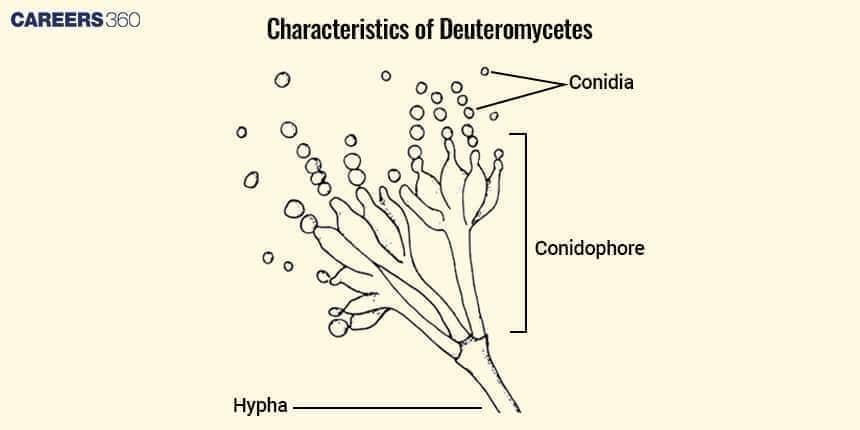
The Deuteromycetes diagram below shows the basic structure of Deuteromycetes along with its components. These fungi, also called deuteromicetos or jamur deuteromycota, reproduce only by conidia. Asexual, non-motile spores are produced by certain fungi for reproduction. These spores are borne on special structures called conidiophores, which come from the hyphae. Hyphae are the thread-like filaments that make up the body of a fungus and help in nutrient absorption and growth.
In the deuteromycyes diagram-
Hyphae - the network of filaments.
Conidiophores - upright structures that bear spores.
Conidia - asexual spores used for reproduction.
Examples of Deuteromycetes (Jamur Deuteromycota / Deuteromicetos)
Deuteromycetes (fungi imperfecti) include many important species. These deuteromycota / deuteromycotina examples show both useful and harmful roles in ecosystems, agriculture, and medicine. Some examples of deuteromycetes are given below:-
Trichoderma - Used in the biocontrol of plant diseases.
Alternaria - Causes leaf spots in plants.
Colletotrichum - Causes anthracnose disease in crops.
Helminthosporium - Causes blight in cereal crops.
Fusarium - Produces microtoxins and causes wilting in plants.
Aspergillusn- Used in fermentation and industrial enzyme production.
Candida - A yeast that causes human infections.
Economic Importance of Deuteromycetes in Agriculture and Medicine
Deuteromycetes, or fungi imperfecti, play a big role in both natural ecosystems and human activities. Some species are highly useful, while others can be harmful. Their economic significance can be seen in the following ways:
Decomposition and nutrient cycling – Many species act as saprophytes. They break down dead organic matter and recycle nutrients in the ecosystem.
Industrial uses – Certain deuteromycota produce useful enzymes, organic acids, and antibiotics. For example, Trichoderma is used for enzymes, and Penicillium notatum gave penicillin.
Biological control agents – Certain species, like Trichoderma, help farmers to control plant pathogens.
Food spoilage – Several deuteromycota species spoil fruits, vegetables, and stored grains, leading to economic losses.
Plant diseases – Pathogenic species such as Alternaria cause leaf spots, and Colletotrichum causes anthracnose.
Medical importance – A few deuteromycete species infect humans and plants. They cause skin diseases like ringworm.
Deuteromycota (Fungi Imperfecti) NEET MCQs with Answers
Q1. The imperfect fungi, which are decomposers of litter and help in mineral cycling, belong to :
Basidiomycetes
Phycomycetes
Ascomycetes
Deuteromycetes
Correct answer: 4) Deuteromycetes
Explanation:
Deuteromycetes, or imperfect fungi, have a branched, filamentous, and septate mycelium. They can be saprophytic, parasitic, or decomposers, which play a vital role in nutrient cycling. Asexual reproduction occurs by the formation of conidiospores. Sexual reproduction is absent in this group, and that is why they are termed "imperfect." Many Deuteromycetes are very important decomposers of organic litter, playing a very important role in mineral cycling in ecosystems.
Hence, the correct answer is Option (4) Deuteromycetes
Q2. Which one is the wrong pairing for the disease and its causal organism?
Black rust of wheat, Puccinia graminis
Loose smut of wheat-Ustilago nuda
Root-knot of vegetables-Meloidogyne sp
Late blight of potato-Alternaria solani
Correct answer: 4) Late blight of potato-Alternaria solani
Explanation:
The late blight of potatoes is a fungal disease, caused by a fungus named Phytophthora infestans. The Alternaria solani causes early blight of potatoes. The late blight of potatoes is a fungal disease caused by Phytophthora infestans, while Alternaria solani is responsible for early blight. Late blight spreads rapidly in cool, wet conditions and leads to water-soaked lesions on leaves, stems, and tubers, often resulting in plant death. It was the primary cause of the Irish Potato Famine in the 19th century. The disease spreads through infected soil, plant debris, and windborne spores. Effective control measures include resistant potato varieties, proper crop rotation, fungicide application, and eliminating infected plant material.
Hence, the correct answer is option 4) Late blight of potato-Alternaria solani
Q3. Which of the following groups of fungi produces cyclosporin A
Imperfect Fungi
Sac Fungi
Club Fungi
Algal Fungi
Correct answer: 1) Imperfect Fungi
Explanation:
Trichoderma is a Deuteromycetes fungus widely used as a biological control agent against plant-pathogenic fungi due to its ability to produce antifungal compounds and enzymes that suppress fungal growth. It is commonly used in agriculture to promote plant health by improving disease resistance and enhancing soil quality.
Hence, the correct answer is option 1) Imperfect Fungi.
Recommended Video on Deuteromycetes
Frequently Asked Questions (FAQs)
They are called fungi imperfecti because no sexual reproduction has been observed. Their classification is based only on their asexual stage.
Deuteromycetes produce exogenous conidia — meaning their asexual spores (conidia) are formed externally on specialized structures called conidiophores, rather than inside a sporangium.
A deuteromycetes diagram highlights hyphae, conidiophores, and conidia. It shows how these fungi reproduce asexually and why they are placed under deuteromycota.
Examples include Trichoderma, Alternaria, Colletotrichum, Helminthosporium, Fusarium, Aspergillus, and Candida. These show both beneficial and harmful roles.
Deuteromycetes can be either saprophytic or parasitic. Many Deuteromycetes are decomposers that feed on dead organic matter, while some are parasites that cause diseases in plants and animals.