KCC Institute of Legal and Higher Education, Greater Noida
Law Admissions 2026 Open | Avail Merit-Based Scholarships


Sexual reproduction involves fusion of male and female gametes to form a zygote, ensuring genetic variation and adaptability. It includes gametogenesis, fertilisation, and development from zygote to embryo and fetus. This guide covers concepts, modes, plant and animal reproduction, and NEET-focused genetics.
This Story also Contains
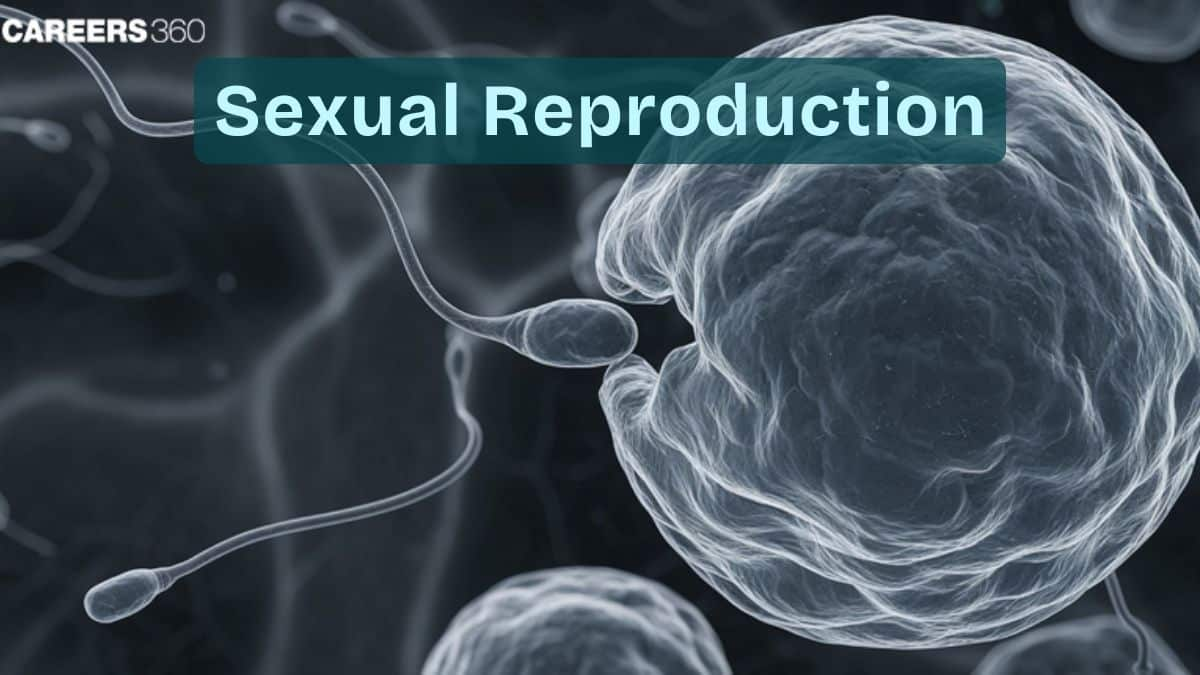
Sexual reproduction is when two different types of gametes fuse to form a zygote. The zygote then undergoes mitosis and differentiation to form a new individual. It is among the major processes of reproduction by which the majority of species propagate their existence through the flow of genetic variation and adaptability. There are some great perks to sexual reproduction from an evolutionary perspective. It permits genetic blending that opens the way for novel traits.
Some of the basic concepts of sexual reproduction:
Sperm: Small, motile, and provided with a flagellum to enable it to move from the site of origin within the female's body.
Egg: Relatively large, immotile, and furnished with nutrients necessary for the development of a zygote.
Law Admissions 2026 Open | Avail Merit-Based Scholarships
BBA/MBA/PGDM Early Bird Applications Deadline 19th Oct '26. Apply now using coupon code CAREER250 and get ₹250 off the application fee
Spermatogenesis: The production of sperm in the testes.
Oogenesis: The production of eggs in the ovaries
It is the process of identification and subsequent fusion of membranes of the sperm and egg cells.
It guarantees that both parents mix genetic material.
The zygote which has been formed divides and differentiates into an offspring.
Sexual reproduction is diversified and standard in so many ways that it is categorised into a variety of modes, all of which are classified based on different types of criteria.
Isogamy has morphologically similar gametes.
Anisogamy, morphologically different gametes in which formation for instance sperm and egg.
Internal Fertilization is a process of fertilisation, which occurs inside the female's body.
External Fertilization occurs outside of the female's body and is common in water sources.
Angiosperms utilise pollen and ovules.
Birds, mammals, reptiles, amphibians, and fish all have special reproductive strategies.
Sexual reproduction in plants utilises structural modifications and complicated processes that lead to seed and fruit formation.
Sepals, petals, stamens (male), and carpels (female).
To attract their pollinators
Produce gametes
Facilitation of fertilisation
Self-pollination: The pollen fertilises ovule of same plant
Cross-pollination: The pollen from one plant fertilises another
Sexual reproduction in animals covers a broad spectrum of reproductive systems and strategies.
Males: Testes, vas deferens, prostate, and penis.
Females: Ovaries, fallopian tubes, uterus, and vagina.
Hormones like testosterone, estrogen, and progesterone regulate reproductive functions.
Gestation occurs when the embryo develops in the uterus.
Birth marks the arrival of a complete human being.
Zygote, blastocyst, embryo, and fetus, with sources of variation in development across fetal age.
Sexual reproduction leads to genetic variation, which makes evolution possible.
Crossing over generates new combinations of genes in offspring.
Crossing over during meiosis, independent assortment of chromosomes, and fertilisation.
Novel traits arise
Natural selection acts on variation
Advantages of sexual reproduction over asexual are:
Higher genetic diversity
Advanced adaptability
Higher evolutionary potential
Better resistance to environmental constraints.
Important questions asked in NEET from this topic are:
Sexual reproduction in plants
Sexual reproduction in animals
Q1. In the embryos of a typical dicot and a grass, true homologous structures are:
Coleorhiza and coleoptile
Coleoptile and scutellum
Cotyledons and scutellum
Hypocotyl and radicle
Correct answer: 3) Cotyledons and scutellum
Explanation:
In monocot, the cotyledon is called scutellum. In monocots, the cotyledon called the scutellum, serves as a specialized structure for storing and absorbing nutrients during seed germination. It is typically smaller and more shield-like compared to the cotyledons of dicots. The scutellum is located next to the embryo and is crucial for the early growth of the seedling. During germination, the scutellum absorbs nutrients from the endosperm, aiding in the development of the embryo into a young plant. This adaptation allows monocots, such as grasses and cereals, to efficiently utilize stored food reserves for initial growth.
Hence, the correct answer is the option (3) Cotyledons and scutellum.
Q2. The male gametes of rice plant have 12 chromosomes in their nucleus.The chromosome number in the female gamete, zygote and the cells of the seedling will be, respectively,
12, 24, 12
24, 12, 12
12, 24, 24
24, 12, 24
Correct answer: 3) 12, 24, 24
Explanation:
For plants, gametes are haploid, meaning that they have half the number of chromosomes compared to their diploid condition. For example, if a gamete had a haploid number of 12 chromosomes, at the time when the gametes fuse during fertilization to form a zygote, the latter will have the diploid number of 24 chromosomes. The plant's somatic cells retain this diploid number, which keeps the chromosome count at 24 both in the zygote and the mature plant.
Hence, the correct answer is Option 3) 12, 24, 24.
Q3. Birth canal is formed during parturition by female accessory ducts namely
Uterus and cervix
Cervix and labia majora
Cervical canal and vagina
Oviduct and uterus
Correct answer: 3) Cervical canal and vagina
Explanation:
Just before parturition, the cervix undergoes significant changes to prepare for childbirth. Under the influence of the hormone relaxin, secreted primarily by the placenta and ovaries, the cervix becomes soft, and elastic, and dilates to allow the baby to pass through. This softening is accompanied by the widening of the cervical canal, which, along with the vagina, forms the birth canal—the pathway through which the baby is delivered. These physiological changes are critical for ensuring a smooth delivery process, as they reduce resistance and create a passage wide enough for the baby to pass through safely.
Hence, the correct answer is option 3) Cervical canal and vagina.
Also Read:
Frequently Asked Questions (FAQs)
Internal fertilisation takes place inside the female organism, while external fertilisation takes place outside the female, typically in water.
Major phases include gamete formation, fertilisation, and the development of the zygote into a new organism.
Human fertilisation is a process by which a male sperm cell fuses or joins a female egg cell. Mammals such as humans under normal circumstances perform their fertilisation process in the female's fallopian tube.
Sexual reproduction is one of the major causes of genetic diversity in which the species are biologically monitored to adapt to a new environment by evolving.
Sexual reproduction is a biological process in which the cells/seeds/organisms are formed through the aid of two parent organisms combined through their genetic material.


Law Admissions 2026 Open | Avail Merit-Based Scholarships
BBA/MBA/PGDM Early Bird Applications Deadline 19th Oct '26. Apply now using coupon code CAREER250 and get ₹250 off the application fee
Ranked #36 amongst institutions in Management by NIRF | 100% Placement
Globally Recognized by AACSB (US) & AMBA (UK) | 18 LPA Avg. CTC for PGPM 2026
Leading Design College | 95% Placement Record | Merit-cum-Means Scholarships for Deserving Students
NEET PG All India & State College Predictor with Admission Process Guide