


Biological Classification Basis: Overview, Importance, Types and FAQ
Biological classification is a systematic process by which biologists group the living organisms based on their similarities and differences. It helps organise Earth’s diverse life forms into groups based on their shared characteristics. The basis of biological classification involves grouping organisms by morphological, anatomical, genetic and embryological features. It provides a framework for understanding the natural world.
This Story also Contains
- What is Biological Classification?
- Basis of Biological Classification
- Types of Biological Classification Systems used in Taxonomy
- Types Of Classification Systems
- Evolutionary Significance of Classification
- Limitations of Current Biological Classification Systems
- Basis of Biological Classification NEET MCQs
- Recommended Video on Biological Classification Basis
The importance of biological classification gives the ability to study living organisms and establish phylogenetic relationships. It gives a clear idea about the speci species and their groups in an ecosystem. The types of biological classification include the two-kingdom classification by Linnaeus, the five-kingdom classification by Whittaker, and the more advanced taxonomic ranks.
What is Biological Classification?
Biological classification is the process through which living organisms are grouped according to their similarities in makeup. It is used in taxonomy - biological classification, establishing an order and structure in an environment that is home to countless living organisms. Aristotle in the early Greek times and Linnaeus in the eighteenth century were perhaps the first to come up with classifications, which focused on the physical characteristics of the items.
These early endeavours became the precursors to contemporary taxonomy, which continuously changes with the newer fields of genetics, molecular biology, and computational tools. Modern systems of classifications not only seek to place organisms in their categories and rank them, but also take into account their phylogenetic relations and genetic kinship, which gives the scientists the idea of the unity and diversity of creation on this planet.
Basis of Biological Classification
The basis of biological classification lies in grouping organisms by shared features such as morphology, anatomy, genetics, and embryology. These criteria help scientists organise Earth’s biodiversity into systematic categories, revealing evolutionary relationships and simplifying the study of life.
Morphological Characteristics
Morphological characteristics can be described as properties related to the form and external appearance of organisms, such as shape, size, colour and surface.
The first taxonomists, for example, Linnaeus, mainly based their grouping on morphological characteristics of the organisms. Grouping closely related species based on characters that were easy to observe, like the shape of a plant’s leaves or the limbs of an animal.
Examples (e.g., plant leaves, animal limbs)- The leaves of plants are seen in shape and position; broad-leaved plants are compared to those with needlelike leaves, while the position of the leaves may be in an alternating or opposite manner; on the other hand, animal limbs include those that are designed for flying, while others are for walking, and so forth. These differences are well represented by diagrams, which can help when it comes to identification or classifying the entities.
Anatomical And Physiological Characteristics
One aspect of animals’ morphology is anatomical, where the inside and outside of organisms are examined and described based on organs, tissues, and cells that perform functions necessary for the feeding and reproduction of species.
Homologous and analogous organs - Two structures are said to be homologous if, despite these dissimilarities, the structures were derived from the same basic plan in the course of evolution, though each may have been adapted to different uses (for example, the forelimbs of different mammals). On the other hand, homologous organs are the organs that have similar structural plans but are not necessarily structurally related (e.g., wings of a bird and wings of a bee).
Genetic And Molecular Basis
Next-generation sequencing, for example, has transformed biological research through accurate identification of nucleotide sequences. SNPs, standing for single-nucleotide polymorphisms, are used as specific points of difference in the genome that are necessary for mapping the traits and analysis of genetic differences within populations.
The relatives of evolution are concerned with assembling genetic sequences from different species, in an attempt to make deductions on ancestorship and diversification. Molecular methods enable researchers to analyse systematic transitions and describe the process of evolution, and organisms' adaptation and radiation based on natural selection and genetic variation.
Phylogenetic trees, as well as cladograms, are tree diagrams that display a hierarchy in the evolutionary patterns concerning the genetic information. It shows the directions of branching of the species regarding the presumed order of division and other evolutionary processes. These diagrams assist biologists in understanding the relatedness of various species and identifying associated groups’ evolutionary patterns.
Embryological Evidence
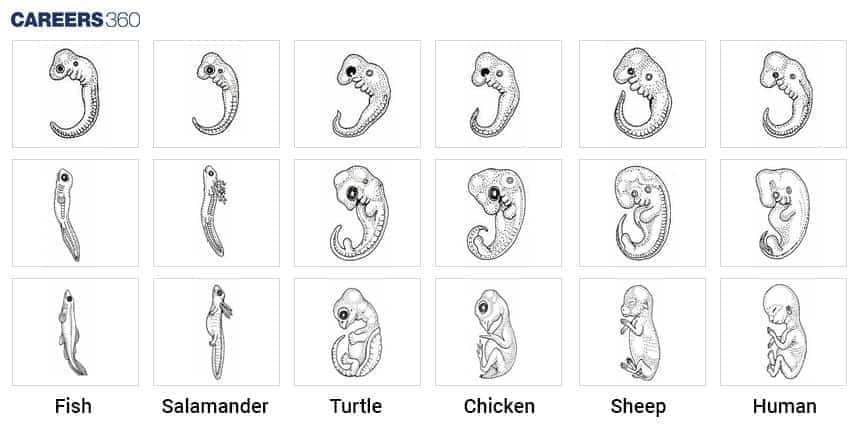
On the same note, embryological data show pronounced similarities in the developmental steps right from fertilisation to the formation of vital organs. These stages, extended from cleavage, gastrulation and neurulation, are some of the conserved processes that have significance to the formation of body structures.
Embryos of different species illustrate that there are similarities in development but also enough differences to establish the principle of convergence. The similarities of structures that are found in embryos of different animals support the theory of evolution because they indicate that the animals evolved from a common ancestor, while differences indicate that animals evolved to suit their environments and the activities they perform. Such comparisons give information and understanding of relatedness in the evolution of genetic variations and the development of species.
Types of Biological Classification Systems used in Taxonomy
Biological classification systems in taxonomy organise organisms into hierarchical categories to reflect similarities, differences, and evolutionary relationships. The Linnaean system arranges life from Kingdom down to Species with binomial nomenclature, while modern taxonomy adds advanced levels like Domain, Superphylum, and Subspecies, supported by genetic and molecular data. The classification is discussed below
The Linnaean System
The Linnaean systematic arrangement puts organisms in progressive order starting with the Kingdom (for instance, Kingdom Animalia) and moving to the Phylum (for instance, Phylum Chordata), class, Order, Family, Genus and Species (for example, Species Homo Sapiens).
As proposed by Linnaeus, binomial taxonomical naming involves the allocation of a two-word scientific name to a species comprising the Genus and Species. The descriptor, such as Homo sapiens, for humans.
Modern Taxonomic Categories
Modern taxonomy expands beyond the Linnaean hierarchy by adding additional levels, such as:
Domain (e.g., Eukarya, Bacteria, Archaea)
Superphylum (e.g., Lophotrochozoa)
Subspecies (e.g., Panthera leo leo - African lion, Panthera leo persica - Asiatic lion)
These advanced categories reflect molecular data, evolutionary relationships, and genetic diversity, making classification more precise.
Examples Of Each Category With Representative Organisms
The domain consists of Eukarya, such as Plants, Animals, Fungi, Bacteria, including Escherichia coli, and Archaea, including Methanogens.
Superphylum examples are Lophotrochozoa (e. g, Mollusca) and Ecdysozoa (e. g., Arthropoda).
Subspecies, for instance, are Panthera leo leo, the African lion, and Panthera leo persica, the Asiatic lion.
Diagram of embryonic stages
Embryological development is a key basis for classification. Diagrams of embryonic stages show how organisms share common developmental pathways, supporting evolutionary and phylogenetic classification.
Types Of Classification Systems
Classification systems in biology help organise organisms scientifically. Artificial systems use visible traits, natural systems rely on genetic and morphological features, while phylogenetic systems trace evolutionary history using molecular data. The classification systems are discussed below:
Artificial Classification
Artificial classification deals with arranging organisms in groups depending on certain physical aspects that one can easily notice.
It helps in identification but can cause more distortion of the true evolutionary relationships.
This method was regarded in the past though advanced molecular techniques have developed later on.
Natural Classification
Natural classification takes into account more attributes than otherwise, that is; genetic and morphological traits.
Although its objectives are quite modest, it seeks to classify organisms based on their natural kinship and share a common ancestry.
Thus, the presented system looks more realistic and reflects the evolutionary relationships much better than artificial classifications.
Phylogenetic Classification
There is a phylogenetic classification that groups organisms according to their evolution and genetic similarity.
It employs molecular information data like DNA sequences to create the phylogenetic tree.
It also helps in the determination of the different species’ evolutionary history and the relationship between the species.
Evolutionary Significance of Classification
Classification is not just about grouping organisms. It reveals their evolutionary connections. It shows how species share common ancestry and diverged over time. It helps construct the phylogenetic tree, tracing lineage and evolutionary pathways. It explains similarities in morphology, anatomy, and genetics across different groups.
Evolutionary Significance of Classification highlights embryological evidence, where early developmental stages reflect shared origins. It supports biodiversity studies and conservation, identifying species with unique evolutionary value. It provides a scientific framework to understand adaptation, speciation, and evolutionary history.
Limitations of Current Biological Classification Systems
Despite major advances, current biological classification systems face certain challenges. Convergent evolution can make unrelated species appear similar, complicating kinship studies. Rapid genetic divergence may not be fully captured by existing methods. Hybrid species blur boundaries, making ancestry harder to trace. These limitations highlight the need for modern genomic tools to achieve more accurate evolutionary classification. The limitations are discussed below
Convergence
One relative drawback is that in the process of convergent evolution, unrelated species over time acquire similar characteristics, and, therefore, the search for close evolutionary kinship solely based on genetic molecular indices is a difficult task.
Divergence
Genetic modification sometimes fails to measure the degree of difference in species of overproduction due to discrepancies in the genetic makeup of species, particularly those species that undergo quicker genetic changes than the time needed to analyse them.
Hybrid species
The problem of hybridisation between different species complicates the definitive identification of its genetic relations, which may be attributed to the events of hybridisation. There is therefore a need for advanced genomic tools to get better and more accurate pictures of hybrid stock ancestry and evolution.
Basis of Biological Classification NEET MCQs
Q1. The level of organization of organisms according to the five kingdom classification is:
Cellularity
Mode of Nutrition
Prokaryotic or Eukaryotic
All of the above
Correct answer: 4) All of the above
Explanation:
The level of organization in the five-kingdom classification is based on key factors such as cellularity (unicellular or multicellular), mode of nutrition (autotrophs or heterotrophs), and whether the organisms are prokaryotic (lacking a true nucleus) or eukaryotic (possessing a true nucleus). Organisms are classified into five kingdoms: Monera, Protista, Fungi, Plantae, and Animalia. The classification helps in understanding the complexity and characteristics of life forms, from simple unicellular organisms to complex multicellular organisms. It also reflects the diversity in metabolic processes, from photosynthesis in plants to ingestion in animals. The level of organization in the five kingdom classification is:
Cellularity( unicellular,muiticellular)
Mode of nutrition ( autotrophs, heterotrophs)
Prokaryotic or Eukaryotic
Hence, the correct answer is option 4) All of the above
Q2. Phylogenetic system of classification is based on :
Morphological features
Chemical constituents
Floral characters
Evolutionary relationships
Correct answer: 4) Evolutionary relationships
Explanation:
The phylogenetic tree depicts the relationships between species based on their shared ancestors. The phylogenetic tree depicts the relationships between species based on their shared ancestors, illustrating evolutionary history. Each branching point, or node, represents a common ancestor, while the branches show the divergence of species over time. This tree helps in understanding how different species are related to each other and can be used to trace the lineage of various traits or characteristics. Phylogenetic trees are constructed using molecular data, such as DNA sequences, to determine the degree of relatedness among species.
Hence, the correct answer is option 4) Evolutionary relationships
Q3. How many kingdoms in Whittaker’s classification system involves organisms with only heterotrophic nutrition?
2
4
3
1
Correct answer: 1) 2
Explanation:
Kingdom fungi and Animalia are strictly heterotrophic in nutrition. Both fungi and animals rely on external sources of organic material for nourishment, as they cannot produce their food through photosynthesis. Fungi absorb nutrients from decaying organic matter through a process known as external digestion, while animals ingest and digest food internally. Fungi obtain their food by secreting enzymes into their environment, breaking down complex substances, and absorbing the simpler molecules. Animals, on the other hand, consume and digest food in a digestive system, breaking it down into usable nutrients.
Hence, the correct answer is option 1) 2.
Recommended Video on Biological Classification Basis
Frequently Asked Questions (FAQs)
The most important parameters used in classification are the ‘‘external’’ ones: morphological, anatomical, behavioural, genetic, and ecological features.
Five kingdom systems sort organisms into Monera (bacterial), Protista (unicellular eukaryotic), Fungi, Plantae, and Animalia based on cell organisation and feeding habits. The domain system divides all known organisms into three groups and uses genetic relationships for classifications.
Genetic and molecular characteristics are relevant in the classification system since they offer information on the relatedness of species, species diversification, and phylogenetic information in the differentiation of species within a related group as well as the evolutionary processes.
Some of the characteristics used to classify organisms currently are as follows: Cell type: prokaryotic or eukaryotic. The number of cells is either unicellular or multicellular. Nutritional Mode - Autotrophs (Photosynthetic) or Heterotrophs (Non-photosynthetic).
Binomial Nomenclature is a nomenclatural system in which each species is given a name composed of two terms, the first of which defines the genus to which it belongs and the second the species itself.
Charles Darwin published the first theory of evolution in 1859.
Systema Naturae is a book written by Carolus Linnaeus on the classification of organisms.