


What Is Hydroponic Farming?: Definition, Uses, Benefits
Hydroponic farming is a soilless cultivation technique in which plants are grown in water enriched with essential nutrients under controlled environmental conditions. By optimizing space, water, and nutrient use, it enables faster growth, higher yields, and year-round production — making it a key innovation for sustainable, urban, and resource-efficient agriculture.
This Story also Contains
- What is Hydroponic Farming?
- Importance of Hydroponic Farming
- Comparison: Hydroponic vs Traditional Farming
- Types of Hydroponic Systems
- Important Components In Hydroponic Systems
- Plant Selection For Hydroponics Farming
- Setting Up A Hydroponic System
- Maintenance Tips and Best Practices
- Advantages and Disadvantages of Hydroponic Farming
- Hydroponic Farming NEET MCQs (With Answers & Explanations)
- Recommended Video On 'Hydroponics Farming'
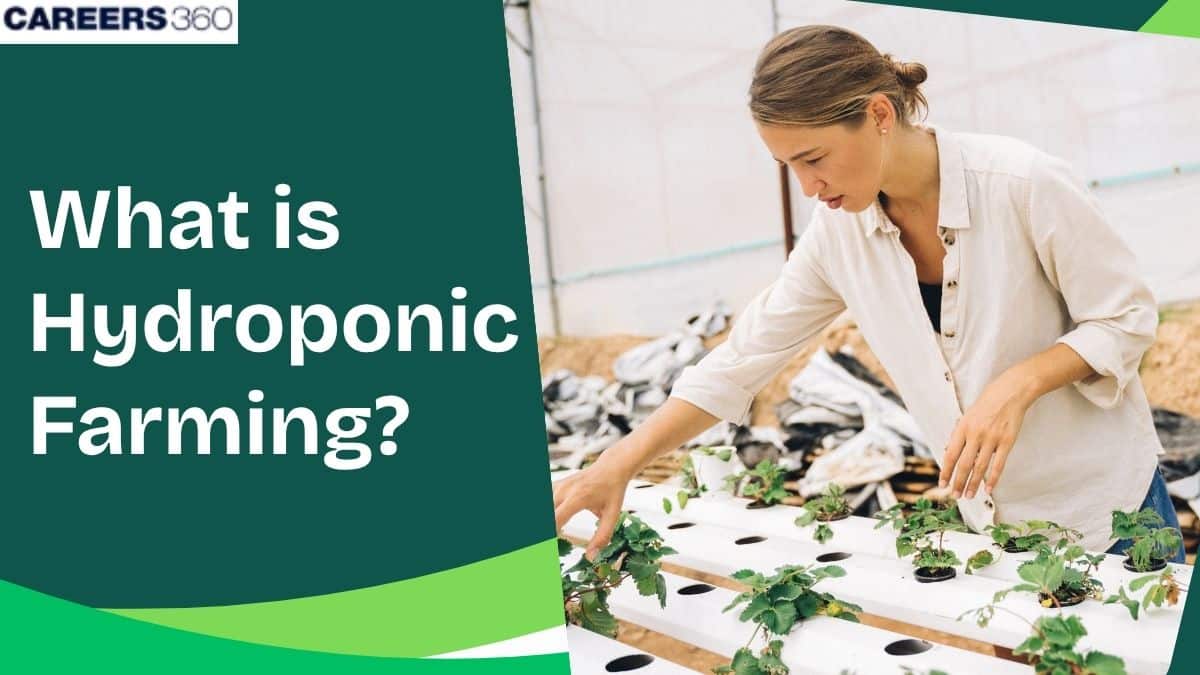
What is Hydroponic Farming?
Hydroponic farming is a method of growing plants without the use of soil, which hails back to the Hanging Gardens of Babylon and the Aztecs' floating gardens. What is now known as modern hydroponics was formalised in the 1930s by Dr William F. Gericke of the University of California, who first publicised the technique for commercial use. His publicity sowed the seeds for major developments in nutrient solutions and growing methods.
Hydroponic farming remains at the centre of agriculture because it deals with food security in both urban and poor soil quality areas. It can grow crops year-round while saving water and spacing out the available area effectively, hence a way of sustainable farming for the future.
Importance of Hydroponic Farming
The importance of hydroponic farming includes:
Growth of plants without the use of soil in nutrient rich water.
Saves the majority of water compared to the traditional farming methods.
Increases yield and allows production of crops all year round.
Supports sustainable food system and climate changes
Comparison: Hydroponic vs Traditional Farming
Hydroponic is an urban farming method which differs from traditional farming in several aspects. This table draws a comparison between the two methods of farming:
Aspect | Hydroponic Farming | Traditional Framing |
Soil use | Not required | Essential |
Water requirement | 80-90% less | Very high |
Growth rate | Faster | Slower |
Space needed | Minimal | More |
Pests and Diseases | Fewer | More frequent |
Setup Cost | High initial | Low initial |
Sustainability | High | Moderate |
Types of Hydroponic Systems
Hydroponic systems are designed differently to feed the plants with nutrients. Following are some of the most common ones:
Nutrient Film Technique
Continuous supply of nutrients.
Requires a minimal growing medium.
Pump failure problems can result in the quick death of a plant.
Not suitable for larger plants.
Deep Water Culture (DWC)
Easy and cheap.
High amounts of oxygenation for roots.
Water temperature fluctuation affects roots.
Not suitable for larger plants.
Wicking System
No pumps or electricity required
Easy to set up
Not suitable for large plants
Salt build-up possible
Ebb And Flow
Flood and Drain
Roots get a good supply of oxygen and nutrients
Plants of any size can be used
Setup is complicated
Pump failure possible
Drip System
Control in the delivery of nutrients
Suitable for a wide variety of plants
Easily becomes clogged
Requires constant maintenance
Aeroponics
Roots receive high amounts of oxygen
Water and nutrients well well-utilised
Set up is expensive
Requires monitoring and adjustment
Important Components In Hydroponic Systems
For a plant to be successful using hydroponics, some important components are required that must be closely monitored to create an ideal growing environment.
Growing Medium
Supports the roots of a plan and retains moisture and nutrients.
Examples include perlite, vermiculite, coconut coir
Nutrient Solution
Essential elements and minerals in solution in water
Provides the complete nutritional needs of plant growth
Light Sources
Provides photosynthesis and plant growth
Natural or artificial light source like sun or grow lamps (LED, fluorescent)
pH And Nutrient Monitoring Equipment
Monitor and maintain correct pH and nutrient levels for proper uptake of nutrient elements by plants.
Equipment includes pH meters, EC metres
Water And Oxygen Supply Systems
Transport water and oxygen to the roots of the plants
Systems like aerstones, pumps, and reservoirs
Plant Selection For Hydroponics Farming
Choosing appropriate plants is a key factor in successful hydroponic farming. Some plants do well in such environments.
Types of Plants | Examples |
Leafy greens | Lettuce, spinach, kale |
Herbs | Basil, mint, parsley |
Fruit and Vegetables | Tomato, strawberry, pepper, cucumber |
Flowers and Ornamentals | Orchid, rose, chrysanthemum |
Selection criteria:
Fast growth rate
Compact root system
Moderate light and nutrient requirements
Setting Up A Hydroponic System
To start a hydroponic system, there needs to be detailed planning and implementation for plants to have conditions that can enable them to grow properly.
Basic Steps
Choose the right type of hydroponic system
Gather equipment and materials — grow lights, nutrient solution, growing medium
Structural setup including reservoir, pump, grow trays
Planting seedlings or seeds in growing medium
Monitor pH and nutrient levels regularly
Essential Equipment
LED Grow lights
pH and nutrition meters
Air pumps and stones
Nutrient Solutions and supplements
Reservoir and tubing
Maintenance Tips and Best Practices
Hydroponic farming requires regular maintenance for better growth
Regularly check pH and nutrient levels and maintain them.
Monitor for pests and diseases.
Cleansing and sanitation of the system to prevent algal growth.
Ensure proper aeration to prevent rotting of the roots
Rotate crops so that there is balance of the nutrients.
Advantages and Disadvantages of Hydroponic Farming
Hydroponic farming has many advantages but with some disadvantages to be taken into consideration.
Advantages
Faster growth and higher yield.
Water and nutrients are well-utilised.
Space efficient and potential for urban farming.
Reduced soil borne diseases.
Environmental friendly.
Disadvantages
High initial setup cost
Technical knowledge and monitoring required.
Constant power required for pumps and lights.
Risk of rapid disease spread in the shared water systems.
Hydroponic Farming NEET MCQs (With Answers & Explanations)
The key concepts to be covered under this topic for different exams are:
Types of Hydroponic Systems
Advantages and Disadvantages of Hydroponics
Practice Questions for NEET
Q1. The advantage of hydroponics is
Hydroponics is used for the production of vegetables such as tomatoes, seedless cucumber and lettuce.
Hydroponics helps in knowing the essentiality of mineral elements.
Hydroponics helps in knowing the role of an essential element in the metabolism of the plant.
All of the above
Correct answer: 4) All of the above
Explanation:
Hydroponics helps in knowing
- Essentiality of the mineral element.
- The deficiency symptoms developed due to the non-availability of a particular nutrient.
- Toxicity to plants when an element is present in excess.
- Possible interaction among different elements present in the plant.
- The role of an essential element in the metabolism of the plant.
Hence, the correct answer is option 4) All of the above.
Q2. Statement 1: For nutrients that are mobile in the plant, deficiency symptoms will first show up in older leaves.
Statement 2: For nutrients that are immobile in the plant, deficiency symptoms will first show up in the new growth.
Choose the correct answer as per the above-given statements
Both statements are correct
Both statements are incorrect
Statement 1 is Incorrect
Statement 2 is correct
Correct answer: 1) Both statements are correct
Explanation:
For nutrients that are mobile within the plant, deficiency symptoms typically appear first in older leaves. This is because the plant can redistribute these nutrients from older tissues to new growth, prioritizing the younger, actively growing parts. Examples of mobile nutrients include nitrogen, phosphorus, and potassium.
For nutrients that are immobile within the plant, deficiency symptoms manifest first in the new growth. Since these nutrients cannot be translocated from older leaves, deficiencies directly affect the developing tissues. Examples of immobile nutrients include calcium, boron, and iron.
Hence, the correct answer is option 1) Both statements are correct.
Q3. Hydroponics or soilless culture helps in knowing
essentiality of an element
deficiency symptoms caused by an element
toxicity caused by an element
All of these
Correct answer: 4) All of these
Explanation:
Hydroponics - The commercial technique of growing plants to maturity in a defined nutrient solution in the complete absence of soil. This method allows for precise control over nutrient delivery, promoting faster growth and higher yields. It is particularly useful in urban and arid regions where arable land is limited. Additionally, hydroponics minimizes water usage compared to traditional farming, making it an eco-friendly alternative.
Hence, the correct answer is option 4) All of these.
Also Read:
Recommended Video On 'Hydroponics Farming'
Frequently Asked Questions (FAQs)
Some of the common ones include the Nutrient Film Technique or NFT, Deep Water Culture or DWC, Wicking System, Ebb and Flow, Drip System, and Aeroponics.
Plants grow in a nutrient-rich solution of water, whereby the growing medium will support the roots with light, nutrients, and oxygen for healthy growth.
Hydroponic farming consumes less water, makes better use of space and has quicker plant growth than any other mode of cultivation.
Determine the type of hydroponic system to be used; procure the required materials to constitute its frame, and plant seedlings, and regularly check the level of pH and the amount of nutrients added.
Lettuce, herbs like basil and mint, tomatoes, and strawberries do well in the hydroponic system. They are fast-growing plants and can be adapted easily.