KCC Institute of Legal and Higher Education, Greater Noida
Law Admissions 2026 Open | Avail Merit-Based Scholarships


Deficiency symptoms appear when plants or humans lack essential nutrients required for growth and metabolism. In plants, deficiencies cause chlorosis, necrosis, and poor fruiting, while in humans they lead to diseases like anemia, goitre, and osteoporosis.
This Story also Contains
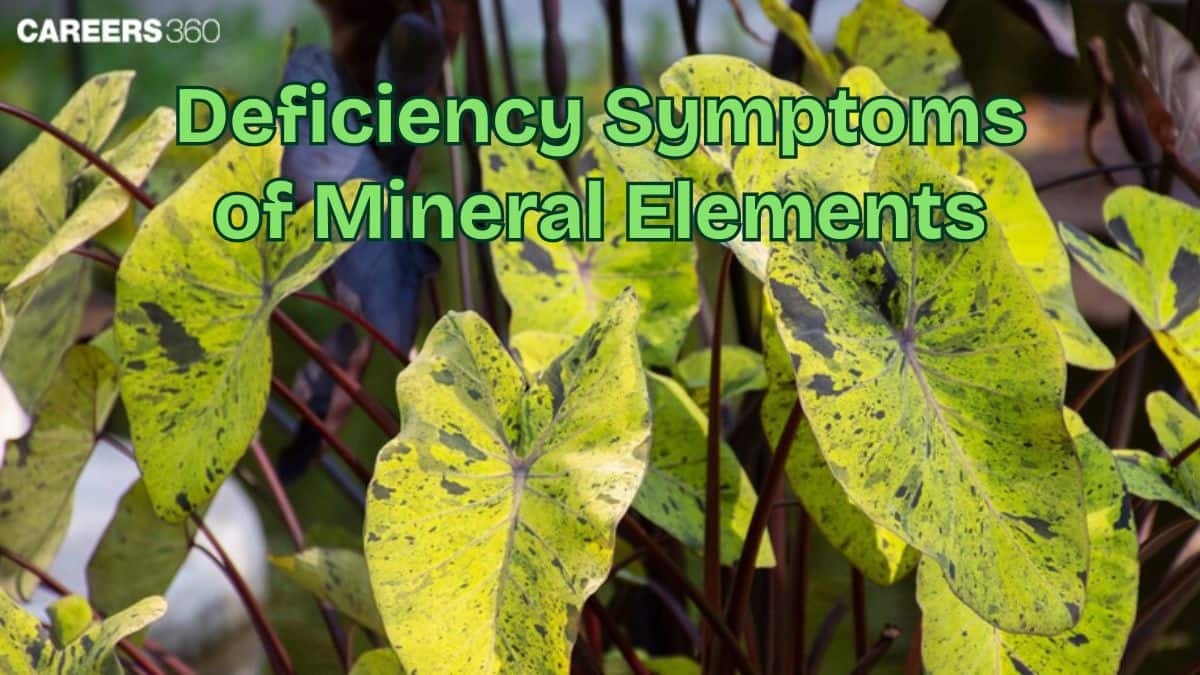
Essential elements are those elements without which the plant or animal cannot grow and develop. Based on the amount required in the organism, these elements are grouped as macronutrients and micronutrients. Macronutrients are those elements which are required in large amounts, while micronutrients are required in traces. The deficiencies of these essential elements may give rise to various health problems and developmental issues. Knowing the deficiency symptoms of these elements in both plants and humans is important for optimum health.
Essential elements can be broadly divided into two groups:
These include carbon (C), hydrogen (H), oxygen (O), nitrogen (N), phosphorus (P), potassium (K), calcium (Ca), magnesium (Mg), and sulfur (S).
These elements are required in relatively large amounts, generally greater than 0.1 per cent of the dry weight, and perform several important physiological functions.
These include boron (B), chlorine (Cl), manganese (Mn), iron (Fe), zinc (Zn), copper (Cu), molybdenum (Mo), and nickel (Ni).
Micronutrients are needed in lesser amounts but are of equal significance to health and development.
Law Admissions 2026 Open | Avail Merit-Based Scholarships
BBA/MBA/PGDM Early Bird Applications Deadline 19th Oct '26. Apply now using coupon code CAREER250 and get ₹250 off the application fee
The deficiency of any one of the essential elements may produce typical symptoms in plants, which adversely affect their growth, development, and productivity.
The macronutrient deficiencies are classified as:
Nitrogen Deficiency
The general major symptoms are that the older leaves become yellow—chlorosis, stunted growth, and poor fruit/flower formation.
Nitrogen is required for protein synthesis and generally in plant vigour.
Phosphorus Deficiency
The symptoms include a dark green or purple colouration of the leaves, stunted growth, and poor root development.
Phosphorus plays a vital role in energy transfer and nucleic acid synthesis.
Potassium Deficiency
This is characterised by the yellowing of the margins of leaves, browning of tips, and weak stems.
Potassium plays a very significant role in the regulation of water in plants and in the activation of enzymes.
Calcium Deficiency
This shows through blossom-end rot in tomatoes, tip burn in lettuce and stunted growth.
Calcium plays a huge role in the structure of cell walls and their stability.
Magnesium deficiency
Causes interveinal chlorosis, which is the yellowing of tissue between veins in a leaf, with curling of leaves.
Magnesium makes a big contribution to chlorophyll and is needed for photosynthesis.
Sulfur deficiency
Caused by yellowing of young leaves and stunted growth.
Sulfur is an integral part of the synthesis of proteins and enzymes.
The micronutrient deficiencies are classified as:
Iron deficiency
Occurs with symptoms such as interveinal chlorosis of the young leaves, progressing to general yellowing.
Iron serves a role in the synthesis of chlorophyll and electron transport in photosynthesis.
Zinc Deficiency
In such cases, stunted growth, leaf distortion, and interveinal chlorosis can be observed.
Zinc is involved in the functions of the enzyme and protein synthesis.
Manganese Deficiency
The common symptoms are interveinal chlorosis in young leaves, poor fruit formation, etc.
Manganese is required in photosynthesis and nitrogen metabolism.
Copper Deficiency
Stunted growth, curling of leaves, and general chlorosis- these are the symptoms.
Copper will have to be present for maintaining enzyme activity and in photosynthesis.
Boron Deficiency
Poor fruit and seed development, deformed leaves, and reduction of flowering are symptoms of its deficiency.
Boron participates in cell wall formation and reproductive growth.
Molybdenum Deficiency
Yellowing of the older leaves and poor nitrogen fixation in legumes are the symptoms of its deficiency.
Molybdenum is required for nitrate reduction and nitrogen metabolism.
The table below is a summary of plant nutrient deficiencies:
Elements | Symptoms | Parts Affected | Function |
N | Yellow of old leaves | Old leaves | Protein formation |
P | Purple leaves, poor roots | Whole plant | Energy metabolism |
K | Leaf tip necrosis | Mature leaves | Enzyme function |
Ca | Tip burn, rot | Meristem | Cell wall stability |
Mg | Chlorosis | Old leaves | Chlorophyll synthesis |
S | Yellow young leaves | Young leaves | Amino acid synthesis |
Fe | Chlorosis | Young leaves | Electron transport |
B | Poor fruiting | Flowers | Cell wall formation |
Zn | Short internodes | Leaves | Enzyme function |
Deficiency of essential elements in humans can also cause severe health disorders:
Iron deficiency may result in anemia, fatigue, and generally a weak immune system.
Iodine deficiency may cause goitre and developmental disorders, such as mental retardation.
Calcium deficiency is linked to osteoporosis, bone fractures, and muscle cramps. Vitamin D deficiency causes a disease called rickets in children and osteomalacia in adults, where the bones become very weak.
Zinc deficiency results in immunological dysfunction, alopecia, and delayed healing of any wounds.
Deficiencies of the essential elements can be prevented and managed by:
Use fertilizers in agriculture to prevent soil depletion.
Promote nutrient recycling and biofertilisers for sustainable growth.
Maintained a balanced diet rich in fruits, vegetables and fortified foods.
The key concepts to be covered under this topic for different exams are:
Macronutrients and Micronutrients
Symptoms of nutrient deficiencies
Nitrogen fixation
Q1. Directions: In the following questions, a statement of Assertion (A) is followed by a statement of reason (R).
Assertion: Symptoms of manganese toxicity are in real the symptoms of calcium deficiency.
Reason: Manganese inhibits calcium translocation in shoot apex.
Mark the correct choice as:
If both assertion and reason are true and reason is the correct explanation of assertion
If both assertion and reason are true but reason is not the correct explanation of assertion
If assertion is true but reason is false
If both assertion and reason are false
Correct answer: 1) If both assertion and reason are true and reason is the correct explanation of assertion
Explanation:
Manganese Function -
Activates enzymes for photosynthesis, respiration and nitrogen metabolism. Photolysis of H2O during photosynthesis. Deficiency - Grey speck of oat, marsh spot disease of pea. The high amounts of micronutrients cause toxicity. The high amount of Manganese in soil/plants inhibits the absorption of iron and magnesium. It also inhibits the translocation of calcium in the shoot apex of the plant.
Hence, the correct answer is option 1) If both assertion and reason are true and reason is the correct explanation of assertion.
Q2. The deficiency of molybdenum causes
Wilting of plant
Increase in growth of the plant
Mottled chlorosis
Mottling and necrosis in plant
Correct answer: 4) Mottling and necrosis in plant
Explanation:
Molybdenum deficiency is primarily characterized by poor nitrogen metabolism, which causes older leaves, particularly in legumes, to mottle (uneven chlorosis) and necrotize. Wilting is not the main sign of a molybdenum shortage, however poor development and reduced growth can result from inadequate nitrogen assimilation.
Wilting of the plant (Inaccurate): Water stress, not a lack of molybdenum, is usually the cause of wilting.
Increase in plant growth (Wrong): A lack of molybdenum results in stunted growth rather than increased growth.
Mottled chlorosis (Partially right but incomplete): Molybdenum deficiency affects more than just chlorosis; it also causes necrosis (tissue death) and mottled chlorosis.
Hence, the correct answer is option 4)Mottling and necrosis in plant
Q3. _____________toxicity is the appearance of brown spots encompassed by chlorotic veins.
Potassium
Manganese
Calcium
Phosphorus
Correct answer: 2) Manganese
Explanation:
Magnesium toxicity can cause oxidative stress and disrupt photosynthesis. Plants with manganese poisoning often exhibit chlorosis of leaves and stunted growth.
Hence, the correct answer is option 2) Manganese toxicity is the appearance of brown spots encompassed by chlorotic veins.
Also Read:
Frequently Asked Questions (FAQs)
Regular soil testing, proper fertilization, and crop rotation must be observed to avoid deficiencies in crops that later on may hamper the growth of the plants.
Essential elements are those nutrients that plants and animals must take up to grow and develop. They can be divided into two general classes: macronutrients, required in relatively large amounts, and micronutrients, required in smaller amounts.
Symptoms include older leaves becoming yellow, general chlorosis, stunted growth of plants, and poor fruit and flower production.
Deficiency in micronutrients leads to various diseases, such as anaemia from iron deficiency, goitre due to iodine deficiency, and impaired immune function due to zinc deficiency.
Through recognition of deficiency symptoms, timely intervention and correction of nutrient imbalances can be done to ensure optimum growth and productivity.


Law Admissions 2026 Open | Avail Merit-Based Scholarships
BBA/MBA/PGDM Early Bird Applications Deadline 19th Oct '26. Apply now using coupon code CAREER250 and get ₹250 off the application fee
Ranked #36 amongst institutions in Management by NIRF | 100% Placement
Globally Recognized by AACSB (US) & AMBA (UK) | 18 LPA Avg. CTC for PGPM 2026
Leading Design College | 95% Placement Record | Merit-cum-Means Scholarships for Deserving Students
NEET PG All India & State College Predictor with Admission Process Guide