KCC Institute of Legal and Higher Education, Greater Noida
Law Admissions 2026 Open | Avail Merit-Based Scholarships


Parathyroid hormone (PTH) is a peptide hormone secreted by the parathyroid glands that plays a central role in calcium and phosphate homeostasis. It regulates blood calcium levels by acting on bones, kidneys, and intestines, often in coordination with vitamin D. This guide covers PTH definition, synthesis, mechanism of action, physiological effects, disorders, diagnosis, treatment, and NEET-focused MCQs.
This Story also Contains
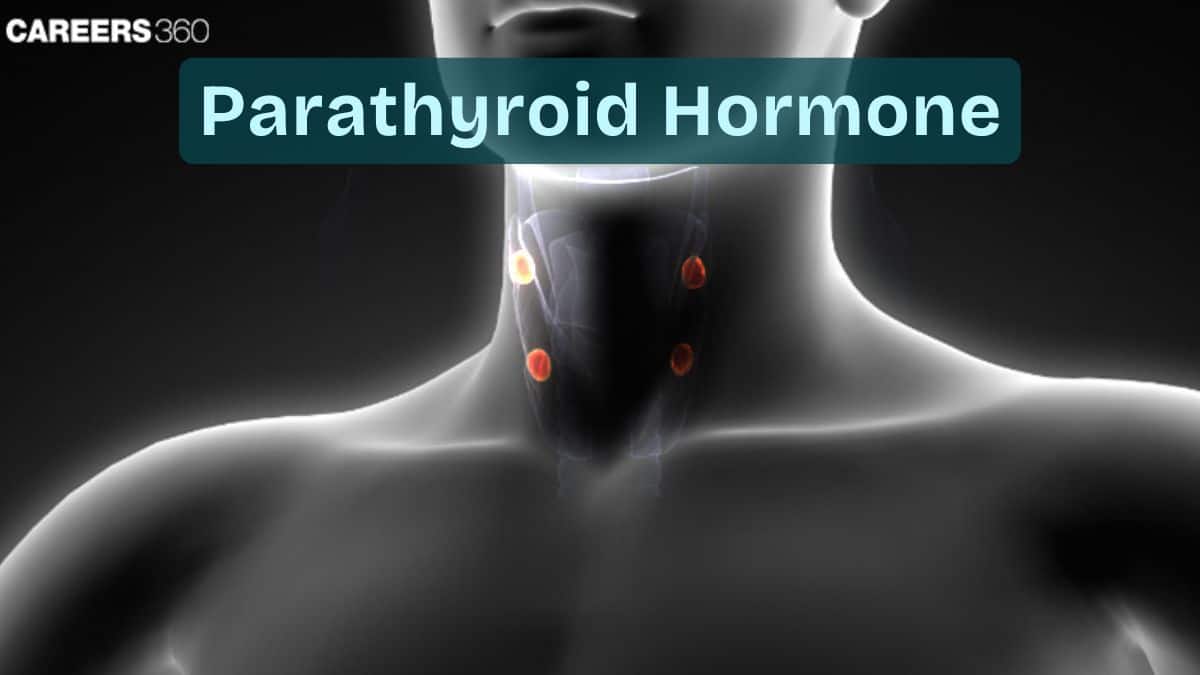
Parathyroid hormone is one of the peptide hormones produced by the parathyroid glands, which have a crucial role in maintaining the calcium and phosphate levels within the blood. PTH is involved in the maintenance of calcium homeostasis by its action on bone remodelling, renal reabsorption of calcium, and intestinal calcium absorption.
These are small endocrine glands located near the thyroid gland and have an important function in maintaining calcium levels within the body.
Four small glands on the posterior surface of the thyroid gland.
Typically, two superior and two inferior glands.
Each gland is about the size of a grain of rice.
Law Admissions 2026 Open | Avail Merit-Based Scholarships
BBA/MBA/PGDM Early Bird Applications Deadline 19th Oct '26. Apply now using coupon code CAREER250 and get ₹250 off the application fee
Synthesis and secretion are tightly regulated processes crucial for calcium homeostasis.
PTH is synthesised as a preprohormone.
Cleaved to form prohormone and then active PTH.
Serum calcium levels: Low levels stimulate secretion.
Serum phosphate levels: High levels stimulate secretion.
Vitamin D levels: Inhibit secretion.
PTH is integral in the regulation of calcium and phosphate balance in the body.
Increases calcium release from bones.
Increases calcium reabsorption in the kidneys.
Stimulates calcium absorption in the intestines by facilitating the action of vitamin D.
Mechanism of action of PTH is discussed below:
The osteoclasts get stimulated to release calcium.
Promotes bone resorption.
Increased calcium reabsorption in renal tubules
Promotes phosphate excretion
Calcium absorption is increased indirectly
Achieved through activation of vitamin D
PT H has several physiological effects that are of importance to calcium equilibrium and bone health.
Stimulates the activity of osteoclasts to resorb the bone, thereby making calcium available.
Increases reabsorption of calcium in renal tubules.
Promotes phosphate excretion to maintain its levels.
Increases absorption indirectly through stimulation of vitamin D.
An abnormal concentration of PTH can result in several clinical disorders.
Types:
Primary: Gland overproduction due to adenoma or hyperplasia.
Secondary: Compensation due to low calcium as seen in chronic renal failure.
Tertiary: Autonomous PTH secretion following long-standing secondary hyperparathyroidism.
Symptoms:
Bone pain
Kidney stones
Fatigue
Insufficient production of PTH
Leads to hypocalcemia.
Symptoms:
Muscle cramps
Tetany
Seizures
For an accurate diagnosis of disorders related to the parathyroid hormone, the following tests are necessary.
Serum PTH levels
Serum calcium and phosphate levels
Ultrasound of parathyroid glands
Sestamibi Scan to detect overactive glands
Treatment will depend on the type and degree of PTH imbalance.
Vitamin D and calcium supplements in hypoparathyroidism.
Calcimimetics (hyperparathyroidism).
Parathyroidectomy for hyperparathyroidism.
Removing of overactive glands
Adequate intake of calcium and vitamin D.
Regular check on calcium levels.
Important questions asked in NEET from this topic are:
Functions of parathyroid hormones
Disorders related to PTH
Q1. The blood calcium level is lowered by the deficiency of
Thyroxine
Calcitonin
Parathormone
Both 1 and 2
Correct answer: 3) Parathormone
Explanation:
The parathyroid glands secrete a peptide hormone called parathyroid hormone (PTH), which plays a crucial role in regulating calcium levels in the blood. The secretion of PTH is primarily controlled by the circulating levels of calcium ions. When blood calcium levels drop, the parathyroid glands increase the release of PTH to stimulate the release of calcium from bones, increase calcium reabsorption by the kidneys, and promote the activation of vitamin D, which enhances calcium absorption from the intestines. Conversely, when calcium levels rise, the secretion of PTH is reduced, maintaining a balanced calcium concentration in the body.
Hence the correct answer is option 3) Parathormone.
Q2. Tetany is caused by
Hyperparathyroidism
Hypoparathyroidism
Hypothyroidism
Hyperthyroidism
Correct answer: 2) Hypoparathyroidism
Explanation:
The clinical complications associated with hypoparathyroidism can result in a disorder termed parathyroid tetany or hypocalcemic tetany, characterized by involuntary muscle contractions that can be distressing and potentially dangerous. Proper diagnosis and management of this condition are essential to restore calcium balance and reduce symptoms.
Hence, the correct answer is option 2) Hypoparathyroidism.
Q3. Which of the following hormones can play a significant role in osteoporosis?
Estrogen and Parathyroid hormone
Progesterone and Aldosterone
Aldosterone and Prolactin
Parathyroid hormone and Prolactin
Correct answer: 1) Estrogen and Parathyroid hormone
Explanation:
Estrogen: By preventing bone resorption, or breakdown, this hormone aids in maintaining bone density. Osteoporosis is a disorder in which bones become weak and can be exacerbated by a reduction in estrogen levels, such as occurs after menopause.
Parathyroid hormone (PTH): PTH affects bone metabolism and controls blood calcium levels. Increased bone resorption brought on by high PTH levels can erode bones even more and exacerbate osteoporosis. PTH promotes bone breakdown to release calcium into the bloodstream when blood calcium levels are low.
Hence, the correct answer is option 1)Estrogen and Parathyroid hormone.
Also Read:
Frequently Asked Questions (FAQs)
Hypoparathyroidism diagnosis is through blood tests showing low PTH and low calcium while phosphate levels are high.
Treatments include vitamin D and calcium supplements, calcimimetics, and surgical removal of the affected glands, parathyroidectomy.
PTH maintains calcium and phosphate levels to have healthy bones and proper nervous and muscle activity.
PTH increases the levels of calcium through an increase in bone resorption, renal reabsorption, and intestinal absorption as a result of the activation of vitamin D.
Bone pain, kidney stones, fatigue, and depression are the evident symptoms.


Law Admissions 2026 Open | Avail Merit-Based Scholarships
BBA/MBA/PGDM Early Bird Applications Deadline 19th Oct '26. Apply now using coupon code CAREER250 and get ₹250 off the application fee
Ranked #36 amongst institutions in Management by NIRF | 100% Placement
Globally Recognized by AACSB (US) & AMBA (UK) | 18 LPA Avg. CTC for PGPM 2026
Leading Design College | 95% Placement Record | Merit-cum-Means Scholarships for Deserving Students
NEET PG All India & State College Predictor with Admission Process Guide