


To draw the I-V characteristics curve of P-N junction In forward bias
Understanding the I-V characteristics of a P-N junction diode in forward bias is important for learning how diodes work in electronic circuits. When a diode is forward biased, the positive terminal of the battery is connected to the P-type side and the negative terminal to the N-type side. This reduces the barrier at the junction and allows current to start flowing. At first, the current is very small, but once the applied voltage reaches a certain level called the threshold or cut-in voltage, the current increases quickly. This behaviour helps students and engineers understand diode operation in devices like rectifiers, chargers, LED circuits, and many other electronic applications.
This Story also Contains
- Aim
- Apparatus
- Theory
- Diagram
- Procedure
- Calculations
- Result
- Precautions
- Solved Examples Based on the I-V Characteristics Curve of P-N Junction In Forward Bias
- Summary

Aim
To draw the I-V characteristic curve of a p-n junction in forward bias
Apparatus
A p-n junction (semi-conductor) diode, a 3-volt battery, a 50-volt battery, a high resistance rheostat, one 0.3 volt voltmeter, one 0.50 volt voltmeter, one 0-100 mA ammeter, one $0.700 \mu \mathrm{A}$ ammeter, one-way key, connecting wires and pieces of sandpaper.
Theory
Forward bias characteristics. When the p-section of the diode is connected to the positive terminal of a battery and the n-section is connected to the negative terminal of the battery then the junction is said to be forward-biased. With the increase in bias voltage, the forward current increases slowly in the beginning and then rapidly. At about 0.7 V for Si diode (0.2 V for Ge), the current increases suddenly. The value of forward bias voltage, at which the forward current increases rapidly, is called cut-in voltage or threshold voltage.
Diagram

Procedure
1. Make a circuit diagram as shown in the diagram.
2. Make all connections neat, clean and tight.
3. Note the least count and zero error of the voltmeter (V) and milli-ammeter (mA).
4. Bring moving contact of the potential divider (rheostat) near the negative end and insert the key K. Voltmeter Vand milli-ammeter mA will give zero reading.
5. Move the contact a little towards the positive end to apply a forward-bias voltage $\left(V_{\mathrm{F}}\right)$ of 0.1 V current remains zero.
6. Increase the forward-bias voltage up to 0.3 V for the Ge diode. The current remains zero, (it is due to the junction the potential barrier of 0.3 V ).
7. Increase VF to 0.4 V . Milli-ammeter records a small current.
8. Increase $V_{\mathrm{F}}$ in steps of 0.2 V and note the corresponding current. Current increases first slowly and then rapidly, till $\mathrm{V}_{\mathrm{F}}$ becomes 0.7 V .
9. Make $V_F=0.72 \mathrm{~V}$. The current increases suddenly. This represents the "forward break-down" stage.
10. If the $V_F$ increases beyond the forward breakdown stage, the forward current does not change much. Now take out the key at once.
Calculations
For forward-bias
Plot a graph between forward-bias voltage $V_F($ column 2$)$ and forward current if (column 3$)$ taking $V_F$ along $x$-axis and If along $Y$-axis.This graph is called the forward-bias characteristic curve a junction diode.

From the graph, For a change from point $A$ to $B$
$
\Delta V_F=2.4-2.0=0.4 \mathrm{~V}, \Delta I_F=30-20=10 \mathrm{~mA}
$
Hence junction resistance for forward bias,
$
r=\frac{\Delta V_F}{\Delta I_F}=\frac{0.4 \mathrm{~V}}{10 \mathrm{~mA}}=40 \text { ohms }
$
Result
The junction resistance for forward bias is 40 ohms.
Precautions
- Ensure all connections are tight to avoid fluctuations in readings.
- Do not exceed the safe forward voltage of the diode to prevent damage.
- Insert the key only for short intervals to avoid heating of the diode.
- Adjust the rheostat smoothly to prevent sudden changes in current.
- Check and set the zero error of the voltmeter and ammeter before starting.
- Use low-range meters for accurate readings of small voltages and currents.
- Keep the diode clean and dry; wipe terminals with sandpaper for good contact.
- Increase the forward voltage gradually and take readings carefully.
- Avoid parallax error while reading the meters.
- Remove the key immediately after taking the final reading to prevent overheating.
Solved Examples Based on the I-V Characteristics Curve of P-N Junction In Forward Bias
Example 1: Find the value of junction resistance (in ohms) if the change in forward voltage is from 1.4 V to 2.0 V and the change in forward current is from 10 mA to 20 mA.
1) 60
2)20
3)30
4)50
Solution
$r=\frac{\Delta V_F}{\Delta I_F}=\frac{0.6 \mathrm{~V}}{10 \mathrm{~mA}}=60 \Omega$
Hence, the answer is (60).
Example 2: The reverse biasing in the junction diode
1) Increase the potential barrier
2) Increase the number of minority charge carrier
3) Increase the number of majority charge carriers
4) Decrease the potential diode
Solution
To draw I-V characters of P-N junction in reverse biased
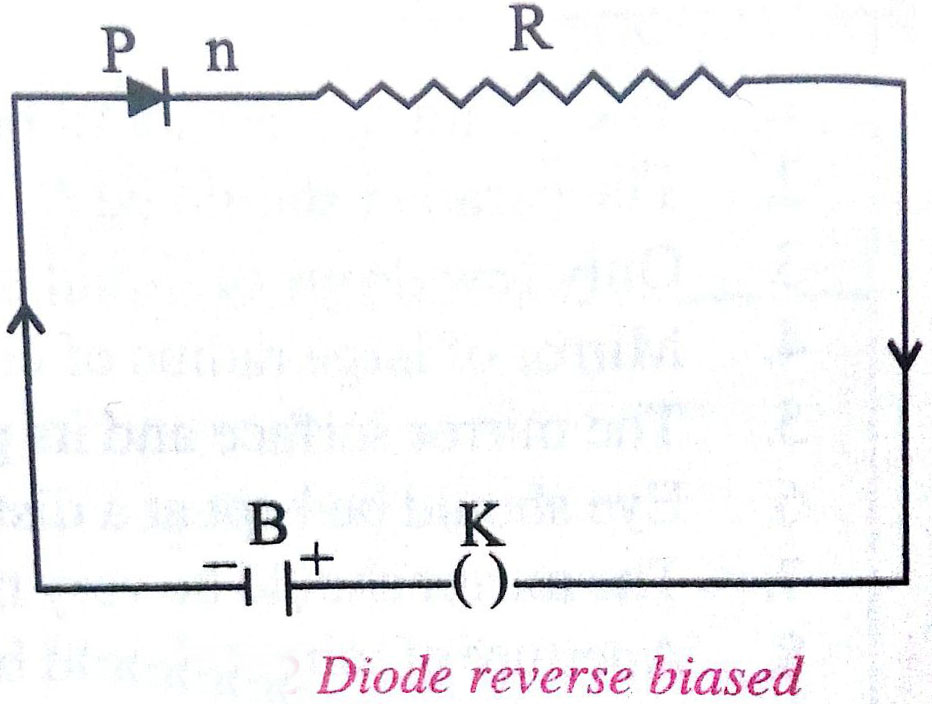
The process by which, a p-n junction diode blocks the electric current in the presence of applied voltage is called reverse biased p-n junction diode.
In reverse biased p-n junction diode, the positive terminal of the battery is connected to the n-type semiconductor material and the negative terminal of the battery is connected to the p-type semiconductor material.
Hence the answer is Option (1).
Summary
The I-V characteristics curve of a P-N junction diode in forward bias shows the relationship between the applied voltage and the resulting current. When the diode is forward-biased, the current remains minimal until the forward voltage exceeds a specific threshold. Once this threshold is crossed, the current increases sharply with small increases in voltage. This curve is crucial for understanding how diodes conduct electricity and for designing circuits that require precise control of current and voltage.
Frequently Asked Questions (FAQs)
It shows the relationship between forward voltage and forward current, helping understand diode behaviour in circuits.
A rheostat helps vary the voltage smoothly so the increasing current can be measured accurately.
It is the minimum forward voltage at which the diode begins to conduct significantly (≈0.7 V for Si, ≈0.2 V for Ge).
Because the potential barrier collapses, allowing charge carriers to flow freely through the junction.
Forward bias means connecting the P-side to the positive terminal and N-side to the negative terminal of a battery, allowing current to flow.
It shows the relationship between forward voltage and forward current, helping understand diode behaviour in circuits.
A rheostat helps vary the voltage smoothly so the increasing current can be measured accurately.
It is the minimum forward voltage at which the diode begins to conduct significantly (≈0.7 V for Si, ≈0.2 V for Ge).
Because the potential barrier collapses, allowing charge carriers to flow freely through the junction.
Forward bias means connecting the P-side to the positive terminal and N-side to the negative terminal of a battery, allowing current to flow.
