KCC Institute of Legal and Higher Education, Greater Noida
Law Admissions 2026 Open | Avail Merit-Based Scholarships


The cerebrum is the largest part of the human brain, controlling higher mental functions such as memory, reasoning, emotions, and voluntary movements. Divided into two hemispheres and four functional lobes, it processes sensory information and drives conscious behaviour. It plays a central role in Neural Control and Coordination.
This Story also Contains
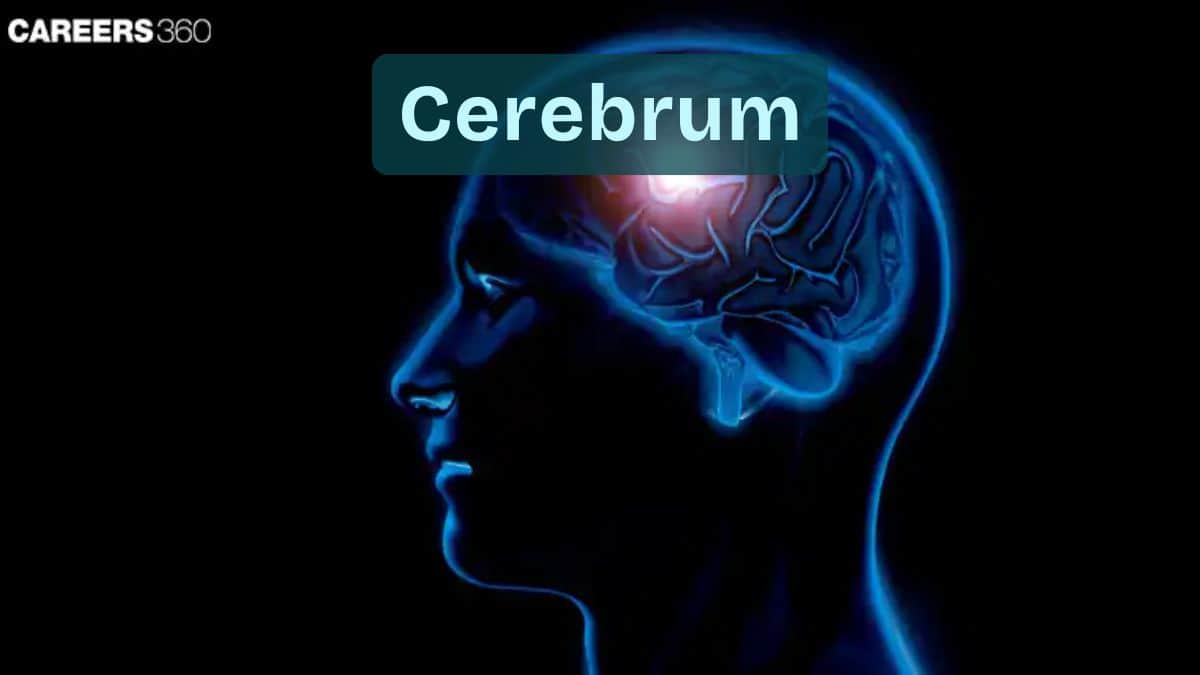
The cerebrum accounts for the largest portion of the volume of the human brain, about two-thirds. It coordinates various kinds of higher brain activities like sensory perception, thought, reasoning, and memory. The cerebrum is divided into two hemispheres, with each controlling the opposite side of the body.
The anatomy of cerebrum is divided into:
The cerebrum is divided again into left and right hemispheres, which specialise in different functions.
Law Admissions 2026 Open | Avail Merit-Based Scholarships
BBA/MBA/PGDM Early Bird Applications Deadline 19th Oct '26. Apply now using coupon code CAREER250 and get ₹250 off the application fee
There are four lobes of cerebrum are:
Frontal lobe which is involved in planning and motor control
Parietal lobe which is somatosensory
Temporal lobe helps in hearing, language, memory
Occipital lobe which has a role in vision.
The outer layer of the cerebrum that deals with higher brain functions such as perception, thought, and decision-making is the cerebral cortex.
The outer grey matter makes up the cerebral cortex. It is highly furrowed to increase the surface area.

Functional areas of each lobe is discussed below:
The frontal lobe manages higher mental functions, including decision-making, problem-solving, and planning.
It directly governs voluntary motor movements and expressive language.
The parietal lobe processes somatosensory input related to touch, temperature, and pain.
It also contributes to spatial orientation and body awareness.
It deals with the processing of hearing, understanding language, and formation of memory.
The hippocampus, essential for forming long-term memory, is present in it.
The occipital lobe is mainly dealing with the processing of vision.
It interprets information that it receives from the eyes to build our visual perception.
The functions performed by the various parts of the cerebrum are:
Our emotions, eyesight, personality, and intelligence are all governed by the cerebrum.
Axons from the motor cortex's upper motor neurones travel to the brainstem and spinal cord, where they make synapses with lower motor neurones that innervate the muscles.
All auditory, visual, somatosensory, and gustatory information is received by the cerebral cortex, which then works with the cortices to process it so that we can experience these sensations.
Beneath the frontal lobe is a little organ called the olfactory bulb. Instead of going via the thalamus, it processes the olfactory data and transmits it straight to the olfactory cortex. Loss of smell may result from damage to the olfactory bulb.
Important questions asked in NEET from this topic are:
Anatomy of Cerebrum
Functions of Cerebrum
Q1. Which part of the brain is responsible for thermoregulation?
Cerebrum
Hypothalamus
Corpus callosum
Medulla oblongata
Correct answer: 2) Hypothalamus
Explanation:
The hypothalamus contains several centres which control body temperature, and urge for eating and drinking. It also contains several groups of neurosecretory cells, which secrete hormones called hypothalamic hormones. The hypothalamus is the part of the brain involved in thermoregulation. The cerebrum is involved in interpreting touch, vision, hearing, speech, reasoning movement, etc. The Corpus callosum joins two hemispheres of the cerebrum. Medulla oblongata helps regulate breathing, heart function, digestion, etc.
Hence the correct answer is option 4)Hypothalamus.
Q2. Injury localized to the hypothalamus would most likely disrupt:
Short-term memory.
Coordination during locomotion.
Executive function, such as decision-making.
Regulation of body temperature.
Correct answer: 4) Regulation of body temperature
Explanation:
A very important part of the brain called the hypothalamus lies at the base of the thalamus. The hypothalamus contains several centres which control body temperature, and urge for eating and drinking. It also contains several groups of neurosecretory cells, which secrete hormones called hypothalamic hormones.
Hence, the correct answer is option 4)Regulation of body temperature.
Q3. The grey matter of cerebellum exhibits tree-like structure called
Arbor vitae
Purkinje cells
Basket cells
Granule cells
Correct answer: 1) Arbor vitae
Explanation:
Three layers of cells and fibres make up the grey matter that surrounds the cerebellum. Arbor vitae are tree-like structures found in the cerebellar grey matter. Characteristically big flask-shaped Purkinje cells are found in the intermediate layer. Granule cells, basket cells, and Golgi cells are also found in the cerebellum. Therefore, the grey matter of the cerebellum exhibits a tree-like structure called arbour vitae.
Hence, the correct answer is option 1) Arbor vitae.
Also Read:
Frequently Asked Questions (FAQs)
The temporal lobe is responsible for processing auditions, language comprehension, and the formation of memories.
The occipital lobe mainly deals with visual processing and interprets the information obtained from the eyes.
Injuries to the cerebrum may result in defects related to sensory perception, cognitive skills, and motor functions if any of its parts are affected.
The frontal lobe includes areas for decision-making, problem-solving, and planning, but also voluntary motor movements and expressive language.
The parietal lobe processes sensory information related to touch, temperature, and pain. It plays an important role in spatial orientation and body awareness.


Law Admissions 2026 Open | Avail Merit-Based Scholarships
BBA/MBA/PGDM Early Bird Applications Deadline 19th Oct '26. Apply now using coupon code CAREER250 and get ₹250 off the application fee
Ranked #36 amongst institutions in Management by NIRF | 100% Placement
Globally Recognized by AACSB (US) & AMBA (UK) | 18 LPA Avg. CTC for PGPM 2026
Leading Design College | 95% Placement Record | Merit-cum-Means Scholarships for Deserving Students
NEET PG All India & State College Predictor