KCC Institute of Legal and Higher Education, Greater Noida
Law Admissions 2026 Open | Avail Merit-Based Scholarships


The cerebrum contains four major lobes—frontal, parietal, temporal, and occipital—each responsible for specialised cognitive, sensory, and motor functions. These lobes enable perception, memory, movement, language, and decision-making. Understanding their roles is essential for NEET and Class 11 Neural Control and Coordination.
This Story also Contains
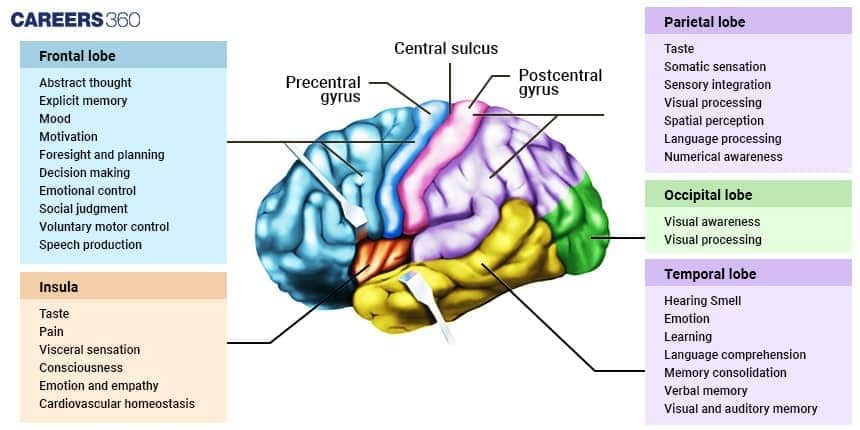
The cerebrum is separated into four lobes, which include the frontal, parietal, temporal, and occipital. The different lobes are associated with unique functions within our general cognitive abilities and senses. Each of these lobes allows us to understand how the brain can make sense of and put together different forms of information.
The structure and function of each lobe are:
Location: The position of the frontal lobe is at the front side of the brain, just behind the forehead.
Functions:
Responsible for higher cognitive functions such as decision-making, planning, problem-solving, and judgment.
Regulates voluntary motor control, thus enabling us to move various parts of the body voluntarily.
Here, Broca's area plays an important part in speech production and expression of language.
Involved in personality traits, regulation of emotions, and social behaviour.
Controlling attention, impulse control, and working memory.
Law Admissions 2026 Open | Avail Merit-Based Scholarships
BBA/MBA/PGDM Early Bird Applications Deadline 06th Nov'26. Apply now using coupon code CAREER250 and get ₹250 off the application fee
Location: It is situated directly at the back of the frontal lobe, at the top of the brain.
Functions:
It is responsible for the processing of sensory inputs such as touch, temperature, pain, and pressure.
Helps in perceiving space, the orientation of the body, and coordination.
It is involved in the integration of different sensory information from various modalities, which helps us move around and live in our environment.
The somatosensory cortex here helps process sensations from the skin, muscles, and joints.
Location: Both sides of the brain, near ears, and down to the bottom part of the brain
Functions:
The main key for hearing is the auditory cortex which processes sound information
Crucial function for memory making, especially if it involves the hippocampus and deals with long-term memory and spatial navigation.
Also deals with the processing of the language. There is an area called Wernicke's area, which helps with the understanding of spoken and written language.
This contributes to emotional responses as it is involved in emotion regulation and behaviour management of the limbic system.
Helps in the detection of faces, objects, and locations.
Location: Located at the back part of the brain behind the parietal and temporal lobes
Functions:
The visual cortex here interprets the information received from the eyes.
Analyze and interpret conditions of vision, which include colour, shape, motion, or depth.
Convert visual stimuli into meaningful images that can be used in visual perception to understand the environment.
Assists in the identification of objects and facial features by using visual input.
The communication among the lobes is explained through:
Neural networks extend from the lobes interconnecting them in integrating information for advanced cognitive processes.
In a way, communication is essential for the existence of coordinated and coherent brain functions.
The cerebral cortex from each lobe communicates with subcortical structures in controlling a variety of activities that go on in the brain.
The connection provides for the effective processing and response to sensory and motor stimulation.
Each lobe is specialised for different aspects of cognitive functioning, from aspects like reasoning and planning in the frontal lobe to memory processing in the temporal lobe.
The integration eventually gives way to complex thoughts and behaviour.
The lobes process sensory information and allow us to perceive and respond to our environment.
For example, the occipital lobe processes visual stimuli, while the parietal lobe processes tactual information.
Important questions asked in NEET from this topic are:
Structure and Function of Each Lobe
How lobes communicate
Q1. The left and right cerebral hemispheres are connected by a large bundle of myelinated fibres, the
Epithalamus
Corpus callosum
Subthalamus
Medulla oblongata
Correct answer: 2) Corpus callosum
Explanation:
The left and right cerebral hemispheres are connected by a large bundle of myelinated fibres, the corpus callosum. The left and right cerebral hemispheres are connected by a large bundle of myelinated fibres, the corpus callosum. It acts as a communication bridge, allowing the transfer of information between the two hemispheres. This structure plays a critical role in coordinating sensory input, motor functions, and cognitive activities across both sides of the brain. The corpus callosum is essential for integrating activities like language, spatial reasoning, and problem-solving, ensuring the hemispheres function as a unified whole. Damage to this structure can result in split-brain syndrome, affecting inter-hemispheric communication.
Hence, the correct answer is option 2) Corpus callosum.
Q2. Assertion: The temporal lobe functions in hearing, memory formation, and learning a new language. The frontal lobe functions in solving problems, controlling body movements, sentence formation, and personality traits.
Reason: Each lobe is responsible for a specific task
If both Assertion & Reason are true and the reason is the correct explanation of the assertion, then mark A
If both Assertion & Reason are true but the reason is not the correct explanation of the assertion, then mark B
If Assertion is true statement but Reason is false, then mark C
If both Assertion and Reason are false statements, then mark D
Correct answer: 1) If both Assertion & Reason are true and the reason is the correct explanation of the assertion, then mark A
Explanation:
Both Assertion & Reason are true and the reason is the correct explanation of the assertion. Each lobe is responsible for a specific task. The frontal lobe functions in solving problems, controlling body movements, sentence formation, and personality traits. The occipital lobe functions in processing visual images. The temporal lobe functions in hearing, memory formation, and learning a new language.
Hence, the correct answer is option 1) Both Assertion & Reason are true and the reason is the correct explanation of the assertion.
Q3. Broca’s area, which is essential for language production is found in
Occipital lobe
Temporal lobe
Parietal lobe
Frontal lobe
Correct answer: 1) Frontal lobe
Explanation:
Broca's area, which is crucial for language production, is located in the left hemisphere of the brain, specifically in the frontal lobe. Broca’s area controls the muscles used in speech production, including those necessary for moving the lips, tongue, and vocal cords.
Hence, the correct answer is option 4) Frontal lobe.
Also Read:
Frequently Asked Questions (FAQs)
The temporal lobe is responsible for processing auditory input, language comprehension, and the forming of memories.
The occipital lobe primarily deals with the processing of visual input and interpreting information acquired from the eyes.
The lobes use neural networks and exploit subcortical structures in empowering the integration of information to be processed for different types of complicated cognitive activity.
Major participation in decision-making, problem-solving, planning, voluntary motor movements, and expressive language.
The parietal lobe processes sensory information related to touch, temperature, and pain and is involved in spatial orientation and body awareness.

Law Admissions 2026 Open | Avail Merit-Based Scholarships
BBA/MBA/PGDM Early Bird Applications Deadline 06th Nov'26. Apply now using coupon code CAREER250 and get ₹250 off the application fee
Ranked #36 amongst institutions in Management by NIRF | 100% Placement
Globally Recognized by AACSB (US) & AMBA (UK) | 18 LPA Avg. CTC for PGPM 2026
NEET PG All India & State College Predictor with Admission Process Guide
Top B-School: Ranked #9 in NIRF Management Rankings 2025.