KCC Institute of Legal and Higher Education, Greater Noida
Law Admissions 2026 Open | Avail Merit-Based Scholarships


The forebrain is the largest and most complex region of the human brain, responsible for cognition, sensory processing, and voluntary motor control. It includes major structures such as the cerebrum, thalamus, and hypothalamus. These components coordinate higher mental functions, homeostasis, and behavioural responses.
This Story also Contains
.jpg)
The forebrain is the largest and most complicated portion of the human brain. The structures of the forebrain participate in running our day-to-day life. It facilitates high mental functions, sensory perception, and voluntary motor activity.
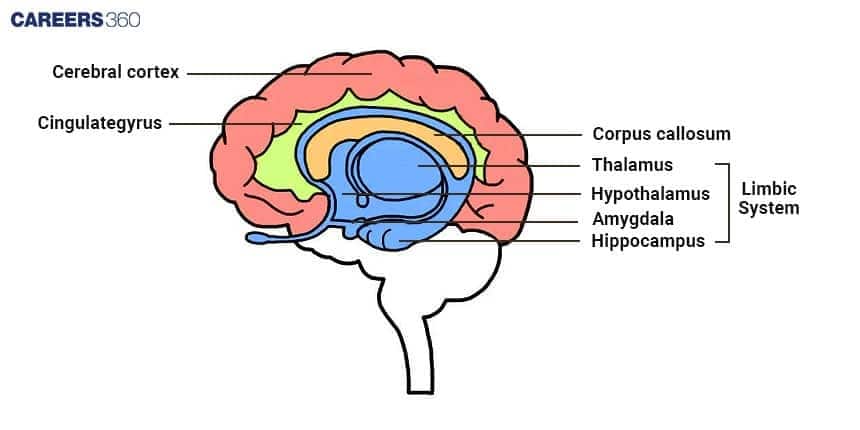
It consists of the structures of cerebrum, thalamus and the hypothalamus.
The division into two hemispheres and four lobes: frontal, parietal, temporal and occipital.
The thalamus acts as a relay station. It is associated with the conduction of sensory and motor signs to the cerebral cortex.
It takes part in the regulation of consciousness, sleep, and alertness
Law Admissions 2026 Open | Avail Merit-Based Scholarships
BBA/MBA/PGDM Early Bird Applications Deadline 19th Oct '26. Apply now using coupon code CAREER250 and get ₹250 off the application fee
The hypothalamus is also concerned with significant homeostasis.
It controls the body temperature, hunger, thirst, sleep, and wakefulness
It controls a pituitary gland that, in turn, controls the secretion of hormones.
The forebrain divides into the diencephalon and telencephalon
Interposed between the telencephalon and midbrain, the diencephalon comprises the thalamus, hypothalamus epithalamus, and subthalamus. It forms in the third week of embryonic development from the neural tube.
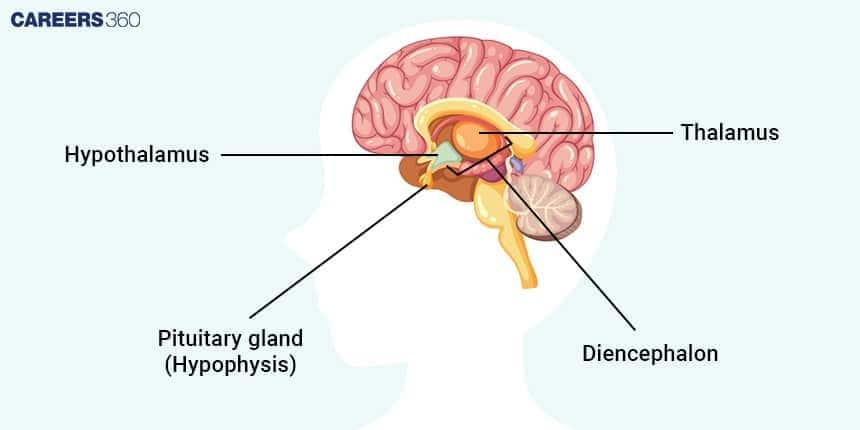
Thalamus: A large grey matter structure that relays sensory information to the cerebral cortex and regulates alertness, sleep, and consciousness.
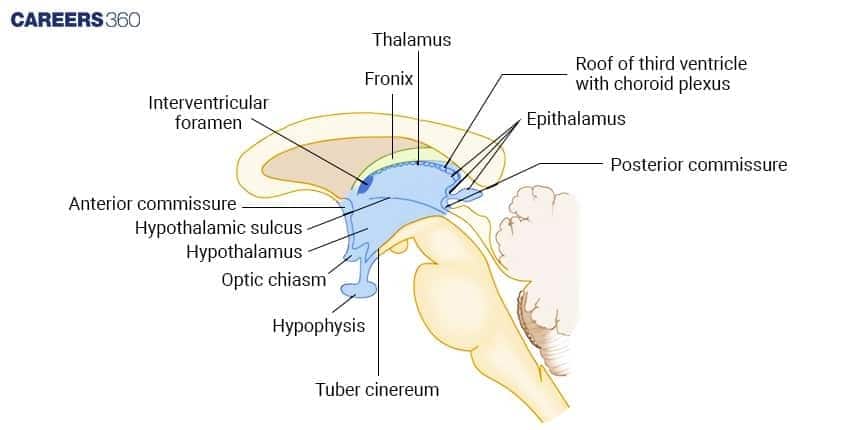
Hypothalamus: The hypothalamus is the portion of the brain lying just underneath the thalamus. The pituitary acts at the interface between the nervous and endocrine systems. These processes control metabolic processes to hunger, thirst, sleep, fatigue, and circadian rhythm.
Epithalamus: A small structure rather located at the dorsal part of the diencephalic region of the brain, consisting of the habenular commissure, habenular nuclei, stria medullaris, and pineal gland producing melatonin and hormones that modulate emotion and conserve energy.
Subthalamus: It is that part of the diencephalon which lies ventrally to the thalamus and laterally to the hypothalamus. It is composed of grey matter nuclei accompanied by the associated white matter structures.
The forebrain forms the cerebrum, which is the largest part of the brain.
It comprises the cerebral cortex, hippocampus, olfactory bulb, and basal ganglia.
It allows for voluntary movements that are possible with the help of the cerebellum.
The basal ganglia comprise a group of nuclei linked to the regulation of voluntary motor movements, procedural learning, and habitual behaviours. Through their influence on the activity in the thalamus, they modulate the coordination of movement and posture.
The functions of forebrain are:
It deals with higher-order functions of the central nervous system involving thought processes, planning, decision-making, and problem-solving.
It thus processes the information from sense organs about different parts of the body and coordinates voluntary movements.
It is in the forebrain that the most elevated and complicated functions of the brain are carried out: cognition and emotion.
In its turn, through the hypothalamus, it makes a huge impact on the internal environment of the body.
Thus, damage to the forebrain can be disastrous for cognition and sensation.
Important questions asked in NEET from this topic are:
Structure of Forebrain
Division of Forebrain
Q1. Which part of the brain is responsible for thermoregulation?
Cerebrum
Hypothalamus
Corpus callosum
Medulla oblongata
Correct answer: 2) Hypothalamus
Explanation:
The hypothalamus contains several centres which control body temperature, and urge for eating and drinking. It also contains several groups of neurosecretory cells, which secrete hormones called hypothalamic hormones. The hypothalamus is the part of the brain involved in thermoregulation. The cerebrum is involved in interpreting touch, vision, hearing, speech, reasoning movement, etc. The Corpus callosum joins two hemispheres of the cerebrum. Medulla oblongata helps regulate breathing, heart function, digestion, etc.
Hence the correct answer is option 4)Hypothalamus.
Q2. Injury localized to the hypothalamus would most likely disrupt:
Short-term memory.
Coordination during locomotion.
Executive function, such as decision-making.
Regulation of body temperature.
Correct answer: 4) Regulation of body temperature.
Explanation:
A very important part of the brain called the hypothalamus lies at the base of the thalamus. The hypothalamus contains several centres which control body temperature, and urge for eating and drinking. It also contains several groups of neurosecretory cells, which secrete hormones called hypothalamic hormones.
Hence, the correct answer is option 4)Regulation of body temperature.
Q3. The grey matter of cerebellum exhibits tree-like structure called
Arbor vitae
Purkinje cells
Basket cells
Granule cells
Correct answer: 1) Arbor vitae
Explanation:
Three layers of cells and fibres make up the grey matter that surrounds the cerebellum. Arbor vitae are tree-like structures found in the cerebellar grey matter. Characteristically big flask-shaped Purkinje cells are found in the intermediate layer. Granule cells, basket cells, and Golgi cells are also found in the cerebellum. Therefore, the grey matter of the cerebellum exhibits a tree-like structure called arbour vitae.
Hence, the correct answer is option 1) Arbor vitae.
Also Read:
Frequently Asked Questions (FAQs)
Therefore, damage to the forebrain can result in serious impairment of cognition and sensation—especially in thinking and planning, including sensory processing.
The thalamus relays sensory and motor signals to the cerebral cortex and participates in regulating consciousness, sleep, and alertness.
Controls body temperature, hunger, thirst, and circadian rhythm; it controls the secretion of hormones.
Basal ganglia have been associated with voluntary motor movements, procedural learning, routine behaviours, and coordination of movement and posture.
Cerebrum, thalamus, and hypothalamus are present.


Law Admissions 2026 Open | Avail Merit-Based Scholarships
BBA/MBA/PGDM Early Bird Applications Deadline 19th Oct '26. Apply now using coupon code CAREER250 and get ₹250 off the application fee
Ranked #36 amongst institutions in Management by NIRF | 100% Placement
Globally Recognized by AACSB (US) & AMBA (UK) | 18 LPA Avg. CTC for PGPM 2026
Leading Design College | 95% Placement Record | Merit-cum-Means Scholarships for Deserving Students
NEET PG All India & State College Predictor